Continuous random variables
[248/100%]For what values of the parameters are the following functions probability density functions?
, the density function of the 'arc sine law'.
, the density function of the 'extreme-value distribution'.
.
Find the density function of , where , in terms of the density function of . Show that the continuous random variables and have the same distribution function if and only if for all .
If and are density functions of random variables and , show that is a density function for , and describe a random variable of which it is the density function.
Let be a positive random variable with density function and distribution function . Define the hazard function and the hazard rate
Show that:
,
If increases with then increases with ,
increases with if and only if for all ,
If increases with , then for all .
I am selling my house, and have decided to accept the first offer exceeding . Assuming that offers are independent random variables with common distribution function , find the expected number of offers received before I sell the house.
Let and be independent random variables with common distribution function and density function . Show that has distribution function and density function . Find the density function of .
The annual rainfall figures in Bandrika are independent identically distributed continuous random variables . Find the probability that:
,
.
Let be independent and identically distributed with distribution function satisfying for all , and let . Show that
Let , be independent, uniformly distributed points in the unit square . A point is called peripheral if, for all , either or , or both. Show that the mean number of peripheral points is .
Let and be independent and uniformly distributed on the interval .
Show that
Find the conditional density function of given .
Find the probability that the equation has two distinct real roots.
Given that the two roots and are real and distinct, find the probability that both roots have absolute value less than 1.
We select points independently and uniformly at random on the perimeter of a circle. What is the probability that they all lie within some semicircle?
This time we place our points uniformly on the surface of a sphere in . Show that they all lie within some hemisphere with probability
For what values of is finite, if the density function of is:
for ,
for ?
If is not integral, then is called the fractional moment of order of , whenever the expectation is well defined; see Exercise (3.3.5).
Let be independent identically distributed random variables, and let . Assume that . Show that, if , then .
Let be a non-negative random variable with density function . Show that
for any for which the expectation is finite.
Show that the mean , median , and variance of the continuous random variable satisfy .
It can be shown that . See Basu and Dasgupta 1997.
Let be a random variable with mean and continuous distribution function .
Show that
if and only if .
Show that the set of medians of is the set of all for which is a minimum.
Let be non-negative random variables with finite means. Show that
If is a continuous random variable and exists, where is an integer, show that
Let be a random variable taking values in , with density function satisfying for all . Show that . More generally, show for that .
Let be continuous with finite variance. Show that is a minimum when .
A target comprising a disc with centre and unit radius is hit by arrows. They strike independent spots on the target, and for each the chance of hitting within distance of O is . Let be the radius of the smallest circle centred at O that covers all the arrow strikes. Show that has density , and find the mean area of this circle.
The arrow furthest from falls out. Show that the area of the smallest circle centred at and covering the remaining arrows is .
Let be continuous with variance , and also unimodal about a mode . Show that , with equality if and only if is uniformly distributed.
What can you say about where is a median of ?
A football is placed at a uniformly distributed position in the unit interval , and kicked with a non-zero random velocity having a distribution that is symmetric about . Assuming that and are independent, show (neglecting air resistance) that the time at which the football hits an endpoint of the interval is unimodal.
Here are two further questions concerning the football of the previous exercise.
Suppose that the football's speed has density function for . Show that the hitting time is exponentially distributed with parameter 1.
Find the density function of when has the so-called Laplace density function .
Prove that the gamma function satisfies for , and deduce that for Show that and deduce a closed form for for .
Show, as in paragraph (4.4.8), that the beta function satisfies .
Let have the uniform distribution on . For what function does have the exponential distribution with parameter 1?
Find the distribution function of a random variable with the Cauchy distribution. For what values of does have a finite (possibly fractional) moment of order ?
Let where has the distribution. Find the density function of .
Let be . Show that when both sides exist.
With the terminology of Exercise (4.1.4), find the hazard rate when:
has the Weibull distribution, ,
has the exponential distribution with parameter ,
has density function , where and and are the densities of exponential variables with respective parameters and . What happens to this last hazard rate in the limit as ?
For the standard normal density function , show that . Hence show that Mills's ratio satisfies
Here, denotes the distribution function.
Let have the distribution where , and show that
Let be independent, exponentially distributed random variables with respective parameters . Show that
Let and be independent, where is uniform on and is exponentially distributed with parameter . Show that .
Let be uniformly distributed on , and let . Find the distribution of .
Let be independent random variables with the same distribution as . Show that has the Pareto density function
and find its mean value.
Find the distribution function of .
Let have the Cauchy distribution, and show that has the arc sine density function
Let be independent and uniformly distributed on .
Find expressions for the probability that
(i) for ,
(ii) for , where .
Show that the median of (that is, the middle value) has density function
Deduce the value of the integral .
Calculate the mean and variance of .
Let have the beta distribution . Show that has density function
This is called the beta distribution of the second kind. Find where .
Let have the distribution of paragraph (4.4.6). Show that
Let
Show that is a continuous joint density function, but that the (first) marginal density function is not continuous.
Let be a set of real numbers, and define
Show that is a continuous joint density function whose first marginal density function is discontinuous at the points in . Can you construct a continuous joint density function whose first marginal density function is continuous nowhere?
Two grids of parallel lines are superimposed: the first grid contains lines distance apart, and the second contains lines distance apart which are perpendicular to those of the first set. A needle of length is dropped at random. Show that the probability it intersects a line equals .
The plane is ruled by the lines , for , and onto this plane we drop a cross formed by welding together two unit needles perpendicularly at their midpoints.
Let be the number of intersections of the cross with the grid of parallel lines. Show that and that
If you had the choice of using either a needle of unit length, or the cross, in estimating , which would you use?
Would it be preferable to use a unit needle on the grid of Exercise (4.5.2) with ?
Let and be independent random variables each having the uniform distribution on . Let and . Find , and hence calculate .
Let and be independent continuous random variables. Show that
whenever these expectations exist. If and have the exponential distribution with parameter 1, find
Let have finite variance. Show that where is independent and distributed as .
Three points A, B, C are chosen independently at random on the circumference of a circle. Let be the probability that at least one of the angles of the triangle ABC exceeds . Show that
Hence find the density and expectation of the largest angle in the triangle.
Let be independent and identically distributed with finite variance, and define . Show that .
Let and be independent random variables with finite variances, and let and . Under what condition are and uncorrelated?
Let and be independent continuous random variables, and let be independent of and taking the values with probability . Define and . Show that and are in general dependent, but and are independent.
Let be independent and identically distributed continuous random variables. Show that . What is ?
Let and be independent random vectors with common distribution function and marginal distribution functions and . Show that, when , we have that and
Let the pair have the bivariate normal distribution with means , variances , and correlation . Show that
Let be exponentially distributed with parameter . Let be the greatest integer not greater than , and set . Show that and are independent. Find the density function of and the distribution of .
Let and be independent random variables. Show, if , and , that
Let be random variables with joint density function and marginal densities . Their contingency coefficient is given as
If are bivariate normal with correlation , show that . Show in addition that their mutual information (see Exercise (3.6.5)) is .
Let be uniformly distributed on . Are the random variables , correlated? Are they independent? Explain your answers.
The mean absolute difference, or MAD, of two independent random variables , with common distribution function , is given by . Show that, for non-negative random variables ,
More generally, for and taking values in , with a common continuous distribution function with unique inverse , show that
Find for the following distributions:
uniform on ,
exponential with parameter ,
Pareto with ,
normal .
Let be independent random variables, and , . Show that .
A point is selected uniformly at random inside a triangle with corners . Show that a triangle ABC with can always be constructed, and prove that the angle is obtuse with probability .
Random variables have joint density function for . Show that and are uncorrelated but dependent.
A point is picked uniformly at random on the surface of a unit sphere. Writing and for its longitude and latitude, find the conditional density functions of given , and of given .
Show that the conditional expectation satisfies , for any function for which both expectations exist.
Construct an example of two random variables and for which but such that almost surely.
Find the conditional density function and expectation of given when they have joint density function:
for ,
for .
Let be distributed as , where is a random variable having a beta distribution on with parameters and . Describe the distribution of , and find its mean and variance. What is the distribution of in the special case when is uniform?
Let be independent and uniformly distributed on . Let and define
Show that , and hence find the mean and variance of .
Let and be random variables with correlation . Show that .
Let be independent and exponential random variables with respective parameters . Find .
Let and have the joint density .
Find .
Show that:
Deduce that and .
Let be independent and identically distributed random variables with density function and distribution function . Let and . Show that has distribution function , and find .
Let the point be uniformly distributed in the square , and denote by the density function of conditional on the event that lies on the diagonal of through the origin.
Let . Find by conditioning on .
Let . Find by conditioning on .
Explain.
Let and be independent with density functions and distribution functions . Show that
and play a game as follows. Each creates a random variable, denoted respectively and , which is uniformly distributed on ; assume and are independent, and neither player knows the opponent's value. Each player has the option to (once) discard their number and to resample from the uniform distribution. After any such choices, the two numbers are compared and the larger wins. Show that the strategy 'replace your number if and only if it is less than ensures a win with probability at least .
Let be independent, each with density function . The index is called a record time if , and is called a record time by convention. Let be the event that is a record time.
Show that the are independent events with .
Show that the number of record times up to time has variance
Show that the first record time after has mean .
A unit stick is broken uniformly at random, and the larger piece is broken again uniformly at random. Show that the probability the three pieces may be used to form a triangle is
Let be independent random variables with the uniform distribution on , and let
Show that and deduce that
Let , and be independent and uniformly distributed on . Find the joint density function of and , and show that .
Let and be independent exponential random variables with parameter 1. Find the joint density function of and , and deduce that is uniformly distributed on .
Let be uniformly distributed on . Find the density function of .
Find the density function of when:
is uniformly distributed on ,
is uniformly distributed on .
Let and have the bivariate normal density function
Show that and are independent variables, and deduce that
Let and have the standard bivariate normal density function of Exercise (4.7.5), and define . Show that , and .
Let and be independent exponential random variables with parameters and . Show that is independent of the event . Find:
,
the distributions of , denoted , and ,
where .
A point is picked at random uniformly in the unit circle. Find the joint density of and , where .
A point is picked uniformly at random inside the unit ball of . Find the joint density of and , where .
Let and be independent and exponentially distributed with parameters and . Find the joint distribution of and . What is the density of ?
Find the density of , where has the Cauchy distribution.
Let have the bivariate normal density of Exercise (4.7.5) with . Show that
where , and and are the density and distribution function of the distribution.
Let have the Cauchy distribution. Show that has the Cauchy distribution also. Find another non-trivial distribution with this property of invariance.
Let and be independent and gamma distributed as respectively.
Show that and are independent, and that has the beta distribution with parameters .
Show that has a beta distribution of the second kind (see Exercise (4.4.14)).
Let be independent, positive, continuous random variables, such that for . The positive parameter may be called the frailty or proportional hazard. In more general models, may itself be a random variable.
Show that
Let and be independent random variables, where has an arc sine distribution and a Rayleigh distribution:
Write down the joint density function of the pair , and deduce that has the standard normal distribution.
Let be uniformly distributed on the interval .
Let be a (measurable) subset of with strictly positive measure (length). Show that the conditional distribution of , given that , is uniform on .
Let , and write the binary expansions of and as and . Show that and are independent for , while . Prove that .
Let have the standard bivariate normal distribution with correlation .
Let . By changing from Cartesian to polar coordinates, or otherwise, show that has the Cauchy distribution.
Let . Show that has density function
Let have the standard bivariate normal distribution with correlation . Show that
where and are the density and distribution functions.
Let have the standard bivariate normal distribution with density function and correlation . Show that the probability that lies in the interior of the ellipse is , where is the area of the ellipse.
Let where are independent and uniformly distributed on . Find the probability that the integer closest to is odd.
Let have the standard bivariate normal distribution with correlation and density function . Show that is uniformly distributed on the interval where .
A number of friends each visit Old Slaughter's coffee house independently and uniformly at random during their lunch break from noon to 1 pm. Each leaves after hours (or at 1 pm if that is sooner), where . Show that the probability that none of them meet inside is .
Let and be independent random variables with the uniform distribution on . Find the joint density function of and , and deduce their marginal density functions.
Let have the distribution with . Show that, for suitable ,
when both sides exist.
More generally, if and have a bivariate normal distribution, show that
Let be a random variable such that for all appropriate smooth functions satisfying as . Show that has the distribution.
Let have the distribution, and let be a function with derivative . Show that
The joint density function of the pair is
Find the joint density function of the pair , and , and deduce the density function of .
Let and be independent variables having the exponential distribution with parameters and respectively. Find the density function of .
Let and be independent variables with the Cauchy distribution. Find the density function of where . (Do you know about contour integration?)
Find the density function of when and have joint density function .
Let be independent exponential random variables with respective parameters no two of which are equal. Find the density function of . [Hint: Use induction.]
Let be independent and uniformly distributed on . Find the density function of .
If are independent and uniformly distributed on , show that the density of at any point is a polynomial in of degree . Show in particular that the density function of satisfies ! for .
Let . What is the probability that the of part (b) can be the lengths of the edges of an -gon?
For independent identically distributed random variables and , show that and are uncorrelated but not necessarily independent. Show that and are independent if and are .
Let and have a bivariate normal density with zero means, variances , and correlation . Show that:
,
,
,
.
Let and be independent random variables, and let . Find the distribution and density of given that and . Show that
Let and be independent random variables. Find the joint density function of and , and hence show that is . Deduce a proof of the last part of Example (4.8.3).
Let and have joint distribution function , with marginals and . Show that, if is well defined, then its value is determined by knowledge of and .
Let be the sum of three independent random variables with the uniform distribution on .
Show that .
Find for .
A symmetric matrix is called non-negative (respectively positive) definite if its eigenvalues are non-negative (respectively strictly positive). Show that a non-negative definite symmetric matrix has a square root, in that there exists a symmetric matrix satisfying . Show further that is non-singular if and only if is positive definite.
If is a random vector with the distribution where is non-singular, show that has the distribution, where is the identity matrix and is a symmetric matrix satisfying . The random vector is said to have the standard multivariate normal distribution.
Let have the distribution, and show that has the (univariate) distribution where
Let and have the bivariate normal distribution with zero means, unit variances, and correlation . Find the joint density function of and , and their marginal density functions.
Let have the distribution and let . Show that the random variable given by
has the distribution, and find an expression for in terms of the density function of . Does the pair have a bivariate normal distribution?
Let be independent random variables, and define , , for constants . Show that
What is ?
Let the vector have a multivariate normal distribution with covariance matrix . Show that, conditional on the event has the distribution where , and .
Let , and have a standard trivariate normal distribution centred at the origin, with zero means, unit variances, and correlation coefficients , and . Show that
Let have the standard trivariate normal density of Exercise (4.9.8), with . Show that
Let and have the standard bivariate normal distribution with correlation , and let and , where . Is there a value of such that and are independent?
Let have the distribution, and let where is independent of with mass function . Show that the pair has a singular distribution (in the sense that the support of the joint density function has zero (Lebesgue) area in the plane), but is not singular bivariate normal.
Let and be independent variables with the and distributions respectively. Show that has the distribution.
Show that the mean of the distribution is , and that the mean of the distribution is if . What happens if ?
Show that the distribution and the Cauchy distribution are the same.
Let and be independent variables having the exponential distribution with parameter 1. Show that has an distribution. Which?
Show the independence of the sample mean and sample variance of an independent sample from the distribution. This may be done by either or both of: (i) the result of Exercise (4.5.7), (ii) induction on .
Let be independent variables. Let be the angle between the vector and some fixed vector in . Show that has density , where is the beta function.
Let be independent random variables, and let be given by . Show that the random vector is uniformly distributed on the unit sphere. Deduce the result of Exercise (4.10.6).
If is uniformly distributed on , what is the distribution of ?
Given the first integers in any sequence , proceed thus:
(a) pick any position from at random, and swap the integer in that place of with the integer in the th place of , yielding .
(b) pick any position from at random, and swap the integer in that place of with the integer in the th place of , yielding ,
(c) at the th stage the integer in position , chosen randomly from , is swapped with the integer at the th place of the sequence . Show that is equally likely to be any of the ! permutations of .
Use the rejection method to sample from the gamma density where may not be assumed integral. [Hint: You might want to start with an exponential random variable with parameter .]
Show how to sample from the beta density where . [Hint: Use Exercise (4.11.3).]
Describe three distinct methods of sampling from the density .
A finite real vector is called a probability vector if it has non-negative entries with sum 1. Show that a probability vector of length may be written in the form
where each is a probability vector with at most two non-zero entries. Describe a method, based on this observation, for sampling from viewed as a probability mass function.
Let and be independent and uniformly distributed on , and let . Show that, conditional on the event that ,
are independent standard normal random variables.
Let be uniform on and . Show that has a geometric distribution.
A point is picked uniformly at random in the semicircle . What is the distribution of ?
Let be a non-negative integer-valued random variable with . If are independent and uniform on , show that has the same distribution as .
Let be an increasing function in all its variables, and let be independent and identically distributed random variables having the uniform distribution on . Show that
[Hint: Use the FKG inequality of Problem (3.11.18).] Explain how this can help in the efficient estimation of .
We wish to estimate , where either it is difficult to sample from the density , or has a very large variance. Let be equivalent to , which is to say that, for all if and only if . Let be independent random variables with density function , and define
A technique invented by J. M. Hammersley and K. W. Morton in 1956.
Show that:
,
,
as . (See Chapter 7 for an account of convergence.)
The idea here is that should be easy to sample from, and chosen if possible so that is much smaller than . The function is called the importance density.
Construct two distinct methods of sampling from the arc sine density function
Let be a random point chosen uniformly on the unit disk. Show that
is uniformly distributed on the unit sphere.
It is desired to sample from a density function satisfying where , and for some random variable . Let be uniformly distributed on , and independent of . From and , we generate another random variable as follows. If , let have density ; otherwise set . Show that has density function .
The function defined in Theorem (4.11.1) may be called the quantile function of the random variable in question.
For a random variable with the uniform distribution on , and a continuously increasing function , show that the quantile function of is .
For a random variable with distribution function and density function , define , where is as in part (a). The Hardy-Littlewood transform of is defined as , where is uniformly distributed on and independent of . Show that the quantile function of is , for .
For an arbitrary (not necessarily continuous) distribution function , define
Let be uniformly distributed on and independent of . We call the generalized distributional transform of . Show that is uniformly distributed on , and that the random variable has distribution function .
Let be a random vector with joint distribution function and continuous marginal distribution functions . Show that there exists a 'copula-form' distribution function such that . [A 'copula-form' distribution function is one with the property that all its marginals are uniform on ].
Show that is stochastically larger than if and only if for any nondecreasing function for which the expectations exist.
Let and be Poisson distributed with respective parameters and . Show that is stochastically larger than if .
Show that the total variation distance between two discrete variables satisfies
Show for discrete random variables that , where denotes total variation distance.
Show that equality is possible in the inequality of Exercise (4.12.4) in the following sense. For any pair of discrete random variables, there exists a pair , having the same marginal distributions as such that .
Let and be indicator variables with . What is the maximum possible value of , as a function of ? Explain how need to be distributed in order that be:
maximized,
minimized.
The random variable is said to be bigger than in stop-loss order if
for all , in which case we write . Show that is equivalent to: and for all increasing convex functions .
The random variable is said to be smaller than in convex order if for all convex functions such that the expectations exist, in which case we write .
Show that, if , then and .
Show that if and only if and .
Pick two points A and B independently at random on the circumference of a circle with centre and unit radius. Let be the length of the perpendicular from to the line , and let be the angle makes with the horizontal. Show that has joint density
Let and be disjoint convex shapes with boundaries of length , as illustrated in the figure beneath. Let be the length of the boundary of the convex hull of and , incorporating their exterior tangents, and the length of the crossing curve using the interior tangents to loop round and . Show that the probability that a random line crossing also crosses is . (See Example (4.13.2) for an explanation of the term 'random line'.) How is this altered if and are not disjoint?
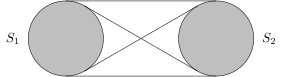
The circles are the shapes and . The shaded regions are denoted and , and is the sum of the perimeter lengths of and .
Let and be convex figures such that . Show that the probability that two independent random lines and , crossing , meet within is , where is the area of and is the length of the boundary of . (See Example (4.13.2) for an explanation of the term 'random line'.)
Let be the distance between two points picked independently at random in a disk of radius . Show that , and .
Pick two points and independently at random in a ball with centre . Show that the probability that the angle is obtuse is . Compare this with the corresponding result for two points picked at random in a circle.
A triangle is formed by , and a point P picked at random in a set with centre of gravity G. Show that .
A point is fixed on the side of the triangle . Two points and are picked independently at random in and respectively. Show that , where and are the centres of gravity of ABD and ADC.
From the set of all triangles that are similar to the triangle , similarly oriented, and inside ABC, one is selected uniformly at random. Show that its mean area is .
Two points and are picked independently at random in the interval . By varying , show that satisfies
and hence find . Let , and show that satisfies
Hence find .
Lines are laid down independently at random on the plane, dividing it into polygons. Show that the average number of sides of this set of polygons is 4. [Hint: Consider random great circles of a sphere of radius ; then let and increase.]
A point is picked at random in the triangle . The lines , produced, meet , respectively at . Show that .
If four points are picked independently at random inside the triangle , show that the probability that no one of them lies inside the triangle formed by the other three is .
If three points are picked independently at random in a disk of radius , show that . [You may find it useful that .]
Two points and are picked independently at random inside a disk . Show that the probability that the circle having centre A and radius lies inside is .
Two points A and B are picked independently at random inside a ball . Show that the probability that the sphere having centre A and radius lies inside is .
Pick two points independently and uniformly at random on the surface of the sphere of with radius 1. Show that the density of the Euclidean distance between them is for .
Two points are chosen independently and uniformly at random on the perimeter (including the diameter) of a semicircle with unit radius. What is the probability of the event that exactly one of them lies on the diameter, and of the event that neither lies on the diameter?
Let be the area of the triangle formed by the two points and the midpoint of the diameter. Show that , and . Hence or otherwise show that .
Stevens's solution of Jeffreys's bicycle wheel problem. After passing over a stretch of road strewn with tacks, a cyclist looks repeatedly at the front wheel to check whether the tyre has picked up a tack. One inspection of the wheel covers a fraction of the tyre. After independent such inspections, each uniformly positioned on the wheel, show that the probability of having inspected the entire tyre is , where the series terminates at the term in where is the integer part of .
Show that , and deduce that
is a density function if .
Calculate the mean and variance of a standard normal variable.
Show that the distribution function satisfies
These bounds are of interest because has no closed form.
Let be , and . Show that as .
Let be continuous with density function , where and .
What are the possible values of and ?
What is ?
Let be a random variable which takes non-negative values only. Show that
where . Deduce that
Let have a continuous distribution function . Show that
(i) is uniformly distributed on ,
(ii) is exponentially distributed.
A straight line touches a circle with unit diameter at the point P which is diametrically opposed on the circle to another point Q. A straight line QR joins Q to some point R on . If the angle between the lines PQ and QR is a random variable with the uniform distribution on , show that the length of PR has the Cauchy distribution (this length is measured positive or negative depending upon which side of P the point R lies).
Let the net scores in the two halves of a game between teams and be independent and identically distributed random variables that are symmetric about 0 and have a continuous distribution function . Team wins (respectively, loses) if (respectively, ). Find the probability that wins conditional on the half-time score .
Let be such that for . If is monotone, show that for some .
Let have an exponential distribution. Show that , for . This is the 'lack of memory' property again. Show that the exponential distribution is the only continuous distribution with this property.
The height of the largest tidal surge in a certain estuary has the exponential distribution with parameter , and it costs to build a barrier with height in order to protect an upstream city. If , the surge costs nothing; if , the surge entails an extra cost of . Show that, for , the expected total cost is minimal when . What if ?
Show that and are independent continuous variables if and only if their joint density function factorizes as the product of functions of the single variables and alone.
Explain why the density function (for ) does not provide a counterexample to this assertion.
Let and have joint density function . Are they independent? Find their marginal density functions and their covariance.
A chord of the unit circle is picked at random. What is the probability that an equilateral triangle with the chord as base can fit inside the circle if:
the chord passes through a point P picked uniformly in the disk, and the angle it makes with a fixed direction is uniformly distributed on ,
the chord passes through a point P picked uniformly at random on a randomly chosen radius, and the angle it makes with the radius is uniformly distributed on .
It is required to estimate where for all , as in Example (2.6.3). Let and be independent random variables with common density function if otherwise. Let , the indicator function of the event that , and let . Show that , and that , so that, of the three, is the most 'efficient' estimator of .
Let be independent exponential variables, parameter . Show by induction that has the distribution.
Let and be independent variables, and respectively.
Use the result of Problem (4.14.10) to show that is when and are integral (the same conclusion is actually valid for non-integral and ).
Find the joint density function of and , and deduce that they are independent.
If is Poisson with parameter , and is integral, show that .
If and is independent of with the beta distribution with parameters and , show that has the same distribution as .
Let be independent variables.
Show that is .
Show that is by expressing its distribution function as an integral and changing to polar coordinates.
More generally, show that is .
Let and have the bivariate normal distribution with means , variances , and correlation . Show that
,
the variance of the conditional density function is .
Let and have joint density function . Find the density function of .
Let and be independent variables with common density function . Show that has the uniform distribution on if and only if
Verify that this is valid if either is the density function or for some constant .
Let and be independent variables, and think of as a random point in the plane. Change to polar coordinates given by ; show that is has the Cauchy distribution, and and are independent. Find the density of .
Find and
If and are independent random variables, show that and have distribution functions
Let and be independent exponential variables, parameter 1. Show that
is exponential, parameter ,
has the same distribution as . Hence find the mean and variance of .
Let and be independent variables having the exponential distribution with parameters and respectively. Let , and .
Find .
Show that and are independent.
Let and be independent non-negative random variables with continuous density functions on .
If, given is uniformly distributed on whatever the value of , show that and have the exponential distribution.
If, given that has a given beta distribution (parameters and , say) whatever the value of , show that and have gamma distributions. You may need the fact that the only non-negative continuous solutions of the functional equation for , with , are of the form . Remember Problem (4.14.5).
Show that it cannot be the case that where is uniformly distributed on and and are independent and identically distributed. You should not assume that and are continuous variables.
Let be independent identically distributed variables with a common density function . Such a collection is called a random sample. For each , arrange the sample values in non-decreasing order , where (1), (2), ,., (n) is a (random) permutation of . The new variables are called the order statistics. Show, by a symmetry argument, that the joint distribution function of the order statistics satisfies
where is given by
and . Deduce that the joint density function of is .
Find the marginal density function of the th order statistic of a sample with size :
by integrating the result of Problem (4.14.21),
directly.
Find the joint density function of the order statistics of independent uniform variables on .
Let be independent and uniformly distributed on , with order statistics .
Show that, for fixed , the density function of converges as , and find and identify the limit function.
Show that has the same distribution as , where the are independent random variables having the exponential distribution with parameter 1.
Show that , defined by for and , are independent random variables with the uniform distribution on .
Let be independent variables with the uniform distribution on . What is the probability that rods of lengths , and may be used to make a triangle? Generalize your answer to rods used to form a polygon.
Let and be independent variables with the uniform distribution on . A stick of unit length is broken at points distance and from one of the ends. What is the probability that the three pieces may be used to make a triangle? Generalize your answer to a stick broken in places.
Let be a pair of jointly continuous variables.
Hölder's inequality. Show that if and then
Set to deduce the Cauchy-Schwarz inequality .
Minkowski's inequality. Show that, if , then
Note that in both cases your proof need not depend on the continuity of and ; deduce that the same inequalities hold for discrete variables.
Let be a random variable. Choose and appropriately in the Cauchy-Schwarz (or Hölder) inequality to show that is a convex function of on the interval of values of such that . Deduce Lyapunov's inequality:
You have shown in particular that, if has finite th moment, then has finite th moment for all positive .
Show more generally that, if are real numbers such that and , then
Show that, using the obvious notation, .
Motor cars of unit length park randomly in a street in such a way that the centre of each car, in turn, is positioned uniformly at random in the space available to it. Let be the expected number of cars which are able to park in a street of length . Show that
It is possible to deduce that is about as big as when is large.
Buffon's needle revisited: Buffon's noodle.
A plane is ruled by the lines . A needle with length is cast randomly onto the plane. Show that the probability that the needle intersects a line is .
Now fix the needle and let be a circle diameter centred at the midpoint of the needle. Let be a line whose direction and distance from the centre of are independent and uniformly distributed on and respectively. This is equivalent to 'casting the ruled plane at random'. Show that the probability of an intersection between the needle and is .
Let be a curve within having finite length . Use indicators to show that the expected number of intersections between and is . This type of result is used in stereology, which seeks knowledge of the contents of a cell by studying its cross sections.
In the excitement of calculating , Mr Buffon (no relation) inadvertently swallows the needle and is X-rayed. If the needle exhibits no preference for direction in the gut, what is the distribution of the length of its image on the X-ray plate? If he swallowed Buffon's cross (see Exercise (4.5.3)) also, what would be the joint distribution of the lengths of the images of the two arms of the cross?
Let be independent exponential variables with parameter , and let be their order statistics. Show that
are also independent and have the same joint distribution as the .
Let be the order statistics of a family of independent variables with common continuous distribution function . Show that
are independent and uniformly distributed on . This is equivalent to Problem (4.14.33). Why?
You are permitted to inspect the prizes at a fête in a given order, at each stage either rejecting or accepting the prize under consideration. There is no recall, in the sense that no rejected prize may be accepted later. It may be assumed that, given complete information, the prizes may be ranked in a strict order of preference, and that the order of presentation is independent of this ranking. Find the strategy which maximizes the probability of accepting the best prize, and describe its behaviour when is large.
Let where are independent normal random variables with means , and common variance , where . Show that the conditional density of the point given , when expressed in spherical polar coordinates relative to an axis in the direction , is of the form
where .
Let be the density function, and define the functions , by , and , the th derivative of . Show that:
is a polynomial of degree having leading term , and
.
Let and have a standard bivariate normal distribution with zero means, unit variances, and correlation coefficient , and suppose and have finite variances. Show that . [Hint: Use Problem (4.14.37) to expand the functions and . You may assume that and lie in the linear span of the .]
Let be the order statistics of independent random variables, uniform on . Show that:
,
for .
Let be independent variables, and set . Show that has a beta distribution with parameters and , and is independent of .
Let be independent and uniform on and set . Find the density of given that .
Skew normal distribution. Let and be the density and distribution functions of the random variable with the standard normal distribution. Show, for , that , , is the density function of some random variable (denoted by ). Show that and have the same distributions. Let have the distribution and be independent of , and define . Write down the joint density of and , and deduce that has density function .
General skew distributions. For , let have a density function , which is symmetric about 0 with distribution function .
(i) Let , and show that and are density functions.
(ii) Let and be independent. Find the conditional density function of given that .
The six coordinates , of three points in the plane are independent . Show that the the probability that C lies inside the circle with diameter AB is .
The coordinates , of three points are independent . Show that the probability that C lies inside the sphere with diameter AB is .
Let have variance and write . Define the skewness of by . Show that:
,
, where is a sum of independent identically distributed random variables,
, when is where ,
, when is Poisson with parameter ,
, when is gamma , and is integral.
Let have variance and . Define the kurtosis of by . Show that:
, when is ,
, when is exponential with parameter ,
, when is Poisson with parameter ,
, where is a sum of independent identically distributed random variables.
Fisher-Gumbel-Tippett distribution. Let , be independent and exponentially distributed with parameter 1. Show that satisfies
Hence show that where is Euler's constant.
Let and have density functions satisfying and . Let be uniformly distributed on and independent of . Given the value , we implement the following algorithm:
Show that, conditional on ultimate acceptance, is distributed as . Explain when you might use this method of sampling.
Let , and be independent random variables, where:
and the are uniform on . Let , and show that is exponentially distributed.
Let and be independent and uniform on . Set and where .
Show that, conditional on the event has density function for .
In sampling from the density function , it is decided to use a rejection method: for given , we sample and repeatedly, and we accept the first time that . What is the optimal value of ?
Describe how to use these facts in sampling from the distribution.
Let be a semicircle of unit radius on a diameter .
A point P is picked at random on . If is the distance from P to along the perpendicular to , show .
A point Q is picked at random on . If is the perpendicular distance from Q to , show .
(Set for the Fellowship examination of St John's College, Cambridge in 1858.) 'A large quantity of pebbles lies scattered uniformly over a circular field; compare the labour of collecting them one by one:
-
at the centre O of the field,
-
at a point A on the circumference.’
To be precise, if and are the respective labours per stone, show that and for some constant .
-
Suppose you take each pebble to the nearer of two points A or B at the ends of a diameter. Show in this case that the labour per stone satisfies
-
Finally suppose you take each pebble to the nearest vertex of an equilateral triangle inscribed in the circle. Why is it obvious that the labour per stone now satisfies ? Enthusiasts are invited to calculate .
The lines , and are parallel, and P lies on . A line picked at random through P meets at Q. A line picked at random through Q meets at R. What is the density function of the angle that RP makes with ? [Hint: Recall Exercise (4.8.2) and Problem (4.14.4).]
Let denote the event that you can form a triangle with three given parts of a rod .
is broken at two points chosen independently and uniformly. Show that .
is broken in two uniformly at random, the longer part is broken in two uniformly at random. Show that .
is broken in two uniformly at random, a randomly chosen part is broken into two equal parts. Show that .
In case (c) show that, given , the triangle is obtuse with probability .
You break a rod at random into two pieces. Let be the ratio of the lengths of the shorter to the longer piece. Find the density function , together with the mean and variance of .
Let be the distance between two points picked at random inside a square of side . Show that , and that has density function
Show that a sheet of paper of area can be placed on the square lattice with period 1 cm in such a way that at least points are covered.
Show that it is possible to position a convex rock of surface area in sunlight in such a way that its shadow has area at least .
Let be independent random variables (respectively).
Show that , are independent random variables.
Show that , have the joint Dirichlet density
Let , be independent multivariate normal random vectors having zero means and the same covariance matrix . Show that the two random variables
are identically distributed.
Choose , and R independently at random in the square of side . Show that . Deduce that four points picked at random in a parallelogram form a convex quadrilateral with probability .
Choose , and R uniformly at random within the convex region illustrated beneath. By considering the event that the convex hull of four randomly chosen points is a triangle, or otherwise, show that the mean area of the shaded region is three times the mean area of the triangle .

Let be a positive-definite symmetric matrix, and a lower-triangular matrix such that ; this is called the Cholesky decomposition of . Let be a vector of independent random variables distributed as . Show that the vector has the multivariate normal distribution with mean vector and covariance matrix .
We need to decide whether or not where are given matrices, and we adopt the following random algorithm. Let be a random -valued vector, each of the possibilities being equally likely. If , we decide that , and otherwise we decide that . Show that
Describe a similar procedure which results in an error probability which may be made as small as desired.
Each box of cereal contains a worthless and inedible object. The objects in different boxes are independent and equally likely to be any of the available types. Let be the number of boxes opened before collection of a full set.
Use the result of Exercise (4.3.6) to show that
Prove the above combinatorial identity directly.
By considering , show that
Points and are picked independently and uniformly at random in the triangle , in such a way that the straight line passing through P and Q divides ABC into a triangle and a quadrilateral . Show that the ratio of the mean area of to that of is .
Let and be independent, identically distributed random variables with finite means. Show that
with equality if and only if their common distribution is symmetric about 0.
Simulated order statistics. Let be independent and identically distributed on . Define recursively as follows:
Show that the random variables have the same joint distribution as the order statistics . You may do this in two different ways: first by construction, and second by using the change of variables formula.
The value of a financial index in one year's time has the normal distribution with mean and standard deviation . You possess a derivative contract that will pay you , where is a predetermined constant. Show that the expected payout of the contract is given by , where and are the density and distribution functions, and . Deduce that, for large positive ,
Let be the density function of a positive, unimodal random variable with finite variance, with a unique mode at 0 (so that is non-increasing on , recall the definitions of Problem (2.7.23)). For any such that , let .
Prove that, for , we have that .
Deduce that
Prove the inequality of (b) for a continuous random variable with a unique mode at 0.
Let be the indicator function of success in the th of independent trials. Let , and let be the th 'odds ratio'. Let , and for the moment assume that for all .
Show that the probability of exactly one success after the th trial is .
Prove that is a unimodal function of , in that there is a unique such that is greatest either for or for .
It is desired to stop the process at the last success. Show that the optimal rule for achieving this is to stop at the first success at time or later, where .
What can be said if for some ?
Show that the probability of stopping at the final success is .
Use this result to solve the marriage problem (4.14.35).
Let be non-negative, independent random variables. Their values are revealed to you in order, and you are required to stop the process at some time , and exit with . Your target is to maximize , and you are permitted to choose any 'stopping strategy' that depends only on the past and present values . (Such a random variable is called a 'stopping time', see Exercise (6.1.6).)
Show that , where is the supremum over all stopping strategies.
A stick of length is broken at points chosen independently and uniformly in the interval . Let the order statistics of the resulting lengths of sticks be . Fix and write . Show that
Deduce that
(i) for , where .
(ii) .
(iii) , where .
Let , and let and have joint density function for , . We set for other pairs .
Find the value of and the joint distribution function of .
Show that it is possible to construct a triangle with side-lengths , with probability one.
Show that the angle opposite the side with length is obtuse with probability
and find when .
You are driving at constant speed along a vast multi-lane highway, and other traffic in the same direction is moving at independent random speeds having the same distribution as a random variable with density function and finite variance.
Show that the expected value of the speed of vehicles passing you or being passed by you is
Suppose that is symmetric about its mean , and that . Show that the difference is positive, and that it has a maximum value for some value .
What can be said if ? Discuss.
Suppose is uniformly distributed on the interval . Show for that , while for we have .