Geometrical probability
[18/100%]Pick two points A and B independently at random on the circumference of a circle with centre and unit radius. Let be the length of the perpendicular from to the line , and let be the angle makes with the horizontal. Show that has joint density
Let and be disjoint convex shapes with boundaries of length , as illustrated in the figure beneath. Let be the length of the boundary of the convex hull of and , incorporating their exterior tangents, and the length of the crossing curve using the interior tangents to loop round and . Show that the probability that a random line crossing also crosses is . (See Example (4.13.2) for an explanation of the term 'random line'.) How is this altered if and are not disjoint?
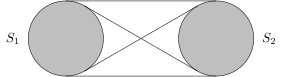
The circles are the shapes and . The shaded regions are denoted and , and is the sum of the perimeter lengths of and .
Let and be convex figures such that . Show that the probability that two independent random lines and , crossing , meet within is , where is the area of and is the length of the boundary of . (See Example (4.13.2) for an explanation of the term 'random line'.)
Let be the distance between two points picked independently at random in a disk of radius . Show that , and .
Pick two points and independently at random in a ball with centre . Show that the probability that the angle is obtuse is . Compare this with the corresponding result for two points picked at random in a circle.
A triangle is formed by , and a point P picked at random in a set with centre of gravity G. Show that .
A point is fixed on the side of the triangle . Two points and are picked independently at random in and respectively. Show that , where and are the centres of gravity of ABD and ADC.
From the set of all triangles that are similar to the triangle , similarly oriented, and inside ABC, one is selected uniformly at random. Show that its mean area is .
Two points and are picked independently at random in the interval . By varying , show that satisfies
and hence find . Let , and show that satisfies
Hence find .
Lines are laid down independently at random on the plane, dividing it into polygons. Show that the average number of sides of this set of polygons is 4. [Hint: Consider random great circles of a sphere of radius ; then let and increase.]
A point is picked at random in the triangle . The lines , produced, meet , respectively at . Show that .
If four points are picked independently at random inside the triangle , show that the probability that no one of them lies inside the triangle formed by the other three is .
If three points are picked independently at random in a disk of radius , show that . [You may find it useful that .]
Two points and are picked independently at random inside a disk . Show that the probability that the circle having centre A and radius lies inside is .
Two points A and B are picked independently at random inside a ball . Show that the probability that the sphere having centre A and radius lies inside is .
Pick two points independently and uniformly at random on the surface of the sphere of with radius 1. Show that the density of the Euclidean distance between them is for .
Two points are chosen independently and uniformly at random on the perimeter (including the diameter) of a semicircle with unit radius. What is the probability of the event that exactly one of them lies on the diameter, and of the event that neither lies on the diameter?
Let be the area of the triangle formed by the two points and the midpoint of the diameter. Show that , and . Hence or otherwise show that .
Stevens's solution of Jeffreys's bicycle wheel problem. After passing over a stretch of road strewn with tacks, a cyclist looks repeatedly at the front wheel to check whether the tyre has picked up a tack. One inspection of the wheel covers a fraction of the tyre. After independent such inspections, each uniformly positioned on the wheel, show that the probability of having inspected the entire tyre is , where the series terminates at the term in where is the integer part of .