The classification of surfaces
[170/100%]Verify that , , is a homeomorphism and that it restricts to a homeomorphism of onto .
Construct a homeomorphism of onto , where , .
Construct a homeomorphism from . (Hint: Use the analog of (a).)
Let and . An -manifold with boundary is a topological space such that:
-
there is an embedding of into for some ;
-
given , there is a neighborhood of and a homeomorphism of onto an open set in .
Show that if is a homeomorphism onto an open set in and , then there is a smaller open set about and a homeomorphism .
In a manifold with boundary, a point with (i.e. in the interior of ) is called an interior point, and a point with is called a boundary point. Assume the following two results (to be proved in Chapter 6 using homology theory): first, an open set in is not homeomorphic to an open set in for ; second, if and is an open set in about , then is not homeomorphic to an open set in (or even any ).
Using these two results, show that the dimension of a manifold is well defined and that an interior point cannot be a boundary point as well, so the concepts of interior point and boundary point are well defined.
Suppose is an open set about and is an open set in . Show that is not homeomorphic to .
Note that there is an interval contained in which is path connected after is removed.
Show that the boundary of an -manifold is either empty or an -manifold.
Use the fact that a point is either an interior point or a boundary point but not both.
Suppose are -manifolds with boundary. Show that if is a homeomorphism, then is a homeomorphism from to .
Theorem (Invariance of domain): Suppose is an open subset of and is -- and continuous. Then is an open map; that is, it maps open sets to open sets.
Apply this theorem to prove the following version for -manifolds: if are -manifolds and is -- and continuous, then is an open map. Show that if we also assume that is compact, connected and is connected, then must be a homeomorphism.
Deduce the fact that the dimension of an -manifold is well defined from the invariance of domain.
Prove that the invariance of domain holds when .
Show directly that is homeomorphic to .
Use polar coordinates to define the map.
Show that the product of an -manifold and -manifold is an -manifold . Conclude that (the torus) is a compact, connected surface.
Construct a homeomorphism between the quotient space and the circle , where denotes a copy of the interval and the identification glues corresponding endpoints of the two copies together via the identity.
Construct a homeomorphism between the lower half of the disk and the upper half of the disk sending the boundary as indicated in Figure 2.11.
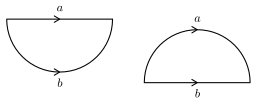 Two homeomorphic half disks.
Construct homeomorphisms between each half disk and the whole disk.
Use the quotient map (identifying each with its antipodal point , giving the projective plane the quotient topology) to show that is a compact, connected surface.
Use the handle decomposition description of (one -handle, one -handle, and one -handle, as constructed above) to show that is a compact connected surface.
Give a description of the Klein bottle as a quotient space of analogous to the description of the torus as a quotient space of given in Chapter 1. Use this description to show that is a surface.
Show that the Klein bottle is compact and connected.
Show by induction that if are disjoint disks in the interior of a connected surface , and is another collection of disjoint disks in the interior of , then there is a homeomorphism which is the identity on sending to .
This is the ``disk lemma'': for disks in the interior of a connected surface (with boundary) , there is a homeomorphism , fixed on , with .
Recall that a homeomorphism is called periodic of period if either (for order preserving) or (for order reversing). Given an order-preserving homeomorphism , define by writing uniquely as with , , and setting . Show that the map defined this way is a periodic homeomorphism.
Given two disjoint arcs in the circle , choose intervals so that , , where , . The unique order-preserving affine linear homeomorphism from to induces (via ) a standard'' homeomorphism from $I$ to $I'$. Show that this standard'' homeomorphism does not depend on the choice of .
Any order-preserving homeomorphism (where ) is isotopic to the identity.
Any order-reversing homeomorphism is isotopic to .
Part (a) is proved using the isotopy . Prove part (b).
Use the homeomorphism , , and the fact that any order-preserving homeomorphism is isotopic to the identity while any order-reversing one is isotopic to (where ), to prove the analogous statement for :
Any order-preserving homeomorphism is isotopic to the identity.
Any orientation-reversing homeomorphism is isotopic to the reflection .
Define an embedding of into to be orientation preserving (resp.reversing) if it is the composition of an order-preserving (reversing) embedding of into and the map , . A homeomorphism from to is orientation preserving if it comes from a periodic homeomorphism of which is order preserving.
Suppose are orientation-preserving embeddings. Show they are ambient isotopic.
Suppose are orientation-reversing embeddings. Show they are ambient isotopic.
Suppose are embeddings so that preserves orientation and reverses orientation. Show they are not ambient isotopic.
A related fact you may use: any orientation-preserving homeomorphism sending to is isotopic to the identity, where is sent to at each stage of the isotopy; any orientation-preserving homeomorphism is isotopic to the identity; this exercise asks you to prove the remaining case:
Any orientation-reversing homeomorphism is isotopic to .
When a -handle is attached to a single boundary circle of a handlebody, there are two standard ways of attaching it up to homeomorphism, pictured in Figure 2.17: on the left, the new boundary has two components in place of one; on the right, the new boundary still consists of one boundary circle, and there is a Möbius band embedded in the surface using a piece of the collar and the handle .
 Attaching a 1-handle to one boundary circle.
Find the Möbius band that is referred to above on the right surface in Figure 2.17.
Show that the result of attaching a 1-handle to the same boundary circle is never homeomorphic to what you get when it is attached to two different boundary circles.
Consider the number of boundary circles in each case.
Theorem: Let be a handlebody with a handle decomposition with -handles and -handles. Then: (a) is homeomorphic to the disjoint union of a finite number of circles; (b) there is a neighborhood of which is homeomorphic to , where is sent to via the standard identification .
The proof outline is by induction on the number of -handles: the case of -handles alone is immediate, and for the inductive step one writes , assumes (a) and (b) hold for , and uses the existence of a collar where the -handle is attached to determine the new boundary and its neighborhood, treating separately the case where the two attaching arcs of lie on the same boundary circle of and the case where they lie on two different boundary circles of .
Fill in the details of this proof.
Show that the complement of the center circle in a Möbius band is connected but that the complement of the center circle in an annulus is separated.
Use the previous exercise to show that a Möbius band cannot be embedded in the plane.
Consider the Jordan curve theorem and invariance of domain.
An orientation for a handle is an orientation of its boundary circle, meaning a consistent ordering for any arc (a homeomorphic image of an interval in the circle): if two arcs intersect in an arc, the two orderings agree on the arc of intersection. In the Möbius band's handle decomposition with one -handle and one -handle, show that no matter how one orients each of the two handles, the -handle is attached to the -handle so that the orientation agrees on one of the two attaching arcs and disagrees on the other.
Use the definition of orientability of a handlebody (choosing an orientation for each handle so that the orientations disagree on all identifications of attaching arcs) to determine whether the handlebodies in Figure 2.25 are orientable or not.
 Some handlebodies.
Show by induction on the number of handles that in a connected handlebody any two handles may be joined by a chain with incident to (where two handles are called incident if they have boundary arcs which are identified).
Give an example of an oriented handlebody and a handle attached to so that cannot be oriented consistently with the chosen orientations of the handles in , but is orientable.
Given two compact connected surfaces with boundary, choose an embedding of which sends into an arc in and sends into an arc in . The boundary connected sum of and , written , is the surface formed by attaching a -handle joining and along these arcs.
If we choose different embeddings (in the analogous construction for the connected sum , where a disk is removed from each of and a cylinder is glued in along the two resulting boundary circles) giving , then there are orientation-preserving homeomorphisms , with , , induced by isotopies connecting and . These induce a homeomorphism between the two ways of forming the connected sum, by sending to via and to via .
Verify that this description of the homeomorphism in pieces does fit together to give a homeomorphism between the two ways of forming the connected sum with and ; that is, check that it is consistent with the identifications being made to form the connected sums.
Construct a homeomorphism from onto which fixes pointwise .
Show that , where denotes boundary connected sum of surfaces with boundary (Exercise 2.5.1).
Show that , where denotes boundary connected sum of surfaces with boundary (Exercise 2.5.1).
Show that , where denotes connected sum of surfaces (possibly without boundary).
Show that .
Show that , where denotes boundary connected sum (Exercise 2.5.1) and is the closed disk.
Write as , where are rectangles joined along a segment in their boundaries, and use the idea of Exercise 2.5.2.
If is a surface without boundary, and denotes with disjoint disks removed from its interior, show that , where is the -sphere and denotes boundary connected sum (Exercise 2.5.1).
Consider first the case .
Show that , where is the -sphere.
Think about what is removed and what is filled in when we form the connected sum with . Alternatively, use Exercise 2.5.7 together with the fact that , where denote with one disk removed, is boundary connected sum, and the final -handle fills in the one remaining boundary circle.
If is the Klein bottle, use (where is the projective plane) to show that , where the subscript denotes removing one disk and is boundary connected sum (Exercise 2.5.1).
Show that , where is boundary connected sum and the subscript denotes removing one disk. Use this to show that the boundary connected sum of copies of is homeomorphic to the connected sum of copies of with one disk removed; that is, denoting the connected sum of copies of by , show that ( copies).
Then show that ( copies of ), where is the -sphere. (This space is denoted .)
Let be the Möbius band. Construct a model of (the connected sum of with the torus ) and show that it is homeomorphic to (the connected sum of with the Klein bottle ).
It will help if the cylinder used to form the connected sum is attached symmetrically, one-fourth and three-fourths of the way across the strip representing .
Here denotes the boundary connected sum of copies of the projective plane with one disk removed, and similarly for copies of the torus . Show that . Conclude from this that .
For each of the orientable surfaces (given by handle decompositions with a single -handle and disjoint -handles attached to its boundary) in Figure 2.46, use handle sliding to put it in standard form and identify the surface. Check your answer using the classification theorem (Theorem 2.6.2: a connected, orientable handlebody with - and -handles and Euler characteristic and boundary circles is homeomorphic to the standard model for or , where ).
 Surfaces for Exercise 2.6.3.
First find a torus pair (a pair of linked -handles which together create when attached to a disk) and slide the other handles off of it.
For each of the nonorientable surfaces in Figure 2.47, use handle sliding to put it in standard form and identify the surface. Check your answer using the classification theorem (Theorem 2.6.2: a connected, nonorientable handlebody with - and -handles and Euler characteristic and boundary circles is homeomorphic to the standard model for , where ).
 Surfaces for Exercise 2.6.4.
First find a twisted handle (a -handle attached to a single boundary circle in a way that creates a Möbius band from the disk) and slide the other handles off of it.
Consider the step in the proof of the classification theorem (Theorem 2.6.2) for the orientable case where a new torus pair (a pair of linked -handles) is created by adding a new -handle to a handlebody already in standard form , giving . Show that, if we regard the -handle together with this new torus pair as giving us the torus-with-one-hole , then we can remove this piece from the surface and replace it by a consistently oriented disk with the same boundary, to which the other handles (those of besides its -handle) are attached. Considering this disk as the new -handle and the other -handles as attached to its boundary, forming a handlebody , show that . Then use induction to show that when .
Consider the step in the proof of the classification theorem (Theorem 2.6.2) for the orientable case where a new -handle is attached to a single boundary circle of a handlebody (already in standard form) to form . Show that if is homeomorphic to , then we can add a -handle to so that . Thus, removing this -handle shows that .
Consider the step in the proof of the classification theorem (Theorem 2.6.2) for the nonorientable case where we attach a new -handle to form from a handlebody , which, by induction, may be assumed to be either or and already in standard form. Show that we can assume in either case that is attached away from the torus pairs or twisted handles of , so it may be regarded as attached to (the disk with trivial handles). In the case where is orientable, will necessarily be attached to so that is nonorientable. Show that this is not necessarily the case when is nonorientable.
Show that if a -handle is attached to a single boundary circle of as a twisted handle to form , then the union of the -handle and forms a Möbius band . Form a new handlebody by replacing by a disk with the same boundary and then attaching the other -handles (those of besides its -handle) to it. Show that and .
Show that if a -handle is attached to two boundary circles of in a twisted fashion to form , and we choose another -handle so that forms an annulus whose boundary consists of these two circles, then is a Klein bottle with a disk removed, . Form a new handlebody by removing and replacing it with a disk (the new -handle), then adding in all of the other handles of the original standard handle decomposition of . Show that and .
Deduce the general induction step for the nonorientable case of the classification theorem (Theorem 2.6.2) from the constructions of the last three exercises (2.6.7--2.6.9), considering separately:
the case where the handle is attached to in an orientable fashion;
the case where the handle is attached to in a nonorientable fashion.
Classification theorem for surfaces: a compact connected surface (possibly with boundary) is homeomorphic to either a sphere with disks removed, , a connected sum of tori with disks removed, , or a connected sum of projective planes with disks removed, . Orientability, the number of boundary components, and the Euler characteristic form a complete set of invariants. If the surface is orientable with boundary components and Euler characteristic , then with (here ); if is nonorientable with boundary components and Euler characteristic , then with .
Verify the formulas given above for in terms of .
Show that , where denotes boundary connected sum.
Show that .
Consider the surface , formed as a Möbius band with a -handle attached (drawn as the right-hand surface of Figure 2.49: a rectangle with a bump pushed back in, giving a Möbius band, together with an extra handle that can be used to get another Möbius band). Show directly that this surface is by finding two Möbius bands which are attached together by a -handle.
Figure 2.50 shows a shaded surface with one boundary component, a knot embedded in (pictured via a planar projection with over/undercrossings). It decomposes into three -handles (disks cut off by line segments joining parts of the knot) and four -handles (twisted rectangular strips in joining these disks), giving Euler characteristic ; orienting counterclockwise and clockwise, the handles can be oriented consistently with these, but cannot be oriented consistently with the rest, so the surface is nonorientable; it is homeomorphic to (a Möbius band boundary-summed with another Möbius band, obtained by noting that is five rectangles laid end on end, equivalent to a single rectangle; adding gives a Möbius band, and adding gives the Klein bottle with one hole).
Figure 2.51 shows another surface with the same knot as its boundary, built by an algorithm due to Seifert, again from three -handles (with lying above the plane containing most of the knot, like the upper hemisphere of the sphere) and four -handles , connected by and so that, as before, these five handles fit together to give one rectangle.
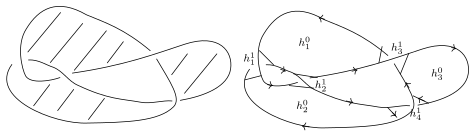 Surface bounded by a knot.
 Another surface bounded by the same knot, via Seifert’s algorithm.
By looking at Figure 2.51 as this rectangle with the two remaining -handles attached, mimic the argument for Figure 2.50 above to show directly that the surface of Figure 2.51 is (it has one boundary circle, the knot, and Euler characteristic , so the handles can in fact be oriented consistently with the rest).
Determine which of the standard model surfaces the two surfaces in Figure 2.52 are homeomorphic to.
 Surfaces to identify for Exercise 2.7.5.
For (b), the exterior region depicts a disk lying over the plane, which can be taken as a -handle. The knot which they bound is called the trefoil knot. Use the classification theorem and then give simpler handle decompositions to exhibit these regions more clearly, in analogy to the worked example of Figure 2.50/2.51 (a shaded surface bounded by a knot, decomposed into -handles given by disks cut off by line segments joining parts of the knot, and -handles given by twisted rectangular strips joining these disks). For each surface, give a handle decomposition with the minimal number of handles.
Identify the following surfaces (in terms of the standard models , , ):
has , is nonorientable, and has three boundary components.
is orientable, has , and has empty boundary.
Identify the surfaces depicted in Figure 2.56.
 Surfaces for Exercise 2.7.7: (a) a sphere with two holes and a 1-handle attached; (b) a disk with two holes and a 1-handle attached.
The sphere with two holes and a 1-handle attached, shown in Figure 2.56(a).
The disk with two holes and a 1-handle attached, shown in Figure 2.56(b).
Identify the surface depicted in Figure 2.57.
 Surface for Exercise 2.7.8.
First fill in the obvious holes. Then find a handle decomposition of what is left. Also, you might try breaking it into a connected sum of pieces that are easier to identify.
Identify the surfaces in Figure 2.58, where the octagon's edges are identified in pairs as indicated by the matching letters and arrow directions.
 Surfaces for Exercise 2.7.9.
The surface obtained from the edge identifications shown in Figure 2.58(a).
The surface obtained from the edge identifications shown in Figure 2.58(b).
Exercises 2.9.1--2.9.8 together outline an argument that any compact connected -manifold is homeomorphic to .
Verify that the circle is a compact connected -manifold. Show that can be covered by two open sets , each homeomorphic to , so that is homeomorphic to the union of two disjoint open rays.
Show that a compact -manifold is not homeomorphic to an open set in .
Show that a proper open set in may be decomposed (uniquely) as the union of a disjoint (countable) collection of intervals and rays.
For , find the largest interval containing .
Suppose are two open sets in a -manifold with homeomorphisms , , and is the homeomorphism between the two images of . Show that if a finite interval is in the decomposition of Exercise 2.9.3 for , then .
Suppose and is order preserving. If is a sequence in converging to , then will be a sequence in converging to both and , which is impossible in a metric space. Similar reasoning shows that the only possibility is .
With as in Exercise 2.9.4, show that one of the following three cases must occur:
or is ;
and are each a ray;
and each consist of two rays.
Show that in cases (a) and (b) of Exercise 2.9.5, is homeomorphic to .
Show that in case (c) of Exercise 2.9.5, is homeomorphic to .
Use induction on the number of open sets in a covering of by open sets homeomorphic to , together with Exercises 2.9.6 and 2.9.7, to conclude that a compact connected -manifold is homeomorphic to .
Show that if already falls into case (c) of Exercise 2.9.5, then any more are superfluous; that is, , using an argument similar to the one outlined in Exercise 2.9.4.
Show that a connected -manifold is path connected.
Mimic the proof that a connected open set in is path connected, or use Exercise 1.9.51.
Show that a compact -manifold has only a finite number of path components, each of which is a compact, connected -manifold. Conclude that a compact -manifold is the disjoint union of a finite number of circles.
Show that in a compact connected -manifold with nonempty boundary, if and and we do not have , and , then and must each be rays, and is homeomorphic to .
Show that in a compact connected -manifold with nonempty boundary, if and with , and , then , , and , with an orientation-reversing diffeomorphism, and is homeomorphic to a closed interval.
Show that a compact connected -manifold with nonempty boundary is homeomorphic to .
Show that Exercise 2.9.13 implies Exercise 2.9.8.
Remove an open interval in a neighborhood homeomorphic to from the given compact connected 1-manifold.
Show that Figure 2.64 does not represent a -manifold.
 Not a 1-manifold.
Look at a small neighborhood of one of the points where three segments come together. Show that if it were a 1-manifold, there would have to be a standard neighborhood that is homeomorphic to a connected open subset of the line, and derive a contradiction from this.
Show that the map , , arising from considering (the projective plane) as a quotient space of (the -sphere) by identifying with , has the property that given , there is a neighborhood of so that (a disjoint union) and is a homeomorphism of onto .
Construct a continuous map (from the torus to the Klein bottle) so that, given , there is a neighborhood of so that (a disjoint union) and is a homeomorphism of onto .
Consider and as quotient spaces of , or alternatively, consider as a quotient space of and as a quotient space of .
Construct a homeomorphism between the complement of two points in the sphere and the complement of one circle (properly chosen) in the torus .
Construct a continuous map from the torus onto the sphere which sends to the south pole and is a homeomorphism on .
Consider a rotating family of planes through the south pole and their intersection with (see Figure 2.65: collapsing a wedge in a torus, going from labeled points on a cylinder identified to get a torus, to the corresponding points on a sphere). Alternatively, think of both and as arising from a disk by making certain identifications on the boundary circle.
Remove a small neighborhood of the center circle in the Möbius band, which is itself a smaller Möbius band. Show that the resulting space is homeomorphic to a cylinder.
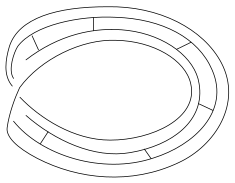 Removing a smaller Möbius band.
Show that there is a circle embedded in (the torus with an open disk removed) which, when removed, has connected complement. Use this fact to show that (the connected sum of tori with disks removed) cannot be embedded in the plane, where , .
Show that a -sphere cannot be embedded in the plane.
Use invariance of domain.
Use Exercises 2.9.21, 2.9.22, 2.4.1, and the classification theorem to characterize the compact connected surfaces (with or without boundary) that can be embedded in the plane.
Construct an embedding of the Möbius band into the solid torus so that the boundary curve of the Möbius band is embedded on the boundary torus . Describe the composition of the embedding of the boundary circle with the projections of onto the circles and .
Theorem (strong form of the Schönflies theorem): let be a simple closed curve in the plane and as given by the Jordan curve theorem, with bounded. Then there is an ambient isotopy with , so that and . The ambient isotopy can be chosen to be the identity outside a large disk.
Lemma: any embedded disk is ambient isotopic to with and , where the ambient isotopy can be chosen to be the identity outside a large disk.
Use the theorem above to prove the lemma.
If is a homeomorphism, say is orientation preserving (reversing) if is. Recall that any orientation-preserving homeomorphism of is isotopic to the identity, and any orientation-reversing one is isotopic to (extending the earlier result for the circle).
Prove the disk version:
An orientation-preserving homeomorphism is isotopic to the identity.
An orientation-reversing homeomorphism is isotopic to the reflection .
The key idea is to first extend to a homeomorphism by coning at , and extend the isotopy between the identity and to an isotopy between the identity and this extension. Then will be isotopic to and will be the identity on . Then show that is isotopic to the identity via an isotopy that gradually increases the annular region near the boundary which is sent via the identity and compresses the action of to smaller and smaller disks about the origin.
This follows from part (a) by using a composition of and the isotopy.
Suppose is isotopic to the identity with the restriction to given by , with and . Extend to a homeomorphism as follows: for , define (using the isotopy on each circle), so that for , and define for .
Give an isotopy between and the identity which extends the isotopy between and the identity.
Theorem (strong form of the disk lemma in the plane): let be an embedded disk in the plane. Then there is an isotopy with and or , where is the inclusion map of the unit disk and is the reflection . This isotopy is the identity outside a large disk. Moreover, there is no such isotopy connecting and .
Deduce all but the last statement of this theorem (i.e.everything except the fact that and are not isotopic, which will be shown in Chapter 6 as an application of homology) from the preceding exercises (Lemma 2.9.1 and Exercises 2.9.26--2.9.27).
For , define to be:
-
the identity on ;
-
the affine linear map sending to by multiplying by ;
-
the unique affine linear map sending to . Give a formula for and show that is isotopic to the identity with an isotopy which is the identity on .
Using of the preceding exercise, define by for , .
Show that is isotopic to the identity with identity isotopy outside , via an isotopy .
For an embedded disk which is the restriction of an embedding , let . Show that is ambient isotopic to , where the ambient isotopy is the identity off of .
Show that if is an open set about , then is ambient isotopic to with .
Show that given , there is a homeomorphism with and for . Show that is isotopic to the identity where the isotopy .
Use coning.
Suppose that is a connected surface with (possibly empty) boundary and . Show that there is an isotopy of which is the identity on with and . If is a collar of the boundary and , show that we can assume that is the identity on .
Fix . Let , and consider the set of those points so that there is an isotopy of which is the identity on with and . Show that is both open and closed in . Use the connectedness of to show that .
Use the preceding exercises and the strong form of the disk lemma in the plane (Theorem 2.4.2, restated in Exercise 2.9.28) to show that given any two embedded disks , there is an isotopy of which is the identity on a collar neighborhood of the boundary so that and or (this is the strong form of the disk lemma, Theorem 2.4.3).
Let be an open set about . Show that there is an ambient isotopy in with and . Then use Theorem 2.4.2.
A space is called homogeneous if, given , there is a homeomorphism with . Use Exercise 2.9.32 to show that a connected manifold without boundary is homogeneous.
Show that if a homeomorphism satisfies (for some , where denotes the disk of radius ), then is isotopic to the identity.
Use Lemma 2.9.1 (Exercise 2.9.25) to show that given any two -disks embedded in the plane, there is an isotopy which is the identity outside of a large disk so that and .
From the proof of the classification theorem for handlebodies, a nonorientable surface possesses an embedded Möbius band which we can think of as arising inside a twisted handle and a collar of the -handle. For any boundary circle , we can take a collar of this circle, the Möbius band, and a rectangle joining them to form a subset which is homeomorphic to the left diagram of Figure 2.67.
 Using a Möbius band to reverse orientation on a boundary circle.
Explain why this region is homeomorphic to a Möbius band with a disk removed, as pictured on the right side of Figure 2.67. Use this homeomorphism to find a homeomorphism of the handlebody which is the identity outside of and reverses the orientation of .
Use the previous exercise and the discussion preceding Theorem 2.6.5 (that, for a connected oriented surface, there is a homeomorphism which reverses orientation on each boundary circle, and if the surface is nonorientable, there is a homeomorphism which reverses orientation on a single chosen boundary circle while preserving orientation on the others) to give an independent proof of Corollary 2.4.6 for handlebodies: that for a compact connected surface with boundary, a subcollection of boundary circles of , and a permutation of , there is a homeomorphism which is the identity on so that , preserving orientation on the boundary circles if is oriented (and, if is nonorientable, can be chosen to preserve or reverse orientation on each independently).
In Chapter 6, it is shown that handle-oriented surfaces (Definition 2.4.4) are disk-oriented (Definition 2.4.2). Use this to show that the three definitions of being orientable for handlebodies (handle-orientable, Möbius-orientable in the sense of Definition 2.4.1, and disk-orientable in the sense of Definition 2.4.2) are equivalent.
Show handle-nonorientable implies Möbius-nonorientable implies disk-nonorientable implies handle-nonorientable.
Give a handlebody decomposition for each of the surfaces in Figure 2.68 and orient the handles consistently to show that the surfaces are orientable.
 Orientable handlebodies.
Show that the surfaces in Figure 2.69 are nonorientable by finding an embedded Möbius band. Then find a handle decomposition in each case and show that the handles cannot be oriented consistently.
 Finding a Möbius band.
Show that a handlebody with only one -handle is connected.
In the connected handlebodies of Figure 2.70, find a new decomposition with exactly one -handle.
 Decompositions with a single 0-handle.
Find a new handle decomposition for Figure 2.70(c) so that the -handles are all attached to the boundaries of the -handles.
What is the minimal number of -handles required for a handle decomposition of ? Construct a handle decomposition of with this minimal number of -handles.
Consider the Euler characteristic.
Construct a handle decomposition of with three -handles, seven -handles, and one -handle.
Write the surfaces in Figure 2.71 as connected sums, or boundary connected sums, of other surfaces, none of which is a disk or a sphere. Indicate in the figure what the two pieces are and which of the standard surfaces (with boundary) each is homeomorphic to.
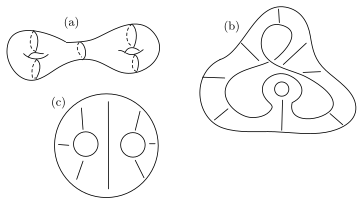 Connected sums.
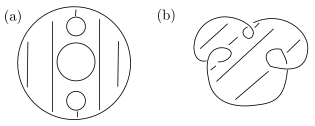
In each of the surfaces with boundary in Figure 2.72, find an arc joining two points on the boundary so that if we cut the surface along the arc and open it up (equivalently, remove a neighborhood of the arc), we get two surfaces, neither of which is homeomorphic to a disk. Relate this to a boundary connected-sum decomposition.
 Separating arcs and boundary sums.
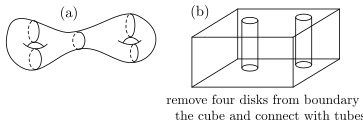
In each of the surfaces in Figure 2.73, find an embedded circle which separates the surface so that if we cut the surface along the circle (equivalently, remove a neighborhood of the circle), we get two surfaces, neither of which is homeomorphic to (a sphere with some disks removed). Relate this to a connected-sum decomposition.
 Separating circles and connected sums.
Show that the disk with the upper semicircle identified to the lower semicircle as indicated in Figure 2.74(a) is homeomorphic to (the sphere).
 Quotients of the disk.
Send the arc to an arc in the -plane joining to going through the south pole, and send vertical lines to the intersection of with planes parallel to the -plane.
Show that the disk with the upper semicircle identified to the lower semicircle as indicated in Figure 2.74(b) is homeomorphic to (the projective plane).
Show that the disk with identifications on the boundary circle as indicated in Figure 2.74(c) is homeomorphic to (the torus).
If the boundary of a disk is divided into edges and the edges are identified in pairs, show that the quotient space represents a compact connected surface.
Suppose a surface comes from a disk by dividing its boundary into edges and identifying the edges in pairs. Associate to the word given by starting at a vertex and reading counterclockwise around the circle (and reading whenever the arrow on edge points clockwise). For example, this gives the words , , and for Figure 2.74(a), (b), and (c) respectively (see Exercises 2.9.50--2.9.52).
Show that if represents the word associated to in this fashion, and similarly (using different letters) is associated to , then the juxtaposition is associated to (e.g. is associated to ).
 Connected sum and words: remove the two disks and identify copies of e.
Form the connected sum as indicated in Figure 2.75.
Using the word-association convention of Exercise 2.9.54, show that (the connected sum of tori) may be represented as a disk with identifications on the boundary associated to the word . Show that (the connected sum of projective planes) may be represented as a disk with identifications on the boundary associated to the word .
Using the word-association convention of Exercise 2.9.54, show that the words , , and are associated to homeomorphic surfaces.
Suppose are triangles in so that:
-
any two triangles are disjoint or they intersect in a common edge or vertex;
-
every edge is the edge of precisely two triangles;
-
for any vertex , the triangles containing may be ordered cyclically so that subsequent triangles intersect along an edge with only the vertex in common, as in the right-hand picture of Figure 2.76.
 Orienting a triangulation.
Show that is a surface (called a triangulated surface).
Find homeomorphic images of (the sphere) and (the torus) in that are triangulated surfaces (Exercise 2.9.57).
A triangulated surface (Exercise 2.9.57) is orientable if we can orient each triangle (by giving a clockwise or counterclockwise direction to its edges) so that for any edge, the two triangles containing the edge impose opposite orientations on the edge (see Figure 2.76). Show how to orient your triangulations of and from Exercise 2.9.58 in this manner.
Indicate how a triangulated surface (Exercise 2.9.57) which cannot be oriented (in terms of orienting the triangles consistently, as in Exercise 2.9.59) will contain a Möbius band.
In this and the following problems, you are asked to identify surfaces; that is, tell which one of the standard model surfaces , , the given surface is homeomorphic to.
Which surface is the surface of a coffee cup (with a handle) homeomorphic to?
Identify the following surface. Take an empty box (with thickness) and poke a small hole in each of its six faces. The surface is the surface of the box after the holes are poked.
Identify the surfaces in Figure 2.68 (see Exercise 2.9.40).
Orientable handlebodies.
Identify the surfaces in Figure 2.69 (see Exercise 2.9.41).
Finding a Möbius band.
Identify the surfaces in Figure 2.70 (see Exercise 2.9.43).
Decompositions with a single 0-handle.
Identify the surfaces in Figure 2.71 (see Exercise 2.9.47).
Connected sums.
Identify the surfaces in Figure 2.72 (see Exercise 2.9.48).
Separating arcs and boundary sums.
Identify the surfaces in Figure 2.73 (see Exercise 2.9.49).
Separating circles and connected sums.
Identify the surface formed from a hexagon by identifying edges as indicated in Figure 2.77.
 Quotient of a hexagon.
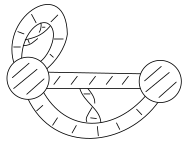
Identify the surface in Figure 2.78.
 Surface for Exercise 2.9.70.
Identify the surface in Figure 2.79.
 Surface for Exercise 2.9.71.
Identify the surface in Figure 2.80.
 Surface for Exercise 2.9.72.
Identify the surface in Figure 2.81.
 Surface for Exercise 2.9.73.
Identify the surface obtained by taking the connected sum of two disks. Identify the surface obtained by taking the boundary connected sum of two disks.
Using a model of in which is symmetric with respect to the -plane and reflection through that plane, construct a homeomorphism from to which reverses orientation on the boundary circle.
Using a model for a general orientable surface in , construct a homeomorphism of which reverses orientation on each boundary circle.
Construct a homeomorphism between and the surface in Figure 2.82 (without the boundary circle).
 T \setminus { p} .
Describe a homeomorphism between the two surfaces in Figure 2.83.
 Constructing a homeomorphism.
Recall that an isotopy between embeddings is called ambient if there is an isotopy with . Show that if and , then every isotopy of embeddings of into is ambient.
A homotopy between continuous maps is a continuous map , , with , ( and are said to be homotopic). If are embeddings and each is an embedding, then will be an isotopy; thus a homotopy is a generalization of an isotopy.
Show that and are homotopic embeddings from to , but they are not isotopic.
Construct a homotopy so that maps to the straight line between and . Show that no isotopy exists because preserves order and reverses order.
Give a homeomorphism between and , where , , and , .
Give a homeomorphism between and , where , , , , and, moreover, restricts to the identity on a small disk in the interior of as well as on .
Exercises 2.9.83--2.9.91 give an outline of another proof of the classification theorem (modeled on a proof of Hirsch), for a surface without boundary given with a handle decomposition, by induction on the number of -handles. The result to be proved: if is a connected handlebody without boundary and is oriented, then is homeomorphic to , where ; if is a connected handlebody without boundary and is nonorientable, then is homeomorphic to , where .
Show that, if has no -handles, then .
First show that it has a single -handle and a single -handle by connectivity.
Show that, if is nonorientable and there is exactly one -handle, then has exactly three handles and is homeomorphic to .
Assume the result of Exercise 2.9.83 is known when has fewer than -handles, and suppose has a handle decomposition with -handles; let denote the first -handle which is attached, so it is attached to either one or two -handles.
Show that, if is attached to two -handles via , then is homeomorphic to a disk. Thinking of this disk as a new -handle to replace , show that has a handle decomposition with fewer -handles, and use induction to prove the result.
Suppose instead that is attached to a single -handle . Then either is a cylinder or is a Möbius band . Suppose first that the original handle decomposition is oriented, so is a cylinder. Remove the interior of the cylinder and glue in two disks to along the boundary circles, oriented so that they form a new oriented handle decomposition of , where are now thought of as -handles to which the remaining handles of are attached to form .
Show that, if is connected, then , where is an oriented surface and we are forming the oriented connected sum. Conclude from this that with .
In the setting of Exercise 2.9.86, show that, if is not connected, then it is the union of two connected oriented surfaces , and is the oriented connected sum . Conclude from this that with , or with .
Next suppose that the handle decomposition for is not orientable, but is a cylinder. As in Exercise 2.9.86, remove and attach two disks which impose the same orientations on their boundaries as , to form from . Suppose first that is connected.
Show that, if the handle decomposition for is orientable, then for some and , moreover .
In the setting of Exercise 2.9.88, show that, if the handle decomposition for is nonorientable, then for some and with .
In the setting of Exercise 2.9.88, next suppose that is not connected and write , where these are each connected. Show that one of is nonorientable and so is homeomorphic to . Show that the other piece is either or . Show that with .
The remaining case is when (a Möbius band). Then replacing it by a disk with the same boundary gives , which has one fewer -handle, and so by induction is homeomorphic to either or , depending on whether the handle decomposition is orientable or not. Show that this implies that is homeomorphic to with .
Consider the following operation on a surface, called a surgery of index : embed into via , remove , and replace it by (gluing via ). Write the result as . (This is the operation performed in getting and from , and in forming a connected sum when .)
Suppose is an isotopy in a connected surface with the identity and . Show that is homeomorphic to .
Using the fact that is homeomorphic to either or depending on the embedding , show that for any connected , (index- surgery, Exercise 2.9.92) is homeomorphic to either or .
Use the preceding two exercises to give another proof that is homeomorphic to .
Figure 2.84 shows (index- surgery, Exercise 2.9.92) for one embedding .
 Surgery on the torus to get a sphere.
What surfaces do we get if we perform surgeries using the three embeddings of indicated in Figure 2.85?
 Other surgeries on the torus.
Construct a homeomorphism from to which sends the center curve in Figure 2.84 to the center curve in Figure 2.85(a).
Show that there does not exist a homeomorphism from to sending in Figure 2.84 to in Figure 2.85(b).
Construct a homeomorphism from to which sends the center curve in Figure 2.84 to in Figure 2.85(c).
Show that if is an embedding so that does not separate (i.e.removing it leaves a path connected surface), then (index- surgery, Exercise 2.9.92) is homeomorphic to .
Note that , for some compact connected surface, and the inverse surgery will give back. But it also gives us either or by the discussion of -surgery. Use the classification theorem.
Suppose are two embeddings, , , and do not separate . Show there is a homeomorphism with .
Use the preceding exercise and the disk lemma.
Define the genus of a connected surface to be the maximal number of disjoint circles that can be embedded in so that is connected.
Show that the genus is a topological invariant of the surface; that is, homeomorphic surfaces have the same genus.
The following facts are useful here and in the exercises below. If is an embedded circle in an orientable surface , then extends to an embedding of into , and is connected iff is connected. If is an embedded circle in a nonorientable surface, then either there is an extension of to an embedding of into as above, or there is an embedding of the Möbius band into with corresponding to the center circle; in either case, the connectivity of is equivalent to the connectivity of the complement of the neighborhood of (either or ). If are disjoint embedded circles, then we can choose the extensions so that the neighborhoods or are disjoint.
Show that the genus (Exercise 2.9.99) of is and the genus of is .
To see that is not the genus of , note what happens when we do a surgery on the first circle.
Show that the genus of is by exhibiting disjoint circles in which do not separate .
Show that the result of doing surgery in via such that does not separate is .
Show that the genus of is .
Use induction on , and the previous exercise.
Show that, for any nonorientable , there is a curve which does not separate , so that there does not exist with .
Show that the genus of is .
Consider the following operation on a surface : embed in via , remove , and sew in a Möbius band via on the boundary circle. Let . (In a nonorientable surface there is an inverse of this operation: first embed a Möbius band via , remove , and sew in a disk, . Done properly, , . These two operations are sometimes called nonorientable surgeries of index and .)
Show that is homeomorphic to .
Show that the genus of is .
Show that the genus of is .
If a curve does not separate , show that its neighborhood is (a Möbius band) and not .
Show that the genus of is .