Markov chains
[190/100%]Show that any sequence of independent random variables taking values in the countable set is a Markov chain. Under what condition is this chain homogeneous?
A die is rolled repeatedly. Which of the following are Markov chains? For those that are, supply the transition matrix.
The largest number shown up to the th roll.
The number of sixes in rolls.
At time , the time since the most recent six.
At time , the time until the next six.
Let be a simple random walk with , and show that defines a Markov chain; find the transition probabilities of this chain. Let , and show that defines a Markov chain. What happens if ?
Let be a Markov chain and let be an unbounded increasing sequence of positive integers. Show that constitutes a (possibly non-homogeneous) Markov chain. Find the transition matrix of when and is:
simple random walk, and
a branching process.
Let be a Markov chain on , and let . Show that the distribution of , conditional on , is identical to the distribution of conditional on .
Let be a Markov chain on , and let be a random variable taking values in with the property that the indicator function , of the event that , is a function of the variables . Such a random variable is called a stopping time, and the above definition requires that it is decidable whether or not with a knowledge only of the past and present, , and with no further information about the future.
Show that
for , and all sequences of states.
Let be a Markov chain with state space , and suppose that is one-one. Show that defines a Markov chain on . Must this be so if is not one-one?
Let and be Markov chains on the set of integers.
Is the sequence necessarily a Markov chain?
Is a Markov chain if and are independent chains? Give a proof or a counterexample.
Show that is a Markov chain if and are independent of one another and have independent increments.
Let be a Markov chain. Which of the following are Markov chains?
for .
for .
The sequence of pairs for .
Let be a Markov chain. Show that, for ,
Let be independent identically distributed integer-valued random variables. Let , with with , and . Which of the following constitute Markov chains:
,
,
,
the sequence of pairs ?
A stochastic matrix is called doubly stochastic if for all . It is called sub-stochastic if for all . Show that, if is stochastic (respectively, doubly stochastic, sub-stochastic), then is stochastic (respectively, doubly stochastic, sub-stochastic) for all .
Let be a Markov chain on the finite state space with transition matrix , and let be a partition of . Let if . The chain is called -lumpable if is a Markov chain.
Show that is -lumpable if and only if, for is constant for .
Let , the probability that the chain passes from to in steps without revisiting . Writing
show that if . Deduce that the first passage times and last exit times have the same distribution for any Markov chain for which for all and . Give an example of such a chain.
Let be a Markov chain containing an absorbing state with which all other states communicate, in the sense that for some . Show that all states other than are transient.
Show that a state is recurrent if and only if the mean number of visits of the chain to , having started at , is infinite. That is to say, is recurrent if and only if .
Let be the number of visits of the Markov chain to , and define . Show that:
where .
The distinct pair of states of a Markov chain is called symmetric if
where . Show that, if and is symmetric, the expected number of visits to before the chain revisits is 1. [Cf. the quotation following Theorem (3.10.18).]
Let be a Markov chain, and let be a geometric random variable with for , which is independent of . By considering the expected number of visits by to a given state before time , prove Theorem (6.2.3).
Let be an ergodic Markov chain started from , and assume is irreducible (in that, for states , there exists such that ). Let be distinct states, and let be the time until first visits , with no intermediate visit to . That is, if visits before , then is that time, and if visits before we set . Let
Show that
where, for example, is the probability generating function of the first passage time from to irrespective of intermediate visits to . Show further that
where, for example, .
Let be a Markov chain on with transition matrix given by for , and for . Classify the states of the chain, and find their mean recurrence times.
Determine whether or not the random walk on the integers having transition probabilities , for all , is recurrent.
Classify the states of the Markov chains with transition matrices
In each case, calculate and the mean recurrence times of the states.
A particle performs a random walk on the vertices of a cube. At each step it remains where it is with probability , or moves to one of its neighbouring vertices each having probability . Let and be two diametrically opposite vertices. If the walk starts at , find:
the mean number of steps until its first return to ,
the mean number of steps until its first visit to ,
the mean number of visits to before its first return to .
With the notation of Exercise (6.2.4), show that
if and is recurrent, then ,
if and only if .
Let , where is a Markov chain and is a subset of the state space , and let . Show that
Show further that if is any non-negative solution of these equations then for all .
In the notation of Exercise (6.3.6), let . Show that
and that if is any non-negative solution of these equations then for all .
Let be an irreducible Markov chain and let be a subset of the state space. Let and be the successive times at which the chain enters and visits respectively. Are the sequences Markov chains? What can be said about the times at which the chain exits ?
Show that for each pair of states of an irreducible aperiodic chain, there exists such that for all .
Show that there exists a function such that, if is the transition matrix of an irreducible aperiodic Markov chain with states, then for all states , and all .
Show further that and . [Hint: The postage stamp lemma asserts that, for coprime, the smallest such that all integers strictly exceeding have the form for some integers is .]
An urn initially contains green balls and red balls. A ball is picked at random: if it is green then a red ball is also removed and both are discarded; if it is red then it is replaced together with an extra red and an extra green ball. This is repeated until there are no green balls in the urn. Show that the probability the process terminates is .
Now reverse the rules: if the ball is green, it is replaced together with an extra green and an extra red ball; if it is red it is discarded along with a green ball. Show that the expected number of iterations until no green balls remain is . [Thus, a minor perturbation of a simple symmetric random walk can be positive recurrent, whereas the original is null recurrent.]
The proof copy of a book is read by an infinite sequence of editors checking for mistakes. Each mistake is detected with probability at each reading; between readings the printer corrects the detected mistakes but introduces a random number of new errors (errors may be introduced even if no mistakes were detected). Assuming as much independence as usual, and that the numbers of new errors after different readings are identically distributed, find an expression for the probability generating function of the stationary distribution of the number of errors after the th editor-printer cycle, whenever this exists. Find it explicitly when the printer introduces a Poisson-distributed number of errors at each stage.
Do the appropriate parts of Exercises (6.3.1)-(6.3.4) again, making use of the new techniques at your disposal. In particular, for Exercise (6.3.3):
redo part (a);
redo part (b).
Let be the amount of water in a reservoir at noon on day . During the 24 hour period beginning at this time, a quantity of water flows into the reservoir, and just before noon on each day exactly one unit of water is removed (if this amount can be found). The maximum capacity of the reservoir is , and excessive inflows are spilled and lost. Assume that the are independent and identically distributed random variables and that, by rounding off to some laughably small unit of volume, all numbers in this exercise are non-negative integers. Show that is a Markov chain, and find its transition matrix and an expression for its stationary distribution in terms of the probability generating function of the .
Find the stationary distribution when has probability generating function .
Show by example that chains which are not irreducible may have many different stationary distributions.
Let be a bounded collection of real numbers.
Show that there exists an increasing sequence of positive integers such that exists for all .
Use this result to prove that, for an irreducible Markov chain, if it is not the case that as for all and , then there exists a sequence and a vector such that as for all and .
Random walk on a graph. A particle performs a random walk on the vertex set of a connected graph , which for simplicity we assume to have neither loops nor multiple edges. At each stage it moves to a neighbour of its current position, each such neighbour being chosen with equal probability. If has edges, show that the stationary distribution is given by , where is the degree of vertex .
Show that a random walk on the infinite binary tree is transient.
At each time a number of particles enters a chamber, where are independent and Poisson distributed with parameter . Lifetimes of particles are independent and geometrically distributed with parameter . Let be the number of particles in the chamber at time . Show that is a Markov chain, and find its stationary distribution.
A random sequence of convex polygons is generated by picking two edges of the current polygon at random, joining their midpoints, and picking one of the two resulting smaller polygons at random to be the next in the sequence. Let be the number of edges of the th polygon thus constructed. Find in terms of , and find the stationary distribution of the Markov chain .
Let be a state of an irreducible Markov chain on the non-negative integers. Show that the chain is recurrent if there exists a solution to the equations , satisfying .
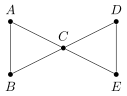
A particle performs a random walk on a bow tie ABCDE drawn beneath on the left, where C is the knot. From any vertex its next step is equally likely to be to any neighbouring vertex. Initially it is at A. Find the expected value of:
the time of first return to A,
the number of visits to D before returning to A,
the number of visits to C before returning to A,
the time of first return to A, given no prior visit by the particle to E,
the number of visits to D before returning to A, given no prior visit by the particle to E.
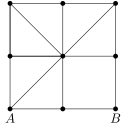
A particle starts at A and executes a symmetric random walk on the graph drawn above on the right. Find the expected number of visits to before it returns to .
A pack contains 52 cards labelled , and initially they are in increasing order from top to bottom. At each stage of the shuffling process, the top card is moved to one of the 52 available places determined by the other 51 cards, this place being chosen uniformly at random, independently of all previous stages. Find the mean number of stages until card 52 is first on top.
Show that, after the moment at which the card labelled 52 is inserted at random from the top, the order of the pack is uniformly distributed over the 52! possibilities.
A pack contains 52 cards labelled , and initially they are in increasing order from top to bottom. At each stage, a card is picked uniformly at random from the pack and placed on top, independently of all previous stages. Find the mean number of stages until every card has been selected at least once.
Show that, after the moment at which the final card to be selected at random is placed on top, the order of the pack is uniformly distributed over the 52! possibilities.
Dick and Jim are writing exercises in sequence for inclusion in a textbook. Dick writes them and Jim checks them. Each exercise is faulty with probability , independently of other exercises. Jim has two modes of operation. In Mode A, he inspects every exercise as it is produced. In Mode B, he inspects each exercise with probability where , independently of all other events.
Let . Jim operates in Mode A until he has found consecutive non-defective exercises, at which point he changes to Mode B. He operates in Mode B until the first defective exercise is found, and then he reverts to Mode A.
Let be the Markov chain which is in state if Jim is operating in Mode A and the last consecutive exercises since entering Mode A have been found to be non-defective, and is in state if Jim is in Mode B.
Write down the transition probabilities of and find its stationary distribution.
Show that the long run proportion of exercises that are inspected is .
Find an expression for the long run proportion of defective exercises which are not detected by Jim.
A particle performs a random walk on the non-negative integers as follows. When at position , its next position is uniformly distributed on the set . Show that the sequence of positions forms an aperiodic, positive recurrent Markov chain, and find its stationary distribution.
Find the mean number of steps required to reach position 0 for the first time from position 1.
Let be an irreducible Markov chain with state space and transition matrix (the chain may be either transient or recurrent). Let and let be a stationary measure such that . Prove that where is given in equation (6.4.5). If the chain is recurrent, show that .
A random walk on the set has transition matrix given by and for , where for all , and for . Show that this process is reversible in equilibrium.
Let be an irreducible, positive recurrent, aperiodic Markov chain on the state space .
Kolmogorov's reversibility criterion. Show that is reversible in equilibrium if and only if
for all and all finite sequences of states.
Kelly's reversibility condition. Show that is reversible in equilibrium if, for all distinct triples ,
and in addition there exists such that for all .
Consider a chain with states. Show that Kolmogorov's criterion, as expressed above, may require the verification of up to ! equations, whereas Kelly's condition, if appropriate, requires no more than .
Show that a random walk on a finite tree is reversible in equilibrium.
Let be a reversible Markov chain, and let be a non-empty subset of the state space . Define the Markov chain on by the transition matrix where
for , and where is a constant satisfying . The diagonal terms are arranged so that is a stochastic matrix. Show that is reversible in equilibrium, and find its stationary distribution. Describe the situation in the limit as .
Can a reversible chain be periodic?
The dog-flea model of Example (6.5.5) is a Markov chain on the state space with transition probabilities
Show that, if ,
Which of the following (when stationary) are reversible Markov chains?
The chain having transition matrix where .
The chain having transition matrix where .
, where and are independent and satisfy (a) and (b).
Let be independent simple random walks. Let be truncated to lie in the region where is integral. Find the stationary distribution of .
Show that an irreducible Markov chain with a finite state space and transition matrix is reversible in equilibrium if and only if for some symmetric matrix and diagonal matrix with strictly positive diagonal entries. Show further that for reversibility in equilibrium to hold, it is necessary but not sufficient that has real eigenvalues.
Random walk on a graph. Let be a finite connected graph with neither loops nor multiple edges, and let be a random walk on as in Exercise (6.4.6). Show that is reversible in equilibrium.
Consider a random walk on the strictly positive integers with transition probabilities
and . Show that the walk is positive recurrent and find the mean recurrence time of the state .
An aleatory beetle performs a random walk on five vertices comprising the principal points (labelled ) and centre (labelled ) of a compass, with transition probabilities
Other moves have probability 0. Show that the mean recurrence time of the centre is .
Let be an irreducible (but not necessarily aperiodic) Markov chain on the countable state space with transition matrix , with invariant distribution . Let and let where is the identity matrix.
Show that is the transition matrix of an irreducible, aperiodic Markov chain with invariant distribution .
Show that, if is reversible in equilibrium, then so is .
The Markov-Kakutani theorem asserts that, for any convex compact subset of and any linear continuous mapping of into has a fixed point (in the sense that for some ). Use this to prove that a finite stochastic matrix has a non-negative non-zero left eigenvector corresponding to the eigenvalue 1.
Let be a matrix and let . Farkas's theorem asserts that exactly one of the following holds:
(i) there exists such that and ,
(ii) there exists such that and .
Use this to prove that a finite stochastic matrix has a non-negative non-zero left eigenvector corresponding to the eigenvalue 1.
Suppose you are betting on a race with possible outcomes. There are bookmakers, and a unit stake with the th bookmaker yields if the th outcome of the race occurs. A vector , where is your stake with the th bookmaker, is called a betting scheme. Show that exactly one of (a) and (b) holds:
(a) there exists a probability mass function such that for all values of ,
(b) there exists a betting scheme for which you surely win, that is, for all .
Let be a Markov chain with state space and transition matrix
where . Prove that
where being a complex cube root of 1.
Let be the transition matrix of a Markov chain with finite state space. Let be the identity matrix, the matrix with all entries unity, and the row -vector with all entries unity. Let be a non-negative vector with . Show that if and only if . Deduce that if is irreducible then .
A chess piece performs a random walk on a chessboard; at each step it is equally likely to make any one of the available moves. What is the mean recurrence time of a corner square if the piece is a:
king?
queen?
bishop?
knight?
rook?
A rook and a bishop perform independent symmetric random walks with synchronous steps on a chessboard (16 squares). If they start together at a corner, show that the expected number of steps until they meet again at the same corner is .
Find the -step transition probabilities for the chain having transition matrix
The pages on the worldwide web form a directed graph with vertices (representing pages) joined by directed edges (representing links). The existence of a link from to is denoted by , and the graph is specified by its adjacency matrix where if and otherwise. The out-degree (respectively, in-degree ) of vertex is the number of links pointing away from (respectively, towards ). Vertex is said to dangle if .
The behaviour of a swiftly bored web surfer is modelled by a random walk on . Let . From any dangling vertex, the random walk moves to a randomly chosen vertex of , each vertex having probability . When at a non-dangling vertex , with probability the walk moves to a random linked vertex (each having probability ), while with probability it moves to a random vertex of (each having probability ).
Show that the transition matrix may be written in the form , where with
and is a row vector with , and is a row vector with entries 1.
Deduce that the stationary distribution is given by where is the identity matrix.
Explain why the elements of , when rearranged in decreasing order, supply a description of the relative popularities of web pages (called 'PageRank' by Google, that being their trademark for the patented algorithm).
Let be the transition matrix of an irreducible Markov chain on a finite state space, and let be a left eigenvector of corresponding to the eigenvalue 1. Show from the equation directly that the entries of are either all positive or all negative, and hence prove Theorem (6.6.1d): there exists a unique distribution satisfying , and, furthermore, all components of are strictly positive.
Let be the size of the th generation of a branching process with and for . Show directly that, as , in agreement with Theorem (6.7.8).
Let be a supercritical branching process with and family-size generating function . Assume that the probability of extinction satisfies . Find a way of describing the process , conditioned on its ultimate extinction.
Let be the size of the th generation of a branching process with and for , where and . Use your answer to Exercise (6.7.2) to show that, if we condition on the ultimate extinction of , then the process grows in the manner of a branching process with generation sizes satisfying and for .
Show that for any random variable taking non-negative values.
Let be the size of the th generation of a branching process with and for , where . Use part (a) to show that , where .
Show that, in the notation of part (b), as .
Flies and wasps land on your dinner plate in the manner of independent Poisson processes with respective intensities and . Show that the arrivals of flying objects form a Poisson process with intensity .
Insects land in the soup in the manner of a Poisson process with intensity , and each such insect is green with probability , independently of the colours of all other insects. Show that the arrivals of green insects form a Poisson process with intensity .
Let be the time of the th arrival in a Poisson process with intensity , and define the excess lifetime process , being the time one must wait subsequent to before the next arrival. Show by conditioning on that
Solve this integral equation in order to find the distribution function of . Explain your conclusion.
Let be a simple birth process of paragraph with ; the birth rates are . Write down the forward system of equations for the process and deduce that
Show also that and .
Let be a process of simple birth with immigration (6.8.11c) with parameters and , and with ; the birth rates are . Write down the sequence of differential-difference equations for . Without solving these equations, use them to show that satisfies , and solve for .
Let be a birth process with intensities , and let . Show that is given by
provided that whenever .
Suppose that the general birth process of the previous exercise is such that . Show that as where is the density function of the random variable . Deduce that is finite or infinite depending on the convergence or divergence of .
Find the Laplace transform of in closed form for the case when , and deduce an expression for .
A traffic light is green at time , and subsequently alternates between green and red at the instants of a Poisson process with intensity . Starting from time , let be the waiting time until the light is green for the first time. Find the distribution of .
Conditional property of simple birth. Let be a simple birth process with rate , and let . Let . Show that, conditional on the event , the times of the births have the same distribution as the order statistics of a random sample of size from the density function
Boulders fall down a chute (or couloir) at the instants of a Poisson process with intensity , and mountaineers ascend the chute at the instants of a Poisson process with intensity (the two processes are independent of one another). If a fall and an ascent occur during any interval of length or less, it is said that a coincidence has occurred. Show that the time until the first coincidence has mean
Show that as . Can you prove the last result directly?
Let be the times of the first two arrivals in a Poisson process with intensity , in order of arrival. Show that
and deduce the joint density function of and .
A freelance salesman is paid units for each sale, and commissions arrive at the instants of a Poisson process of rate . Living costs consume his resources at unit rate. If his initial wealth is , show that the probability that he ever becomes bankrupt is , where is the smallest such that .
Prove that if , while if .
Let and let be a Markov chain on with generator
Write down the forward equations and solve them for the transition probabilities 1,2.
Calculate and hence find . Compare your answer with that to part (a).
Solve the equation in order to find the stationary distribution. Verify that as .
As a continuation of the previous exercise, find:
,
.
Jobs arrive in a computer queue in the manner of a Poisson process with intensity . The central processor handles them one by one in the order of their arrival, and each has an exponentially distributed runtime with parameter , the runtimes of different jobs being independent of each other and of the arrival process. Let be the number of jobs in the system (either running or waiting) at time , where . Explain why is a Markov chain, and write down its generator. Show that a stationary distribution exists if and only if , and find it in this case.
Let be a Markov chain having stationary distribution . We may sample at the times of a Poisson process: let be a Poisson process with intensity , independent of , and define . Show that is a discrete-time Markov chain with the same stationary distribution as . (This exemplifies the 'Pasta' property: Poisson arrivals see time averages.) [The full assumption of the independence of and is not necessary for the conclusion. It suffices that be independent of , a property known as 'lack of anticipation'. It is not even necessary that be Markov; the Pasta property holds for many suitable ergodic processes.]
Let be a continuous-time Markov chain with generator satisfying for all . Let be the hitting time of the set of states, and let be the chance of ever reaching from . By using properties of the jump chain, which you may assume to be well behaved, show that for .
In continuation of the preceding exercise, let . Show that the vector is the minimal non-negative solution of the equations
Let be a continuous-time Markov chain with transition probabilities and define where is the time of the first jump of . Show that, if , then if and only if is recurrent.
Let be the simple symmetric random walk on the integers in continuous time, so that
Show that the walk is recurrent. Let be the time spent visiting during an excursion from 0. Find the distribution of .
Let be a transient state of a continuous-time Markov chain with . Show that the total time spent in state has an exponential distribution.
Let be an asymmetric simple random walk in continuous time on the non-negative integers with retention at , so that
Suppose that and . Show that the total time spent in state is exponentially distributed with parameter .
Assume now that has some general distribution with probability generating function . Find the expected amount of time spent at 0 in terms of .
Let be the continuous-time Markov chain on the finite state space with generator . Show from first principles that the transition probabilities satisfy
Let be a Markov chain on the integers with generator satisfying for , and for other pairs with . Does explode?
A population grows subject to the threat of total annihilation. It is modelled as a Markov chain with generator satisfying
the other off-diagonal elements of being 0. Show that the chain is null recurrent.
Let where is a Markov chain and . Show that is recurrent for if and only if it is recurrent for . Show that is irreducible if and only if is irreducible.
Let , and let be the space of matrices with real entries, with norm
where is the Euclidean norm of the vector , and the supremum is over all non-zero column vectors.
Show for that
Show for that converges with respect to to a limit which we denote .
Show that if and are commuting elements of .
Let be an irreducible discrete-time Markov chain on a countably infinite state space , having transition matrix satisfying for all states , and with stationary distribution . Construct a continuous-time process on for which is the jump chain, such that has no stationary distribution.
Let be a Markov chain on with generator given by
Show that is recurrent. Is positive recurrent?
Let be a Markov chain on with generator satisfying
Show that is transient, but has an invariant distribution. Explain.
Let be a Markov chain with generator on the finite state space , and let be a function, which we identify with the vector . Show that
where denotes the standard matrix multiplication. Show that
and deduce that
Describe the jump chain for a birth-death process with rates and .
Consider an immigration-death process , being a birth-death process with birth rates and death rates . Find the transition matrix of the jump chain , and show that it has as stationary distribution
where . Explain why this differs from the stationary distribution of .
Consider the birth-death process with and for all . Suppose and let . Show that satisfies the differential equation
Hence find , and calculate for .
For the birth-death process of the previous exercise with , show that the distribution of , conditional on the event , converges as to a geometric distribution.
Let be a birth-death process with and , and suppose . Show that the time at which first takes the value 0 satisfies
What happens when ?
Let be the birth-death process of Exercise (6.11.5) with , and let be the total amount of time the process has spent in state , up to time . Find the distribution of and the generating function . Hence show in two ways that . Show further that .
Repeat the calculations of Exercise (6.11.6) in the case .
Consider a birth-death process with birth rates for , death rates for , and . Let , and let be the time until the process first takes the value .
Show that satisfies
Show that the moment generating function satisfies
In a model for a biofilm population, we assume there are colonizable 'niches' (or 'food sources'). Let be the number of occupied niches at time , and assume is a Markov chain that evolves as follows. The lifetime of any colony is exponentially distributed with parameter ; if , the rate of establishment of a new colony in an empty niche is . The usual independence may be assumed.
For , find the mean time until the population is extinct, which is to say that no niches are occupied. Discuss the implications when is large.
Customers entering a shop are served in the order of their arrival by the single server. They arrive in the manner of a Poisson process with intensity , and their service times are independent exponentially distributed random variables with parameter . By considering the jump chain, show that the expected duration of a busy period of the server is when . (The busy period runs from the moment a customer arrives to find the server free until the earliest subsequent time when the server is again free.)
Immigrants arrive at the instants of a Poisson process of rate , and each independently founds a simple birth process of rate . At the instants of an independent Poisson process of rate , the population is annihilated. Find the probability generating function of the population , given that .
In the framework of Exercise (6.12.2), suppose that each immigrant gives rise to a simple birth-death process of rates and . Show that the mean population size stays bounded if and only if .
The queue . An ftp server receives clients at the times of a Poisson process with parameter , beginning at time 0. The th client remains connected for a length of time, where the are independent identically distributed random variables, independent of the process of arrivals. Assuming that the server has an infinite capacity, show that the number of clients being serviced at time has the Poisson distribution with parameter , where is the common distribution function of the . Show that the mean of this distribution converges to as .
In a certain town at time there are no bears. Brown bears and grizzly bears arrive as independent Poisson processes and with respective intensities and .
Show that the first bear is brown with probability .
Find the probability that between two consecutive brown bears, there arrive exactly grizzly bears.
Given that , find the expected value of the time at which the first bear arrived.
Let be the points of a non-homogeneous Poisson process on with intensity function . Let where is a (measurable) function which we assume for convenience to be non-negative.
Show directly that and , provided these integrals converge.
Show that
and deduce that if .
If the integral condition of part (b) holds, show that the characteristic function of satisfies
Let be a Poisson process with constant intensity on the surface of the sphere of with radius 1. Let be the process given by the coordinates of the points projected on a plane passing through the centre of the sphere. Show that is a Poisson process, and find its intensity function.
Repeat Exercise (6.13.3), when is a homogeneous Poisson process on the ball .
You stick pins in a Mercator projection of the Earth in the manner of a Poisson process with constant intensity . What is the intensity function of the corresponding process on the globe? What would be the intensity function on the map if you formed a Poisson process of constant intensity of meteorite strikes on the surface of the Earth?
The th point of a Poisson process of constant intensity on gives rise to an effect at time , where the are independent and identically distributed with finite variance. Find the mean and variance of the total effect in terms of the first two moments of the , and calculate .
What is the behaviour of the correlation as with fixed?
Let be a non-homogeneous Poisson process on with intensity function . Find the joint density of the first two inter-event times, and deduce that they are not in general independent.
Let be a collection of independent Poisson processes on with respective constant intensities , such that . Set , and let denote the index of the process supplying the first point in , occurring at time . Show that
Let be a Poisson process on with intensity function . Each point gives rise to a line in the -plane .
Let be the polar coordinates of the foot of the perpendicular from the origin onto the line in the -plane . Express in terms of .
Show that the Poisson line process is mapped by the map of part (a) to a uniform Poisson process on the strip .
Show that the line process in is invariant under translations and rotations of .
A large continent is traversed by a doubly-infinite straight freeway on which lorries are parked at the points of a Poisson process with constant intensity 1. The masses of the lorries are independent, identically distributed random variables that are independent of the parking places. Let be the gravitational attraction due to the lorries on a pedestrian of unit mass standing beside the freeway. You may take the gravitational constant to be 1.
Show that has characteristic function of the form where . Express in terms of the mean of a typical mass .
Let be a stochastic matrix on the finite set with stationary distribution . Define the inner product , and let . Show, in the obvious notation, that is reversible with respect to if and only if for all .
Show that a possible choice for the acceptance probabilities in Hastings's general algorithm is
where is the proposal matrix.
Let be a countable set. For each , the sets , form a partition of the interval . Let be given by if . The sequence of random variables is generated recursively by , where are independent random variables with the uniform distribution on . Show that is a Markov chain, and find its transition matrix.
Let be a finite stochastic matrix. Dobrushin's ergodic coefficient is defined to be
Show that, if is a finite stochastic matrix, then .
Let and be discrete-time Markov chains with the same transition matrix , and show that
Let be a positive mass function on the finite set , and let be the transition matrix of an irreducible, aperiodic Markov chain with stationary distribution . Let be a vector of random variables such that for , and use as an update rule in the coupling-from-the-past algorithm for sampling from .
If the , are independent, show that the coalescence time is a.s. finite.
Give two examples of situations in which the coalescence time is a.s. infinite.
Show that the Ising distribution of Example (6.14.2) satisfies the FKG lattice condition (6.14.20).
Classify the states of the discrete-time Markov chains with state space and the following transition matrices:
Calculate , and deduce that the probability of ultimate absorption in state , starting from , equals .
Find the mean recurrence times of the states.
A transition matrix is called doubly stochastic if all its column sums equal , that is, if for all .
Show that if a finite chain has a doubly stochastic transition matrix, then all its states are positive recurrent, and that if it is, in addition, irreducible and aperiodic then as , where is the number of states.
Show that, if an infinite irreducible chain has a doubly stochastic transition matrix, then its states are either all null recurrent or all transient.
Prove that intercommunicating states of a Markov chain have the same period.
Show that for each pair of states of an irreducible aperiodic chain, there exists such that for all .
Let and be independent irreducible aperiodic chains with the same state space and transition matrix . Show that the bivariate chain , is irreducible and aperiodic.
Show that the bivariate chain may be reducible if and are periodic.
Suppose is a discrete-time Markov chain with . Let be the total number of visits made subsequently by the chain to the state . Show that
and deduce that if and only if .
Let and be two states of a discrete-time Markov chain. Show that if communicates with , then there is positive probability of reaching from without revisiting in the meantime. Deduce that, if the chain is irreducible and recurrent, then the probability of ever reaching from equals 1 for all and .
Let be a recurrent irreducible Markov chain on the state space with transition matrix , and let be a positive solution of the equation .
Show that
defines the -step transition probabilities of a recurrent irreducible Markov chain on whose first-passage probabilities are given by
where and .
Show that is unique up to a multiplicative constant.
Let and define . Show that for all .
The sequence is called a 'renewal sequence' if
for some collection of non-negative numbers summing to 1.
Show that is a renewal sequence if and only if there exists a Markov chain on a countable state space such that , for some recurrent and all .
Show that if and are renewal sequences then so is .
Consider the symmetric random walk in three dimensions on the set of points ; this process is a sequence of points such that for . Suppose that . Show that
and deduce by Stirling's formula that the origin is a transient state.
Consider the three-dimensional version of the cancer model (6.12.12). If , are the empires of Theorem (6.12.14) inevitable in this case?
Let be a discrete-time Markov chain with state space , and transition matrix
Classify the states of the chain. Suppose that and . Find the -step transition probabilities and show directly that they converge to the unique stationary distribution as . For what values of and is the chain reversible in equilibrium?
black balls and white balls are placed in two urns so that each contains balls. After each unit of time one ball is selected at random from each urn, and the two balls thus selected are interchanged. Let the number of black balls in the first urn denote the state of the system. Write down the transition matrix of this Markov chain and find the unique stationary distribution. Is the chain reversible in equilibrium?
Consider a Markov chain on the set with transition probabilities , , where is a sequence of constants which satisfy for all . Let for . Show that the chain is
recurrent if and only if as ,
positive recurrent if and only if , and write down the stationary distribution if the latter condition holds. Let and be positive constants and suppose that for all large . Show that the chain is
transient if ,
positive recurrent if .
Finally, if show that the chain is
positive recurrent if ,
null recurrent if .
Let be a continuous-time Markov chain with countable state space and semigroup . Show that is a continuous function of . Let ; show that is a continuous function, , and . We say that is 'subadditive', and a well known theorem gives the result that
Deduce that the limit exists.
Let be a continuous-time Markov chain with generator . Show that is irreducible if and only if for any pair of distinct states there exists a sequence of distinct states such that .
Let and let be an irreducible, non-explosive Markov chain with stationary distribution , and suppose that has distribution . Let for . We call reversible (in equilibrium) if and have the same joint distributions.
(i) Show that is a (left-continuous) Markov chain with transition probabilities and generator satisfying , where the and are those of . Show that is irreducible and non-explosive with stationary distribution .
(ii) Show that is reversible in equilibrium if and only if the detailed balance equations (for all and ) hold.
(iii) Show that a measure satisfies if it satisfies the detailed balance equations.
Let be irreducible and non-explosive with stationary distribution , and assume has distribution .
(i) Kolmogorov’s criterion. Show that is reversible if and only if, for all and all finite sequences of states,
(ii) Kelly’s criterion. Show that is reversible if, for all distinct triples , we have , and in addition there exists such that for all .
Show that every irreducible chain with exactly two states is reversible in equilibrium.
Show that every non-explosive birth-death process having a stationary distribution is reversible in equilibrium.
Show that not every discrete-time Markov chain can be imbedded in a continuous-time chain. More precisely, let
be a transition matrix. Show that there exists a semigroup of transition probabilities in continuous time such that , if and only if . In this case show that is unique and calculate it in terms of .
Consider an immigration-death process , being a birth-death process with rates , . Show that its generating function is given by
where and . Deduce the limiting distribution of as .
Let be a non-homogeneous Poisson process on with intensity function .
Write down the forward and backward equations for , and solve them.
Let , and find the density function of the time until the first arrival in the process. If , show that if and only if .
Successive offers for my house are independent identically distributed random variables , , having density function and distribution function . Let , let be the first offer exceeding , and generally let be the first offer exceeding . Show that are the times of arrivals in a non-homogeneous Poisson process with intensity function . The are called 'record values'.
Now let be the first offer received which is the second largest to date, and let be the second such offer, and so on. Show that the are the arrival times of a non-homogeneous Poisson process with intensity function .
Let be a Poisson process with constant intensity , and let be independent random variables with common characteristic function and density function . The process is called a compound Poisson process. is the change in the value of at the th arrival of the Poisson process . Think of it like this. A 'random alarm clock' rings at the arrival times of a Poisson process. At the th ring the process accumulates an extra quantity . Write down a forward equation for and hence find the characteristic function of . Can you see directly why it has the form which you have found?
If the intensity function of a non-homogeneous Poisson process is itself a random process, then is called a doubly stochastic Poisson process (or Cox process).
Consider the case when for all , and is a random variable taking either of two values or , each being picked with equal probability . Find the probability generating function of , and deduce its mean and variance.
For a doubly stochastic Poisson process , show that .
Let be an ordinary Poisson process on the time-interval with constant rate 1. Let be obtained from by deleting the th arrival for every odd value of . Is either: (i) a Poisson process, or (ii) a doubly stochastic Poisson process?
Show that a simple birth process with parameter is a doubly stochastic Poisson process with intensity function .
The Markov chain is a birth process whose intensities depend also on the time and are given by
as . Show that the probability generating function satisfies
Hence find the mean and variance of when .
Let be a birth-death process with strictly positive birth rates and death rates Let be the probability that ever takes the value 0 starting from . Show that
and deduce that for all so long as where .
For the discrete-time chain on the non-negative integers with
find the probability that the chain ever visits , starting from 1.
Find a good necessary condition and a good sufficient condition for the birth-death process of Problem (6.15.25a) to be honest.
Let be a simple symmetric birth-death process with , and let be the time until extinction. Show that
and deduce that extinction is certain if . Show that as .
Let be an immigration-death-disaster process, that is, a birth-death process with parameters , and with the additional possibility of 'disasters' which reduce the population to 0. Disasters occur at the times of a Poisson process with intensity , independently of all previous births and deaths.
Show that has a stationary distribution, and find an expression for the generating function of this distribution.
Show that, in equilibrium, the mean of is .
With any sufficiently nice (Lebesgue measurable, say) subset of the real line is associated a random variable such that
(a) takes values in ,
(b) if are disjoint then are independent, and furthermore
(c) the distribution of depends only on through its Lebesgue measure (’length’) , and
Show that is a Poisson process.
Let be a Poisson process in with constant intensity , and let ... be the ordered distances from the origin of the points of the process.
Show that are the points of a Poisson process on with intensity .
Show that has density function
Let be a -dimensional Poisson process with constant intensity . Show that the volume of the largest (-dimensional) sphere centred at the origin which contains no point of is exponentially distributed. Deduce the density function of the distance from the origin to the nearest point of . Show that where is the volume of the unit ball of and is the gamma function.
A village of people suffers an epidemic. Let be the number of ill people at time , and suppose that and is a birth process with rates . Let be the length of time required until every member of the population has succumbed to the illness. Show that
and deduce that
where is Euler's constant. It is striking that decreases with , for large .
A particle has velocity at time , where is assumed to take values in . Transitions during are possible as follows:
Initially . Let
Show that
and deduce that .
Show that the expected length of time for which during the time interval is given by
and that, for fixed as .
What is the expected velocity of the particle at time ?
A sequence of random integers is generated as follows. First, . For , conditional on , the next value is equally likely to be either or .
Is a Markov chain?
Use the Markov chain to find the probability that hits the value 3 before it revisits 0.
Show that the probability that ever reaches the state , having started at , is .
Take a regular hexagon and join opposite corners by straight lines meeting at the point C. A particle performs a symmetric random walk on these 7 vertices, starting at . Find:
the probability of return to A without hitting C,
the expected time to return to A,
the expected number of visits to C before returning to A,
the expected time to return to A, given that there is no prior visit to C.
Markov chains are defined by the following procedures at any time :
Bernoulli model. Two adjacent containers A and B each contain particles; are of type I and are of type II. A particle is selected at random in each container. If they are of opposite types they are exchanged with probability if the type I is in A, or with probability if the type I is in B. Let be the number of type I particles in A at time .
Ehrenfest dog-flea model. Two adjacent containers contain particles in all. A particle is selected at random. If it is in A it is moved to B with probability , if it is in B it is moved to A with probability . Let be the number of particles in A at time . In each case find the transition matrix and stationary distribution of the chain.
Let be an irreducible continuous-time Markov chain on the state space with transition probabilities and unique stationary distribution , and write . If is a concave function, show that the function increases to as .
The relative entropy (or Kullback-Leibler divergence) of two strictly positive probability mass functions on a subset of integers is defined as
Prove that, if has a finite state space and stationary distribution , the relative entropy decreases monotonely to 0 as .
With the notation of the preceding problem, let , and suppose the chain is reversible in equilibrium (see Problem (6.15.16)). Show that , and deduce that decreases to as .
Let be the set of points in a Poisson process on with constant intensity . Each point is displaced, where the displacements are independent and identically distributed. Show that the resulting point process is a Poisson process with intensity .
Suppose for convenience in Problem (6.15.39) that the displacements have a continuous distribution function and finite mean, and that . Suppose also that you are at the origin originally, and you move to in the perturbed process. Let be the number of points formerly on your left that are now on your right, and the number of points formerly on your right that are now on your left. Show that if and only if where is the mean displacement of a particle.
Deduce that if cars enter the start of a long road at the instants of a Poisson process, having independent identically distributed velocities, then, if you travel at the average speed, in the long run the rate at which you are overtaken by other cars equals the rate at which you overtake other cars.
Ants enter a kitchen at the instants of a Poisson process of rate ; they each visit the pantry and then the sink, and leave. The th ant spends time in the pantry and in the sink (and in the kitchen altogether), where the vectors and are independent for . At time the kitchen is free of ants. Find the joint distribution of the numbers of ants in the pantry and of ants in the sink at time .
Show that, as , the number of ants in the kitchen converges in distribution, provided .
Now suppose the ants arrive in pairs at the times of the Poisson process, but then separate to behave independently as above. Find the joint distribution of the numbers of ants in the two locations.
Let be independent exponential random variables with parameter , and set . Show that:
, have the same distribution as the order statistics of independent variables which are uniformly distributed on ,
, have the same joint distribution as the coordinates of a point chosen uniformly at random on the simplex for all .
Let be a discrete-time Markov chain with a finite number of states and transition matrix where for all . Show that there exists such that , where is the stationary distribution.
Under the conditions of Problem (6.15.43), let be the number of visits of the chain to before time . Show that
Show further that, if is any bounded function on the state space, then
Let and be a discrete random variable and vector, respectively. The conditional entropy of with respect to is defined as where . Let be an aperiodic Markov chain on a finite state space. Show that
and that
if is aperiodic with a unique stationary distribution .
Let and be independent recurrent birth-death processes with the same parameters (and no explosions). It is not assumed that . Show that:
for any as ,
if , then for any increasing function .
The number of birds in a wood at time is a continuous-time Markov process . Food resources impose the constraint . Competition entails that the transition probabilities obey
Find , together with the mean and variance of , when . What happens as ?
A counter performs an irreducible random walk on the vertices of the triangle in the figure beneath, with transition matrix
where for all . Show that the stationary distribution has
with corresponding formulae for .

Suppose that you gain one peseta for each clockwise step of the walk, and you lose one peseta for each anticlockwise step. Show that, in equilibrium, the mean yield per step is
Consider now three cases of this process: A. We have for each , where . Show that the mean yield per step satisfies . B. We have that , where . Show that for sufficiently small . C. At each step the counter is equally likely to move according to the transition probabilities of case or case , the choice being made independently at every step. Show that, in this case, . Show that for sufficiently small . The fact that two systematically unfavourable games may be combined to make a favourable game is called Parrondo's paradox. Such bets are not available in casinos.
Cars arrive at the beginning of a long road in a Poisson stream of rate from time onwards. A car has a fixed velocity which is a random variable. The velocities of cars are independent and identically distributed, and independent of the arrival process. Cars can overtake each other freely. Show that the number of cars on the first miles of the road at time has the Poisson distribution with parameter .
Events occur at the times of a Poisson process with intensity , and you are offered a bet based on the process. Let . You are required to say the word 'now' immediately after the event which you think will be the last to occur prior to time . You win if you succeed, otherwise you lose. If no events occur before you lose. If you have not selected an event before time you lose.
Consider the strategy in which you choose the first event to occur after a specified time , where .
Calculate an expression for the probability that you win using this strategy.
Which value of maximizes this probability?
If , show that the probability that you win using this value of is .
A new Oxbridge professor wishes to buy a house, and can afford to spend up to one million pounds. Declining the services of conventional estate agents, she consults her favourite internet property page on which houses are announced at the times of a Poisson process with intensity per day. House prices may be assumed to be independent random variables which are uniformly distributed over the interval . She decides to view every affordable property announced during the next 30 days. The time spent viewing any given property is uniformly distributed over the range hours. What is the moment generating function of the total time spent viewing houses?
Let be an irreducible, aperiodic Markov chain on the finite state space , and let denote the mean hitting time of (noting that ). Let be the mean time to hit a state chosen at random according to the stationary distribution . Show that is independent of the choice of .
A professor travels between home and work on foot. She possesses a total of umbrellas, being those at home and at work. If it is raining when she leaves either home or work, she takes an umbrella with her (if there is one available). Assume that it is raining at the start of any given walk with probability (subject to the usual independence). Let be the number of umbrellas available to her at the start of her th walk.
Explain why is a Markov chain, and write down its transition matrix.
Show that the chain has stationary distribution given by
What proportion of walks result in her getting wet, in the long run?
Let and . Calculate the mean number of walks made before she gets wet.
A spider climbs a vertical spout of height at speed 1. At the instants of a Poisson process of constant rate , the spider is flushed back to the bottom of the spout. It then recommences its climb. Let be the time to reach the top, and the number of intermediate flushes. Show that
By calculating or otherwise, determine for .
Let be an ergodic Markov chain with transition matrix and stationary distribution . Show for any set of states that
A hiker of unit mass stands at the origin of the plain . Boulders with independent, identically distributed masses lie scattered on the plain at the points of a Poisson process with intensity 1. Let be the -component of the gravitational attraction on the hiker of the boulders within distance of the hiker. You may take the gravitational constant to be 1.
Show that, as converges in distribution to a Cauchy distribution with characteristic function of the form , and express in terms of a typical mass .
Holtsmark distribution for stellar gravity. Let stars of common mass be positioned at the points of a Poisson process with intensity 1 in . Let be the -component of the gravitational attraction due to the stars within distance of the origin, upon a hitchhiker of unit mass at the origin. You may take the gravitational constant to be 1.
Show that, as converges in distribution to a symmetric distribution with characteristic function where .
What is the answer if the stars have independent, identically distributed random masses ?