Fundamentals of Graph Theory
[52/56%]Every graph has a bipartite subgraph containing at least half of the edges of the graph.
A path in a graph is a sequence in which, for every , the edge joins the vertices and . The number is called the length of the path. (The edges need not be pairwise distinct.)
A cycle in a graph is a sequence in which, for every , the edge joins the vertices and , and the edge joins the vertices and . Cycles are considered the same if they differ by a cyclic shift of the sequence. The number is called the length of the cycle.
A cycle is called non-self-intersecting if its vertices are pairwise distinct and its edges are pairwise distinct. The standard term (less convenient for beginners) is a simple cycle.
Every cycle that does not pass along any edge twice contains a non-self-intersecting cycle.
Every cycle of odd length contains a non-self-intersecting cycle of odd length.
Does the analogous statement hold for cycles of even length that do not pass along any edge twice?
A graph has a non-self-intersecting cycle passing through the edges and , and also a non-self-intersecting cycle passing through the edges and . Then there is a non-self-intersecting cycle passing through the edges and .
If the degree of each of the vertices of a graph is greater than , then the graph is connected.
Let a directed graph be given, with a weight written on each edge . (This weight can be understood as the work that must be expended in order to traverse the edge from its start to its end.) A function (a potential'') such that $f(x,y) = p(x) - p(y)$ for every edge $u = (x,y)$ exists if and only if the sum of the weights of the edges of every cycle equals zero (when an edge is traversed along the cycle in the direction opposite to its orientation, its weight enters the sum with a minus'' sign).
Every tree has a leaf, i.e., a vertex of degree 1.
Every tree with vertices has edges.
In every tree, between any two vertices there exists a unique non-self-intersecting path.
A sequence of positive integers is the degree sequence of some tree if and only if the sum of its terms equals .
Note that the graphs and are distinct. A graph means precisely a graph, not an isomorphism class of graphs. Or, informally speaking, the vertices of graphs are considered to be numbered. Therefore the term labeled graph'' is sometimes used instead of the word graph''.
Which graphs with given vertices are more numerous:
those having an isolated vertex or those not having one?
connected ones or disconnected ones?
Cayley's formula. The number of trees with given vertices equals .
If the sum of positive integers equals , then the number of trees with given vertices in which the -th vertex has degree equals .
This statement can be reformulated as follows:
where the sum is taken over all trees with vertices , and denotes the degree of the vertex of the tree .
Let be trees whose vertex sets are pairwise disjoint. How many trees are there whose vertex set is the union of the vertex sets of these trees and which contain ?
The Prüfer code assigns to a tree with vertices a sequence of numbers from 1 to by the following algorithm.
Initially the Prüfer code is the empty word. While the number of vertices is greater than two:
-
a leaf (see Problem 2.2.1) with the smallest number is chosen;
-
the number of the vertex adjacent to is appended to the Prüfer code;
-
the vertex and the edge incident to it are removed from the tree. When two vertices remain, the algorithm terminates.
Find the Prüfer code of the tree with vertices and edges .
Reconstruct the tree from the Prüfer code .
The Prüfer code defines a bijection between the set of trees with given vertices and the set of words of length over the numbers from 1 to .
In the Prüfer code, a vertex of degree occurs times.
A graph is called unicyclic if it becomes a tree after the removal of some edge. (Or, equivalently, if it is connected and has exactly one non-self-intersecting cycle, up to cyclic shift and symmetry.)
Which are more numerous: trees with 100 given vertices or unicyclic graphs with 98 given vertices?
Express the number of unicyclic graphs with given vertices as a sum of at most terms.
A tree has no nonempty subgraphs in which the degree of every vertex is even and positive.
For a graph , denote by the number of its subgraphs without isolated vertices in which the degree of every vertex is even. (The empty subgraph satisfies this condition.) Prove that is a power of two. Express in terms of the number of vertices, the number of edges, and the number of connected components of the graph.
The edges of a tree are marked with the signs and . It is allowed to change the signs on all edges issuing from one vertex. Then any arrangement can be obtained from any other.
For a graph , denote by the largest number of arrangements of the signs and on its edges such that none of them can be obtained from another by the operations described above. Prove that is a power of two. Express in terms of , , and .
Prove that and do not change under the contraction of an edge, and deduce from this that .
Remark. Such subgraphs (from part (2)) are called cycles in the sense of homology theory (not to be confused with cycles in the sense of graph theory). How they arise is described, for example, in [S1, 6].
Remark. In cohomology theory such arrangements (from part (4)) are called cocycles, and the equivalence relation on cocycles given above is called cohomologousness. How cohomologousness of cocycles arises is described, for example, in [S4, Sec. 11.1, 11.2].
Roughly speaking, graphs are isomorphic if they are the same (although their drawings in the plane may differ). Formally, graphs and are called isomorphic if there exists a one-to-one mapping satisfying the condition: vertices are joined by an edge if and only if the vertices are joined by an edge.
Which of the graphs in Fig. 3 are isomorphic?
 Fig. 3. Which of the graphs in the figure are isomorphic?
For arbitrary , find the number of
cliques of size in the graph ,
cliques of size in the graph ,
independent sets of size in the graph ,
independent sets of size in the graph ,
subgraphs of isomorphic to ,
subgraphs of isomorphic to .
Be careful: these problems are simple, but almost all of them require a case analysis.
List all pairwise non-isomorphic
graphs with four vertices,
connected graphs with five vertices and five edges,
disconnected graphs with five vertices.
How many pairwise non-isomorphic graphs with 8 vertices and 25 edges are there?
The number of isomorphism classes of trees with vertices (i.e., the number of distinct trees with unlabeled vertices) is less than .
A plane graph with triangular faces and more than three vertices is given. A vertex was deleted together with the edges emanating from it.
Is it true that the resulting face is bounded by a non-self-intersecting cycle?
Is it true that if one more vertex is removed, then all faces will again be bounded by non-self-intersecting cycles?
Suppose that in the resulting graph every vertex has degree at least 3. Is it true that any vertex of the new graph can be deleted so as to obtain a graph all of whose faces are bounded by non-self-intersecting cycles?
A plane graph is a drawing of a graph in the plane in which any two edges intersect only at their common vertices (in particular, if there are no such vertices, they do not intersect). A plane graph divides the plane into parts called the faces of the graph; one of these parts is ``infinite''.
Euler's formula. For any connected plane graph with faces, the equality holds.
(For a proof see, e.g., [R]. From now on this result may be used without proof. This formula is often written in the form .)
Find an analogue of Euler's formula for a plane graph with connected components.
Neither of the graphs and can be drawn in the plane without self-intersections.
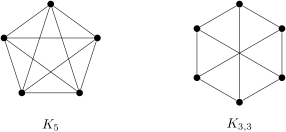 Fig. 5. Nonplanar graphs
In the plane, points are marked. It is allowed to join some two of them by a polygonal line not passing through the other points. Two players take turns joining some two not yet joined points by a polygonal line. It is required that these polygonal lines do not self-intersect and do not intersect anywhere except at the marked points. The player who cannot make a move loses. For which does the player who moves first win with correct play?
List all connected plane graphs (up to isomorphism) in which the degrees of all vertices are equal and the ``degrees'' of all faces are equal (i.e., the boundary of each face consists of the same number of edges).
Remark. If parts (1), (2), or (3) do not work out, solve the following parts. For the definition of isomorphism see Sec. 2.3.
There are exactly 5 convex regular polyhedra (all faces are regular polygons with the same number of sides, and the degrees of all vertices are equal) (up to isomorphism of their graphs). A construction of the corresponding polyhedra must be given; it is not assumed to be known.
For any connected plane graph without loops and multiple edges having more than two vertices, and .
Every plane graph has a vertex of degree at most 5.
If every vertex of a connected plane graph has degree and the boundary of every face consists of exactly edges, then
A map in the plane is a partition of the plane into a finite number of polygons (possibly ``infinite'' ones). A coloring of a map is called proper if distinct polygons having a common boundary segment have distinct colors. Prove that every map can be properly colored with
6 colors;
5 colors;
[You won't be able to prove it anyway.]
Remark. Using the construction of the dual graph, one can prove that proper colorability of every map in the plane with colors is equivalent to proper colorability of every plane graph with colors (Sec. 3.1).
Devise an algorithm
for recognizing whether a graph is planar (here you may use Kuratowski's theorem without proof);
for drawing a graph that is known to be planar in the plane without self-intersections.
Find the asymptotics of the complexity of your algorithm as a function of the number of edges of the graph, i.e., the asymptotics of the maximum, over graphs with edges, of the number of steps of the algorithm applied to the given graph. See the ``definition'' of finding asymptotics in Sec. 6.1.
Hopcroft--Tarjan theorem. There exists an algorithm for recognizing planarity of a graph that is linear in the number of edges.
The operation of subdividing an edge of a graph: the edge is removed, and in its place a new vertex and two new edges and are added.
Two graphs are called homeomorphic if one can pass from one to the other by means of edge-subdivision operations and their inverses; or, equivalently, if there exists a graph obtained from each of the given graphs by edge-subdivision operations.
Clearly, homeomorphic graphs are either both planar or both non-planar.
Kuratowski's theorem. A graph is planar if and only if it contains no subgraph homeomorphic to the graph or . (For a proof of this theorem see, e.g., [S5].)
Fáry's theorem. A plane graph can be drawn in the plane without self-intersections so that all edges are line segments.
A non-convex polygon with opaque sides is given. Call a vertex visible from a point if the interior of the segment does not intersect the boundary of the polygon. Call the kernel of the polygon the set of its interior points from which all vertices of the polygon are visible. Prove that if a point of the kernel is joined by segments to several arbitrarily chosen vertices of the original polygon (at least two, and not necessarily all of them), then the polygon splits into polygons with nonempty kernels.
Draw on the torus without self-intersections the graph
;
;
;
;
;
.
The torus and the Möbius band are assumed to be transparent, i.e., a point (or a subset) lying on one side of the surface'' also lies on the other side''. This is analogous to the fact that in studying geometry we speak, for example, of a triangle in the plane, and not of a triangle on the upper (or lower) side of the plane.
Draw on the Möbius band without self-intersections the graph
;
;
;
.
A map on the torus is a partition of the torus into finitely many (curvilinear and bent) polygons. A coloring of a map on the torus is called proper if distinct polygons having a common boundary curve have distinct colors. Can every map on the torus be properly colored
with 5 colors;
with 6 colors;
with 7 colors?
For details see [S1, 2].
Remark. Any connected graph with edges can be drawn on a sphere with $g$ handles'' (i.e., inside a regular $2g$-gon whose diametrically opposite sides are glued''), in such a way that some edges are line segments, and the remaining edges are unions of two disjoint segments, each of which has one endpoint at a vertex of the graph and the other endpoint on a side of the -gon.
How many multigraphs are there on given vertices that are
directed, without multiple edges but possibly with loops?
undirected, without loops but possibly with multiple edges?
A multigraph (or a graph with loops and multiple edges) is a square table of nonnegative integers that is symmetric with respect to the main diagonal. The number at the intersection of the -th row and the -th column is interpreted as the number of edges (or the multiplicity of the edge) between the vertices numbered and when , and as the number of loops at the vertex numbered when . An edge is called multiple if its multiplicity is greater than one.
A directed multigraph (or a directed graph with loops and multiple edges) is a square table of nonnegative integers. If some cell (no matter whether diagonal or not) contains a number greater than 1, then the directed multigraph is said to have multiple edges.
How many multigraphs are there on given vertices that have edges and are
undirected, without loops and multiple edges?
undirected, with multiple edges and loops allowed?
An Eulerian cycle (path) in a multigraph is a cycle (path) that passes along every edge of the multigraph exactly once.
A connected multigraph has an Eulerian cycle if and only if the degree of each of its vertices is even.
A connected multigraph has an Eulerian cycle if and only if its edge set decomposes into non-self-intersecting cycles.
Under what condition does a multigraph have an Eulerian path?
Under what condition does a directed multigraph have a directed Eulerian cycle?
For which does the graph have an Eulerian cycle?
The same for the graph .
If the number of vertices of odd degree in a connected graph equals , then its edge set can be represented as the union of paths, none of which passes along any edge twice and no two of which have common edges.
The edges of a graph in which the degree of each vertex is even can be supplied with arrows so that at each vertex the in-degree equals the out-degree.
All edges of a connected graph are colored in two colors. Each vertex has equally many edges of both colors leaving it. Then from any vertex one can reach any other one, changing the color of the edge at every step.
A connected graph drawn in the plane without self-intersections has an Eulerian cycle if and only if its faces can be properly colored in 2 colors, i.e., so that the color changes when crossing each edge.
The in-degree of a vertex of a directed multigraph is the number of edges entering it (counted with multiplicity). The out-degree is defined similarly. Here a loop of multiplicity ``contributes'' both to the in-degree and to the out-degree.
A mathematician has forgotten the three-digit code of his lock. The lock opens if the three digits of the code are entered consecutively (even if other digits were entered before that). The mathematician enters one digit per second; each entered digit is appended at the end. Prove that the mathematician can open the lock within
29 seconds if only the digits 1, 3 and 7 can be used in the code;
1002 seconds if ten digits can be used in the code.
Formulate and prove the ``'' rule for opening the lock within 1002 seconds.
A de Bruijn sequence (d.B.s.) with parameters and is a sequence whose elements belong to a given set of elements (usually ), such that all of its subsequences of length are distinct and among these subsequences all possible sequences occur. (Thus the length of a d.B.s. equals .)
(An infinite periodic sequence with period , each subsequence of length of which is a d.B.s. with parameters and , is also called a d.B.s.)
Construct a de Bruijn sequence with parameters (``binary'') and
, starting with 111;
, starting with 1011;
, ending with 1010.
Consider the sequence of zeros and ones constructed by the following rules. It starts with ones. After that, we write 1 only if, when writing 0, not all subsequences of length of the new sequence are distinct. If even when writing 1 not all subsequences of length of the new sequence are distinct, then we stop writing the sequence. Prove that in this way a de Bruijn sequence is obtained.
A connected directed multigraph with vertices is given. The in-degree of each vertex equals its out-degree.
There exists a tree containing all vertices of this multigraph, all of whose edges are directed towards vertex 1.
Fix a tree from part (1). We traverse this graph (along the arrows), passing along each edge at most once. First we leave vertex 1 in an arbitrary direction. Next, suppose we have arrived at some vertex . We leave it along any edge not belonging to , if this is possible. If it is impossible, we leave it along the edge belonging to (such an edge is unique). Prove that the walk ends at vertex 1 and that the result is a directed Eulerian cycle.
The number of directed Eulerian cycles in this multigraph is a multiple of the number .
The faces of a Hamiltonian plane graph can be properly colored in 4 colors.
A Hamiltonian path (cycle) in a graph is a path (cycle) passing through each vertex exactly once.
Recall (Sec. 2.1) that the length of a path is the number of its edges (not vertices).
If a graph is connected and , then it has a Hamiltonian cycle.
The Dirac--Ore theorem. A graph in which the sum of the degrees of any two non-adjacent vertices is at least has a Hamiltonian cycle.
Dirac's lemma. If is a maximal one among the paths in the graph that pass through each of their vertices only once, and , then this graph has a non-self-intersecting cycle of length .
If a connected graph has a non-self-intersecting cycle of length , then this graph has a path of length passing through each of its vertices only once.
A graph in which the sum of the degrees of any two non-adjacent vertices is at least has a Hamiltonian path.
Suppose that for some graph and some integer , among any vertices of the graph there is an edge, and after deleting any set of vertices the graph remains connected. Then this graph has a Hamiltonian cycle.
Suppose that among any vertices of a graph there is an edge, and after deleting any set of vertices the graph remains connected.
This graph has at least one non-self-intersecting cycle.
Denote by a maximal non-self-intersecting cycle in this graph. Denote by any connected component of the graph obtained from the original graph by deleting the vertices of this non-self-intersecting cycle. Denote by the set of vertices of the non-self-intersecting cycle that are adjacent to .
Then .
The vertices do not both lie in .
If , then the graph has no edge .
Is there a Hamiltonian path in the graph in Fig. 8?
 Fig. 8. Does this graph have a Hamiltonian path?
Is there a Hamiltonian cycle in the graph in Fig. 9?
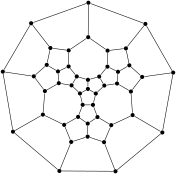 Fig. 9. The graph of the Grinberg polyhedron. Does it have a Hamiltonian path?
For which is there a Hamiltonian cycle in the graph whose vertices are the 3-element subsets of an -element set, two subsets being joined by an edge if they intersect in exactly one element?
The maximum number of pairwise edge-disjoint Hamiltonian cycles in the graph equals .
Every tournament has a directed Hamiltonian path.
For every there exists a tournament with vertices that has at least directed Hamiltonian paths.
A tournament is a directed graph in which any two vertices are joined by an edge. (That is, for any two vertices of a tournament, its edges include or , but not both.)
The line graph of a graph is the graph whose vertices are the edges of ; two vertices of the line graph are joined by an edge if the corresponding edges of have a common vertex. Find, in terms of the graph , a necessary and sufficient condition for its line graph to have a Hamiltonian cycle.
See also [Ve].
The parts of this problem, except (2), are various versions and special cases of Turán's theorem.
A triangle in a graph is a cycle of length 3.
If a graph contains no triangles, then .
If , then the graph has at least triangles.
If and the graph contains no -clique, then . (Passing to the complementary graph, we obtain that if and the graph contains no -anticlique, then .)
If the graph contains no -anticlique, then , where and .
If a graph contains no non-self-intersecting cycle of length 4, then .
If a graph contains no subgraph , then .
If a graph contains no subgraph , then .
For any integers , , if a graph contains no subgraph , then .
For any points in the plane there are at most diameters, i.e., (unordered) pairs of points whose distance equals the maximum of all possible distances between pairs of these points.
For any points in , denote by the number of (unordered) pairs of points whose distance equals 1. Let
Then:
;
;
;
.
Let be an -element subset of the space (for the definition of the space , see Ch. 7) every -element subset of which contains two points at distance 1: . Prove that for sufficiently large the number of unit distances between points of the set is greater than :
Prove that under the conditions of the previous part the number can be replaced by .
One can consider a generalization of Turán's problem (see Problem 2.7.1) in which, instead of cliques of a given size, other subgraphs are forbidden. Denote by the maximum number of edges in a graph with vertices containing no subgraphs isomorphic to . For example, is the maximum number of edges in a graph with vertices containing no -clique.
Prove that if is a subgraph of the graph , then .
See also Problems 6.1.2 and 6.1.3.
From every connected multigraph one can remove a vertex (together with all edges incident to it) so that it remains connected.
A graph or multigraph is called 2-connected if it differs from and remains connected after the removal of any vertex.
A special case of the vertex version of Menger's theorem. Any two distinct vertices of a 2-connected multigraph that are not joined by an edge lie on some non-self-intersecting cycle.
Is it true that for any path in a multigraph having at least three vertices there exists another path in the same multigraph with the same endpoints that does not intersect anywhere except at the endpoints?
If a multigraph has at least one edge and, after the removal of any edge, there is still a path between the vertices and , then the multigraph contains two paths between the vertices and having no edges in common.
For any edge of a 2-connected graph different from , at least one of the graphs and is 2-connected.
For any two vertices of a convex polyhedron there exist three paths along its edges from one vertex to the other that are disjoint (everywhere except at these vertices). (Such graphs are called 3-connected.)
For a 3-connected graph with an edge (whose vertices are ), the graph is 3-connected if and only if the graph is 2-connected.
Whitney's theorem (vertex version). A multigraph remains connected after the removal of any vertices if and only if any two of its vertices can be joined by paths intersecting only at these two vertices.
Menger's theorem (vertex version). If vertices and of a multigraph that are not joined by an edge remain in the same connected component after the removal of any other vertices, then and can be joined by paths intersecting only at these two vertices.
Call vertices and of a graph equivalent if there exists a sequence of vertices such that any two consecutive vertices and can be joined by paths having no common intermediate vertices. Then any two equivalent vertices can be joined by paths having no common edges.