Hamiltonian Paths and Cycles
[8/88%]The faces of a Hamiltonian plane graph can be properly colored in 4 colors.
A Hamiltonian path (cycle) in a graph is a path (cycle) passing through each vertex exactly once.
Recall (Sec. 2.1) that the length of a path is the number of its edges (not vertices).
If a graph is connected and , then it has a Hamiltonian cycle.
The Dirac--Ore theorem. A graph in which the sum of the degrees of any two non-adjacent vertices is at least has a Hamiltonian cycle.
Dirac's lemma. If is a maximal one among the paths in the graph that pass through each of their vertices only once, and , then this graph has a non-self-intersecting cycle of length .
If a connected graph has a non-self-intersecting cycle of length , then this graph has a path of length passing through each of its vertices only once.
A graph in which the sum of the degrees of any two non-adjacent vertices is at least has a Hamiltonian path.
Suppose that for some graph and some integer , among any vertices of the graph there is an edge, and after deleting any set of vertices the graph remains connected. Then this graph has a Hamiltonian cycle.
Suppose that among any vertices of a graph there is an edge, and after deleting any set of vertices the graph remains connected.
This graph has at least one non-self-intersecting cycle.
Denote by a maximal non-self-intersecting cycle in this graph. Denote by any connected component of the graph obtained from the original graph by deleting the vertices of this non-self-intersecting cycle. Denote by the set of vertices of the non-self-intersecting cycle that are adjacent to .
Then .
The vertices do not both lie in .
If , then the graph has no edge .
Is there a Hamiltonian path in the graph in Fig. 8?
 Fig. 8. Does this graph have a Hamiltonian path?
Is there a Hamiltonian cycle in the graph in Fig. 9?
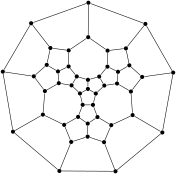 Fig. 9. The graph of the Grinberg polyhedron. Does it have a Hamiltonian path?
For which is there a Hamiltonian cycle in the graph whose vertices are the 3-element subsets of an -element set, two subsets being joined by an edge if they intersect in exactly one element?
The maximum number of pairwise edge-disjoint Hamiltonian cycles in the graph equals .
Every tournament has a directed Hamiltonian path.
For every there exists a tournament with vertices that has at least directed Hamiltonian paths.
A tournament is a directed graph in which any two vertices are joined by an edge. (That is, for any two vertices of a tournament, its edges include or , but not both.)
The line graph of a graph is the graph whose vertices are the edges of ; two vertices of the line graph are joined by an edge if the corresponding edges of have a common vertex. Find, in terms of the graph , a necessary and sufficient condition for its line graph to have a Hamiltonian cycle.
See also [Ve].