Planar Graphs
[9/44%]A plane graph with triangular faces and more than three vertices is given. A vertex was deleted together with the edges emanating from it.
Is it true that the resulting face is bounded by a non-self-intersecting cycle?
Is it true that if one more vertex is removed, then all faces will again be bounded by non-self-intersecting cycles?
Suppose that in the resulting graph every vertex has degree at least 3. Is it true that any vertex of the new graph can be deleted so as to obtain a graph all of whose faces are bounded by non-self-intersecting cycles?
A plane graph is a drawing of a graph in the plane in which any two edges intersect only at their common vertices (in particular, if there are no such vertices, they do not intersect). A plane graph divides the plane into parts called the faces of the graph; one of these parts is ``infinite''.
Euler's formula. For any connected plane graph with faces, the equality holds.
(For a proof see, e.g., [R]. From now on this result may be used without proof. This formula is often written in the form .)
Find an analogue of Euler's formula for a plane graph with connected components.
Neither of the graphs and can be drawn in the plane without self-intersections.
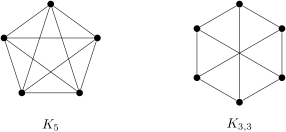 Fig. 5. Nonplanar graphs
In the plane, points are marked. It is allowed to join some two of them by a polygonal line not passing through the other points. Two players take turns joining some two not yet joined points by a polygonal line. It is required that these polygonal lines do not self-intersect and do not intersect anywhere except at the marked points. The player who cannot make a move loses. For which does the player who moves first win with correct play?
List all connected plane graphs (up to isomorphism) in which the degrees of all vertices are equal and the ``degrees'' of all faces are equal (i.e., the boundary of each face consists of the same number of edges).
Remark. If parts (1), (2), or (3) do not work out, solve the following parts. For the definition of isomorphism see Sec. 2.3.
There are exactly 5 convex regular polyhedra (all faces are regular polygons with the same number of sides, and the degrees of all vertices are equal) (up to isomorphism of their graphs). A construction of the corresponding polyhedra must be given; it is not assumed to be known.
For any connected plane graph without loops and multiple edges having more than two vertices, and .
Every plane graph has a vertex of degree at most 5.
If every vertex of a connected plane graph has degree and the boundary of every face consists of exactly edges, then
A map in the plane is a partition of the plane into a finite number of polygons (possibly ``infinite'' ones). A coloring of a map is called proper if distinct polygons having a common boundary segment have distinct colors. Prove that every map can be properly colored with
6 colors;
5 colors;
[You won't be able to prove it anyway.]
Remark. Using the construction of the dual graph, one can prove that proper colorability of every map in the plane with colors is equivalent to proper colorability of every plane graph with colors (Sec. 3.1).
Devise an algorithm
for recognizing whether a graph is planar (here you may use Kuratowski's theorem without proof);
for drawing a graph that is known to be planar in the plane without self-intersections.
Find the asymptotics of the complexity of your algorithm as a function of the number of edges of the graph, i.e., the asymptotics of the maximum, over graphs with edges, of the number of steps of the algorithm applied to the given graph. See the ``definition'' of finding asymptotics in Sec. 6.1.
Hopcroft--Tarjan theorem. There exists an algorithm for recognizing planarity of a graph that is linear in the number of edges.
The operation of subdividing an edge of a graph: the edge is removed, and in its place a new vertex and two new edges and are added.
Two graphs are called homeomorphic if one can pass from one to the other by means of edge-subdivision operations and their inverses; or, equivalently, if there exists a graph obtained from each of the given graphs by edge-subdivision operations.
Clearly, homeomorphic graphs are either both planar or both non-planar.
Kuratowski's theorem. A graph is planar if and only if it contains no subgraph homeomorphic to the graph or . (For a proof of this theorem see, e.g., [S5].)
Fáry's theorem. A plane graph can be drawn in the plane without self-intersections so that all edges are line segments.
A non-convex polygon with opaque sides is given. Call a vertex visible from a point if the interior of the segment does not intersect the boundary of the polygon. Call the kernel of the polygon the set of its interior points from which all vertices of the polygon are visible. Prove that if a point of the kernel is joined by segments to several arbitrarily chosen vertices of the original polygon (at least two, and not necessarily all of them), then the polygon splits into polygons with nonempty kernels.
Draw on the torus without self-intersections the graph
;
;
;
;
;
.
The torus and the Möbius band are assumed to be transparent, i.e., a point (or a subset) lying on one side of the surface'' also lies on the other side''. This is analogous to the fact that in studying geometry we speak, for example, of a triangle in the plane, and not of a triangle on the upper (or lower) side of the plane.
Draw on the Möbius band without self-intersections the graph
;
;
;
.
A map on the torus is a partition of the torus into finitely many (curvilinear and bent) polygons. A coloring of a map on the torus is called proper if distinct polygons having a common boundary curve have distinct colors. Can every map on the torus be properly colored
with 5 colors;
with 6 colors;
with 7 colors?
For details see [S1, 2].
Remark. Any connected graph with edges can be drawn on a sphere with $g$ handles'' (i.e., inside a regular $2g$-gon whose diametrically opposite sides are glued''), in such a way that some edges are line segments, and the remaining edges are unions of two disjoint segments, each of which has one endpoint at a vertex of the graph and the other endpoint on a side of the -gon.