Computing projections along a complementary subspace

[22/95%]
Show
LaTeX

Let H\mathcal{H} be the two-dimensional real Hilbert space R2\mathbb {R}^{2}, let M≡{(x,0)∈R2:x∈R}\mathcal{M} \equiv \left\{ (x,0) \in \mathbb {R}^{2}: x \in \mathbb {R}\right\} and let N≡{(x,xtan⁡θ):x∈R}\mathcal{N} \equiv \left\{ (x, x \tan \theta ): x \in \mathbb {R}\right\}, where 0<θ<12π0 < \theta < \frac{1}{2}\pi. Find a formula for the idempotent EθE_{\theta } with ran⁡Eθ=M\operatorname {ran} E_{\theta } = \mathcal{M} and ker⁡Eθ=N\ker E_{\theta } = \mathcal{N}. Show that ∥Eθ∥=(sin⁡θ)−1\left\| E_{\theta }\right\| = (\sin \theta )^{-1}.

?

Let U\mathcal{U} and W\mathcal{W} represent essentially disjoint subspaces (of Rn×1\mathbb {R}^{n \times 1}) whose sum is Rn×1\mathbb {R}^{n \times 1}, and let U\mathbf{U} represent any n×sn \times s matrix such that C(U)=UC(\mathbf{U}) = \mathcal{U} and W\mathbf{W} any n×tn \times t matrix such that C(W)=WC(\mathbf{W}) = \mathcal{W}.

?
(a)

Show that the n×(s+t)n \times (s+t) partitioned matrix (U,W)(\mathbf{U}, \mathbf{W}) has a right inverse.

(b)

Taking R\mathbf{R} to be an arbitrary right inverse of (U,W)(\mathbf{U}, \mathbf{W}) and partitioning R\mathbf{R} as R=(R1R2)\mathbf{R} = \begin{pmatrix} \mathbf{R}_{1} \\ \mathbf{R}_{2} \end{pmatrix} (where R1\mathbf{R}_{1} has ss rows), show that the projection matrix for U\mathcal{U} along W\mathcal{W} equals UR1\mathbf{U}\mathbf{R}_{1} and that the projection matrix for W\mathcal{W} along U\mathcal{U} equals WR2\mathbf{W}\mathbf{R}_{2}.

Let V\mathbf{V} represent an n×nn \times n symmetric nonnegative definite matrix and X\mathbf{X} an n×pn \times p matrix. Further, let Z\mathbf{Z} represent any matrix whose columns span N(X′)N(\mathbf{X}') or, equivalently, C⊥(X)C^{\perp }(\mathbf{X}). And, adopt the same terminology as in Exercise 17.20.

?
(a)

Using the result of Part (a) of Exercise 17.20 (or otherwise) show that an n×nn \times n matrix H\mathbf{H} is a projection matrix for C(X)C(\mathbf{X}) along C(VZ)C(\mathbf{V}\mathbf{Z}) if and only if H′\mathbf{H}' is the first (n×nn \times n) part of a solution to the consistent linear system

(VXX′0)(AR)=(0X′)(E.1) \begin{pmatrix} \mathbf{V} & \mathbf{X} \\ \mathbf{X}' & \mathbf{0} \end{pmatrix} \begin{pmatrix} \mathbf{A} \\ \mathbf{R} \end{pmatrix} = \begin{pmatrix} \mathbf{0} \\ \mathbf{X}' \end{pmatrix} \tag {E.1}

(in an n×nn \times n matrix A\mathbf{A} and a p×np \times n matrix R\mathbf{R}).

(b)

Letting U\mathbf{U} represent any p×pp \times p matrix such that C(X)⊂C(V+XUX′)C(\mathbf{X}) \subset C(\mathbf{V} + \mathbf{X}\mathbf{U}\mathbf{X}') and letting W\mathbf{W} represent an arbitrary generalized inverse of V+XUX′\mathbf{V} + \mathbf{X}\mathbf{U}\mathbf{X}', show that an n×nn \times n matrix H\mathbf{H} is a projection matrix for C(X)C(\mathbf{X}) along C(VZ)C(\mathbf{V}\mathbf{Z}) if and only if

H=PX,W+K[I−(V+XUX′)W] \mathbf{H} = \mathbf{P}_{\mathbf{X},\mathbf{W}} + \mathbf{K}[\mathbf{I} - (\mathbf{V} + \mathbf{X}\mathbf{U}\mathbf{X}')\mathbf{W}]

for some n×nn \times n matrix K\mathbf{K}.

Find the projection of the given vector x\mathbf{x} of the nn-dimensional arithmetic space onto the vector subspace P\mathcal{P} parallel to the vector subspace Q\mathcal{Q}, where P\mathcal{P} is the linear span of the system of vectors a1,…,ak\mathbf{a}_{1}, \ldots , \mathbf{a}_{k}, and Q\mathcal{Q} is the linear span of the system of vectors b1,…,bl\mathbf{b}_{1}, \ldots , \mathbf{b}_{l}:

?
(1)

n=2,x=c32,a1=c30,b1=c34n = 2, \quad \mathbf{x} = \mathbf{c}_{32}, \quad \mathbf{a}_{1} = \mathbf{c}_{30}, \quad \mathbf{b}_{1} = \mathbf{c}_{34}. c32=[2−2],c30=[−11],c34=[13]\mathbf{c}_{32} = \left[\begin{smallmatrix} 2 \\ -2 \end{smallmatrix}\right], \mathbf{c}_{30} = \left[\begin{smallmatrix} -1 \\ 1 \end{smallmatrix}\right], \mathbf{c}_{34} = \left[\begin{smallmatrix} 1 \\ 3 \end{smallmatrix}\right].

(2)

n=2,x=c37,a1=c30,b1=c34n = 2, \quad \mathbf{x} = \mathbf{c}_{37}, \quad \mathbf{a}_{1} = \mathbf{c}_{30}, \quad \mathbf{b}_{1} = \mathbf{c}_{34}. c37=[26],c30=[−11],c34=[13]\mathbf{c}_{37} = \left[\begin{smallmatrix} 2 \\ 6 \end{smallmatrix}\right], \mathbf{c}_{30} = \left[\begin{smallmatrix} -1 \\ 1 \end{smallmatrix}\right], \mathbf{c}_{34} = \left[\begin{smallmatrix} 1 \\ 3 \end{smallmatrix}\right].

(3)

n=2,x=c35,a1=c30,b1=c34n = 2, \quad \mathbf{x} = \mathbf{c}_{35}, \quad \mathbf{a}_{1} = \mathbf{c}_{30}, \quad \mathbf{b}_{1} = \mathbf{c}_{34}. c35=[14],c30=[−11],c34=[13]\mathbf{c}_{35} = \left[\begin{smallmatrix} 1 \\ 4 \end{smallmatrix}\right], \mathbf{c}_{30} = \left[\begin{smallmatrix} -1 \\ 1 \end{smallmatrix}\right], \mathbf{c}_{34} = \left[\begin{smallmatrix} 1 \\ 3 \end{smallmatrix}\right].

(4)

n=3,x=c146,a1=c66,a2=c121,a3=c122,b1=c145n = 3, \mathbf{x} = \mathbf{c}_{146}, \mathbf{a}_{1} = \mathbf{c}_{66}, \mathbf{a}_{2} = \mathbf{c}_{121}, \mathbf{a}_{3} = \mathbf{c}_{122}, \mathbf{b}_{1} = \mathbf{c}_{145}. c146=[141],c66=[111],c121=[−320],c122=[−231],c145=[20−1]\mathbf{c}_{146} = \left[\begin{smallmatrix} 1 \\ 4 \\ 1 \end{smallmatrix}\right], \mathbf{c}_{66} = \left[\begin{smallmatrix} 1 \\ 1 \\ 1 \end{smallmatrix}\right], \mathbf{c}_{121} = \left[\begin{smallmatrix} -3 \\ 2 \\ 0 \end{smallmatrix}\right], \mathbf{c}_{122} = \left[\begin{smallmatrix} -2 \\ 3 \\ 1 \end{smallmatrix}\right], \mathbf{c}_{145} = \left[\begin{smallmatrix} 2 \\ 0 \\ -1 \end{smallmatrix}\right].

(5)

n=4,x=c201,a1=c166,a2=c199,b1=c197,b2=c198n = 4, \mathbf{x} = \mathbf{c}_{201}, \mathbf{a}_{1} = \mathbf{c}_{166}, \mathbf{a}_{2} = \mathbf{c}_{199}, \mathbf{b}_{1} = \mathbf{c}_{197}, \mathbf{b}_{2} = \mathbf{c}_{198}. c201=[1−75−2],c166=[1111],c199=[3−572],c197=[1122],c198=[1113]\mathbf{c}_{201} = \left[\begin{smallmatrix} 1 \\ -7 \\ 5 \\ -2 \end{smallmatrix}\right], \mathbf{c}_{166} = \left[\begin{smallmatrix} 1 \\ 1 \\ 1 \\ 1 \end{smallmatrix}\right], \mathbf{c}_{199} = \left[\begin{smallmatrix} 3 \\ -5 \\ 7 \\ 2 \end{smallmatrix}\right], \mathbf{c}_{197} = \left[\begin{smallmatrix} 1 \\ 1 \\ 2 \\ 2 \end{smallmatrix}\right], \mathbf{c}_{198} = \left[\begin{smallmatrix} 1 \\ 1 \\ 1 \\ 3 \end{smallmatrix}\right].

Find the projection of the given vector x\mathbf{x} of the two-dimensional complex arithmetic space onto the vector subspace P\mathcal{P} parallel to the vector subspace Q\mathcal{Q}, where P\mathcal{P} is spanned by the vector c44\mathbf{c}_{44}, and Q\mathcal{Q} is spanned by the vector c40\mathbf{c}_{40}. c44=[i2],c40=[1+i3]\mathbf{c}_{44} = \left[\begin{smallmatrix} i \\ 2 \end{smallmatrix}\right], \mathbf{c}_{40} = \left[\begin{smallmatrix} 1+i \\ 3 \end{smallmatrix}\right].

?
(1)

x=c26\mathbf{x} = \mathbf{c}_{26}. c26=[−12i]\mathbf{c}_{26} = \left[\begin{smallmatrix} -1 \\ 2i \end{smallmatrix}\right].

(2)

x=c42\mathbf{x} = \mathbf{c}_{42}. c42=[3−i3−6i]\mathbf{c}_{42} = \left[\begin{smallmatrix} 3-i \\ 3-6 i \end{smallmatrix}\right].

(3)

x=c45\mathbf{x} = \mathbf{c}_{45}. c45=[2+3i−3i]\mathbf{c}_{45} = \left[\begin{smallmatrix} 2+3 i \\ -3 i \end{smallmatrix}\right].

Let a\mathbf{a} and n\mathbf{n} be nonzero vectors of a three-dimensional geometric vector space, with (a,n)≠0,L1(\mathbf{a}, \mathbf{n}) \neq 0, \mathcal{L}_{1} a line with directing vector a\mathbf{a}, and L2\mathcal{L}_{2} a plane with normal vector n\mathbf{n}. Write a formula for the transformation φ\varphi, verify its linearity, find the kernel, the range, and the rank, if φ\varphi is:

?
(1)

orthogonal projection onto L2\mathcal{L}_{2}

(2)

orthogonal projection onto L1\mathcal{L}_{1}

(3)

projection onto L2\mathcal{L}_{2} parallel to the vector a\mathbf{a}

(4)

projection onto L1\mathcal{L}_{1} parallel to L2\mathcal{L}_{2}

(5)

orthogonal reflection with respect to L2\mathcal{L}_{2}

(6)

orthogonal reflection with respect to L1\mathcal{L}_{1}

(7)

reflection in L2\mathcal{L}_{2} parallel to the vector a\mathbf{a}

(8)

reflection in L1\mathcal{L}_{1} parallel to L2\mathcal{L}_{2}.

Compute the matrix of the orthogonal projection of the space E3\mathcal{E}_{3} onto the subspace L\mathcal{L}, if L\mathcal{L} is:

?
(1)

the line x=z=0x = z = 0

(2)

the line x=y=zx = y = z

(3)

the plane x+y+z=0x + y + z = 0

(4)

the plane spanned by the vectors a(−1,1,−1)\mathbf{a}(- 1, 1, - 1) and b(1,−3,2)\mathbf{b}(1, - 3, 2).

In this problem, the vector subspaces of the three-dimensional geometric vector space E3\mathcal{E}_{3} are given by their equations in some orthonormal basis.

Compute the matrix of the projection of the space E3\mathcal{E}_{3} onto the subspace L\mathcal{L} parallel to the subspace M\mathcal{M}, if:

?
(1)

L\mathcal{L} is defined by the equation x=0x = 0, M\mathcal{M} by the equations 2x=2y=−z2x = 2y = - z

(2)

L\mathcal{L} has the equation x=yx = y, M\mathcal{M} is defined by the system of equations x+y+z=0,2x+y+4z=0x + y + z = 0, 2x + y + 4z = 0

(3)

L\mathcal{L} is defined by the equations −20x=15y=12z- 20x = 15y = 12z, M\mathcal{M} by the equation 2x+3y−z=02x + 3y - z = 0

(4)

L\mathcal{L} is defined by the system of equations x−y+z=0,2x−3y+4z=0x - y + z = 0, 2x - 3y + 4z = 0, M\mathcal{M} by the equation 2x+3y−4z=02x + 3y - 4z = 0.

In this problem, the vector subspaces of the three-dimensional geometric vector space E3\mathcal{E}_{3} are given by their equations in some orthonormal basis.

The transformations of the space E3\mathcal{E}_{3} from problems 23.9 (items 1-4, orthogonal projection) and 23.10 (items 5-8, projection parallel to M\mathcal{M}) are considered as linear maps of the space E3\mathcal{E}_{3} onto the subspace L\mathcal{L}. Compute the matrix of each of these maps in some pair of bases.

?
(1)

L\mathcal{L} is the line x=z=0x = z = 0

(2)

L\mathcal{L} is the line x=y=zx = y = z

(3)

L\mathcal{L} is the plane x+y+z=0x + y + z = 0

(4)

L\mathcal{L} is the plane spanned by the vectors a(−1,1,−1)\mathbf{a}(- 1, 1, - 1) and b(1,−3,2)\mathbf{b}(1, - 3, 2)

(5)

L\mathcal{L} is defined by the equation x=0x = 0, M\mathcal{M} by the equations 2x=2y=−z2x = 2y = - z

(6)

L\mathcal{L} has the equation x=yx = y, M\mathcal{M} is defined by the system of equations x+y+z=0,2x+y+4z=0x + y + z = 0, 2x + y + 4z = 0

(7)

L\mathcal{L} is defined by the equations −20x=15y=12z- 20x = 15y = 12z, M\mathcal{M} by the equation 2x+3y−z=02x + 3y - z = 0

(8)

L\mathcal{L} is defined by the system of equations x−y+z=0,2x−3y+4z=0x - y + z = 0, 2x - 3y + 4z = 0, M\mathcal{M} by the equation 2x+3y−4z=02x + 3y - 4z = 0.

In this problem, the vector subspaces of the three-dimensional geometric vector space E3\mathcal{E}_{3} are given by their equations in some orthonormal basis.

Compute the matrix of the linear transformation φ\varphi of the set of vectors of the plane with a given basis on it, if φ\varphi is:

?
(1)

reflection of the plane in the line x+2y=0x + 2y = 0 parallel to the line x+3y=0x + 3y = 0

(2)

projection of the plane onto the line x+y=0x + y = 0 parallel to the line 4x+5y=04x + 5y = 0

(3)

contraction with coefficient λ=2\lambda = 2 toward the line 3x−2y=03x - 2y = 0 parallel to the line x−y=0x - y = 0.

Compute the matrix of the linear transformation φ\varphi of the three-dimensional geometric vector space (in which an orthonormal basis is given), using a suitable change of basis, if φ\varphi is:

?
(1)

projection onto the plane 3x−y=03x - y = 0 parallel to the line x+z=0,x+y+2z=0x + z = 0, x + y + 2z = 0

(2)

reflection of the space in the line x=y=−2zx = y = - 2z parallel to the plane x+y+3z=0x + y + 3z = 0

(3)

contraction with coefficient λ=2\lambda = 2 toward the plane x−2z=0x - 2z = 0 parallel to the line x=y=zx = y = z

(4)

rotation about the line x=y=−zx = y = - z by angle π/2\pi / 2

(5)

rotation about the line x+y=0,y−z=0x + y = 0, y - z = 0 by an angle such that the first of the given planes goes into the second.

Let a1,…,aka_{1}, \ldots , a_{k} be an orthonormal basis in the subspace L⊂E\mathcal{L} \subset \mathcal{E}. The coordinate columns of these vectors in an orthonormal basis ee of the space E\mathcal{E} form the matrix AA. Write, in the basis ee, the matrix of

?
(1)

orthogonal projection onto the space L\mathcal{L}

(2)

the matrix of reflection in the subspace L\mathcal{L}.

Let a1,…,aka_{1}, \ldots , a_{k} be a basis in the subspace L⊂E\mathcal{L} \subset \mathcal{E}. The coordinate columns of these vectors in an orthonormal basis ee of the space E\mathcal{E} form the matrix AA. Write, in the basis ee, the matrix:

?
(1)

of orthogonal projection onto the subspace L\mathcal{L}

(2)

the matrix of reflection in the subspace L\mathcal{L}.

Let a1,…,aka_{1}, \ldots , a_{k} be a basis in the subspace L⊂E\mathcal{L} \subset \mathcal{E}. The coordinate columns of these vectors in a basis ee of the space E\mathcal{E} form the matrix AA. The Gram matrix Γ\Gamma of the basis e\mathbf{e} is given. Write, in the basis ee, the matrix:

?
(1)

of orthogonal projection onto the subspace L\mathcal{L}

(2)

the matrix of reflection in the subspace L\mathcal{L}.

Let a1,…,aka_{1}, \ldots , a_{k} be a basis in the subspace L⊂U\mathcal{L} \subset \mathcal{U}. The coordinate columns of these vectors in an orthonormal basis ee of the space U\mathcal{U} form the matrix AA. Write, in the basis e:

?
(1)

the matrix PP of orthogonal projection onto the subspace L\mathcal{L},

(2)

the matrix QQ of reflection in the subspace L\mathcal{L}.

Let L⊂U\mathcal{L} \subset \mathcal{U} be the linear span of vectors a1a_{1} and a2a_{2}. In an orthonormal basis ee of the space U\mathcal{U} the coordinate columns of these vectors are given. Write, in the basis ee, the matrix PP of orthogonal projection onto the subspace L\mathcal{L} and the matrix QQ of reflection in the subspace L\mathcal{L}:

?
(1)

[1i1+i],[i11−i]\left[\begin{smallmatrix} 1 \\ i \\ 1 + i\end{smallmatrix}\right], \quad \left[\begin{smallmatrix} i \\ 1 \\ 1-i\end{smallmatrix}\right];

(2)

[ii1],[2i03]\left[\begin{smallmatrix} i \\ i \\ 1\end{smallmatrix}\right], \quad \left[\begin{smallmatrix} 2i \\ 0 \\ 3\end{smallmatrix}\right];

(3)

[i11i],[2i03i]\left[\begin{smallmatrix} i \\ 1 \\ 1 \\ i\end{smallmatrix}\right], \quad \left[\begin{smallmatrix} 2i \\ 0 \\ 3 \\ i\end{smallmatrix}\right].

Let a vector space VV be the direct sum of subspaces L1L_{1} and L2L_{2} with bases (a1,…,ak)\left(a_{1}, \ldots , a_{k}\right) and (ak+1,…,an)\left(a_{k+1}, \ldots , a_{n}\right). Prove that the projection onto L1L_{1} parallel to L2L_{2} is a linear operator, and find its matrix in the basis (a1,…,an)\left(a_{1}, \ldots , a_{n}\right).

?

For u,w∈Rnu,w \in \mathbb {R}^{n} such that uTw≠0u^{T}w \neq 0, let M=u⊥M = u^{\perp } and W=⟨w⟩W = \left\langle w\right\rangle.

?
(a)

Explain why Rn=M⊕W\mathbb {R}^{n} = M\oplus W.

(b)

For b∈Rnb \in \mathbb {R}^{n}, explain why the oblique projection of bb onto MM along WW is given by p=b−uTbuTwwp = b - \dfrac {u^{T}b}{u^{T}w}w.

(c)

For a given scalar β\beta, let HH be the hyperplane H={x∣uTx=β}H=\left\{ x \mid u^{T}x=\beta \right\}. Explain why the oblique projection of bb onto HH along WW should be given by p=b−(uTb−βuTw)wp = b - \left(\dfrac {u^{T}b-\beta }{u^{T}w}\right)w.

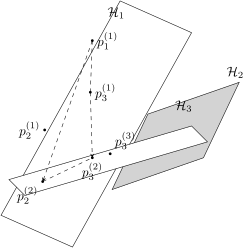
Assume a nonsingular system An×nx=bA_{n\times n}x=b has been row scaled so that ∥Ai∗∥2=1\left\| A_{i*}\right\|_{2}=1 for each ii, and let Hi={x∣Ai∗x=bi}H_{i} = \left\{ x \mid A_{i*}x=b_{i}\right\}. In theory, the system can be solved by n−1n-1 oblique projections (Exercise 5.13.18): an arbitrary point p1p_{1} in H1H_{1} is projected obliquely onto H2H_{2} along H1H_{1} to produce p2∈H1∩H2p_{2} \in H_{1}\cap H_{2}, then p2p_{2} is projected onto H3H_{3} along H1∩H2H_{1}\cap H_{2} to produce p3p_{3}, and so on. Since ⋂i=1kHi\bigcap_{i=1}^{k} H_{i} is generally unknown, the procedure is modified — use the following figure, showing the n=3n=3 case, as a guide.

Successive oblique projections for n=3: p_1^{(1)} is projected through p_2^{(1)}, p_3^{(1)} onto \mathcal{H}_2, producing points in \mathcal{H}_1 \cap \mathcal{H}_2.Successive oblique projections for n=3: p_1^{(1)} is projected through p_2^{(1)}, p_3^{(1)} onto \mathcal{H}_2, producing points in \mathcal{H}_1 \cap \mathcal{H}_2.

Step 0. Begin with any set {p1(1),p2(1),…,pn(1)}⊂H1\left\{ p_{1}^{(1)}, p_{2}^{(1)}, \ldots , p_{n}^{(1)}\right\} \subset H_{1} such that {p1(1)−p2(1),…,p1(1)−pn(1)}\left\{ p_{1}^{(1)}-p_{2}^{(1)}, \ldots , p_{1}^{(1)}-p_{n}^{(1)}\right\} is linearly independent and A2∗(p1(1)−pk(1))≠0A_{2*}(p_{1}^{(1)}-p_{k}^{(1)}) \neq 0 for k=2,…,nk=2,\ldots ,n. Step 1. In turn, project p1(1)p_{1}^{(1)} onto H2H_{2} through p2(1),…,pn(1)p_{2}^{(1)},\ldots ,p_{n}^{(1)} to produce {p2(2),…,pn(2)}⊂H1∩H2\left\{ p_{2}^{(2)},\ldots ,p_{n}^{(2)}\right\} \subset H_{1}\cap H_{2}. Step 2. Project p2(2)p_{2}^{(2)} onto H3H_{3} through p3(2),…,pn(2)p_{3}^{(2)},\ldots ,p_{n}^{(2)} to produce {p3(3),…,pn(3)}⊂H1∩H2∩H3\left\{ p_{3}^{(3)},\ldots ,p_{n}^{(3)}\right\} \subset H_{1}\cap H_{2}\cap H_{3}, and so on. Step n−1n-1. Project pn−1(n−1)p_{n-1}^{(n-1)} through pn(n−1)p_{n}^{(n-1)} to produce pn(n)∈⋂i=1nHip_{n}^{(n)} \in \bigcap_{i=1}^{n} H_{i}. Then x=pn(n)x = p_{n}^{(n)} is the solution. Explain why the following algorithm performs the computations of Steps 1,2,…,n−11,2,\ldots ,n-1. For i=2i=2 to nn For j=ij=i to nn xj←xj−(Ai∗xi−1−bi)xi−1−xjAi∗(xi−1−xj)x_{j} \leftarrow x_{j} - (A_{i*}x_{i-1}-b_{i})\dfrac {x_{i-1}-x_{j}}{A_{i*}(x_{i-1}-x_{j})} x←xnx \leftarrow x_{n} (the solution of the system)

?

Let XX and YY be subspaces of R3\mathbb {R}^{3} whose respective bases are BX={(111),(122)}B_{X} = \left\{ \begin{pmatrix} 1 \\ 1 \\ 1 \end{pmatrix}, \begin{pmatrix} 1 \\ 2 \\ 2 \end{pmatrix}\right\} and BY={(123)}B_{Y} = \left\{ \begin{pmatrix} 1 \\ 2 \\ 3 \end{pmatrix}\right\}.

?
(a)

Explain why XX and YY are complementary subspaces of R3\mathbb {R}^{3}.

(b)

Determine the projector PP onto XX along YY as well as the complementary projector QQ onto YY along XX.

(c)

Determine the projection of v=(2−11)v = \begin{pmatrix} 2 \\ -1 \\ 1 \end{pmatrix} onto YY along XX.

(d)

Verify that PP and QQ are both idempotent.

(e)

Verify that R(P)=X=N(Q)\mathcal{R}(P) = X = \mathcal{N}(Q) and N(P)=Y=R(Q)\mathcal{N}(P) = Y = \mathcal{R}(Q).

Remark.
?

(5.9.4): X,YX, Y (with bases BX,BYB_{X},B_{Y}) are complementary subspaces of VV if and only if BX∩BY=∅B_{X}\cap B_{Y}=\emptyset and BX∪BYB_{X}\cup B_{Y} is a basis for VV. (5.9.12): if the columns of X,YX,Y (matrices) are bases for X,YX,Y, the projector onto XX along YY is P=[X∣0][X∣Y]−1P = \left[X\mid 0\right]\left[X\mid Y\right]^{-1}.

Explain why Rn×n=S⊕K\mathbb {R}^{n \times n} = S \oplus K, where SS and KK are the subspaces of n×nn\times n symmetric and skew-symmetric matrices, respectively. What is the projection of A=(123456789)A = \begin{pmatrix} 1& 2& 3 \\ 4& 5& 6 \\ 7& 8& 9 \end{pmatrix} onto SS along KK?

?
Remark.
?

Exercise 3.2.6 shows that every A∈Rn×nA \in \mathbb {R}^{n\times n} has the unique decomposition A=A+AT2+A−AT2A = \frac{A+A^{T}}{2} + \frac{A-A^{T}}{2}, a symmetric matrix plus a skew-symmetric matrix.

Suppose that XX and YY are complementary subspaces of Rn\mathbb {R}^{n}, and let B=[X∣Y]B = \left[X \mid Y\right] be a nonsingular matrix in which the columns of XX and YY constitute respective bases for XX and YY. For an arbitrary vector v∈Rnv \in \mathbb {R}^{n}, explain why the projection of vv onto XX along YY can be obtained by the following two-step process.

  1. Solve the system Bz=vBz=v for zz.

  2. Partition zz as z=(z1z2)z = \begin{pmatrix} z_{1} \\ z_{2} \end{pmatrix}, and set p=Xz1p = Xz_{1}.

?

References

[Con07] Conway J.B. A Course in Functional Analysis. 2nd ed., Springer, 2007.
[Har01] Harville D.A. Matrix Algebra: Exercises and Solutions. Springer, 2001.
[ББП+23] Беклемишева Л.А., Беклемишев Д.В., Петрович А.Ю., Чубаров И.А. Сборник задач по аналитической геометрии и линейной алгебре. Лань, 2023.
[Кос15] Кострикин А.И. Сборник задач по алгебре. МЦНМО, 2015.
[Mey00] Meyer C.D. Matrix Analysis and Applied Linear Algebra. SIAM, 2000.