Section 5.13

Orthogonal Projection

[22/100%]
Show
LaTeX
Problem 5.13.1

Find the orthogonal projection of bb onto M=⟨u⟩M = \left\langle u\right\rangle, and then determine the orthogonal projection of bb onto M⊥M^{\perp }, where b=(48)Tb = \begin{pmatrix} 4 & 8 \end{pmatrix}^{T} and u=(31)Tu = \begin{pmatrix} 3 & 1 \end{pmatrix}^{T}.

?
Problem 5.13.2

Let A=(120241120)A = \begin{pmatrix} 1& 2& 0 \\ 2& 4& 1 \\ 1& 2& 0 \end{pmatrix} and b=(111)b = \begin{pmatrix} 1\\ 1\\ 1 \end{pmatrix}.

?
(a)

Compute the orthogonal projectors onto each of the four fundamental subspaces associated with AA.

(b)

Find the point in N(A)⊥\mathcal{N}(A)^{\perp } that is closest to bb.

Problem 5.13.3

For an orthogonal projector PP, prove that ∥Px∥2=∥x∥2\left\| Px\right\|_{2} = \left\| x\right\|_{2} if and only if x∈R(P)x \in \mathcal{R}(P).

?
Problem 5.13.4

Explain why ATPR(A)=ATA^{T}P_{\mathcal{R}(A)} = A^{T} for all A∈Rm×nA \in \mathbb {R}^{m\times n}.

?
Problem 5.13.5

Explain why PM=∑i=1ruiuiTP_{M} = \sum_{i=1}^{r} u_{i}u_{i}^{T} whenever B={u1,u2,…,ur}B = \left\{ u_{1},u_{2},\ldots ,u_{r}\right\} is an orthonormal basis for M⊆Rn×1M \subseteq \mathbb {R}^{n\times 1}.

?
Problem 5.13.6

Explain how to use orthogonal reduction techniques to compute the orthogonal projectors onto each of the four fundamental subspaces of a matrix A∈Rm×nA \in \mathbb {R}^{m\times n}.

?
Problem 5.13.7
?
(a)

Describe all 2×22\times 2 orthogonal projectors in R2×2\mathbb {R}^{2\times 2}.

(b)

Describe all 2×22\times 2 (oblique) projectors in R2×2\mathbb {R}^{2\times 2}.

Problem 5.13.8

The line LL in Rn\mathbb {R}^{n} passing through two distinct points uu and vv is L=u+⟨u−v⟩L = u + \left\langle u-v\right\rangle. If u≠0u \neq 0 and v≠αuv \neq \alpha u, then LL is a line not passing through the origin — i.e., LL is not a subspace. Explain how to project a vector bb orthogonally onto LL.

?
Problem 5.13.9

Explain why x^\hat{x} is a least squares solution for Ax=bAx=b if and only if ∥Ax^−b∥2=∥PN(AT)b∥2\left\| A\hat{x}-b\right\|_{2} = \left\| P_{\mathcal{N}(A^{T})}b\right\|_{2}.

?
Problem 5.13.10

Prove that if ε=Ax^−b\varepsilon = A\hat{x}-b, where x^\hat{x} is a least squares solution for Ax=bAx=b, then ∥ε∥22=∥b∥22−∥PR(A)b∥22\left\| \varepsilon \right\|_{2}^{2} = \left\| b\right\|_{2}^{2} - \left\| P_{\mathcal{R}(A)}b\right\|_{2}^{2}.

?
Problem 5.13.11

Let MM be an rr-dimensional subspace of Rn\mathbb {R}^{n}. If B={u1,u2,…,ur}B = \left\{ u_{1},u_{2},\ldots ,u_{r}\right\} is an orthonormal basis for MM, and if x∈Mx \in M, then xx equals its Fourier expansion with respect to BB: x=∑i=1r(uiTx)uix = \sum_{i=1}^{r}(u_{i}^{T}x)u_{i}. Show that when x∉Mx \notin M, this same sum ∑i=1r(uiTx)ui\sum_{i=1}^{r}(u_{i}^{T}x)u_{i} is the point in MM closest to xx — i.e., show ∑i=1r(uiTx)ui=PMx\sum_{i=1}^{r}(u_{i}^{T}x)u_{i} = P_{M}x.

?
Problem 5.13.12

Determine the orthogonal projection of bb onto MM, where

b=(5253)andM=⟨(−3/504/50),(0001),(4/503/50)⟩. b = \begin{pmatrix} 5\\ 2\\ 5\\ 3 \end{pmatrix} \qquad \text{and} \qquad M = \left\langle \begin{pmatrix} -3/5\\ 0\\ 4/5\\ 0 \end{pmatrix}, \begin{pmatrix} 0\\ 0\\ 0\\ 1 \end{pmatrix}, \begin{pmatrix} 4/5\\ 0\\ 3/5\\ 0 \end{pmatrix}\right\rangle .
?
Remark.
?

Is this spanning set in fact an orthonormal basis?

Problem 5.13.13

Let MM and NN be subspaces of a vector space VV, and consider the associated orthogonal projectors PMP_{M} and PNP_{N}.

?
(a)

Prove that PMPN=0P_{M}P_{N} = 0 if and only if M⊥NM \perp N.

(b)

Is it true that PMPN=0P_{M}P_{N}=0 if and only if PNPM=0P_{N}P_{M}=0? Why?

Problem 5.13.14

Let MM and NN be subspaces of the same vector space, and let PMP_{M} and PNP_{N} be orthogonal projectors onto MM and NN, respectively.

?
(a)

Prove that R(PM+PN)=R(PM)+R(PN)=M+N\mathcal{R}(P_{M}+P_{N}) = \mathcal{R}(P_{M}) + \mathcal{R}(P_{N}) = M+N.

(b)

Explain why M⊥NM\perp N if and only if PMPN=0P_{M}P_{N}=0.

(c)

Explain why PM+PNP_{M}+P_{N} is an orthogonal projector if and only if PMPN=0P_{M}P_{N}=0, in which case R(PM+PN)=M⊕N\mathcal{R}(P_{M}+P_{N}) = M\oplus N and M⊥NM\perp N.

Problem 5.13.15

Prove that if MM and NN are subspaces of the same vector space, then the orthogonal projector onto M∩NM\cap N is given by PM∩N=2PM(PM+PN)†PNP_{M\cap N} = 2P_{M}(P_{M}+P_{N})^{\dagger }P_{N}.

?
Remark.
?

This formula generalizes the resistance of a circuit composed of two resistors r1r_{1} and r2r_{2} connected in parallel, r1r2/(r1+r2)=r1(r1+r2)−1r2r_{1}r_{2}/(r_{1}+r_{2}) = r_{1}(r_{1}+r_{2})^{-1}r_{2}; PM(PM+PN)†PNP_{M}(P_{M}+P_{N})^{\dagger }P_{N} is called the parallel sum of PMP_{M} and PNP_{N}.

Problem 5.13.16

Given a square matrix XX, the matrix exponential is eX=I+X+X22!+X33!+⋯=∑n=0∞Xnn!e^{X} = I+X+\dfrac {X^{2}}{2!}+\dfrac {X^{3}}{3!}+\cdots = \sum_{n=0}^{\infty } \dfrac {X^{n}}{n!}, and it is legitimate to differentiate/integrate it term by term, giving deAt/dt=AeAt=eAtAde^{At}/dt = Ae^{At} = e^{At}A and ∫eAtA dt=eAt\int e^{At}A\, dt = e^{At}.

?
(a)

Use the fact that lim⁡t→∞e−ATAt=0\lim_{t\to \infty } e^{-A^{T}At} = 0 for all A∈Rm×nA \in \mathbb {R}^{m\times n} to show A†=∫0∞e−ATAtAT dtA^{\dagger } = \int_{0}^{\infty } e^{-A^{T}At}A^{T}\, dt.

(b)

If lim⁡t→∞e−Ak+1t=0\lim_{t\to \infty } e^{-A^{k+1}t} = 0, show AD=∫0∞e−Ak+1tAk dtA^{D} = \int_{0}^{\infty } e^{-A^{k+1}t}A^{k}\, dt, where k=index⁡(A)k = \operatorname {index}(A).

(c)

For nonsingular matrices, show that if lim⁡t→∞e−At=0\lim_{t\to \infty } e^{-At} = 0, then A−1=∫0∞e−At dtA^{-1} = \int_{0}^{\infty } e^{-At}\, dt.

Problem 5.13.17

An affine space v+M⊆Rnv+M \subseteq \mathbb {R}^{n} for which dim⁡M=n−1\dim M = n-1 is called a hyperplane.

?
(a)

Prove that for a given scalar β\beta and a nonzero vector u∈Rnu \in \mathbb {R}^{n}, the set H={x∣uTx=β}H = \left\{ x \mid u^{T}x = \beta \right\} is a hyperplane in Rn\mathbb {R}^{n}.

(b)

Explain why the orthogonal projection of b∈Rnb \in \mathbb {R}^{n} onto HH is p=b−(uTb−βuTu)up = b - \left(\dfrac {u^{T}b-\beta }{u^{T}u}\right)u.

Problem 5.13.18

For u,w∈Rnu,w \in \mathbb {R}^{n} such that uTw≠0u^{T}w \neq 0, let M=u⊥M = u^{\perp } and W=⟨w⟩W = \left\langle w\right\rangle.

?
(a)

Explain why Rn=M⊕W\mathbb {R}^{n} = M\oplus W.

(b)

For b∈Rnb \in \mathbb {R}^{n}, explain why the oblique projection of bb onto MM along WW is given by p=b−uTbuTwwp = b - \dfrac {u^{T}b}{u^{T}w}w.

(c)

For a given scalar β\beta, let HH be the hyperplane H={x∣uTx=β}H=\left\{ x \mid u^{T}x=\beta \right\}. Explain why the oblique projection of bb onto HH along WW should be given by p=b−(uTb−βuTw)wp = b - \left(\dfrac {u^{T}b-\beta }{u^{T}w}\right)w.

Problem 5.13.19

For a consistent system An×rx=bA_{n\times r}x=b with rk⁡(A)=r\operatorname {rk}\left(A\right)=r, scale the rows so that ∥Ai∗∥2=1\left\| A_{i*}\right\|_{2}=1 for each ii, and let Hi={x∣Ai∗x=bi}H_{i} = \left\{ x \mid A_{i*}x=b_{i}\right\} be the hyperplane defined by the iith equation. Beginning with an arbitrary vector p0p_{0}, the Kaczmarz sequence is generated by the double loop For k=0,1,2,3,…k=0,1,2,3,\ldots For i=1,2,…,ni=1,2,\ldots ,n pkn+i=pkn+i−1−(Ai∗pkn+i−1−bi)(Ai∗)Tp_{kn+i} = p_{kn+i-1} - (A_{i*}p_{kn+i-1}-b_{i})(A_{i*})^{T} Prove that the Kaczmarz sequence converges to the solution xx of Ax=bAx=b by showing

∥pkn+i−x∥22=∥pkn+i−1−x∥22−(Ai∗pkn+i−1−bi)2. \left\| p_{kn+i}-x\right\| _{2}^{2} = \left\| p_{kn+i-1}-x\right\| _{2}^{2} - (A_{i*}p_{kn+i-1}-b_{i})^{2}.
?
Problem 5.13.20

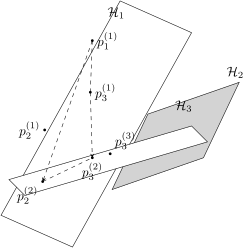
Assume a nonsingular system An×nx=bA_{n\times n}x=b has been row scaled so that ∥Ai∗∥2=1\left\| A_{i*}\right\|_{2}=1 for each ii, and let Hi={x∣Ai∗x=bi}H_{i} = \left\{ x \mid A_{i*}x=b_{i}\right\}. In theory, the system can be solved by n−1n-1 oblique projections (Exercise 5.13.18): an arbitrary point p1p_{1} in H1H_{1} is projected obliquely onto H2H_{2} along H1H_{1} to produce p2∈H1∩H2p_{2} \in H_{1}\cap H_{2}, then p2p_{2} is projected onto H3H_{3} along H1∩H2H_{1}\cap H_{2} to produce p3p_{3}, and so on. Since ⋂i=1kHi\bigcap_{i=1}^{k} H_{i} is generally unknown, the procedure is modified — use the following figure, showing the n=3n=3 case, as a guide.

Successive oblique projections for n=3: p_1^{(1)} is projected through p_2^{(1)}, p_3^{(1)} onto \mathcal{H}_2, producing points in \mathcal{H}_1 \cap \mathcal{H}_2.Successive oblique projections for n=3: p_1^{(1)} is projected through p_2^{(1)}, p_3^{(1)} onto \mathcal{H}_2, producing points in \mathcal{H}_1 \cap \mathcal{H}_2.

Step 0. Begin with any set {p1(1),p2(1),…,pn(1)}⊂H1\left\{ p_{1}^{(1)}, p_{2}^{(1)}, \ldots , p_{n}^{(1)}\right\} \subset H_{1} such that {p1(1)−p2(1),…,p1(1)−pn(1)}\left\{ p_{1}^{(1)}-p_{2}^{(1)}, \ldots , p_{1}^{(1)}-p_{n}^{(1)}\right\} is linearly independent and A2∗(p1(1)−pk(1))≠0A_{2*}(p_{1}^{(1)}-p_{k}^{(1)}) \neq 0 for k=2,…,nk=2,\ldots ,n. Step 1. In turn, project p1(1)p_{1}^{(1)} onto H2H_{2} through p2(1),…,pn(1)p_{2}^{(1)},\ldots ,p_{n}^{(1)} to produce {p2(2),…,pn(2)}⊂H1∩H2\left\{ p_{2}^{(2)},\ldots ,p_{n}^{(2)}\right\} \subset H_{1}\cap H_{2}. Step 2. Project p2(2)p_{2}^{(2)} onto H3H_{3} through p3(2),…,pn(2)p_{3}^{(2)},\ldots ,p_{n}^{(2)} to produce {p3(3),…,pn(3)}⊂H1∩H2∩H3\left\{ p_{3}^{(3)},\ldots ,p_{n}^{(3)}\right\} \subset H_{1}\cap H_{2}\cap H_{3}, and so on. Step n−1n-1. Project pn−1(n−1)p_{n-1}^{(n-1)} through pn(n−1)p_{n}^{(n-1)} to produce pn(n)∈⋂i=1nHip_{n}^{(n)} \in \bigcap_{i=1}^{n} H_{i}. Then x=pn(n)x = p_{n}^{(n)} is the solution. Explain why the following algorithm performs the computations of Steps 1,2,…,n−11,2,\ldots ,n-1. For i=2i=2 to nn For j=ij=i to nn xj←xj−(Ai∗xi−1−bi)xi−1−xjAi∗(xi−1−xj)x_{j} \leftarrow x_{j} - (A_{i*}x_{i-1}-b_{i})\dfrac {x_{i-1}-x_{j}}{A_{i*}(x_{i-1}-x_{j})} x←xnx \leftarrow x_{n} (the solution of the system)

?
Problem 5.13.21

Let MM be a subspace of Rn\mathbb {R}^{n}, and let R=I−2PMR = I-2P_{M}. Prove that the orthogonal distance between any point x∈Rnx \in \mathbb {R}^{n} and M⊥M^{\perp } is the same as the orthogonal distance between RxRx and M⊥M^{\perp } (i.e., RR reflects everything about M⊥M^{\perp }).

?
Problem 5.13.22

In 1938 the Italian mathematician Gianfranco Cimmino used the following elementary observation to construct an iterative algorithm for solving linear systems. For a 2×22\times 2 system Ax=bAx=b, let H1H_{1} and H2H_{2} be the two lines (hyperplanes) defined by the two equations. For an arbitrary guess r0r_{0}, let r1r_{1} be the reflection of r0r_{0} about the line H1H_{1}, and let r2r_{2} be the reflection of r0r_{0} about the line H2H_{2}. As illustrated below, the three points r0r_{0}, r1r_{1}, and r2r_{2} lie on a circle whose center is H1∩H2H_{1}\cap H_{2} (the solution of the system).

The reflections r_1, r_2 of an arbitrary point r_0 about lines \mathcal{H}_1, \mathcal{H}_2 lie, together with r_0, on a circle centered at \mathcal{H}_1 \cap \mathcal{H}_2.The reflections r_1, r_2 of an arbitrary point r_0 about lines \mathcal{H}_1, \mathcal{H}_2 lie, together with r_0, on a circle centered at \mathcal{H}_1 \cap \mathcal{H}_2.

The mean value m=(r1+r2)/2m = (r_{1}+r_{2})/2 is strictly inside the circle, so mm is a better approximation to the solution than r0r_{0}. It's visually evident that iteration produces a sequence that converges to the solution of Ax=bAx=b. Prove this in general by using the following blueprint.

?
(a)

For a scalar β\beta and a vector u∈Rnu \in \mathbb {R}^{n} such that ∥u∥2=1\left\| u\right\|_{2}=1, consider the hyperplane H={x∣uTx=β}H = \left\{ x \mid u^{T}x=\beta \right\} (Exercise 5.13.17). Show that the reflection of a vector bb about HH is r=b−2(uTb−β)ur = b - 2(u^{T}b-\beta )u.

(b)

For a system Ax=bAx=b in which the rows of A∈Rn×rA \in \mathbb {R}^{n\times r} have been scaled so that ∥Ai∗∥2=1\left\| A_{i*}\right\|_{2}=1 for each ii, let Hi={x∣Ai∗x=bi}H_{i} = \left\{ x \mid A_{i*}x=b_{i}\right\}. If r0∈Rrr_{0} \in \mathbb {R}^{r} is arbitrary, and rir_{i} is the reflection of r0r_{0} about HiH_{i}, explain why the mean value of the reflections {r1,…,rn}\left\{ r_{1},\ldots ,r_{n}\right\} is m=r0−(2/n)ATεm = r_{0} - (2/n)A^{T}\varepsilon, where ε=Ar0−b\varepsilon = Ar_{0}-b.

(c)

Iterating part (b) produces mk=mk−1−(2/n)ATεk−1m_{k} = m_{k-1} - (2/n)A^{T}\varepsilon_{k-1}, where εk−1=Amk−1−b\varepsilon_{k-1} = Am_{k-1}-b. Show that if AA is nonsingular, and x=A−1bx=A^{-1}b, then x−mk=(I−(2/n)ATA)k(x−m0)x-m_{k} = \left(I-(2/n)A^{T}A\right)^{k}(x-m_{0}).

Remark.
?

It can be proven that (I−(2/n)ATA)k→0\left(I-(2/n)A^{T}A\right)^{k} \to 0 as k→∞k\to \infty, so mk→xm_{k}\to x for all m0m_{0}, even if AA is rank deficient (converging to a solution if consistent, else a least squares solution). Cimmino's method also works with weighted means: if W=diag⁡(w1,…,wn)W = \operatorname {diag}(w_{1},\ldots ,w_{n}), wi>0w_{i}>0, ∑wi=1\sum w_{i}=1, then mk=mk−1−ωATWεk−1m_{k} = m_{k-1} - \omega A^{T}W\varepsilon_{k-1} converges for a relaxation parameter 0<ω<20<\omega <2.