Norms, Inner Products, and Orthogonality
[208/100%]Find the 1-, 2-, and -norms of and .
Consider the euclidean norm with and .
Determine the distance between and .
Verify that the triangle inequality holds for and .
Verify that the CBS inequality holds for and .
Show that for .
Using the euclidean norm, describe the solid ball in centered at the origin with unit radius.
Describe a solid ball centered at the point with radius .
If such that , what is ?
Explain why is true for all norms.
For every vector norm on , prove that depends continuously on the components of in the sense that for each , there corresponds a such that whenever for each .
For , explain why .
For , show that , where is the -entry in the following matrix. (See Exercise 5.12.3 for a similar statement regarding matrix norms.)
For , , explain why equality holds in the CBS inequality if and only if , where .
Formula (5.1.4), from the proof of the CBS inequality, states that for ,
For nonzero vectors with the euclidean norm, prove that equality holds in the triangle inequality if and only if , where is real and positive.
Use Holder's inequality
(where , , ) to prove that if the components of sum to zero (i.e., for ), then
for all .
For "zero sum" vectors , this bound is at least as sharp, and usually sharper, than Holder's inequality itself, because .
The classical form of Holder's inequality states that if and are real numbers such that , then
Derive this inequality by executing the following steps:
By considering the function for , establish the inequality
for nonnegative real numbers and .
Let and , and apply the inequality of part (a) to obtain
Deduce the classical form of Holder's inequality, and then explain why this means that .
The triangle inequality for a general -norm is really the classical Minkowski inequality, which states that for ,
Derive Minkowski's inequality.
Evaluate the Frobenius matrix norm for each matrix below.
Evaluate the induced 1-, 2-, and -matrix norm for each of the three matrices given in Exercise 5.2.1: , , .
Explain why for every induced matrix norm .
What is ?
Explain why for the Frobenius matrix norm .
For matrices and and for vectors , establish the following compatibility properties between a vector norm defined on every and the associated induced matrix norm .
Show that .
Show that .
Explain why .
Establish the following properties of the matrix 2-norm.
,
,
,
(take to be real),
when and .
Using the induced matrix norm , prove that if is nonsingular, then
For and a parameter , the matrix is called the resolvent of . Prove that if for any induced matrix norm, then
The backward triangle inequality (Example 5.1.1) states that .
For , , determine which of the following are inner products for .
,
,
,
.
An inner product on a real vector space is a function of ordered pairs of vectors satisfying: is real with , and if and only if ; for all scalars ; ; and .
For a general inner-product space , explain why each of the following statements must be true.
If for all , then .
for all and for all scalars .
for all .
Let be an inner-product space with an inner product . Explain why the function defined by satisfies the first two general-matrix-norm properties with , and .
For a real inner-product space with , derive the inequality
For matrices and , explain why each of the following inequalities is valid.
.
for real matrices.
for real matrices.
Example 5.3.3: for equipped with the standard matrix inner product and associated Frobenius norm , the CBS inequality gives .
Extend the proof of the parallelogram identity's converse to include complex spaces.
The parallelogram identity states that for a given norm on a vector space , there exists an inner product on such that if and only if holds for all . For a real space satisfying this identity, the inner product recovering the norm is .
Explain why there does not exist an inner product on () such that .
Explain why the Frobenius matrix norm on must satisfy the parallelogram identity.
For , is either the matrix 1-, 2-, or -norm generated by an inner product on ?
Using the standard inner product, determine which of the following pairs are orthogonal vectors in the indicated space.
and in ,
and in ,
and in ,
and in ,
and in .
Find two vectors of unit norm that are orthogonal to .
Consider the following set of three vectors:
Using the standard inner product in , verify that these vectors are mutually orthogonal.
Find a nonzero vector such that is a set of mutually orthogonal vectors.
Convert the resulting set into an orthonormal basis for .
Using the standard inner product, determine the Fourier expansion of with respect to , where
With respect to the inner product for matrices , verify that the set
is an orthonormal basis for , and then compute the Fourier expansion of with respect to .
Determine the angle between and .
Given an orthonormal basis for a space , explain why the Fourier expansion for is uniquely determined by .
Explain why the columns of are an orthonormal basis for if and only if .
Such matrices are said to be unitary; their properties are studied in a later section.
Matrices with the property are said to be normal (hermitian matrices as well as real symmetric matrices are included in this class). Prove that if is normal, then — i.e., every vector in the range of is orthogonal to every vector in the nullspace of .
For , equations (4.5.5)-(4.5.6) state , , , and .
Using the trace inner product , determine the angle between the following pairs of matrices.
and .
and .
Why is the definition for not good for ? Explain how to define so that it makes sense in .
If is an orthonormal basis for an inner-product space , explain why
holds for every .
Consider a real inner-product space, where .
Prove that if , then .
For the standard inner product in , draw a picture of this. That is, sketch the location of and for two vectors with equal norms.
Let be a general inner-product space in which .
When is a real space, prove that if and only if .
Construct an example to show that one of the implications in part (a) does not hold when is a complex space.
When is a complex space, prove that if and only if for all scalars and .
Let be an orthonormal basis for an inner-product space , and let be the Fourier expansion of .
If is a real space, and if is the angle between and , explain why . Sketch a picture of this in or to show why the component represents the orthogonal projection of onto the line determined by , and thus illustrate the fact that a Fourier expansion is nothing more than simply resolving into mutually orthogonal components.
Derive Parseval's identity, which says .
Let be an orthonormal set in an -dimensional inner-product space . Derive Bessel's inequality, which says that if and , then
Explain why equality holds if and only if .
Construct an example using the standard inner product in to show that two vectors and can have an angle between them that is close to without being close to .
Example 5.4.3 shows that is linearly correlated with in the sense that if and only if the standardization vectors and are "close" in the sense that they are almost on the same line in (where are the mean and standard deviation of 's entries, and similarly for ). Explain why simply measuring does not always gauge the degree of linear correlation.
Let be the angle between two vectors and from a real inner-product space.
Prove that if and only if for .
Prove that if and only if for .
With respect to the orthonormal set
determine the Fourier series expansion of the saw-toothed function defined by for (extended periodically).
 The periodic extension of the saw-toothed function f(t)=t on (-\pi ,\pi ).
Let .
Use the classical Gram-Schmidt algorithm (with exact arithmetic) to determine an orthonormal basis for .
Verify directly that the Gram-Schmidt sequence produced in part (a) is indeed an orthonormal basis for .
Repeat part (a) using the modified Gram-Schmidt algorithm, and compare the results.
Use the Gram-Schmidt procedure to find an orthonormal basis for the four fundamental subspaces of .
Apply the Gram-Schmidt procedure with the standard inner product for to .
Explain what happens when the Gram-Schmidt process is applied to an orthonormal set of vectors.
Explain what happens when the Gram-Schmidt process is applied to a linearly dependent set of vectors.
Let and .
Determine the rectangular QR factorization of .
Use the QR factors from part (a) to determine the least squares solution to .
Given a linearly independent set of vectors in an inner-product space, let for . Give an induction argument to prove that if is the Gram-Schmidt sequence
then is indeed an orthonormal basis for for each .
Prove that if , then the rectangular QR factorization of is unique. That is, if , where has orthonormal columns and is upper triangular with positive diagonal entries, then and are unique.
Equation (5.5.6) shows that if with having orthonormal columns, then . Example 3.10.7 states that the Cholesky factorization of a positive definite matrix is unique.
Apply classical Gram-Schmidt with 3-digit floating-point arithmetic to . You may assume that .
Again using 3-digit floating-point arithmetic, apply the modified Gram-Schmidt algorithm to , and compare the result with that of part (a).
Depending on how the inner products are defined, verify that the following code implements both the classical and modified Gram-Schmidt algorithms applied to a set of vectors . For to For to End If quit (because ) Else End If exact arithmetic is used, will the inner products be the same for both implementations?
Let be the inner-product space of real-valued continuous functions defined on the interval , where the inner product is defined by , and let be the subspace of that is spanned by the three linearly independent polynomials , , .
Use the Gram-Schmidt process to determine an orthonormal set of polynomials that spans . These polynomials are the first three normalized Legendre polynomials.
Verify that satisfies Legendre's differential equation for .
Determine which of the following matrices are isometries.
.
.
.
.
Is a unitary matrix?
How many matrices are both diagonal and orthogonal?
How many matrices are both diagonal and orthogonal?
How many matrices are both diagonal and unitary?
Under what conditions on the real numbers and will be an orthogonal matrix?
Under what conditions on the real numbers and will be a unitary matrix?
Let and be two unitary (orthogonal) matrices.
Explain why the product must be unitary (orthogonal).
Explain why the sum need not be unitary (orthogonal).
Explain why must be unitary (orthogonal).
Prove, as Cayley did in 1846, that if is skew hermitian (or real skew symmetric), then is unitary (orthogonal) by first showing that exists for skew-hermitian matrices, and that .
Exercise 3.7.6 establishes that whenever is nonsingular. There is a more direct approach to this exercise, but it requires the diagonalization theorem for normal matrices (Exercise 7.5.5).
Suppose that and are elementary reflectors.
Is an elementary reflector?
Is an elementary reflector?
Explain why the standard inner product is invariant under a unitary transformation. That is, if is any unitary matrix, and if and , then .
Given any two vectors , explain why the angle between them is invariant under an orthogonal transformation. That is, if and , where is an orthogonal matrix, then .
Let be a matrix with orthonormal columns, and let be a matrix with orthonormal rows. For an arbitrary , solve the following problems using the matrix 2-norm and the Frobenius matrix norm.
Determine the values of , , , and .
Show that .
Show that .
In particular, these properties are valid when and are unitary matrices. Because of parts (b) and (c), the 2-norm and the Frobenius norm are said to be unitarily invariant norms.
Let and .
Determine the orthogonal projection of onto .
Determine the orthogonal projection of onto .
Determine the orthogonal projection of onto .
Determine the orthogonal projection of onto .
Equation (5.6.6): for a nonzero vector , the orthogonal projector onto is , and the orthogonal projector onto is .
Consider elementary orthogonal projectors (where ).
Prove that is singular.
Now prove that if is , then .
For vectors such that , let be the orthogonal projection of onto . Explain why with equality holding if and only if is a scalar multiple of .
Equation (5.6.5) states . The CBS inequality (5.1.3) states .
Let .
Determine an elementary reflector such that lies on the -axis.
Verify by direct computation that your reflector is symmetric, orthogonal, and involutory.
Extend to an orthonormal basis for by using an elementary reflector.
Let , where . If is a fixed point for in the sense that , and if , prove that must be orthogonal to , and then sketch a picture of this situation in .
 The fixed-point plane u^{\perp } of the reflector R = I - 2uu^{*}, with u and a fixed point x shown.
Let be vectors such that but . Explain how to construct an elementary reflector such that .
The vector that defines can be determined visually in by considering the reflection-about-a-plane picture from the elementary-reflector construction (source Figure 5.6.2).
Let be a vector such that , and partition as , where is .
If the entries of are real, and if , show that , where , is an orthogonal matrix.
Suppose the entries of are complex. If , and if is the number defined by if is real, if is not real, show that the matrix , where , is unitary.
These results provide an easy way to extend a given vector to an orthonormal basis for the entire space or .
Perform the following sequence of rotations in beginning with .
-
Rotate counterclockwise around the -axis to produce .
-
Rotate clockwise around the -axis to produce .
-
Rotate counterclockwise around the -axis to produce . Determine the coordinates of as well as an orthogonal matrix such that .
The counterclockwise rotation matrices around each coordinate axis through an angle are , , ; a clockwise rotation through is .
Does it matter in what order rotations in are performed? For example, suppose that a vector is first rotated counterclockwise around the -axis through an angle , and then that vector is rotated counterclockwise around the -axis through an angle . Is the result the same as first rotating counterclockwise around the -axis through an angle followed by a rotation counterclockwise around the -axis through an angle ?
For each nonzero vector , prove that .
A matrix satisfying is said to be an involution or an involutory matrix, and a matrix satisfying is called a projector or is said to be an idempotent matrix. Show that there is a one-to-one correspondence between the set of involutions and the set of projectors in .
Equations (5.6.6)-(5.6.7) show that an elementary reflector (an involution) is built from the projector via .
When using a computer to generate and display a three-dimensional convex polytope, it is desirable to not draw those faces that should be hidden from the perspective of a viewer. The cross product in can be used to decide which faces are visible and which are not: if and , then is a vector orthogonal to both and , with direction given by the right-hand rule.
 Left: the viewer positioned on the positive x-axis looking toward the origin (source Figure 5.6.6). Middle: the right-hand rule for u \times v (source Figure 5.6.8). Right: a face with vertices p_0,p_1,p_2 and outward normal n (source Figure 5.6.9).
Assume the origin is interior to the polytope, and consider a particular face and three vertices on the face, listed counterclockwise as seen from outside the face. The vector is orthogonal to the face, and it points in the outward direction. Explain why the outside of the face is visible from the perspective of a viewer positioned on the positive -axis looking toward the origin if and only if the first component of the outward normal vector is positive. In other words, the face is drawn if and only if .
Using Householder reduction, compute the QR factors of .
Repeat part (a) using Givens reduction.
For , suppose that , and let be an orthogonal matrix such that , where is upper triangular. If is partitioned as , explain why the columns of constitute an orthonormal basis for .
By using Householder reduction, find an orthonormal basis for , where .
Equation (5.7.1): given , the first column of , set (with as in (5.6.10)) and build the elementary reflector , which annihilates every entry below the first pivot of .
Use Householder reduction to compute the least squares solution for , where and .
If is the QR factorization for , explain why .
Find an orthogonal matrix such that is in upper-Hessenberg form, where .
Let be an upper-Hessenberg matrix, and suppose that , where is a nonsingular upper-triangular matrix. Prove that as well as the product must also be in upper-Hessenberg form.
Approximately how many multiplications are needed to reduce an nonsingular upper-Hessenberg matrix to upper-triangular form by using plane rotations?
Evaluate the following convolutions (using the convolution of two vectors, as defined in this section: for , , the vector of size whose th entry is , padding for ).
.
.
.
Evaluate the discrete Fourier transform of .
Evaluate the inverse transform of .
Example 5.8.1 gives and (using , i.e. has the same entries as , which for this real-symmetric-conjugate case coincides with up to conjugation of each entry).
Verify directly that , where are as defined in the Fourier-matrix decomposition (5.8.15): for , , where ( the primitive th root of unity used throughout this section) and is the even-odd permutation matrix.
Use the following vectors to perform the indicated computations: , , , .
Compute , , and (where is the entrywise product).
By using as given in Example 5.8.1, compute . Compare this with the results guaranteed by the convolution theorem.
For and , compute the product by using the convolution theorem.
The convolution theorem: for with padded forms , and , , so . By Example 5.8.4, if and (coefficients padded into ), then the coefficient vector of is exactly .
Use convolutions to form the following products.
.
.
.
Interpreting each number's base- digit string as the coefficient vector of a polynomial evaluated at reduces multiplication to convolution (Example 5.8.4), followed by carrying (substituting wherever a digit meets or exceeds the base ).
Let and be vectors, where is a power of 2.
Show that the number of multiplications required to form by using the definition of convolution is .
Show that the number of multiplications required to form by using the FFT in conjunction with the convolution theorem is .
For part (a): . For part (b): compare a plotted graph of (dropping the less significant term) against to see the size of the FFT's advantage for large .
A waveform given by a finite sum , in which the 's are integers and , is sampled at eight equally spaced points between and . Let , and suppose that
What is the equation of the waveform?
Equations (5.8.7)-(5.8.8) show that , so each pair of pulses at index and in reveals (from the sum of the two entries) and (from their difference, divided by ).
Prove that for all — i.e., convolution is a commutative operation.
For and the th roots of unity , let and . Explain why and .
For two polynomials and , let and , where are now the th roots of unity. Explain why the coefficients in the product must be given by
A circulant matrix is defined to be a square matrix that has the form — i.e., the entries in each column are the same as the previous column, but shifted one position downward and wrapped around at the top; the -entry is .
If is the circulant matrix defined by , and if , verify that .
Explain why the Fourier matrix of order diagonalizes in the sense that , where the 's are the th roots of unity.
Prove that the Fourier matrix of order diagonalizes every circulant in the sense that , where .
If and are any pair of circulants, explain why — i.e., all circulants commute with each other.
For a nonsingular circulant , explain how to use the FFT algorithm to efficiently perform the following operations.
Solve a system .
Compute .
Multiply two circulants .
For the vectors , , , and , let be the circulant matrix (Exercise 5.8.12) whose first column is .
Show that the convolution operation can be described as a matrix-vector product by demonstrating that .
Use this relationship to give an alternate proof of the convolution theorem.
The Kronecker product of two matrices and is the matrix , satisfying and (when and exist).
If , and if is the even-odd permutation matrix from the Fourier-matrix decomposition (5.8.15), explain why is the permutation matrix associated with the bit-reversing (perfect shuffle) permutation.
Suppose , and set . According to (5.8.15), the Fourier matrix can be written as . Prove that can be factored as , where , and is the bit-reversing permutation of part (a).
This says : the discrete Fourier transform of is obtained by first performing the bit-reversing permutation, then applying successive terms of — this is the FFT algorithm in factored form.
For , prove that
where are the th roots of unity.
Consider a waveform given by a finite sum , in which the 's are distinct integers, and let be the vector containing the values of at equally spaced points between and (Example 5.8.3). Use the discrete Fourier transform to prove that
Equation (5.8.7): .
Let be an arbitrary scalar, and let and . Prove that .
Example 5.8.4: if , then .
Apply the FFT algorithm to the vector , and then verify that your answer agrees with the result obtained by computing directly.
Let and be subspaces of whose respective bases are and .
Explain why and are complementary subspaces of .
Determine the projector onto along as well as the complementary projector onto along .
Determine the projection of onto along .
Verify that and are both idempotent.
Verify that and .
(5.9.4): (with bases ) are complementary subspaces of if and only if and is a basis for . (5.9.12): if the columns of (matrices) are bases for , the projector onto along is .
Construct an example of a pair of nontrivial complementary subspaces of , and explain why your example is valid.
Construct an example to show that if but , then a vector can have two different representations as and , where and , but and .
Explain why , where and are the subspaces of symmetric and skew-symmetric matrices, respectively. What is the projection of onto along ?
Exercise 3.2.6 shows that every has the unique decomposition , a symmetric matrix plus a skew-symmetric matrix.
For a general vector space, let and be two subspaces with respective bases and .
Prove that if and only if is a linearly independent set.
Does being linearly independent imply ?
If is a linearly independent set, does it follow that and are complementary subspaces? Why?
Let be a projector defined on a vector space . Prove that the range of a projector is the set of its "fixed points," i.e. .
Suppose that , and let be the projector onto along . Prove that and .
Explain why for every projector . When is ?
For a projector with , , the angle between and (the "minimal angle," (5.9.16)) satisfies (equation (5.9.18)).
Explain why for all projectors that are not zero and not equal to the identity.
Prove that if are vectors such that , then .
Suppose that and are complementary subspaces of , and let be a nonsingular matrix in which the columns of and constitute respective bases for and . For an arbitrary vector , explain why the projection of onto along can be obtained by the following two-step process.
-
Solve the system for .
-
Partition as , and set .
Let and be projectors.
Prove if and only if and .
Prove if and only if and .
Prove that if are projectors with the same range, and if are scalars such that , then is a projector.
Prove that for every projector defined on .
Let be a collection of subspaces from a vector space , and let denote a basis for . Prove that the following statements are equivalent.
-
and for each .
-
For each vector , there is one and only one way to write , where .
-
with for is a basis for .
Whenever any one of these statements is true, is said to be the direct sum of the 's, written . For , (i) and (5.9.1) say the same thing, and (ii), (iii) reduce to (5.9.3), (5.9.4), respectively.
For complementary subspaces and of , let be the projector onto along , and let , where the columns of and constitute bases for and , respectively. Prove that if is partitioned as , then
This means that if is a linear operator on , and (the bases making up the columns of ), then the matrix representation of with respect to is , where , , , (each a matrix representation of a restricted operator).
Suppose that , where , and let be the projector onto along . Explain why there exist matrices and such that , where and .
This is a full-rank factorization for (Exercise 3.9.8).
For either a real or complex vector space, let be the projector onto along , and let be the projector onto along . Prove that is a projector if and only if , and under this condition, prove that and .
For either a real or complex vector space, let be the projector onto along , and let be the projector onto along . Prove that is a projector if and only if , and under this condition, prove that and .
For either a real or complex vector space, let be the projector onto along , and let be the projector onto along . Prove that if , then is the projector onto along .
An inner pseudoinverse for is a matrix such that , and an outer pseudoinverse for is a matrix satisfying . When is both an inner and outer pseudoinverse, is called a reflexive pseudoinverse.
If is a consistent system of equations in unknowns, and if is any inner pseudoinverse for , explain why the set of all solutions to can be expressed as .
Let and be respective complements of and so that and . Prove that there is a unique reflexive pseudoinverse for such that and . Show that , where is any inner pseudoinverse for , is the projector onto along , and is the projector onto along .
If is a square matrix of index , prove that .
If is a nilpotent matrix of index , describe the components in a core-nilpotent decomposition of .
Prove that if is a symmetric matrix, then .
is said to be a normal matrix whenever . Prove that if is normal, then .
All symmetric matrices are normal, so this result includes Exercise 5.10.3 as a special case.
Find a core-nilpotent decomposition and the Drazin inverse of .
For a square matrix , any scalar that makes singular is called an eigenvalue for . The index of an eigenvalue is defined to be . Determine the eigenvalues and the index of each eigenvalue for the following matrices:
.
.
Let be a projector different from the identity.
Explain why . What is the index of ?
Determine the core-nilpotent decomposition for .
Let be a nilpotent matrix of index , and suppose that is a vector such that . Prove that the set is a linearly independent set.
Let be a square matrix of index , and let .
Explain why the linear system must be consistent.
Explain why is the unique solution in .
Explain why the general solution is given by .
Suppose that is a square matrix of index , and let be the Drazin inverse of . Explain why is the projector onto along . What does project onto and along?
An algebraic group is a set together with an associative operation between its elements such that is closed with respect to this operation; possesses an identity element (unique); and every member has an inverse (unique). A matrix group is a set of square matrices that forms an algebraic group under ordinary matrix multiplication.
Show that the set of nonsingular matrices is a matrix group.
Show that the set of unitary matrices is a subgroup of the nonsingular matrices.
Show that the set is a matrix group. In particular, what does the identity element look like, and what does the inverse of look like?
These axioms are essentially (A1), (A2), (A4), (A5) in the definition of a vector space.
For singular matrices, prove that the following statements are equivalent.
is a group matrix (i.e., belongs to a matrix group).
.
and are complementary subspaces.
.
There are nonsingular matrices and such that , where .
Let for some matrix group .
Show that the identity element is the projector onto along by arguing that must be of the form .
Show that the group inverse of (the inverse of in ) must be of the form .
Verify the orthogonal decomposition theorem for .
The orthogonal decomposition theorem: for , and , so and .
For an inner-product space , what is ? What is ?
Find a basis for the orthogonal complement of .
For every inner-product space , prove that if , then is a subspace of .
If and are subspaces of an -dimensional inner-product space, prove that the following statements are true.
.
.
.
Explain why the rank plus nullity theorem is a corollary of the orthogonal decomposition theorem.
Suppose is a URV factorization of an matrix of rank , and suppose is partitioned as , where is . Prove that is the projector onto along .
In this case, is said to be an orthogonal projector because its range is orthogonal to its nullspace. What is the orthogonal projector onto along ?
Use the Householder reduction method to compute a URV factorization as well as orthonormal bases for the four fundamental subspaces of .
Compute a URV factorization for the matrix given in Exercise 5.11.8 by using elementary row operations together with Gram-Schmidt orthogonalization. Are the results the same as those of Exercise 5.11.8?
For the matrix of Exercise 5.11.8, find vectors and such that , where . Is there more than one choice for and ?
Construct a square matrix such that , but is not orthogonal to .
For singular, explain why implies , but not conversely.
Prove that real-symmetric matrix hermitian normal (complex) RPN (i.e., ). Construct examples to show that none of the implications is reversible.
Let be a normal matrix.
Prove that for every scalar .
Let and be scalars such that and are singular matrices (eigenvalues of ). Prove that if , then .
Following the derivation in the text, find an SVD for .
If are the nonzero singular values of , then it can be shown that the function defines a unitarily invariant norm (Exercise 5.6.9) for (or ) for each . Explain why the 2-norm and the Frobenius norm are the extreme cases in the sense that and .
Equation (5.12.4): .
Explain why (the and entries of the matrix-norm equivalence table from Exercise 5.1.8/5.12.3's own bound matrix).
Prove that if are the nonzero singular values of a rank matrix , and if , then .
(5.12.10): if are the nonzero singular values of , then for each , the distance from to the closest matrix of rank is . This clarifies the meaning of "sufficiently small" in the fact that small perturbations can't reduce rank.
Extend the result on the image of the unit sphere to include singular and rectangular matrices by showing that if are the nonzero singular values of , then the image of the unit 2-sphere is an ellipsoid (possibly degenerate) in which the th semiaxis is , where and are respective left-hand and right-hand singular vectors for .
Prove that if is the smallest nonzero singular value of , then
Extend the bound (where , for a nonsingular system's uncertainty analysis) to include singular and rectangular matrices by showing that if and are the respective minimum 2-norm solutions of consistent systems and , then
Can the same reasoning as in the nonsingular uncertainty example be used to argue that for , the upper and lower bounds are attainable for every ?
Prove that if for the smallest nonzero singular value of , then exists, and .
Consider a system in which , and suppose is subject to an uncertainty . Using -norms, determine the directions of and that give rise to the worst-case scenario .
An ill-conditioned matrix is suspected when a small pivot emerges during the LU factorization of (because is then large), but this is not an absolute test.
Construct an example of a matrix that is well conditioned but has a small pivot.
Construct an example of a matrix that is ill conditioned but has no small pivots.
Bound the relative uncertainty in the solution of a nonsingular system for which there is some uncertainty in but not in , by showing that if , where for any matrix norm with , then
If the 2-norm is used, insures .
Now bound the relative uncertainty in the solution of a nonsingular system for which there is some uncertainty in both and , by showing that if , where for any matrix norm with , then
If the 2-norm is used, insures . This exercise underscores the conclusion that if is well conditioned and the relative uncertainties in and are small, the relative uncertainty in must be small.
Consider the matrix .
Use the URV factorization computed in Exercise 5.11.8 to determine .
Now use the URV factorization obtained in Exercise 5.11.9 to determine . Do your results agree with those of part (a)?
For matrix in Exercise 5.11.8, and for , find the solution of that has minimum euclidean norm.
Equation (5.12.17): when is consistent, is the solution of minimal euclidean norm.
Suppose is a URV factorization (so it could be an SVD) of an matrix of rank , and suppose is partitioned as , where is . Prove that is the projector onto along .
In this case, is said to be an orthogonal projector because its range is orthogonal to its nullspace. What is the orthogonal projector onto along ?
Establish the following properties of .
when is nonsingular.
.
.
for all .
for all .
, and .
when and are orthogonal matrices, but in general (the reverse-order law fails).
and .
Explain why if and only if is an RPN matrix (i.e., ).
Let be such that .
Establish the Pythagorean theorem for matrices by proving .
Give an example to show that the result of part (a) does not hold for the matrix 2-norm.
Demonstrate that is the best approximate inverse for in the sense that is the matrix of smallest Frobenius norm that minimizes .
Find the orthogonal projection of onto , and then determine the orthogonal projection of onto , where and .
Let and .
Compute the orthogonal projectors onto each of the four fundamental subspaces associated with .
Find the point in that is closest to .
For an orthogonal projector , prove that if and only if .
Explain why for all .
Explain why whenever is an orthonormal basis for .
Explain how to use orthogonal reduction techniques to compute the orthogonal projectors onto each of the four fundamental subspaces of a matrix .
Describe all orthogonal projectors in .
Describe all (oblique) projectors in .
The line in passing through two distinct points and is . If and , then is a line not passing through the origin — i.e., is not a subspace. Explain how to project a vector orthogonally onto .
Explain why is a least squares solution for if and only if .
Prove that if , where is a least squares solution for , then .
Let be an -dimensional subspace of . If is an orthonormal basis for , and if , then equals its Fourier expansion with respect to : . Show that when , this same sum is the point in closest to — i.e., show .
Determine the orthogonal projection of onto , where
Is this spanning set in fact an orthonormal basis?
Let and be subspaces of a vector space , and consider the associated orthogonal projectors and .
Prove that if and only if .
Is it true that if and only if ? Why?
Let and be subspaces of the same vector space, and let and be orthogonal projectors onto and , respectively.
Prove that .
Explain why if and only if .
Explain why is an orthogonal projector if and only if , in which case and .
Prove that if and are subspaces of the same vector space, then the orthogonal projector onto is given by .
This formula generalizes the resistance of a circuit composed of two resistors and connected in parallel, ; is called the parallel sum of and .
Given a square matrix , the matrix exponential is , and it is legitimate to differentiate/integrate it term by term, giving and .
Use the fact that for all to show .
If , show , where .
For nonsingular matrices, show that if , then .
An affine space for which is called a hyperplane.
Prove that for a given scalar and a nonzero vector , the set is a hyperplane in .
Explain why the orthogonal projection of onto is .
For such that , let and .
Explain why .
For , explain why the oblique projection of onto along is given by .
For a given scalar , let be the hyperplane . Explain why the oblique projection of onto along should be given by .
For a consistent system with , scale the rows so that for each , and let be the hyperplane defined by the th equation. Beginning with an arbitrary vector , the Kaczmarz sequence is generated by the double loop For For Prove that the Kaczmarz sequence converges to the solution of by showing
Assume a nonsingular system has been row scaled so that for each , and let . In theory, the system can be solved by oblique projections (Exercise 5.13.18): an arbitrary point in is projected obliquely onto along to produce , then is projected onto along to produce , and so on. Since is generally unknown, the procedure is modified — use the following figure, showing the case, as a guide.
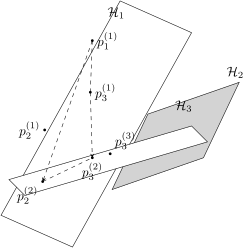 Successive oblique projections for n=3: p_1^{(1)} is projected through p_2^{(1)}, p_3^{(1)} onto \mathcal{H}_2, producing points in \mathcal{H}_1 \cap \mathcal{H}_2.
Step 0. Begin with any set such that is linearly independent and for . Step 1. In turn, project onto through to produce . Step 2. Project onto through to produce , and so on. Step . Project through to produce . Then is the solution. Explain why the following algorithm performs the computations of Steps . For to For to (the solution of the system)
Let be a subspace of , and let . Prove that the orthogonal distance between any point and is the same as the orthogonal distance between and (i.e., reflects everything about ).
In 1938 the Italian mathematician Gianfranco Cimmino used the following elementary observation to construct an iterative algorithm for solving linear systems. For a system , let and be the two lines (hyperplanes) defined by the two equations. For an arbitrary guess , let be the reflection of about the line , and let be the reflection of about the line . As illustrated below, the three points , , and lie on a circle whose center is (the solution of the system).
 The reflections r_1, r_2 of an arbitrary point r_0 about lines \mathcal{H}_1, \mathcal{H}_2 lie, together with r_0, on a circle centered at \mathcal{H}_1 \cap \mathcal{H}_2.
The mean value is strictly inside the circle, so is a better approximation to the solution than . It's visually evident that iteration produces a sequence that converges to the solution of . Prove this in general by using the following blueprint.
For a scalar and a vector such that , consider the hyperplane (Exercise 5.13.17). Show that the reflection of a vector about is .
For a system in which the rows of have been scaled so that for each , let . If is arbitrary, and is the reflection of about , explain why the mean value of the reflections is , where .
Iterating part (b) produces , where . Show that if is nonsingular, and , then .
It can be proven that as , so for all , even if is rank deficient (converging to a solution if consistent, else a least squares solution). Cimmino's method also works with weighted means: if , , , then converges for a relaxation parameter .
For a matrix of random variables, is the matrix whose -entry is . Consider the standard linear model such that , , , and let denote the vector of random variables defined by , in which . Demonstrate that
is an unbiased estimator for .
(5.14.5): under the standard linear model, and if , otherwise. Exercise 5.9.13: for any projector .
Determine the angles and between the following subspaces of .
, .
, .
Determine the principal angles between the following subspaces of .
, .
, .
The principal angles between and are defined recursively: , with the unit vectors attaining the maximum in ; then , , and is the minimal angle between and , and so on.
Let be the minimal angle between nonzero subspaces .
Explain why if and only if .
Explain why if and only if .
Explain why if and only if .
Equation (5.15.16): the maximal angle satisfies .
Let be the minimal angle between nonzero subspaces , and let denote the minimal angle between and . Prove that if , then .
Equation (5.15.4): if are complementary, .
For nonzero subspaces , let denote the minimal angle between and , and let be the maximal angle between and . Prove that if , then .
For subspaces , prove that is nonsingular if and only if and are complementary.
Equation (5.15.7): with U = [U1 | U2], V = [V1 | V2] orthogonal matrices whose columns give orthonormal bases for M, M-perp, N-perp, N respectively (so that P_M = U1 U1^T, P_N = V2 V2^T), U^T (P_M - P_N) V = block-diag(U1^T V1, -U2^T V2).
For complementary spaces , let be the oblique projector onto along , and let be the oblique projector onto along .
Prove that .
If is the minimal angle between and , explain why .
Explain why .
Prove that if is a function defined on a space such that for scalars , then .
Let and be nonzero complementary subspaces of .
Explain why , where and are the orthogonal projectors onto and , respectively, and is the oblique projector onto along .
If is the minimal angle between and , explain why
For complementary subspaces , let be the minimal angle between and , and let denote the minimal angle between and .
If is the oblique projector onto along , prove that .
Explain why .
Let and be the orthogonal matrices whose columns give orthonormal bases for respectively (as in the proof of (5.15.3)-(5.15.4)).
Prove that if is nonsingular, then .
Prove that if is nonsingular, then .