Chapter I

Introduction

[107/91%]
Show
LaTeX
Problem I.1.1

At a ball there are equal numbers of young men and young women present. It is known that for any group of young men there are at least as many young women, each of whom has an acquaintance in that group. Is it possible to form pairs of mutually acquainted partners so that all participants of the ball dance?

?
Problem I.1.2

Let the sequence {rn}\left\{ r_{n}\right\} be defined as follows:

r1=1,r2k=1+rk,r2k+1=1r2k(k∈N). r_{1}=1, \quad r_{2 k}=1+r_{k}, \quad r_{2 k+1}=\frac{1}{r_{2 k}} \quad (k \in \mathbb {N}) .

Prove that the map n↦rnn \mapsto r_{n} is a bijection of the set N\mathbb {N} onto the set Q+=Q∩(0,+∞)\mathbb {Q}_{+}=\mathbb {Q} \cap (0,+\infty ).

?
Problem I.1.3

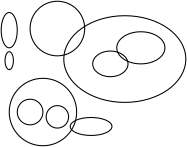
Prove that in the plane one can arrange a continuum of pairwise disjoint fives, but only an at most countable set of eights (Fig. 1 and 2).
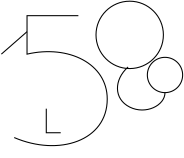
Fig. 1Fig. 1

Fig. 2Fig. 2

?
Problem I.1.4

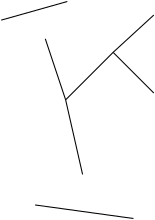
Call a bird's track a set in the plane that is the union of three segments (lying on distinct rays) having a common endpoint — the vertex of the track (Fig. 3). Prove that in the plane one can arrange only an at most countable set of pairwise disjoint bird's tracks.

?
Problem I.1.5

By a T-shaped figure we mean the union of two mutually perpendicular segments, where the midpoint of one of them is an endpoint of the other. Estimate from above the number NN of pairwise disjoint T-shaped figures formed by segments of unit length and contained in a square of side aa.

Fig. 3Fig. 3

?
Problem I.1.6

Prove that in space one can arrange only an at most countable set of pairwise disjoint "hoops" — cylindrical rings of fixed radius (the hoops having zero thickness).

?
Problem I.1.7

After losing all the competitions to Balda, the demons (of whom there were infinitely many) decided to take up physical education and organized sports clubs. Each club contained only finitely many demons, but there were so many clubs that among any infinite group of demons one could find at least two who had joined the same club. Prove that, with the exception of a finite number of lazy demons, each demon was enrolled in an infinite set of clubs.

?
Problem I.1.8

We say that a sequence {An}\left\{ A_{n}\right\} of finite subsets of the set N\mathbb {N} densely covers N\mathbb {N} if for every infinite set B⊂NB \subset \mathbb {N} there is an index mm such that card⁡(B∩Am)⩾2\operatorname {card}\left(B \cap A_{m}\right) \geqslant 2. Prove that

?
(a)

the natural numbers belonging to only finitely many of the sets AnA_{n} form a finite set;

(b)

there exists an infinite set E⊂NE \subset \mathbb {N} such that for every number k∈Ek \in E the inclusion E\⋃n:An∋kAn⊂{1,…,k−1}E \backslash \bigcup_{n: A_{n} \ni k} A_{n} \subset \left\{ 1, \ldots , k-1\right\} holds.

Problem I.1.9

Prove that if {An},{Bn}\left\{ A_{n}\right\} ,\left\{ B_{n}\right\} are two sequences of finite sets, each of which densely covers N\mathbb {N} (see Problem 1.8), then there exist indices pp and qq such that card⁡(Ap∩Bq)⩾2\operatorname {card}\left(A_{p} \cap B_{q}\right) \geqslant 2.

A binary sequence is a sequence "consisting of zeros and ones," i.e., a sequence ε={εk}\varepsilon =\left\{ \varepsilon_{k}\right\} where εk=0\varepsilon_{k}=0 or 1 for every k∈Nk \in \mathbb {N}. We shall denote the set of all binary sequences by the letter Ξ.

Speaking of sets whose elements are themselves sets, we shall use the term "system of sets."

?
Problem I.1.10

Let P(N)\mathscr {P}(\mathbb {N}) be the system of all possible subsets of the set N\mathbb {N}. Prove that

?
(a)

the sets Ξ\Xi and P(N)\mathscr {P}(\mathbb {N}) are equipotent;

(b)

the sets Ξ\Xi and Ξ×Ξ\Xi \times \Xi are equipotent.

Problem I.1.11

Prove that the set Ξ\Xi has the cardinality of the continuum.

?
Problem I.1.12

Prove that the sets R2\mathbb {R}^{2} and R3\mathbb {R}^{3} have the cardinality of the continuum.

?
Problem I.1.13

Prove that the set RN\mathbb {R}^{\mathbb {N}} of all sequences of real numbers has the cardinality of the continuum.

?
Problem I.1.14

Prove that the set of continuous functions defined on the interval [a,b]\left[a, b\right] has the cardinality of the continuum.

?
Problem I.1.15

Does there exist a system A\mathfrak {A} of subsets of the set N\mathbb {N} satisfying the conditions:

?
(a)

A\mathfrak {A} has the cardinality of the continuum;

(b)

card⁡(A∩B)<+∞\operatorname {card}(A \cap B)<+\infty for any A,B∈A,A≠BA, B \in \mathfrak {A}, A \neq B ?

Problem I.1.16

Does there exist a system A\mathfrak {A} of subsets of the set N\mathbb {N} satisfying the conditions:

?
(a)

A\mathfrak {A} has the cardinality of the continuum;

(b)

for any number tt and any distinct sets A,B∈AA, B \in \mathfrak {A} the inequality ∣a−b∣<t\left|a-b\right|<t holds only for finitely many points a∈A,b∈Ba \in A, b \in B ?

Problem I.1.17

Does there exist a system A\mathfrak {A} of subsets of the set N\mathbb {N} satisfying the conditions:

?
(a)

A\mathfrak {A} has the cardinality of the continuum;

(b)

the system A\mathfrak {A} is linearly ordered by inclusion, i.e., of any two sets belonging to A\mathfrak {A}, one is contained in the other?

Problem I.1.18

Let F(N)={A⊂N∣card⁡(A)<+∞}\mathscr {F}(\mathbb {N})=\left\{ A \subset \mathbb {N} \mid \operatorname {card}(A)<+\infty \right\} be the system of all finite subsets of the set N\mathbb {N}. Prove that

?
(a)

the system F(N)\mathscr {F}(\mathbb {N}) is countable;

(b)

there exists a bijection φ:F(N)→N\varphi : \mathscr {F}(\mathbb {N}) \rightarrow \mathbb {N} such that φ(A)⩽φ(B)\varphi (A) \leqslant \varphi (B) if A⊂B(A,B∈F(N))A \subset B(A, B \in \mathscr {F}(\mathbb {N})).

Problem I.1.19
?
(a)

Introduce on the set R+=(0,+∞)\mathbb {R}_{+}=(0,+\infty ) an equivalence relation by declaring x∼yx \sim y if xy∈Q\frac{x}{y} \in \mathbb {Q}. Prove that the intersection of each equivalence class with any (nonempty) interval contained in R+\mathbb {R}_{+} is nonempty.

(b)

Introduce on the circle S1={z∈C∣∣z∣=1}S^{1}=\left\{ z \in \mathbb {C} \mid \left|z\right|=1\right\} an equivalence relation by declaring z∼ξz \sim \xi if zξ=e2πiθ\frac{z}{\xi }=e^{2 \pi i \theta }, where θ∈Q\theta \in \mathbb {Q}. Prove that the set of limit points of any equivalence class coincides with S1S^{1}.

Problem I.1.20

Let S1={z∈C∣∣z∣=1}S^{1}=\left\{ z \in \mathbb {C} \mid \left|z\right|=1\right\}. Sets A,B⊂S1A, B \subset S^{1} are called congruent if there exists a number α∈R\alpha \in \mathbb {R} such that B={zeiα∣z∈A}B=\left\{ z e^{i \alpha } \mid z \in A\right\}, i.e., ``the set BB is obtained from the set AA by a rotation through the angle α\alpha''. Prove that there exists a sequence {En}\left\{ E_{n}\right\} of pairwise disjoint congruent sets such that S1=⋃n⩾1EnS^{1}=\bigcup_{n \geqslant 1} E_{n}.

?
Problem I.1.21

Let E⊂RE \subset \mathbb {R} and x+y2.∈E\frac{x+y}{2} . \in E for any x,y∈Ex, y \in E.

?
(a)

Is it true that E⊃[500,1500]E \supset [500,1500] if E⊃[0,1]E \supset [0,1] and 2001∈E2001 \in E ?

(b)

Prove that if Int⁡(E)≠∅\operatorname {Int}(E) \neq \varnothing, then EE is an interval.

Problem I.1.22

Find all limit points of the sets

?
(a)

{n−1+m−1∣m,n∈N}\left\{ n^{-1}+m^{-1} \mid m, n \in \mathbb {N}\right\};

(b)

{m+n2∣m,n∈Z}\left\{ m+n \sqrt{2} \mid m, n \in \mathbb {Z}\right\};

(c)

{m−n∣m,n∈N}\left\{ \sqrt{m}-\sqrt{n} \mid m, n \in \mathbb {N}\right\};

(d)

{m−nm+n∣ m,n∈N}\left\{ \left.\frac{\sqrt{m}-\sqrt{n}}{\sqrt{m}+\sqrt{n}} \right\rvert \, m, n \in \mathbb {N}\right\}.

Problem I.1.23

Let E⊂R+,E≠∅E \subset \mathbb {R}_{+}, E \neq \varnothing. Prove that if x2+y2∈E\sqrt{x^{2}+y^{2}} \in E and x2∈E\frac{x}{2} \in E for any x,y∈Ex, y \in E, then Eˉ=[0,+∞)\bar{E}=[0,+\infty ).

?
Problem I.1.24

Let E⊂R2E \subset \mathbb {R}^{2}. Prove that

?
(a)

if a family of open disks {Bα}α∈A\left\{ B_{\alpha }\right\}_{\alpha \in A} is such that E⊂⋃α∈ABαE \subset \bigcup_{\alpha \in A} B_{\alpha }, then there exists an at most countable set A0⊂AA_{0} \subset A such that E⊂⋃α∈A0BαE \subset \bigcup_{\alpha \in A_{0}} B_{\alpha };

(b)

there exists an at most countable subset of the set EE whose closure contains EE.

Problem I.1.25
?
(a)

A set is called discrete if every point of it is isolated. Prove that every discrete set in the plane is at most countable, and its closure cannot have interior points.

(b)

A point aa of a set E⊂RE \subset \mathbb {R} will be called semi-isolated if there exists ε>0\varepsilon >0 such that at least one of the intervals (a−ε,a),(a,a+ε)(a-\varepsilon , a),(a, a+\varepsilon ) contains no points of the set EE. Prove that the set of semi-isolated points of any set E⊂RE \subset \mathbb {R} is at most countable.

Problem I.1.26

Let E⊂N,card⁡E=+∞E \subset \mathbb {N}, \operatorname {card} E=+\infty. Prove the existence of a number a>1a>1 such that infinitely many numbers [ak](k∈N)\left[a^{k}\right](k \in \mathbb {N}) are contained in EE.

?
Problem I.1.27

Let GG be an open subset of R\mathbb {R} that is unbounded above. Does there exist a positive number x0x_{0} such that the set GG contains infinitely many points of the form nx0(n∈N)n x_{0}(n \in \mathbb {N}) ?

?
Problem I.1.28

Let {Gm}\left\{ G_{m}\right\} be a sequence of open subsets of R\mathbb {R} that are unbounded above. Prove that there exists a number x0>0x_{0}>0 such that every set GmG_{m} contains infinitely many points of the form nx0(n∈N)n x_{0}(n \in \mathbb {N}).

?
Problem I.1.29

Prove that

?
(a)

the set CC has the cardinality of the continuum;

(b)

the set CC is closed and has no isolated points;

(c)

the sum of the lengths of the intervals making up the set [0,1]\C\left[0,1\right] \backslash C equals one.

Remark.
?

The classical Cantor set CC can be briefly described as follows. It is obtained by removing from the interval [0,1]\left[0,1\right] a countable family of intervals. First, one interval is discarded — the central third of the original interval [0,1]\left[0,1\right] (i.e., (13,23)\left(\frac{1}{3}, \frac{2}{3}\right)), then the central thirds are removed from the two remaining segments, and so on. The points of [0,1]\left[0,1\right] that do not fall into any of the removed intervals form the Cantor set CC.

Problem I.1.30
?
(a)

Prove that a number tt belongs to CC if and only if it can be represented in the form t=∑2εj3jt=\sum \frac{2 \varepsilon_{j}}{3^{j}}, where εj\varepsilon_{j} equals zero or one.

(b)

Describe the sets

C−C={s−t∣s,t∈C} and C+C={s+t∣s,t∈C}. C-C=\left\{ s-t \mid s, t \in C\right\} \quad \text{ and } \quad C+C=\left\{ s+t \mid s, t \in C\right\} .
Remark.
?

The classical Cantor set CC can be briefly described as follows. It is obtained by removing from the interval [0,1]\left[0,1\right] a countable family of intervals. First, one interval is discarded — the central third of the original interval [0,1]\left[0,1\right] (i.e., (13,23)\left(\frac{1}{3}, \frac{2}{3}\right)), then the central thirds are removed from the two remaining segments, and so on. The points of [0,1]\left[0,1\right] that do not fall into any of the removed intervals form the Cantor set CC.

Problem I.1.31

Let KK be a set with constant ratio θ\theta, constructed on the interval Δ=[0,L]\Delta =\left[0, L\right]. Let ε={ε1,ε2,…}\varepsilon =\left\{ \varepsilon_{1}, \varepsilon_{2}, \ldots \right\} be an arbitrary binary sequence, and let t(ε)t(\varepsilon ) be the unique point in the intersection ⋂n⩾1Δε1…εn\bigcap_{n \geqslant 1} \Delta_{\varepsilon_{1} \ldots \varepsilon_{n}}. Prove that

?
(a)

∣Δε1…εn∣=Lθn,∣δε1…εn∣=L(1−2θ)θn\left|\Delta_{\varepsilon_{1} \ldots \varepsilon_{n}}\right|=L \theta^{n}, \quad \left|\delta_{\varepsilon_{1} \ldots \varepsilon_{n}}\right|=L(1-2 \theta ) \theta^{n};

(b)

the left endpoint of the segment Δε1…εn\Delta_{\varepsilon_{1} \ldots \varepsilon_{n}} equals L1−θθ∑1⩽k⩽nεkθkL \frac{1-\theta }{\theta } \sum_{1 \leqslant k \leqslant n} \varepsilon_{k} \theta^{k};

(c)

t(ε)=L1−θθ∑k⩾1εkθkt(\varepsilon )=L \frac{1-\theta }{\theta } \sum_{k \geqslant 1} \varepsilon_{k} \theta^{k};

(d)

the interval δσ1…σn\delta_{\sigma_{1} \ldots \sigma_{n}} lies to the left of the point t(ε)t(\varepsilon ) if and only if (σ1…σn)≺ε\left(\sigma_{1} \ldots \sigma_{n}\right) \prec \varepsilon; the latter means that the "words" (σ1…σn)\left(\sigma_{1} \ldots \sigma_{n}\right) and ε\varepsilon are ordered essentially lexicographically, more precisely: either there exists a natural number m,1⩽m⩽nm, 1 \leqslant m \leqslant n, such that σm=0,εm=1\sigma_{m}=0, \varepsilon_{m}=1 and σj=εj\sigma_{j}=\varepsilon_{j} for j<mj<m, or σj=εj\sigma_{j}=\varepsilon_{j} for all j=1,…,nj=1, \ldots , n and εn+1=1\varepsilon_{n+1}=1;

(e)

t(ε)=ε1∣δ∣+∑n⩾1∑(σ1…σn)≺ε∣δσ1…σn∣t(\varepsilon )=\varepsilon_{1}\left|\delta \right|+\sum_{n \geqslant 1} \sum_{\left(\sigma_{1} \ldots \sigma_{n}\right) \prec \varepsilon }\left|\delta_{\sigma_{1} \ldots \sigma_{n}}\right|.

Remark.
?

Let Δ=[a,b]\Delta =\left[a, b\right] be an arbitrary nondegenerate segment. The set K1K_{1} is obtained by removing from Δ\Delta a nonempty interval δ=(p,q)\delta =(p, q) whose endpoints do not coincide with aa and bb. In other words, K1K_{1} is the union of two nondegenerate segments Δ0=[a,p]\Delta_{0}=\left[a, p\right] and Δ1=[q,b]\Delta_{1}=\left[q, b\right], which we shall call segments of the first rank. The set K2K_{2} is obtained after removing from the segments Δ0\Delta_{0} and Δ1\Delta_{1} the intervals δ0,δ1\delta_{0}, \delta_{1}, whose endpoints do not coincide with the endpoints of Δ0\Delta_{0} and Δ1\Delta_{1} respectively. The difference Δε\δε(ε=0,1)\Delta_{\varepsilon } \backslash \delta_{\varepsilon }(\varepsilon =0,1) consists of two nondegenerate segments, of which we denote the left one by Δε0\Delta_{\varepsilon 0}, and the right one by Δε1\Delta_{\varepsilon 1}. Thus, K2K_{2} is the union of four segments Δ00,Δ01,Δ10,Δ11\Delta_{00}, \Delta_{01}, \Delta_{10}, \Delta_{11}, which we shall call segments of the second rank. The further construction continues by induction. Suppose the set KnK_{n}, consisting of segments of rank nn, has been constructed. It is convenient to ``number'' the segments of rank nn by means of indices ε1,…,εn\varepsilon_{1}, \ldots , \varepsilon_{n}, where εj\varepsilon_{j} may take the value 0 or 1. The indices of the segments of the first and second ranks have already been specified; the further indexing proceeds as follows. In constructing the segments of rank (n+1)(n+1), a nonempty interval δε1…εn\delta_{\varepsilon_{1} \ldots \varepsilon_{n}}, whose endpoints do not coincide with the endpoints of the segment Δε1…εn\Delta_{\varepsilon_{1} \ldots \varepsilon_{n}}, is removed from each segment of rank nn, Δε1…εn\Delta_{\varepsilon_{1} \ldots \varepsilon_{n}}. The difference Δε1…εn\δε1…εn\Delta_{\varepsilon_{1} \ldots \varepsilon_{n}} \backslash \delta_{\varepsilon_{1} \ldots \varepsilon_{n}} consists of two segments of rank (n+1)(n+1), of which the left one is denoted Δε1…εn0\Delta_{\varepsilon_{1} \ldots \varepsilon_{n} 0}, and the right one Δε1…εn1\Delta_{\varepsilon_{1} \ldots \varepsilon_{n} 1}. The set Kn+1K_{n+1} is the union of all segments of rank (n+1)(n+1). Finally, let K=⋂n⩾1KnK=\bigcap_{n \geqslant 1} K_{n}. If the set KK has no interior points, it is called a generalized Cantor set.

We obtain an important example of a generalized Cantor set if the lengths of all segments of a given rank are equal. In this case the lengths of all the intervals δε1,…εn\delta_{\varepsilon_{1}, \ldots \varepsilon_{n}} (for fixed nn) are also equal, and these intervals are located symmetrically with respect to the midpoints of the segments Δε1…εn\Delta_{\varepsilon_{1} \ldots \varepsilon_{n}}. We shall call such sets homogeneous generalized Cantor sets. Set ∣Δ∣=l0,∣Δε1…εn∣=ln\left|\Delta \right|=l_{0},\left|\Delta_{\varepsilon_{1} \ldots \varepsilon_{n}}\right|=l_{n}, where the symbol ∣ω∣\left|\omega \right| denotes the length of the interval ω\omega. The sequence {ln}n⩾0\left\{ l_{n}\right\}_{n \geqslant 0} will be called the defining sequence of the generalized homogeneous Cantor set. It is easy to see that every positive sequence {ln}n⩾0\left\{ l_{n}\right\}_{n \geqslant 0} satisfying the condition 2ln<ln−12 l_{n}<l_{n-1} for all n∈Nn \in \mathbb {N} can be the defining sequence for some generalized Cantor set, which is unique up to congruence.

If the quantity θ=lnln−1\theta =\frac{l_{n}}{l_{n-1}} is the same for all n∈Nn \in \mathbb {N}, then the generalized Cantor set defined by the sequence {ln}n⩾0\left\{ l_{n}\right\}_{n \geqslant 0} will be called a set of constant ratio. Clearly, θ\theta can be any number from the interval (0,12)\left(0, \frac{1}{2}\right). We obtain the classical Cantor set CC when Δ=[0,1]\Delta =\left[0,1\right] and θ=13\theta =\frac{1}{3}.

Problem I.1.32

Consider the set KK described in the construction of the generalized Cantor set. Prove that it

?
(a)

has the cardinality of the continuum;

(b)

is closed and has no isolated points;

(c)

is a generalized Cantor set if and only if Ln→0L_{n} \rightarrow 0, where LnL_{n} is the maximal length of the rank-nn segments.

Remark.
?

Let Δ=[a,b]\Delta =\left[a, b\right] be an arbitrary nondegenerate segment. The set K1K_{1} is obtained by removing from Δ\Delta a nonempty interval δ=(p,q)\delta =(p, q) whose endpoints do not coincide with aa and bb. In other words, K1K_{1} is the union of two nondegenerate segments Δ0=[a,p]\Delta_{0}=\left[a, p\right] and Δ1=[q,b]\Delta_{1}=\left[q, b\right], which we shall call segments of the first rank. The set K2K_{2} is obtained after removing from the segments Δ0\Delta_{0} and Δ1\Delta_{1} the intervals δ0,δ1\delta_{0}, \delta_{1}, whose endpoints do not coincide with the endpoints of Δ0\Delta_{0} and Δ1\Delta_{1} respectively. The difference Δε\δε(ε=0,1)\Delta_{\varepsilon } \backslash \delta_{\varepsilon }(\varepsilon =0,1) consists of two nondegenerate segments, of which we denote the left one by Δε0\Delta_{\varepsilon 0}, and the right one by Δε1\Delta_{\varepsilon 1}. Thus, K2K_{2} is the union of four segments Δ00,Δ01,Δ10,Δ11\Delta_{00}, \Delta_{01}, \Delta_{10}, \Delta_{11}, which we shall call segments of the second rank. The further construction continues by induction. Suppose the set KnK_{n}, consisting of segments of rank nn, has been constructed. It is convenient to ``number'' the segments of rank nn by means of indices ε1,…,εn\varepsilon_{1}, \ldots , \varepsilon_{n}, where εj\varepsilon_{j} may take the value 0 or 1. The indices of the segments of the first and second ranks have already been specified; the further indexing proceeds as follows. In constructing the segments of rank (n+1)(n+1), a nonempty interval δε1…εn\delta_{\varepsilon_{1} \ldots \varepsilon_{n}}, whose endpoints do not coincide with the endpoints of the segment Δε1…εn\Delta_{\varepsilon_{1} \ldots \varepsilon_{n}}, is removed from each segment of rank nn, Δε1…εn\Delta_{\varepsilon_{1} \ldots \varepsilon_{n}}. The difference Δε1…εn\δε1…εn\Delta_{\varepsilon_{1} \ldots \varepsilon_{n}} \backslash \delta_{\varepsilon_{1} \ldots \varepsilon_{n}} consists of two segments of rank (n+1)(n+1), of which the left one is denoted Δε1…εn0\Delta_{\varepsilon_{1} \ldots \varepsilon_{n} 0}, and the right one Δε1…εn1\Delta_{\varepsilon_{1} \ldots \varepsilon_{n} 1}. The set Kn+1K_{n+1} is the union of all segments of rank (n+1)(n+1). Finally, let K=⋂n⩾1KnK=\bigcap_{n \geqslant 1} K_{n}. If the set KK has no interior points, it is called a generalized Cantor set.

Problem I.1.33

Prove that for any two points of a homogeneous generalized Cantor set KK that are not endpoints of the complementary intervals, sufficiently small relative neighborhoods are congruent (the relative neighborhood of a point x∈Kx \in K is the intersection of KK with an interval containing xx).

?
Remark.
?

Let Δ=[a,b]\Delta =\left[a, b\right] be an arbitrary nondegenerate segment. The set K1K_{1} is obtained by removing from Δ\Delta a nonempty interval δ=(p,q)\delta =(p, q) whose endpoints do not coincide with aa and bb. In other words, K1K_{1} is the union of two nondegenerate segments Δ0=[a,p]\Delta_{0}=\left[a, p\right] and Δ1=[q,b]\Delta_{1}=\left[q, b\right], which we shall call segments of the first rank. The set K2K_{2} is obtained after removing from the segments Δ0\Delta_{0} and Δ1\Delta_{1} the intervals δ0,δ1\delta_{0}, \delta_{1}, whose endpoints do not coincide with the endpoints of Δ0\Delta_{0} and Δ1\Delta_{1} respectively. The difference Δε\δε(ε=0,1)\Delta_{\varepsilon } \backslash \delta_{\varepsilon }(\varepsilon =0,1) consists of two nondegenerate segments, of which we denote the left one by Δε0\Delta_{\varepsilon 0}, and the right one by Δε1\Delta_{\varepsilon 1}. Thus, K2K_{2} is the union of four segments Δ00,Δ01,Δ10,Δ11\Delta_{00}, \Delta_{01}, \Delta_{10}, \Delta_{11}, which we shall call segments of the second rank. The further construction continues by induction. Suppose the set KnK_{n}, consisting of segments of rank nn, has been constructed. It is convenient to ``number'' the segments of rank nn by means of indices ε1,…,εn\varepsilon_{1}, \ldots , \varepsilon_{n}, where εj\varepsilon_{j} may take the value 0 or 1. The indices of the segments of the first and second ranks have already been specified; the further indexing proceeds as follows. In constructing the segments of rank (n+1)(n+1), a nonempty interval δε1…εn\delta_{\varepsilon_{1} \ldots \varepsilon_{n}}, whose endpoints do not coincide with the endpoints of the segment Δε1…εn\Delta_{\varepsilon_{1} \ldots \varepsilon_{n}}, is removed from each segment of rank nn, Δε1…εn\Delta_{\varepsilon_{1} \ldots \varepsilon_{n}}. The difference Δε1…εn\δε1…εn\Delta_{\varepsilon_{1} \ldots \varepsilon_{n}} \backslash \delta_{\varepsilon_{1} \ldots \varepsilon_{n}} consists of two segments of rank (n+1)(n+1), of which the left one is denoted Δε1…εn0\Delta_{\varepsilon_{1} \ldots \varepsilon_{n} 0}, and the right one Δε1…εn1\Delta_{\varepsilon_{1} \ldots \varepsilon_{n} 1}. The set Kn+1K_{n+1} is the union of all segments of rank (n+1)(n+1). Finally, let K=⋂n⩾1KnK=\bigcap_{n \geqslant 1} K_{n}. If the set KK has no interior points, it is called a generalized Cantor set.

We obtain an important example of a generalized Cantor set if the lengths of all segments of a given rank are equal. In this case the lengths of all the intervals δε1,…εn\delta_{\varepsilon_{1}, \ldots \varepsilon_{n}} (for fixed nn) are also equal, and these intervals are located symmetrically with respect to the midpoints of the segments Δε1…εn\Delta_{\varepsilon_{1} \ldots \varepsilon_{n}}. We shall call such sets homogeneous generalized Cantor sets.

Problem I.1.34

Let ν={nk}\nu =\left\{ n_{k}\right\} be a strictly increasing sequence of natural numbers,

Eν={∑εk2−nk∣εk=0 or 1}. E_{\nu }=\left\{ \sum \varepsilon _{k} 2^{-n_{k}} \mid \varepsilon _{k}=0 \text{ or } 1\right\} .

Prove that

?
(a)

the set EνE_{\nu } is closed and has no isolated points;

(b)

the following statements are equivalent:

  1. EνE_{\nu } contains no interior points;

  2. nk+1>1+nkn_{k+1}>1+n_{k} infinitely many times;

  3. for any number t∈Eνt \in E_{\nu } the expansion t=∑εk2−nkt=\sum \varepsilon_{k} 2^{-n_{k}} (where εk=0\varepsilon_{k}=0 or 1) is unique;

  4. EνE_{\nu } is a homogeneous generalized Cantor set.

What is the defining sequence of the set EνE_{\nu }? When is EνE_{\nu } a set with constant ratio?

Remark.
?

Let Δ=[a,b]\Delta =\left[a, b\right] be an arbitrary nondegenerate segment. The set K1K_{1} is obtained by removing from Δ\Delta a nonempty interval δ=(p,q)\delta =(p, q) whose endpoints do not coincide with aa and bb. In other words, K1K_{1} is the union of two nondegenerate segments Δ0=[a,p]\Delta_{0}=\left[a, p\right] and Δ1=[q,b]\Delta_{1}=\left[q, b\right], which we shall call segments of the first rank. The set K2K_{2} is obtained after removing from the segments Δ0\Delta_{0} and Δ1\Delta_{1} the intervals δ0,δ1\delta_{0}, \delta_{1}, whose endpoints do not coincide with the endpoints of Δ0\Delta_{0} and Δ1\Delta_{1} respectively. The difference Δε\δε(ε=0,1)\Delta_{\varepsilon } \backslash \delta_{\varepsilon }(\varepsilon =0,1) consists of two nondegenerate segments, of which we denote the left one by Δε0\Delta_{\varepsilon 0}, and the right one by Δε1\Delta_{\varepsilon 1}. Thus, K2K_{2} is the union of four segments Δ00,Δ01,Δ10,Δ11\Delta_{00}, \Delta_{01}, \Delta_{10}, \Delta_{11}, which we shall call segments of the second rank. The further construction continues by induction. Suppose the set KnK_{n}, consisting of segments of rank nn, has been constructed. It is convenient to ``number'' the segments of rank nn by means of indices ε1,…,εn\varepsilon_{1}, \ldots , \varepsilon_{n}, where εj\varepsilon_{j} may take the value 0 or 1. The indices of the segments of the first and second ranks have already been specified; the further indexing proceeds as follows. In constructing the segments of rank (n+1)(n+1), a nonempty interval δε1…εn\delta_{\varepsilon_{1} \ldots \varepsilon_{n}}, whose endpoints do not coincide with the endpoints of the segment Δε1…εn\Delta_{\varepsilon_{1} \ldots \varepsilon_{n}}, is removed from each segment of rank nn, Δε1…εn\Delta_{\varepsilon_{1} \ldots \varepsilon_{n}}. The difference Δε1…εn\δε1…εn\Delta_{\varepsilon_{1} \ldots \varepsilon_{n}} \backslash \delta_{\varepsilon_{1} \ldots \varepsilon_{n}} consists of two segments of rank (n+1)(n+1), of which the left one is denoted Δε1…εn0\Delta_{\varepsilon_{1} \ldots \varepsilon_{n} 0}, and the right one Δε1…εn1\Delta_{\varepsilon_{1} \ldots \varepsilon_{n} 1}. The set Kn+1K_{n+1} is the union of all segments of rank (n+1)(n+1). Finally, let K=⋂n⩾1KnK=\bigcap_{n \geqslant 1} K_{n}. If the set KK has no interior points, it is called a generalized Cantor set.

We obtain an important example of a generalized Cantor set if the lengths of all segments of a given rank are equal. In this case the lengths of all the intervals δε1,…εn\delta_{\varepsilon_{1}, \ldots \varepsilon_{n}} (for fixed nn) are also equal, and these intervals are located symmetrically with respect to the midpoints of the segments Δε1…εn\Delta_{\varepsilon_{1} \ldots \varepsilon_{n}}. We shall call such sets homogeneous generalized Cantor sets. Set ∣Δ∣=l0,∣Δε1…εn∣=ln\left|\Delta \right|=l_{0},\left|\Delta_{\varepsilon_{1} \ldots \varepsilon_{n}}\right|=l_{n}, where the symbol ∣ω∣\left|\omega \right| denotes the length of the interval ω\omega. The sequence {ln}n⩾0\left\{ l_{n}\right\}_{n \geqslant 0} will be called the defining sequence of the generalized homogeneous Cantor set. It is easy to see that every positive sequence {ln}n⩾0\left\{ l_{n}\right\}_{n \geqslant 0} satisfying the condition 2ln<ln−12 l_{n}<l_{n-1} for all n∈Nn \in \mathbb {N} can be the defining sequence for some generalized Cantor set, which is unique up to congruence.

If the quantity θ=lnln−1\theta =\frac{l_{n}}{l_{n-1}} is the same for all n∈Nn \in \mathbb {N}, then the generalized Cantor set defined by the sequence {ln}n⩾0\left\{ l_{n}\right\}_{n \geqslant 0} will be called a set of constant ratio. Clearly, θ\theta can be any number from the interval (0,12)\left(0, \frac{1}{2}\right). We obtain the classical Cantor set CC when Δ=[0,1]\Delta =\left[0,1\right] and θ=13\theta =\frac{1}{3}.

Problem I.1.35

Let a set E⊂RE \subset \mathbb {R} have the property: between any two of its points there is a third point from this set. Must the closure of the set EE contain a nonempty interval?

?
Problem I.1.36

Construct in the plane a discrete set (see problem 1.25) whose closure has the cardinality of the continuum. Does there exist a discrete set on the line with the same property?

?
Problem I.1.37

Let {Δε1…εn}\left\{ \Delta_{\varepsilon_{1} \ldots \varepsilon_{n}}\right\}, where n∈Nn \in \mathbb {N} and εj\varepsilon_{j} take the values 0 or 11, be a family of nonempty bounded open intervals satisfying the conditions: 1) Δε1…εn⊃Δε1…εn0∪Δε1…εn1\Delta_{\varepsilon_{1} \ldots \varepsilon_{n}} \supset \Delta_{\varepsilon_{1} \ldots \varepsilon_{n} 0} \cup \Delta_{\varepsilon_{1} \ldots \varepsilon_{n} 1}; 2) for each n∈Nn \in \mathbb {N} the intervals Δε1…εn\Delta_{\varepsilon_{1} \ldots \varepsilon_{n}} and Δε1′…εn′\Delta_{\varepsilon_{1}^{\prime } \ldots \varepsilon_{n}^{\prime }} do not intersect if (ε1…εn)≠(ε1′…εn′)\left(\varepsilon_{1} \ldots \varepsilon_{n}\right) \neq \left(\varepsilon_{1}^{\prime } \ldots \varepsilon_{n}^{\prime }\right).

Set

Gn=⋃ε1,…,εn∈{0,1}Δε1…εn G_{n}=\bigcup _{\varepsilon _{1}, \ldots , \varepsilon _{n} \in \left\{ 0,1\right\} } \Delta _{\varepsilon _{1} \ldots \varepsilon _{n}}

Prove that the set A=⋂n⩾1GnA=\bigcap_{n \geqslant 1} G_{n} has the cardinality of the continuum.

?
Problem I.1.38

Prove that a nonempty interval cannot be represented as the union of a sequence of pairwise disjoint closed sets.

?
Problem I.1.39

Prove that the plane cannot be covered by a family of closed disks with no common interior points.

?
Problem I.1.40

Let the union of sets En⊂R(n∈N)E_{n} \subset \mathbb {R}(n \in \mathbb {N}) have an interior point. Prove that the closure of at least one set EnE_{n} has an interior point.

?
Problem I.1.41

Prove that the set of irrational numbers is not a union of a sequence of closed sets.

?
Problem I.2.1

Prove that for any finite sequence {ak}k=1n\left\{ a_{k}\right\}_{k=1}^{n} of real numbers

?
(a)

there exists an index m∈{0,1,…,n}m \in \left\{ 0,1, \ldots , n\right\} such that

∣∑1⩽k⩽mak−∑m<k⩽nak∣⩽max⁡1⩽k⩽n∣ak∣ \left|\sum _{1 \leqslant k \leqslant m} a_{k}-\sum _{m<k \leqslant n} a_{k}\right| \leqslant \max _{1 \leqslant k \leqslant n}\left|a_{k}\right|

(for m=0m=0 the first sum is taken to be zero, for m=nm=n — the second);

(b)

the inequality

max⁡1⩽k⩽n∣ak∣⩽12n∑εk=±1∣∑1⩽k⩽nεkak∣ \max _{1 \leqslant k \leqslant n}\left|a_{k}\right| \leqslant \frac{1}{2^{n}} \sum _{\varepsilon _{k}= \pm 1}\left|\sum _{1 \leqslant k \leqslant n} \varepsilon _{k} a_{k}\right|

holds (the sum is over all possible sign assignments ε1,…,εn\varepsilon_{1}, \ldots , \varepsilon_{n}).

Problem I.2.2

Let {ak}k=1n\left\{ a_{k}\right\}_{k=1}^{n} and {bk}k=1n\left\{ b_{k}\right\}_{k=1}^{n} be finite nonnegative sequences, with the sequence {ak}\left\{ a_{k}\right\} nonincreasing; B=max⁡1⩽k⩽nbkB=\max_{1 \leqslant k \leqslant n} b_{k}. Prove that if the indices m,Mm, M do not exceed nn and satisfy the inequality mB⩽∑1⩽k⩽nbk⩽MBm B \leqslant \sum_{1 \leqslant k \leqslant n} b_{k} \leqslant M B, then

B∑n−m<k⩽nak⩽∑1⩽k⩽nakbk⩽B∑1⩽k⩽Mak. B \sum _{n-m<k \leqslant n} a_{k} \leqslant \sum _{1 \leqslant k \leqslant n} a_{k} b_{k} \leqslant B \sum _{1 \leqslant k \leqslant M} a_{k} .
?
Problem I.2.3

Let {ak}k=1n\left\{ a_{k}\right\}_{k=1}^{n} be a finite sequence of positive numbers and M=max⁡1⩽k⩽nak,m=min⁡1⩽k⩽nakM=\max_{1 \leqslant k \leqslant n} a_{k}, m=\min_{1 \leqslant k \leqslant n} a_{k}. Prove that

?
(a)

2nmM⩽∑1⩽k⩽nakM+∑1⩽k⩽nmak⩽n(1+mM)2 n \sqrt{\frac{m}{M}} \leqslant \sum_{1 \leqslant k \leqslant n} \frac{a_{k}}{M}+\sum_{1 \leqslant k \leqslant n} \frac{m}{a_{k}} \leqslant n\left(1+\frac{m}{M}\right);

(b)

n2⩽∑1⩽k⩽nak∑1⩽k⩽n1ak⩽n2(m+M)24mMn^{2} \leqslant \sum_{1 \leqslant k \leqslant n} a_{k} \sum_{1 \leqslant k \leqslant n} \frac{1}{a_{k}} \leqslant n^{2} \frac{(m+M)^{2}}{4 m M}.

Problem I.2.4

Let {qk}k=1n\left\{ q_{k}\right\}_{k=1}^{n} be a finite sequence of numbers, with qk⩾1q_{k} \geqslant 1 for all kk. Prove the inequality

1+1+…+1qnq2q1⩽1+1q1+1q1q2+…+1q1q2…qn. \sqrt[q_{1}]{1+\sqrt[q_{2}]{1+\ldots +\sqrt[q_{n}]{1}}} \leqslant 1+\frac{1}{q_{1}}+\frac{1}{q_{1} q_{2}}+\ldots +\frac{1}{q_{1} q_{2} \ldots q_{n}} .
?
Problem I.2.5

Let {ak}k=1n\left\{ a_{k}\right\}_{k=1}^{n} be a finite sequence of nonnegative numbers, with S=a1+a2+…+an<1S=a_{1}+a_{2}+\ldots +a_{n}<1. Prove the inequalities

1+S⩽∏1⩽k⩽n(1+ak)⩽11−Sˉ,1−S⩽∏1⩽k⩽n(1−ak)⩽11+Sˉ; 1+S \leqslant \prod _{1 \leqslant k \leqslant n}\left(1+a_{k}\right) \leqslant \frac{1}{1-\bar{S}}, \quad 1-S \leqslant \prod _{1 \leqslant k \leqslant n}\left(1-a_{k}\right) \leqslant \frac{1}{1+\bar{S}} ;

the right-hand inequalities are strict if S>0S>0; the left-hand inequalities are strict if at least two of the numbers {ak}k=1n\left\{ a_{k}\right\}_{k=1}^{n} are positive.

?
Problem I.2.6

Let {ak}k=1n\left\{ a_{k}\right\}_{k=1}^{n} be a finite sequence of real numbers, with ak>−1a_{k}>-1 for k=1,…,nk=1, \ldots , n. Prove that

?
(a)

if S=a1+…+an⩾0S=a_{1}+\ldots +a_{n} \geqslant 0, then

∏1⩽k⩽n(1+ak)⩽1+S1!+…+Snn!; \prod _{1 \leqslant k \leqslant n}\left(1+a_{k}\right) \leqslant 1+\frac{S}{1!}+\ldots +\frac{S^{n}}{n!} ;

equality is possible only in the cases where n=1n=1 or a1=a2==…=an=0a_{1}=a_{2}= =\ldots =a_{n}=0;

(b)

if σ=a11+a1+…+an1+an⩾0\sigma =\frac{a_{1}}{1+a_{1}}+\ldots +\frac{a_{n}}{1+a_{n}} \geqslant 0, then

1+σ1!+…+σnn!⩽∏1⩽k⩽n(1+ak); 1+\frac{\sigma }{1!}+\ldots +\frac{\sigma ^{n}}{n!} \leqslant \prod _{1 \leqslant k \leqslant n}\left(1+a_{k}\right) ;

equality is possible only in the case where a1=…=an=0a_{1}=\ldots =a_{n}=0.

Problem I.2.7

Let {ak}k=1n\left\{ a_{k}\right\}_{k=1}^{n} and {bk}k=1n\left\{ b_{k}\right\}_{k=1}^{n} be finite sequences of nonnegative numbers. Prove that

?
(a)

if Δ=min⁡1⩽k⩽n(bk−ak)⩾0\Delta =\min_{1 \leqslant k \leqslant n}\left(b_{k}-a_{k}\right) \geqslant 0, then b1…bnn⩾Δ+a1…ann\sqrt[n]{b_{1} \ldots b_{n}} \geqslant \Delta +\sqrt[n]{a_{1} \ldots a_{n}};

(b)

(a1+b1)…(an+bn)n⩾a1…ann+b1…bnn\sqrt[n]{\left(a_{1}+b_{1}\right) \ldots \left(a_{n}+b_{n}\right)} \geqslant \sqrt[n]{a_{1} \ldots a_{n}}+\sqrt[n]{b_{1} \ldots b_{n}} (Minkowski's inequality).

Problem I.2.8

Let {zk}k=1n\left\{ z_{k}\right\}_{k=1}^{n} be a finite sequence of complex numbers, Sn=∣z1∣+…+∣zn∣S_{n}=\left|z_{1}\right|+\ldots +\left|z_{n}\right| and Pn=(1+z1)…(1+zn)P_{n}=\left(1+z_{1}\right) \ldots \left(1+z_{n}\right). Prove that ∣Pn∣⩽eSn\left|P_{n}\right| \leqslant e^{S_{n}} and ∣1−Pn∣⩽SneSn\left|1-P_{n}\right| \leqslant S_{n} e^{S_{n}}.

?
Problem I.2.9

Let t,p>0t, p>0. Prove that for all n∈Nn \in \mathbb {N} the inequalities

∏1⩽k⩽n(1+tkp)⩽{etpp−1 for p>1;(ne)t for p=1;exp⁡(t1−pn1−p) for p<1. \prod _{1 \leqslant k \leqslant n}\left(1+\frac{t}{k^{p}}\right) \leqslant \begin{cases} e^{\frac{t p}{p-1}} & \text{ for } p>1 ; \\ (n e)^{t} & \text{ for } p=1 ; \\ \exp \left(\frac{t}{1-p} n^{1-p}\right) & \text{ for } p<1 .\end{cases}

hold.

For which p⩽1p \leqslant 1 are these inequalities sharp in order as nn increases without bound?

?
Problem I.2.10

Prove that

?
(a)

(ne)n<n!\left(\frac{n}{e}\right)^{n}<n! for n⩾1n \geqslant 1;

(b)

n!<n(ne)nn!<n\left(\frac{n}{e}\right)^{n} for n⩾11n \geqslant 11.

From these inequalities it follows that n!=(ne)nnαnn!=\left(\frac{n}{e}\right)^{n} n^{\alpha_{n}}, where αn∈(0,1)\alpha_{n} \in (0,1). More precise representations of the factorial are considered in problems II.2.9 and II.2.10.

Problem I.2.11

{pn}\left\{ p_{n}\right\} is the sequence of prime numbers, numbered in increasing order (p1=2p_{1}=2). Let s>0s>0. Prove that

?
(a)

∑1⩽m⩽pn1ms<(1−12s)−1(1−13s)−1…(1−1pns)−1\sum_{1 \leqslant m \leqslant p_{n}} \frac{1}{m^{s}}<\left(1-\frac{1}{2^{s}}\right)^{-1}\left(1-\frac{1}{3^{s}}\right)^{-1} \ldots \left(1-\frac{1}{p_{n}^{s}}\right)^{-1};

(b)

∑m⩾11ms=∏k⩾1(1−1pks)−1\sum_{m \geqslant 1} \frac{1}{m^{s}}=\prod_{k \geqslant 1}\left(1-\frac{1}{p_{k}^{s}}\right)^{-1} for s>1s>1.

Problem I.2.12

{pn}\left\{ p_{n}\right\} is the sequence of prime numbers, numbered in increasing order (p1=2p_{1}=2). Prove that for s>1s>1 the following inequalities hold:

?
(a)

s−1s<∏k⩾1(1−1pks)<s−1\frac{s-1}{s}<\prod_{k \geqslant 1}\left(1-\frac{1}{p_{k}^{s}}\right)<s-1;

(b)

−1+ln⁡ss−1<∑k⩾11pks<ln⁡ss−1-1+\ln \frac{s}{s-1}<\sum_{k \geqslant 1} \frac{1}{p_{k}^{s}}<\ln \frac{s}{s-1}.

Problem I.2.13

{pn}\left\{ p_{n}\right\} is the sequence of prime numbers, numbered in increasing order (p1=2p_{1}=2). Let π(n)\pi (n) be the number of primes not exceeding nn. Verify that

nπ(2n)−π(n)<∏n<pk⩽2npk<C2nn. n^{\pi (2 n)-\pi (n)}<\prod _{n<p_{k} \leqslant 2 n} p_{k}<C_{2 n}^{n} .

Deduce from this that for all n∈Nn \in \mathbb {N} the following inequalities hold:

?
(a)

∑1⩽k⩽nln⁡pk<3pn\sum_{1 \leqslant k \leqslant n} \ln p_{k}<3 p_{n};

(b)

∑1⩽k⩽nln⁡pkpk<2ln⁡pn\sum_{1 \leqslant k \leqslant n} \frac{\ln p_{k}}{p_{k}}<2 \ln p_{n};

(c)

π(n)<6nln⁡n\pi (n)<6 \frac{n}{\ln n};

(d)

pn>n6ln⁡np_{n}>\frac{n}{6} \ln n.

Problem I.2.14

{pn}\left\{ p_{n}\right\} is the sequence of prime numbers, numbered in increasing order (p1=2p_{1}=2). Let QnQ_{n} be the least common multiple of the numbers n+1,n+2,…n+1, n+2, \ldots, 2n+12 n+1. Verify that

?
(a)

1Qn<∫01xn(1−x)ndx<14n\frac{1}{Q_{n}}<\int_{0}^{1} x^{n}(1-x)^{n} d x<\frac{1}{4^{n}};

(b)

Qn<(2n+1)π(2n+1)Q_{n}<(2 n+1)^{\pi (2 n+1)}.

Using these relations, prove that the estimates for π(n)\pi (n) and pnp_{n} obtained in problems 2.13 c), d) are sharp in order:

π(n)>n3ln⁡n and pn<12nln⁡n(n=2,3,…). \pi (n)>\frac{n}{3 \ln n} \quad \text{ and } \quad p_{n}<12 n \ln n \quad (n=2,3, \ldots ) .
Problem I.2.15

{pn}\left\{ p_{n}\right\} is the sequence of prime numbers, numbered in increasing order (p1=2p_{1}=2). Prove that

−1+ln⁡ln⁡pn<12+13+15+…+1pn<2+ln⁡ln⁡pn. -1+\ln \ln p_{n}<\frac{1}{2}+\frac{1}{3}+\frac{1}{5}+\ldots +\frac{1}{p_{n}}<2+\ln \ln p_{n} .
?
Problem I.2.16

For finite sequences of real numbers {ak}k=1n\left\{ a_{k}\right\}_{k=1}^{n} and {bk}k=1n\left\{ b_{k}\right\}_{k=1}^{n}, denote by {a^k}k=1n\left\{ \hat{a}_{k}\right\}_{k=1}^{n} and {b^k}k=1n\left\{ \hat{b}_{k}\right\}_{k=1}^{n} (respectively {aVk}k=1n\left\{ \stackrel{V}{a}_{k}\right\}_{k=1}^{n} and {bkV}k=1n\left\{ \stackrel{V}{b_{k}}\right\}_{k=1}^{n}) the nondecreasing (respectively nonincreasing) rearrangements of these sequences. Prove the inequalities

?
(a)

∑1⩽k⩽na^kbk⩽∑1⩽k⩽nakbk⩽∑1⩽k⩽na^kb^k\sum_{1 \leqslant k \leqslant n} \hat{a}_{k} b_{k} \leqslant \sum_{1 \leqslant k \leqslant n} a_{k} b_{k} \leqslant \sum_{1 \leqslant k \leqslant n} \hat{a}_{k} \hat{b}_{k};

(b)

∑1⩽k⩽na^kb∨k⩽1n∑1⩽k⩽nak∑1⩽k⩽nbk⩽∑1⩽k⩽na^kb^k\sum_{1 \leqslant k \leqslant n} \hat{a}_{k} \stackrel{\vee }{b}_{k} \leqslant \frac{1}{n} \sum_{1 \leqslant k \leqslant n} a_{k} \sum_{1 \leqslant k \leqslant n} b_{k} \leqslant \sum_{1 \leqslant k \leqslant n} \hat{a}_{k} \hat{b}_{k}.

In solving the following problems the Abel transformation (the discrete analogue of the integration-by-parts formula) may prove useful:

∑1⩽k⩽nakbk=anBn+∑1⩽k<n(ak−ak+1)Bk, \sum _{1 \leqslant k \leqslant n} a_{k} b_{k}=a_{n} B_{n}+\sum _{1 \leqslant k<n}\left(a_{k}-a_{k+1}\right) B_{k},

where Bk=b1+…+bk(k=1,…,n)B_{k}=b_{1}+\ldots +b_{k} \quad (k=1, \ldots , n). This equality is especially convenient to use in those cases where the sequence {ak}\left\{ a_{k}\right\} is monotone.

Problem I.2.17

Let {bk}k=1n\left\{ b_{k}\right\}_{k=1}^{n} be a finite sequence of real numbers. Prove that for any finite nonnegative nonincreasing sequence {ak}k=1n\left\{ a_{k}\right\}_{k=1}^{n} the following inequalities hold:

?
(a)

a1min⁡1⩽k⩽n(b1+…+bk)⩽∑1⩽k⩽nakbk⩽a1max⁡1⩽k⩽n(b1+…+bk)a_{1} \min_{1 \leqslant k \leqslant n}\left(b_{1}+\ldots +b_{k}\right) \leqslant \sum_{1 \leqslant k \leqslant n} a_{k} b_{k} \leqslant a_{1} \max_{1 \leqslant k \leqslant n}\left(b_{1}+\ldots +b_{k}\right);

(b)

∣∑1⩽k⩽nakbk∣⩽a1max⁡1⩽k⩽n∣b1+…+bk∣\left|\sum_{1 \leqslant k \leqslant n} a_{k} b_{k}\right| \leqslant a_{1} \max_{1 \leqslant k \leqslant n}\left|b_{1}+\ldots +b_{k}\right|;

(c)

β∑1⩽k⩽nak⩽∑1⩽k⩽nakbk⩽B∑1⩽k⩽nak\beta \sum_{1 \leqslant k \leqslant n} a_{k} \leqslant \sum_{1 \leqslant k \leqslant n} a_{k} b_{k} \leqslant B \sum_{1 \leqslant k \leqslant n} a_{k},

where β=min⁡1⩽k⩽nb1+…+bkk\beta =\min_{1 \leqslant k \leqslant n} \frac{b_{1}+\ldots +b_{k}}{k} and B=max⁡1⩽k⩽nb1+…+bkkB=\max_{1 \leqslant k \leqslant n} \frac{b_{1}+\ldots +b_{k}}{k}. Here the factor BB cannot be replaced by a smaller one, and the factor β\beta cannot be replaced by a larger one.

Problem I.2.18

Let {ak}k=1n\left\{ a_{k}\right\}_{k=1}^{n} be a finite sequence of real numbers. Prove that

δ212(n2−1)⩽1n∑1⩽k⩽nak2−(1n∑1⩽k⩽nak)2⩽Δ212(n2−1), \frac{\delta ^{2}}{12}\left(n^{2}-1\right) \leqslant \frac{1}{n} \sum _{1 \leqslant k \leqslant n} a_{k}^{2}-\left(\frac{1}{n} \sum _{1 \leqslant k \leqslant n} a_{k}\right)^{2} \leqslant \frac{\Delta ^{2}}{12}\left(n^{2}-1\right),

where Δ=max⁡1⩽k<n∣ak−ak+1∣,δ=min⁡1⩽j<k⩽n∣ak−aj∣\Delta =\max_{1 \leqslant k<n}\left|a_{k}-a_{k+1}\right|, \delta =\min_{1 \leqslant j<k \leqslant n}\left|a_{k}-a_{j}\right|. In which cases do these inequalities become equalities?

?
Problem I.2.19

Let {ak}k=1n\left\{ a_{k}\right\}_{k=1}^{n} be a nondecreasing convex (or nonincreasing concave) sequence of real numbers. Prove the inequalities

13n2∑1⩽k<n(n−k)3(ak+1−ak)2⩽1n∑1⩽k⩽nak2−(1n∑1⩽k⩽nak)2⩽⩽13n2∑1⩽k<n(k+1)3(ak+1−ak)2 \begin{aligned} & \frac{1}{3 n^{2}} \sum _{1 \leqslant k<n}(n-k)^{3}\left(a_{k+1}-a_{k}\right)^{2} \leqslant \frac{1}{n} \sum _{1 \leqslant k \leqslant n} a_{k}^{2}-\left(\frac{1}{n} \sum _{1 \leqslant k \leqslant n} a_{k}\right)^{2} \leqslant \\ & \leqslant \frac{1}{3 n^{2}} \sum _{1 \leqslant k<n}(k+1)^{3}\left(a_{k+1}-a_{k}\right)^{2} \end{aligned}

If the sequence {ak}k=1n\left\{ a_{k}\right\}_{k=1}^{n} is nonincreasing and convex (or nondecreasing and concave), then the inequality signs should be reversed.

?
Problem I.2.20

The Chebyshev polynomial TnT_{n} is the polynomial defined on the interval [−1,1]\left[-1,1\right] by the equality

Tn(x)=cos⁡(narccos⁡x)(n=0,1,2,…) T_{n}(x)=\cos (n \arccos x) \quad (n=0,1,2, \ldots )

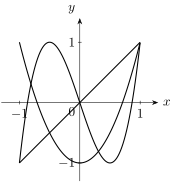
(the graphs of TnT_{n} for n=1,2,3n=1,2,3 are shown in Fig. 4, and for n=8n=8 in Fig. 5).

Fig. 4Fig. 4

Fig. 5Fig. 5

Prove that

?
(a)

TnT_{n} is a polynomial of degree nn;

(b)

for n∈Nn \in \mathbb {N} the leading coefficient of TnT_{n} equals 2n−12^{n-1};

(c)

the Chebyshev polynomials satisfy the recurrence relation Tn+1(x)=2xTn(x)−Tn−1(x)(n∈N)T_{n+1}(x)=2 x T_{n}(x)-T_{n-1}(x) \quad (n \in \mathbb {N});

(d)

the Chebyshev polynomials satisfy the differential equation (1−x2)y′′−xy′+n2y=0\left(1-x^{2}\right) y^{\prime \prime }-x y^{\prime }+n^{2} y=0;

(e)

for ∣x∣⩾1\left|x\right| \geqslant 1 the Chebyshev polynomials satisfy the equality Tn(x)=12((x+x2−1)n+(x−x2−1)n);T_{n}(x)=\frac{1}{2}\left(\left(x+\sqrt{x^{2}-1}\right)^{n}+\left(x-\sqrt{x^{2}-1}\right)^{n}\right) ;

(f)

the fraction 1−tx1−2tx+t2\frac{1-t x}{1-2 t x+t^{2}} is a generating function for the Chebyshev polynomials, i.e.

1−tx1−2tx+t2=∑n⩾0tnTn(x) for x,t∈(−1,1). \frac{1-t x}{1-2 t x+t^{2}}=\sum _{n \geqslant 0} t^{n} T_{n}(x) \quad \text{ for } \quad x, t \in (-1,1) .
Remark.
?

More detailed information on Chebyshev polynomials can be found in the book [ Pa].

Problem I.2.21

This problem uses the Chebyshev polynomials Tn(x)=cos⁡(narccos⁡x)T_{n}(x)=\cos (n \arccos x) (see problem 2.20). Prove the extremal property of Chebyshev polynomials: if PP is an algebraic polynomial of degree nn (with real or complex coefficients) and ∣P(x)∣⩽1\left|P(x)\right| \leqslant 1 for all x∈[−1,1]x \in [-1,1], then ∣P(j)(x)∣⩽∣Tn(j)(x)∣\left|P^{(j)}(x)\right| \leqslant \left|T_{n}^{(j)}(x)\right| for all j=0,1,…,nj=0,1, \ldots , n and x∈R,∣x∣>1x \in \mathbb {R},\left|x\right|>1. The inequality is strict if P≠cTnP \neq c T_{n}, where c∈C,∣c∣=1c \in \mathbb {C},\left|c\right|=1.

In particular, for j=0j=0 we obtain ∣P(x)∣⩽∣Tn(x)∣\left|P(x)\right| \leqslant \left|T_{n}(x)\right| outside the interval [−1,1]\left[-1,1\right], and the inequality for j=nj=n implies that the leading coefficient of the polynomial PP is, in absolute value, at most 2n−12^{n-1}, with equality possible only for P=cTnP=c T_{n}, where c∈C,∣c∣=1c \in \mathbb {C},\left|c\right|=1.

?
Problem I.2.22

This problem uses the Chebyshev polynomials Tn(x)=cos⁡(narccos⁡x)T_{n}(x)=\cos (n \arccos x) (see problem 2.20). Let P(φ)=a0+∑k=1n(akcos⁡kφ+bksin⁡kφ)P(\varphi )=a_{0}+\sum_{k=1}^{n}\left(a_{k} \cos k \varphi +b_{k} \sin k \varphi \right) be a trigonometric polynomial of order nn with real coefficients a0,a1,…,ana_{0}, a_{1}, \ldots , a_{n} and b1,…,bnb_{1}, \ldots , b_{n}. Set M=max⁡φ∈R∣P(φ)∣M=\max_{\varphi \in \mathbb {R}}\left|P(\varphi )\right|. Prove Bernstein's inequality:

∣P′(φ)∣⩽nM for all φ∈R. \left|P^{\prime }(\varphi )\right| \leqslant n M \quad \text{ for all } \quad \varphi \in \mathbb {R} .

Deduce from this Bernstein's inequality for algebraic polynomials:

∣P′(x)∣⩽nM1−x2 for all x∈(−1,1), \left|P^{\prime }(x)\right| \leqslant \frac{n M}{\sqrt{1-x^{2}}} \quad \text{ for all } \quad x \in (-1,1),

where PP is an algebraic polynomial of degree nn with real coefficients, M=max⁡∣x∣⩽1∣P(x)∣M=\max_{\left|x\right| \leqslant 1}\left|P(x)\right|.

In which cases do these inequalities turn into equalities at at least one point?

?
Problem I.2.23

Let n∈Nn \in \mathbb {N}. Prove the inequalities

?
(a)

x2n2e−x<e−x−(1−xn)n⩽x2ne−x\frac{x^{2}}{n^{2}} e^{-x}<e^{-x}-\left(1-\frac{x}{n}\right)^{n} \leqslant \frac{x^{2}}{n} e^{-x} \quad for x∈[0,n],n>1x \in [0, n], n>1;

(b)

x24ne−x⩽(1+xn)−n−e−x⩽x2ne−x\frac{x^{2}}{4 n} e^{-x} \leqslant \left(1+\frac{x}{n}\right)^{-n}-e^{-x} \leqslant \frac{x^{2}}{n} e^{-x} for x∈[0,n]x \in [0, \sqrt{n}].

Problem I.2.24

Let n∈Nn \in \mathbb {N} and φn(x)=e−x22n−ex(1−xn)n\varphi_{n}(x)=e^{-\frac{x^{2}}{2 n}}-e^{x}\left(1-\frac{x}{n}\right)^{n}. Prove that the function φn\varphi_{n} is nonnegative on the interval [0,n]\left[0, n\right] and

14en⩽max⁡[0,n]φn⩽1en \frac{1}{4 \sqrt{e n}} \leqslant \max _{\left[0, n\right]} \varphi _{n} \leqslant \frac{1}{\sqrt{e n}}

The next problem considers relations that supplement the classical inequalities

sin⁡x<x<tg⁡x,ln⁡(1+x)<x<ex−1,arctg⁡x<x<arcsin⁡x. \sin x<x<\operatorname {tg} x, \quad \ln (1+x)<x<e^{x}-1, \quad \operatorname {arctg} x<x<\arcsin x .
?
Problem I.2.25

Prove the inequalities

?
(a)

(1+x)ln⁡2(1+x)<x2(1+x) \ln^{2}(1+x)<x^{2} \quad for x>−1,x≠0x>-1, x \neq 0;

(b)

x1+2πx<arctg⁡x\frac{x}{1+\frac{2}{\pi } x}<\operatorname {arctg} x \quad for x>0x>0;

(c)

x2<ln⁡(1+tg⁡2x)<sin⁡xtg⁡xx^{2}<\ln \left(1+\operatorname {tg}^{2} x\right)<\sin x \operatorname {tg} x \quad for x∈(0,π2)x \in \left(0, \frac{\pi }{2}\right);

(d)

3x−x3<2sin⁡(π2x)3 x-x^{3}<2 \sin \left(\frac{\pi }{2} x\right) \quad for x∈(0,1)x \in (0,1);

(e)

x3<sin⁡2xtg⁡xx^{3}<\sin^{2} x \operatorname {tg} x \quad for x∈(0,π2)x \in \left(0, \frac{\pi }{2}\right).

(f)

Does the inequality x3+ε<sin⁡2+εxtg⁡xx^{3+\varepsilon }<\sin^{2+\varepsilon } x \operatorname {tg} x hold on (0,π2)(0, \frac{\pi }{2}) for some fixed ε>0\varepsilon >0?

Problem I.2.26

Prove that on the interval [−1,1]\left[-1,1\right] the inequalities hold

?
(a)

(1−x2)(1−14x2)⩽cos⁡π2x⩽(1−x2)(1−15x2)\left(1-x^{2}\right)\left(1-\frac{1}{4} x^{2}\right) \leqslant \cos \frac{\pi }{2} x \leqslant \left(1-x^{2}\right)\left(1-\frac{1}{5} x^{2}\right);

(b)

(1−x2)(1−23x2)⩽sin⁡πxπx⩽(1−x2)(1−12x2)\left(1-x^{2}\right)\left(1-\frac{2}{3} x^{2}\right) \leqslant \frac{\sin \pi x}{\pi x} \leqslant \left(1-x^{2}\right)\left(1-\frac{1}{2} x^{2}\right).

Problem I.2.27

Prove the inequalities

?
(a)

(ex−1)ln⁡(1+x)>x2\left(e^{x}-1\right) \ln (1+x)>x^{2} \quad for x>0x>0;

(b)

tg⁡xarctg⁡x>x2\operatorname {tg} x \operatorname {arctg} x>x^{2} \quad for x∈(0,π2)x \in \left(0, \frac{\pi }{2}\right);

(c)

((1+x)p−1)((1+x)1/p−1)>x2\left((1+x)^{p}-1\right)\left((1+x)^{1 / p}-1\right)>x^{2} for x>0,p>0,p≠1x>0, p>0, p \neq 1.

What happens for p<0p<0?

(d)

((1−x)p−1)(1−(1+x)1/p)>x2\left((1-x)^{p}-1\right)\left(1-(1+x)^{1 / p}\right)>x^{2} for x∈(0,1),p<−1x \in (0,1), p<-1.

What happens for p∈(−1,0)p \in (-1,0)?

Problem I.2.28

Prove the inequalities

2πsin⁡(π2x)arcsin⁡x<x2<sin⁡xarcsin⁡x for x∈(0,1). \frac{2}{\pi } \sin \left(\frac{\pi }{2} x\right) \arcsin x<x^{2}<\sin x \arcsin x \quad \text{ for } \quad x \in (0,1) .
?
Problem I.2.29

Prove that for any x∈Rx \in \mathbb {R} and n∈Nn \in \mathbb {N} the inequalities hold

?
(a)

∣(sin⁡xx)(n)∣⩽1n+1\left|\left(\frac{\sin x}{x}\right)^{(n)}\right| \leqslant \frac{1}{n+1};

(b)

∣(1−cos⁡xx2)(n)∣⩽1(n+1)(n+2)\left|\left(\frac{1-\cos x}{x^{2}}\right)^{(n)}\right| \leqslant \frac{1}{(n+1)(n+2)};

(c)

∣(11+x2)(n)∣⩽n!(1+x2)n+12\left|\left(\frac{1}{1+x^{2}}\right)^{(n)}\right| \leqslant \frac{n!}{\left(1+x^{2}\right)^{\frac{n+1}{2}}}.

Problem I.2.30

Prove that ∣(sin⁡xx)′∣⩽1kπ\left|\left(\frac{\sin x}{x}\right)^{\prime }\right| \leqslant \frac{1}{k \pi } for x∈[kπ,kπ+π](k∈N)x \in [k \pi , k \pi +\pi ](k \in \mathbb {N}).

?
Problem I.2.31

Prove that for any x∈[0,1]x \in [0,1] the following inequalities hold

?
(a)

2⩽(1+x)p+(1−x)p⩽2p(p⩾1)2 \leqslant (1+x)^{p}+(1-x)^{p} \leqslant 2^{p} \quad (p \geqslant 1);

(b)

2(1+xp)⩽(1+x)p+(1−x)p⩽2p−1(1+xp)(p⩾2)2\left(1+x^{p}\right) \leqslant (1+x)^{p}+(1-x)^{p} \leqslant 2^{p-1}\left(1+x^{p}\right) \quad (p \geqslant 2);

(c)

(1+x)p+(1−x)p⩽2(1+(p−1)x2)p2(p⩾2)\quad (1+x)^{p}+(1-x)^{p} \leqslant 2\left(1+(p-1) x^{2}\right)^{\frac{p}{2}} \quad (p \geqslant 2);

(d)

(1+x)p+(1−x)p⩽2(1+xpp−1)p−1(p⩾2)\quad (1+x)^{p}+(1-x)^{p} \leqslant 2\left(1+x^{\frac{p}{p-1}}\right)^{p-1} \quad (p \geqslant 2).

In the case 1⩽p⩽21 \leqslant p \leqslant 2, the signs of the inequalities in (b)-(d) are reversed.

Problem I.2.32

Let f,g∈C([0,1])f, g \in C(\left[0,1\right]), where the function ff is nondecreasing and 0⩽f,g⩽10 \leqslant f, g \leqslant 1 on [0,1]\left[0,1\right]. Prove the inequality

∫01f(g(x))dx⩽∫01f(x)dx+∫01g(x)dx \int _{0}^{1} f(g(x)) d x \leqslant \int _{0}^{1} f(x) d x+\int _{0}^{1} g(x) d x
?
Problem I.2.33

The integral inequalities considered here have obvious summation analogues; their proofs can be obtained either by passing to the limit in the summation inequality, or by modifying the proofs used in the discrete case. Let the function ff be integrable on the interval [a,b]\left[a, b\right] and 0<m=inf⁡f,M=sup⁡f0<m=\inf f, M=\sup f. Then the following inequalities hold:

2mM(b−a)⩽1M∫abf(x)dx+m∫abdxf(x)⩽(1+mM)(b−a)(b−a)2⩽∫abf(x)dx∫abdxf(x)⩽(m+M)24mM(b−a)2 \begin{aligned} 2 \sqrt{\frac{m}{M}}(b-a) & \leqslant \frac{1}{M} \int _{a}^{b} f(x) d x+m \int _{a}^{b} \frac{d x}{f(x)} \leqslant \left(1+\frac{m}{M}\right)(b-a) \\ (b-a)^{2} & \leqslant \int _{a}^{b} f(x) d x \int _{a}^{b} \frac{d x}{f(x)} \leqslant \frac{(m+M)^{2}}{4 m M}(b-a)^{2} \end{aligned}
?
Problem I.2.34

The integral inequalities considered here have obvious summation analogues; their proofs can be obtained either by passing to the limit in the summation inequality, or by modifying the proofs used in the discrete case. By means of passage to the limit these inequalities carry over to the case of improper integrals over the interval [a,+∞)[a,+\infty ). Let the functions ff and gg be integrable on the interval [a,b]\left[a, b\right], with f↓,f⩾0f \downarrow , f \geqslant 0. For x∈[a,b]x \in [a, b] set G(x)=∫axg(t)dtG(x)=\int_{a}^{x} g(t) d t. Then the following inequalities hold:

?
(a)

f(a)inf⁡a⩽x⩽bG(x)⩽∫abf(x)g(x)dx⩽f(a)sup⁡a⩽x⩽bG(x)f(a) \inf_{a \leqslant x \leqslant b} G(x) \leqslant \int_{a}^{b} f(x) g(x) d x \leqslant f(a) \sup_{a \leqslant x \leqslant b} G(x);

(b)

∣∫abf(x)g(x)dx∣⩽f(a)sup⁡a⩽x⩽b∣G(x)∣\left|\int_{a}^{b} f(x) g(x) d x\right| \leqslant f(a) \sup_{a \leqslant x \leqslant b}\left|G(x)\right|;

(c)

(inf⁡a<x⩽bG(x)x−a)∫abf(x)dx⩽∫abf(x)g(x)dx⩽\left(\inf_{a<x \leqslant b} \frac{G(x)}{x-a}\right) \int_{a}^{b} f(x) d x \leqslant \int_{a}^{b} f(x) g(x) d x \leqslant

⩽(sup⁡a<x⩽bG(x)x−a)∫abf(x)dx \leqslant \left(\sup _{a<x \leqslant b} \frac{G(x)}{x-a}\right) \int _{a}^{b} f(x) d x
Problem I.2.35

The integral inequality considered here has an obvious summation analogue; its proof can be obtained either by passing to the limit in the summation inequality, or by modifying the proof used in the discrete case. Let the functions ff and gg be integrable on the interval [a,b]\left[a, b\right], with f↓f \downarrow and 0⩽g⩽10 \leqslant g \leqslant 1. Set c=∫abg(x)dxc=\int_{a}^{b} g(x) d x. Then

∫b−cbf(x)dx⩽∫abf(x)g(x)dx⩽∫aa+cf(x)dx \int _{b-c}^{b} f(x) d x \leqslant \int _{a}^{b} f(x) g(x) d x \leqslant \int _{a}^{a+c} f(x) d x
?
Problem I.2.36

The integral inequality considered here has an obvious summation analogue; its proof can be obtained either by passing to the limit in the summation inequality, or by modifying the proof used in the discrete case. Let f∈C1([a,b]),δ=min⁡[a,b]∣f′∣,Δ=max⁡[a,b]∣f′∣f \in C^{1}(\left[a, b\right]), \delta =\min_{\left[a, b\right]}\left|f^{\prime }\right|, \Delta =\max_{\left[a, b\right]}\left|f^{\prime }\right|. Then

δ212(b−a)2⩽1b−a∫abf2(x)dx−(1b−a∫abf(x)dx)2⩽Δ212(b−a)2 \frac{\delta ^{2}}{12}(b-a)^{2} \leqslant \frac{1}{b-a} \int _{a}^{b} f^{2}(x) d x-\left(\frac{1}{b-a} \int _{a}^{b} f(x) d x\right)^{2} \leqslant \frac{\Delta ^{2}}{12}(b-a)^{2}

Equality holds only for linear functions.

?
Problem I.2.37

The integral inequalities considered here have obvious summation analogues; their proofs can be obtained either by passing to the limit in the summation inequality, or by modifying the proofs used in the discrete case. If a continuously differentiable function ff is nondecreasing and convex (or nonincreasing and concave) on the interval [0,1]\left[0,1\right], then

13∫01(1−x)3(f′(x))2dx⩽∫01f2(x)dx−(∫01f(x)dx)2⩽⩽13∫01x3(f′(x))2dx \begin{aligned} \frac{1}{3} \int _{0}^{1}(1-x)^{3}\left(f^{\prime }(x)\right)^{2} d x \leqslant \int _{0}^{1} f^{2}(x) d x-\left(\int _{0}^{1} f(x) d x\right)^{2} & \leqslant \\ & \leqslant \frac{1}{3} \int _{0}^{1} x^{3}\left(f^{\prime }(x)\right)^{2} d x \end{aligned}

For a nondecreasing concave (or nonincreasing convex) function the signs of the inequalities are reversed. Equality is possible only for a linear function.

?
Problem I.2.38

The integral inequalities considered here have obvious summation analogues; their proofs can be obtained either by passing to the limit in the summation inequality, or by modifying the proofs used in the discrete case. Let the functions ff and gg be positive and integrable on the interval [a,b]\left[a, b\right]. Then the following inequalities hold:

?
(a)

exp⁡(1b−a∫abln⁡f(x)dx)⩽1b−a∫abf(x)dx\exp \left(\frac{1}{b-a} \int_{a}^{b} \ln f(x) d x\right) \leqslant \frac{1}{b-a} \int_{a}^{b} f(x) d x (an analogue of the Cauchy inequality between the arithmetic mean and the geometric mean);

(b)

exp⁡(1b−a∫abln⁡f(x)dx)+exp⁡(1b−a∫abln⁡g(x)dx)⩽\exp \left(\frac{1}{b-a} \int_{a}^{b} \ln f(x) d x\right)+\exp \left(\frac{1}{b-a} \int_{a}^{b} \ln g(x) d x\right) \leqslant

⩽exp⁡(1b−a∫abln⁡(f(x)+g(x))dx) \leqslant \exp \left(\frac{1}{b-a} \int _{a}^{b} \ln (f(x)+g(x)) d x\right)

(an analogue of the Minkowski inequality — see problem 2.7 (b)).

Problem I.2.39

The integral inequality considered here has an obvious summation analogue; its proof can be obtained either by passing to the limit in the summation inequality, or by modifying the proof used in the discrete case. Let the functions ff and gg be monotonic on the interval [a,b]\left[a, b\right], and let the function hh be nonnegative and integrable on it. If the monotonicity of the functions f,gf, g is of the same type, then the following inequality holds:

∫abf(x)h(x)dx∫abg(x)h(x)dx⩽∫abh(x)dx∫abf(x)g(x)h(x)dx, \int _{a}^{b} f(x) h(x) d x \int _{a}^{b} g(x) h(x) d x \leqslant \int _{a}^{b} h(x) d x \int _{a}^{b} f(x) g(x) h(x) d x,

while if the monotonicity is of different types, then the sign of the inequality is reversed.

?
Problem I.2.40
  1. Let f∈C1([0,π])f \in C^{1}(\left[0, \pi \right]), with f(0)=f(π)=0f(0)=f(\pi )=0. Prove the inequality

    ∫0πf2(x)dx⩽∫0π(f′(x))2dx \int _{0}^{\pi } f^{2}(x) d x \leqslant \int _{0}^{\pi }\left(f^{\prime }(x)\right)^{2} d x

    by representing the difference of these integrals as an integral of a nonnegative function.

  2. Prove that the inequality remains valid if, instead of the condition f(0)=f(π)=0f(0)=f(\pi )=0, we assume that f(0)=f(π)f(0)=f(\pi ) and ∫0πf(x)dx=0\int_{0}^{\pi } f(x) d x=0.

  3. Let f∈C1([0,2π]),f(0)=f(2π)f \in C^{1}(\left[0,2 \pi \right]), f(0)=f(2 \pi ) and ∫02πf(x)dx=0\int_{0}^{2 \pi } f(x) d x=0. Prove that

    ∫02πf2(x)dx⩽∫02π(f′(x))2dx \int _{0}^{2 \pi } f^{2}(x) d x \leqslant \int _{0}^{2 \pi }\left(f^{\prime }(x)\right)^{2} d x

For which functions do these inequalities become equalities?

?
Problem I.2.41

Let a smooth closed curve of length LL bound a plane figure of area SS. Using the natural parametrization of the curve and Wirtinger's inequality, prove the isoperimetric inequality: 4πS⩽L24 \pi S \leqslant L^{2}. Use it to determine the maximal area of a figure that can be bounded by a curve of length LL, lying in a half-plane, with endpoints on the boundary of the half-plane — "Dido's problem"∗){ }^{*)}.

?
Remark.
?

∗){ }^{*)} According to legend, the ship of Dido, fleeing the persecution of her brother, the Tyrian king Pygmalion, landed on the African shore. The local king Iarbas, in response to the fugitives' request for land to settle on, allowed them to occupy a plot on the seashore of the size of an ox hide. Dido ordered the hide to be cut into thin strips and used them to enclose a plot of land on which she founded Carthage.

Problem I.3.1

Let x∈Rx \in \mathbb {R}. Prove the equivalence of the statements

  1. x∉Qx \notin \mathbb {Q};

  2. there exist infinitely many irreducible fractions pq\frac{p}{q} (q∈N,p∈Zq \in \mathbb {N}, p \in \mathbb {Z}) such that ∣x−pq∣<1q2\left|x-\frac{p}{q}\right|<\frac{1}{q^{2}};

  3. there exists a sequence of fractions pkqk(qk∈N,pk∈Z)\frac{p_{k}}{q_{k}}\left(q_{k} \in \mathbb {N}, p_{k} \in \mathbb {Z}\right) such that qk→+∞q_{k} \rightarrow +\infty and 0≠x−pkqk=o(1qk)0 \neq x-\frac{p_{k}}{q_{k}}=o\left(\frac{1}{q_{k}}\right) as k→+∞k \rightarrow +\infty.

?
Problem I.3.2

We use the notation δ(x)=x−[x]\delta (x)=x-\left[x\right] for the fractional part of a real number xx. Let xx be an irrational number. Prove that the sequence {δ(nx)}\left\{ \delta (n x)\right\} is dense in (0,1)(0,1).

?
Problem I.3.3
?
(a)

Prove that the sequences {sin⁡n2}\left\{ \sin n^{2}\right\} and {sin⁡4n}\left\{ \sin 4^{n}\right\} have no limits;

(b)

prove that if the sequence {sin⁡(2nθ)}\left\{ \sin \left(2^{n} \theta \right)\right\} has a limit, then it equals zero and θ=πp2q\theta =\frac{\pi p}{2^{q}}, where q∈N,p∈Zq \in \mathbb {N}, p \in \mathbb {Z}.

Problem I.3.4

We use the notation δ(x)=x−[x]\delta (x)=x-\left[x\right] for the fractional part of a real number xx. Let x∈Rx \in \mathbb {R}. Prove the equivalence of the statements

  1. x∈Qx \in \mathbb {Q};

  2. the set {δ(n2005x)∣n∈N}\left\{ \delta \left(n^{2005} x\right) \mid n \in \mathbb {N}\right\} is finite.

?
Problem I.3.5

We use the notation δ(x)=x−[x]\delta (x)=x-\left[x\right] for the fractional part of a real number xx. Show by examples that the sequence {δ(10nx)}\left\{ \delta \left(10^{n} x\right)\right\} can be everywhere dense, and can be infinite but nowhere dense in (0,1)(0,1).

?
Problem I.3.6

Find the sets of partial limits of the sequences

?
(a)

{sin⁡n2/3}\left\{ \sin n^{2 / 3}\right\};

(b)

{n4sin⁡n}\left\{ \sqrt[4]{n} \sin \sqrt{n}\right\};

(c)

{sin⁡(πn3/2)}\left\{ \sin \left(\pi n^{3 / 2}\right)\right\};

(d)

{sin⁡ln⁡n}\left\{ \sin \ln n\right\};

(e)

{sin⁡(πnln⁡n)}\left\{ \sin (\pi n \ln n)\right\}.

Problem I.3.7

We use the notation δ(x)=x−[x]\delta (x)=x-\left[x\right] for the fractional part of a real number xx. Find the sets of partial limits of the sequences

?
(a)

{δ(nx)}\left\{ \delta (n x)\right\}, where x∈Qx \in \mathbb {Q};

(b)

{δ(nx)}\left\{ \delta (n x)\right\}, where x∈R\Qx \in \mathbb {R} \backslash \mathbb {Q};

(c)

{δ(nα)}\left\{ \delta \left(n^{\alpha }\right)\right\}, where α∈(0,1)\alpha \in (0,1);

(d)

{δ(n5/2)}\left\{ \delta \left(n^{5 / 2}\right)\right\}.

Problem I.3.8

We use the notation δ(x)=x−[x]\delta (x)=x-\left[x\right] for the fractional part of a real number xx. Does there exist a real number xx such that δ(xn)∈[13,23]\delta \left(x^{n}\right) \in \left[\frac{1}{3}, \frac{2}{3}\right] for all indices nn?

?
Problem I.3.9

We use the notation δ(x)=x−[x]\delta (x)=x-\left[x\right] for the fractional part of a real number xx. Let f∈C([0,1])f \in C(\left[0,1\right]) and x∈R\Qx \in \mathbb {R} \backslash \mathbb {Q}. Prove that

1n∑1⩽k⩽nf(δ(kx))→∫01f(t)dt as n→+∞. \frac{1}{n} \sum _{1 \leqslant k \leqslant n} f(\delta (k x)) \rightarrow \int _{0}^{1} f(t) d t \quad \text{ as } \quad n \rightarrow +\infty .
?
Problem I.3.10

Let x=(x1,…,xm)∈Rmx=\left(x_{1}, \ldots , x_{m}\right) \in \mathbb {R}^{m}. Prove that there exist fractions p1q,…,pmq\frac{p_{1}}{q}, \ldots , \frac{p_{m}}{q} with arbitrarily large denominator q∈Nq \in \mathbb {N} (p1,…,pm∈Zp_{1}, \ldots , p_{m} \in \mathbb {Z}) such that

∣xj−pjq∣<q−(1+1m) for all j=1,2,…,m. \left|x_{j}-\frac{p_{j}}{q}\right|<q^{-\left(1+\frac{1}{m}\right)} \quad \text{ for all } j=1,2, \ldots , m .
?
Problem I.3.11

Let αq=min⁡p∈Z∣2−pq∣,q∈N\alpha_{q}=\min_{p \in \mathbb {Z}}\left|\sqrt{2}-\frac{p}{q}\right|, q \in \mathbb {N}. Prove that

?
(a)

(2q)−2<αq<(2q)−1(2 q)^{-2}<\alpha_{q}<(2 q)^{-1};

(b)

if a strictly increasing sequence of indices {qj}\left\{ q_{j}\right\} is such that αqj⩽Cqj2(j∈N)\alpha_{q_{j}} \leqslant \frac{C}{q_{j}^{2}}(j \in \mathbb {N}), where CC is a fixed number, then {qj}\left\{ q_{j}\right\} grows at least like a geometric progression: qj+1qj⩾1+18C\frac{q_{j+1}}{q_{j}} \geqslant 1+\frac{1}{8 C}. Thus the lower bound in inequality a) is crude for most indices.

Problem I.3.12

Let α\alpha be an algebraic number of degree at most rr (i.e., α\alpha is a root of an algebraic polynomial of degree rr with integer coefficients). Prove Liouville's theorem: if α\alpha is irrational, then ∣α−pq∣>cαqr\left|\alpha -\frac{p}{q}\right|>\frac{c_{\alpha }}{q^{r}} for all p∈Zp \in \mathbb {Z} and q∈Nq \in \mathbb {N} (the positive coefficient cαc_{\alpha } depends only on α\alpha).

?
Remark.
?

An irrational number α\alpha is called a Liouville number if it has arbitrarily good approximations by fractions: for any r>0r>0 there exists a fraction pq(p∈Z,q∈N,q>1)\frac{p}{q}(p \in \mathbb {Z}, q \in \mathbb {N}, q>1) such that ∣α−pq∣<1qr\left|\alpha -\frac{p}{q}\right|<\frac{1}{q^{r}} (for examples of such numbers see problem 3.19). Liouville's theorem immediately implies that α\alpha is a transcendental number.

Problem I.3.13

An irrational number α\alpha is called a Liouville number if for any r>0r>0 there exists a fraction pq(p∈Z,q∈N,q>1)\frac{p}{q}(p \in \mathbb {Z}, q \in \mathbb {N}, q>1) such that ∣α−pq∣<1qr\left|\alpha -\frac{p}{q}\right|<\frac{1}{q^{r}}. Let α\alpha be an irrational non-Liouville number: ∣α−pq∣⩾cαqr\left|\alpha -\frac{p}{q}\right| \geqslant \frac{c_{\alpha }}{q^{r}} for every fraction pq(p∈Z,q∈N)\frac{p}{q}(p \in \mathbb {Z}, q \in \mathbb {N}), where cαc_{\alpha } and rr are fixed positive numbers (this is possible only for r⩾2r \geqslant 2 -- see 3.1).

?
(a)

Generalize the result of problem 3.11 b) by proving that this bound is crude for most fractions pq\frac{p}{q}: if ∣α−pjqj∣⩽Cqjr\left|\alpha -\frac{p_{j}}{q_{j}}\right| \leqslant \frac{C}{q_{j}^{r}}, where pj∈Z,qj∈Np_{j} \in \mathbb {Z}, q_{j} \in \mathbb {N} and qj+1>qjq_{j+1}>q_{j} for all j∈Nj \in \mathbb {N}, then the sequence {qj}\left\{ q_{j}\right\} grows no slower than a geometric progression (more precisely, qj+1qj⩾1+(cα2C)1r−1\frac{q_{j+1}}{q_{j}} \geqslant 1+\left(\frac{c_{\alpha }}{2 C}\right)^{\frac{1}{r-1}}).

(b)

Estimate from below the denominators qjq_{j}, if the sequence of fractions {pjqj}\left\{ \frac{p_{j}}{q_{j}}\right\} is such that for all indices jj

qj<qj+1 and ∣α−pjqj∣⩽Cqjρ q_{j}<q_{j+1} \quad \text{ and } \quad \left|\alpha -\frac{p_{j}}{q_{j}}\right| \leqslant \frac{C}{q_{j}^{\rho }}

for some C>0C>0 and ρ∈(1,r)\rho \in (1, r).

Note that, by Liouville's theorem, α\alpha can be taken to be any irrational algebraic number. Moreover, for r>2r>2 almost all real numbers α\alpha satisfy the inequality ∣α−pq∣⩾cαqr\left|\alpha -\frac{p}{q}\right| \geqslant \frac{c_{\alpha }}{q^{r}} for all fractions pq\frac{p}{q} (see VIII.1.7).

Problem I.3.14

{εk}\left\{ \varepsilon_{k}\right\} is an arbitrary sequence of +1+1's and −1-1's, and {nk}\left\{ n_{k}\right\} is a strictly increasing sequence of natural numbers. Prove that the sum of the series ∑εk2−nk\sum \varepsilon_{k} 2^{-n_{k}} is irrational if lim⁡‾(nk+1−nk)=+∞\overline{\lim }\left(n_{k+1}-n_{k}\right)=+\infty.

?
Problem I.3.15

{εk}\left\{ \varepsilon_{k}\right\} is an arbitrary sequence of +1+1's and −1-1's, and {nk}\left\{ n_{k}\right\} is a strictly increasing sequence of natural numbers. Let lim‾⁡nk+1n1n2…nk=+∞\varlimsup \frac{n_{k+1}}{n_{1} n_{2} \ldots n_{k}}=+\infty. Prove that

?
(a)

the sum of the series ∑(−1)knk\sum \frac{(-1)^{k}}{n_{k}} is irrational;

(b)

if nk+1nk⩾2\frac{n_{k+1}}{n_{k}} \geqslant 2 for all k∈Nk \in \mathbb {N}, then the sum of the series ∑εknk\sum \frac{\varepsilon_{k}}{n_{k}} is irrational. Is this so in the case nk+1nk⩾Q>1\frac{n_{k+1}}{n_{k}} \geqslant Q>1?

Problem I.3.16

{εk}\left\{ \varepsilon_{k}\right\} is an arbitrary sequence of +1+1's and −1-1's, and {nk}\left\{ n_{k}\right\} is a strictly increasing sequence of natural numbers. Let lim‾⁡ln⁡nk2k=+∞\varlimsup \frac{\ln n_{k}}{2^{k}}=+\infty. Prove that

?
(a)

the sum of the series ∑(−1)knk\sum \frac{(-1)^{k}}{n_{k}} is irrational;

(b)

if nk+1nk⩾2\frac{n_{k+1}}{n_{k}} \geqslant 2 for all k∈Nk \in \mathbb {N}, then the sum of the series ∑εknk\sum \frac{\varepsilon_{k}}{n_{k}} is irrational.

Problem I.3.17

{εk}\left\{ \varepsilon_{k}\right\} is an arbitrary sequence of +1+1's and −1-1's, and {nk}\left\{ n_{k}\right\} is a strictly increasing sequence of natural numbers.

?
(a)

Prove that the sum of the series S=∑εkFkS=\sum \frac{\varepsilon_{k}}{F_{k}} is irrational, if Fk=22k+1F_{k}=2^{2^{k}}+1 are the Fermat numbers.

(b)

Let the sequence {nk}\left\{ n_{k}\right\} be such that

nk+1⩾nk2−nk+1 for all k∈N. n_{k+1} \geqslant n_{k}^{2}-n_{k}+1 \quad \text{ for all } \quad k \in \mathbb {N} .

Prove the rationality of the sum ∑1nk\sum \frac{1}{n_{k}}, if nk+1=nk2−nk+1n_{k+1}=n_{k}^{2}-n_{k}+1 for all sufficiently large kk.

Is the converse statement true? Is the number ∑122k−2\sum \frac{1}{2^{2^{k}}-2} rational?

Problem I.3.18

{εk}\left\{ \varepsilon_{k}\right\} is an arbitrary sequence of +1+1's and −1-1's, and {nk}\left\{ n_{k}\right\} is a strictly increasing sequence of natural numbers. Let lim‾⁡ln⁡nk3k=+∞\varlimsup \frac{\ln n_{k}}{3^{k}}=+\infty. Prove that

?
(a)

the number ∑(−1)knk\sum \frac{(-1)^{k}}{n_{k}} is not a quadratic irrational;

(b)

if nk+1nk⩾2\frac{n_{k+1}}{n_{k}} \geqslant 2 for all k∈Nk \in \mathbb {N}, then the number ∑εknk\sum \frac{\varepsilon_{k}}{n_{k}} is not a quadratic irrational.

Problem I.3.19

{εk}\left\{ \varepsilon_{k}\right\} is an arbitrary sequence of +1+1's and −1-1's. Prove the transcendence of the numbers ∑εk2−k!\sum \varepsilon_{k} 2^{-k!}.

?
Problem I.3.20

{εk}\left\{ \varepsilon_{k}\right\} is an arbitrary sequence of +1+1's and −1-1's, and {nk}\left\{ n_{k}\right\} is a strictly increasing sequence of natural numbers. Let lim⁡‾ln⁡nkk!>0\overline{\lim } \frac{\ln n_{k}}{k!}>0. Prove that

?
(a)

the number ∑(−1)knk\sum \frac{(-1)^{k}}{n_{k}} is transcendental;

(b)

if nk+1nk⩾2\frac{n_{k+1}}{n_{k}} \geqslant 2 for all k∈Nk \in \mathbb {N}, then the number ∑εknk\sum \frac{\varepsilon_{k}}{n_{k}} is transcendental.

Problem I.3.21

Irrationality of the number ee. Using the expansions

e=∑n⩾01n! and 1e=∑n⩾0(−1)nn!, e=\sum _{n \geqslant 0} \frac{1}{n!} \quad \text{ and } \quad \frac{1}{e}=\sum _{n \geqslant 0} \frac{(-1)^{n}}{n!},

prove that

?
(a)

the number ee is irrational;

(b)

Ae2+Be+C≠0A e^{2}+B e+C \neq 0, if A,B,CA, B, C are integers not all equal to zero.

Problem I.3.22

Let σ(n)\sigma (n) be the sum of divisors of a natural number nn. Prove the irrationality of the sums of the series

?
(a)

∑σ(n)n!\sum \frac{\sigma (n)}{n!};

(b)

∑(−1)nσ(n)n!\sum (-1)^{n} \frac{\sigma (n)}{n!}.

Problem I.3.23

Irrationality of the number π\pi.

?
(a)

Let Hn=1n!∫−π/2π/2(π24−t2)ncos⁡tdt(n=0,1,2,…)H_{n}=\frac{1}{n!} \int_{-\pi / 2}^{\pi / 2}\left(\frac{\pi^{2}}{4}-t^{2}\right)^{n} \cos t d t(n=0,1,2, \ldots ). Prove that Hn=Pn(π2)H_{n}=P_{n}\left(\pi^{2}\right), where PnP_{n} is an algebraic polynomial of degree at most nn with integer coefficients.

(b)

Deduce from this that π2\pi^{2} (and hence also π\pi) is an irrational number.

Problem I.3.24

Irrationality of the values of the exponential function at rational points.

?
(a)

Let Jn(x)=1n!∫−xx(x2−t2)netdt(n=0,1,2,…)J_{n}(x)=\frac{1}{n!} \int_{-x}^{x}\left(x^{2}-t^{2}\right)^{n} e^{t} d t \quad (n=0,1,2, \ldots ). Prove that Jn(x)=An(x)ex+Bn(x)e−xJ_{n}(x)=A_{n}(x) e^{x}+B_{n}(x) e^{-x}, where An,BnA_{n}, B_{n} are algebraic polynomials of degree at most nn with integer coefficients.

(b)

Deduce from this that er∉Qe^{r} \notin \mathbb {Q}, if r∈Q,r≠0r \in \mathbb {Q}, r \neq 0.

Problem I.3.25

Irrationality of the values of the tangent at rational points.

?
(a)

Let Hn(x)=1n!∫−xx(x2−t2)ncos⁡tdt(n=0,1,2,…)H_{n}(x)=\frac{1}{n!} \int_{-x}^{x}\left(x^{2}-t^{2}\right)^{n} \cos t d t(n=0,1,2, \ldots ). Prove that Hn(x)=Cn(x)cos⁡x+Sn(x)sin⁡xH_{n}(x)=C_{n}(x) \cos x+S_{n}(x) \sin x, where Cn,SnC_{n}, S_{n} are algebraic polynomials of degree at most nn with integer coefficients.

(b)

Deduce from this that tg⁡r∉Q\operatorname {tg} r \notin \mathbb {Q}, if r∈Q,r≠0r \in \mathbb {Q}, r \neq 0.