Section I.2

Inequalities

[41/85%]
Show
LaTeX
Problem I.2.1

Prove that for any finite sequence {ak}k=1n\left\{ a_{k}\right\}_{k=1}^{n} of real numbers

?
(a)

there exists an index m∈{0,1,…,n}m \in \left\{ 0,1, \ldots , n\right\} such that

∣∑1⩽k⩽mak−∑m<k⩽nak∣⩽max⁡1⩽k⩽n∣ak∣ \left|\sum _{1 \leqslant k \leqslant m} a_{k}-\sum _{m<k \leqslant n} a_{k}\right| \leqslant \max _{1 \leqslant k \leqslant n}\left|a_{k}\right|

(for m=0m=0 the first sum is taken to be zero, for m=nm=n — the second);

(b)

the inequality

max⁡1⩽k⩽n∣ak∣⩽12n∑εk=±1∣∑1⩽k⩽nεkak∣ \max _{1 \leqslant k \leqslant n}\left|a_{k}\right| \leqslant \frac{1}{2^{n}} \sum _{\varepsilon _{k}= \pm 1}\left|\sum _{1 \leqslant k \leqslant n} \varepsilon _{k} a_{k}\right|

holds (the sum is over all possible sign assignments ε1,…,εn\varepsilon_{1}, \ldots , \varepsilon_{n}).

Problem I.2.2

Let {ak}k=1n\left\{ a_{k}\right\}_{k=1}^{n} and {bk}k=1n\left\{ b_{k}\right\}_{k=1}^{n} be finite nonnegative sequences, with the sequence {ak}\left\{ a_{k}\right\} nonincreasing; B=max⁡1⩽k⩽nbkB=\max_{1 \leqslant k \leqslant n} b_{k}. Prove that if the indices m,Mm, M do not exceed nn and satisfy the inequality mB⩽∑1⩽k⩽nbk⩽MBm B \leqslant \sum_{1 \leqslant k \leqslant n} b_{k} \leqslant M B, then

B∑n−m<k⩽nak⩽∑1⩽k⩽nakbk⩽B∑1⩽k⩽Mak. B \sum _{n-m<k \leqslant n} a_{k} \leqslant \sum _{1 \leqslant k \leqslant n} a_{k} b_{k} \leqslant B \sum _{1 \leqslant k \leqslant M} a_{k} .
?
Problem I.2.3

Let {ak}k=1n\left\{ a_{k}\right\}_{k=1}^{n} be a finite sequence of positive numbers and M=max⁡1⩽k⩽nak,m=min⁡1⩽k⩽nakM=\max_{1 \leqslant k \leqslant n} a_{k}, m=\min_{1 \leqslant k \leqslant n} a_{k}. Prove that

?
(a)

2nmM⩽∑1⩽k⩽nakM+∑1⩽k⩽nmak⩽n(1+mM)2 n \sqrt{\frac{m}{M}} \leqslant \sum_{1 \leqslant k \leqslant n} \frac{a_{k}}{M}+\sum_{1 \leqslant k \leqslant n} \frac{m}{a_{k}} \leqslant n\left(1+\frac{m}{M}\right);

(b)

n2⩽∑1⩽k⩽nak∑1⩽k⩽n1ak⩽n2(m+M)24mMn^{2} \leqslant \sum_{1 \leqslant k \leqslant n} a_{k} \sum_{1 \leqslant k \leqslant n} \frac{1}{a_{k}} \leqslant n^{2} \frac{(m+M)^{2}}{4 m M}.

Problem I.2.4

Let {qk}k=1n\left\{ q_{k}\right\}_{k=1}^{n} be a finite sequence of numbers, with qk⩾1q_{k} \geqslant 1 for all kk. Prove the inequality

1+1+…+1qnq2q1⩽1+1q1+1q1q2+…+1q1q2…qn. \sqrt[q_{1}]{1+\sqrt[q_{2}]{1+\ldots +\sqrt[q_{n}]{1}}} \leqslant 1+\frac{1}{q_{1}}+\frac{1}{q_{1} q_{2}}+\ldots +\frac{1}{q_{1} q_{2} \ldots q_{n}} .
?
Problem I.2.5

Let {ak}k=1n\left\{ a_{k}\right\}_{k=1}^{n} be a finite sequence of nonnegative numbers, with S=a1+a2+…+an<1S=a_{1}+a_{2}+\ldots +a_{n}<1. Prove the inequalities

1+S⩽∏1⩽k⩽n(1+ak)⩽11−Sˉ,1−S⩽∏1⩽k⩽n(1−ak)⩽11+Sˉ; 1+S \leqslant \prod _{1 \leqslant k \leqslant n}\left(1+a_{k}\right) \leqslant \frac{1}{1-\bar{S}}, \quad 1-S \leqslant \prod _{1 \leqslant k \leqslant n}\left(1-a_{k}\right) \leqslant \frac{1}{1+\bar{S}} ;

the right-hand inequalities are strict if S>0S>0; the left-hand inequalities are strict if at least two of the numbers {ak}k=1n\left\{ a_{k}\right\}_{k=1}^{n} are positive.

?
Problem I.2.6

Let {ak}k=1n\left\{ a_{k}\right\}_{k=1}^{n} be a finite sequence of real numbers, with ak>−1a_{k}>-1 for k=1,…,nk=1, \ldots , n. Prove that

?
(a)

if S=a1+…+an⩾0S=a_{1}+\ldots +a_{n} \geqslant 0, then

∏1⩽k⩽n(1+ak)⩽1+S1!+…+Snn!; \prod _{1 \leqslant k \leqslant n}\left(1+a_{k}\right) \leqslant 1+\frac{S}{1!}+\ldots +\frac{S^{n}}{n!} ;

equality is possible only in the cases where n=1n=1 or a1=a2==…=an=0a_{1}=a_{2}= =\ldots =a_{n}=0;

(b)

if σ=a11+a1+…+an1+an⩾0\sigma =\frac{a_{1}}{1+a_{1}}+\ldots +\frac{a_{n}}{1+a_{n}} \geqslant 0, then

1+σ1!+…+σnn!⩽∏1⩽k⩽n(1+ak); 1+\frac{\sigma }{1!}+\ldots +\frac{\sigma ^{n}}{n!} \leqslant \prod _{1 \leqslant k \leqslant n}\left(1+a_{k}\right) ;

equality is possible only in the case where a1=…=an=0a_{1}=\ldots =a_{n}=0.

Problem I.2.7

Let {ak}k=1n\left\{ a_{k}\right\}_{k=1}^{n} and {bk}k=1n\left\{ b_{k}\right\}_{k=1}^{n} be finite sequences of nonnegative numbers. Prove that

?
(a)

if Δ=min⁡1⩽k⩽n(bk−ak)⩾0\Delta =\min_{1 \leqslant k \leqslant n}\left(b_{k}-a_{k}\right) \geqslant 0, then b1…bnn⩾Δ+a1…ann\sqrt[n]{b_{1} \ldots b_{n}} \geqslant \Delta +\sqrt[n]{a_{1} \ldots a_{n}};

(b)

(a1+b1)…(an+bn)n⩾a1…ann+b1…bnn\sqrt[n]{\left(a_{1}+b_{1}\right) \ldots \left(a_{n}+b_{n}\right)} \geqslant \sqrt[n]{a_{1} \ldots a_{n}}+\sqrt[n]{b_{1} \ldots b_{n}} (Minkowski's inequality).

Problem I.2.8

Let {zk}k=1n\left\{ z_{k}\right\}_{k=1}^{n} be a finite sequence of complex numbers, Sn=∣z1∣+…+∣zn∣S_{n}=\left|z_{1}\right|+\ldots +\left|z_{n}\right| and Pn=(1+z1)…(1+zn)P_{n}=\left(1+z_{1}\right) \ldots \left(1+z_{n}\right). Prove that ∣Pn∣⩽eSn\left|P_{n}\right| \leqslant e^{S_{n}} and ∣1−Pn∣⩽SneSn\left|1-P_{n}\right| \leqslant S_{n} e^{S_{n}}.

?
Problem I.2.9

Let t,p>0t, p>0. Prove that for all n∈Nn \in \mathbb {N} the inequalities

∏1⩽k⩽n(1+tkp)⩽{etpp−1 for p>1;(ne)t for p=1;exp⁡(t1−pn1−p) for p<1. \prod _{1 \leqslant k \leqslant n}\left(1+\frac{t}{k^{p}}\right) \leqslant \begin{cases} e^{\frac{t p}{p-1}} & \text{ for } p>1 ; \\ (n e)^{t} & \text{ for } p=1 ; \\ \exp \left(\frac{t}{1-p} n^{1-p}\right) & \text{ for } p<1 .\end{cases}

hold.

For which p⩽1p \leqslant 1 are these inequalities sharp in order as nn increases without bound?

?
Problem I.2.10

Prove that

?
(a)

(ne)n<n!\left(\frac{n}{e}\right)^{n}<n! for n⩾1n \geqslant 1;

(b)

n!<n(ne)nn!<n\left(\frac{n}{e}\right)^{n} for n⩾11n \geqslant 11.

From these inequalities it follows that n!=(ne)nnαnn!=\left(\frac{n}{e}\right)^{n} n^{\alpha_{n}}, where αn∈(0,1)\alpha_{n} \in (0,1). More precise representations of the factorial are considered in problems II.2.9 and II.2.10.

Problem I.2.11

{pn}\left\{ p_{n}\right\} is the sequence of prime numbers, numbered in increasing order (p1=2p_{1}=2). Let s>0s>0. Prove that

?
(a)

∑1⩽m⩽pn1ms<(1−12s)−1(1−13s)−1…(1−1pns)−1\sum_{1 \leqslant m \leqslant p_{n}} \frac{1}{m^{s}}<\left(1-\frac{1}{2^{s}}\right)^{-1}\left(1-\frac{1}{3^{s}}\right)^{-1} \ldots \left(1-\frac{1}{p_{n}^{s}}\right)^{-1};

(b)

∑m⩾11ms=∏k⩾1(1−1pks)−1\sum_{m \geqslant 1} \frac{1}{m^{s}}=\prod_{k \geqslant 1}\left(1-\frac{1}{p_{k}^{s}}\right)^{-1} for s>1s>1.

Problem I.2.12

{pn}\left\{ p_{n}\right\} is the sequence of prime numbers, numbered in increasing order (p1=2p_{1}=2). Prove that for s>1s>1 the following inequalities hold:

?
(a)

s−1s<∏k⩾1(1−1pks)<s−1\frac{s-1}{s}<\prod_{k \geqslant 1}\left(1-\frac{1}{p_{k}^{s}}\right)<s-1;

(b)

−1+ln⁡ss−1<∑k⩾11pks<ln⁡ss−1-1+\ln \frac{s}{s-1}<\sum_{k \geqslant 1} \frac{1}{p_{k}^{s}}<\ln \frac{s}{s-1}.

Problem I.2.13

{pn}\left\{ p_{n}\right\} is the sequence of prime numbers, numbered in increasing order (p1=2p_{1}=2). Let π(n)\pi (n) be the number of primes not exceeding nn. Verify that

nπ(2n)−π(n)<∏n<pk⩽2npk<C2nn. n^{\pi (2 n)-\pi (n)}<\prod _{n<p_{k} \leqslant 2 n} p_{k}<C_{2 n}^{n} .

Deduce from this that for all n∈Nn \in \mathbb {N} the following inequalities hold:

?
(a)

∑1⩽k⩽nln⁡pk<3pn\sum_{1 \leqslant k \leqslant n} \ln p_{k}<3 p_{n};

(b)

∑1⩽k⩽nln⁡pkpk<2ln⁡pn\sum_{1 \leqslant k \leqslant n} \frac{\ln p_{k}}{p_{k}}<2 \ln p_{n};

(c)

π(n)<6nln⁡n\pi (n)<6 \frac{n}{\ln n};

(d)

pn>n6ln⁡np_{n}>\frac{n}{6} \ln n.

Problem I.2.14

{pn}\left\{ p_{n}\right\} is the sequence of prime numbers, numbered in increasing order (p1=2p_{1}=2). Let QnQ_{n} be the least common multiple of the numbers n+1,n+2,…n+1, n+2, \ldots, 2n+12 n+1. Verify that

?
(a)

1Qn<∫01xn(1−x)ndx<14n\frac{1}{Q_{n}}<\int_{0}^{1} x^{n}(1-x)^{n} d x<\frac{1}{4^{n}};

(b)

Qn<(2n+1)π(2n+1)Q_{n}<(2 n+1)^{\pi (2 n+1)}.

Using these relations, prove that the estimates for π(n)\pi (n) and pnp_{n} obtained in problems 2.13 c), d) are sharp in order:

π(n)>n3ln⁡n and pn<12nln⁡n(n=2,3,…). \pi (n)>\frac{n}{3 \ln n} \quad \text{ and } \quad p_{n}<12 n \ln n \quad (n=2,3, \ldots ) .
Problem I.2.15

{pn}\left\{ p_{n}\right\} is the sequence of prime numbers, numbered in increasing order (p1=2p_{1}=2). Prove that

−1+ln⁡ln⁡pn<12+13+15+…+1pn<2+ln⁡ln⁡pn. -1+\ln \ln p_{n}<\frac{1}{2}+\frac{1}{3}+\frac{1}{5}+\ldots +\frac{1}{p_{n}}<2+\ln \ln p_{n} .
?
Problem I.2.16

For finite sequences of real numbers {ak}k=1n\left\{ a_{k}\right\}_{k=1}^{n} and {bk}k=1n\left\{ b_{k}\right\}_{k=1}^{n}, denote by {a^k}k=1n\left\{ \hat{a}_{k}\right\}_{k=1}^{n} and {b^k}k=1n\left\{ \hat{b}_{k}\right\}_{k=1}^{n} (respectively {aVk}k=1n\left\{ \stackrel{V}{a}_{k}\right\}_{k=1}^{n} and {bkV}k=1n\left\{ \stackrel{V}{b_{k}}\right\}_{k=1}^{n}) the nondecreasing (respectively nonincreasing) rearrangements of these sequences. Prove the inequalities

?
(a)

∑1⩽k⩽na^kbk⩽∑1⩽k⩽nakbk⩽∑1⩽k⩽na^kb^k\sum_{1 \leqslant k \leqslant n} \hat{a}_{k} b_{k} \leqslant \sum_{1 \leqslant k \leqslant n} a_{k} b_{k} \leqslant \sum_{1 \leqslant k \leqslant n} \hat{a}_{k} \hat{b}_{k};

(b)

∑1⩽k⩽na^kb∨k⩽1n∑1⩽k⩽nak∑1⩽k⩽nbk⩽∑1⩽k⩽na^kb^k\sum_{1 \leqslant k \leqslant n} \hat{a}_{k} \stackrel{\vee }{b}_{k} \leqslant \frac{1}{n} \sum_{1 \leqslant k \leqslant n} a_{k} \sum_{1 \leqslant k \leqslant n} b_{k} \leqslant \sum_{1 \leqslant k \leqslant n} \hat{a}_{k} \hat{b}_{k}.

In solving the following problems the Abel transformation (the discrete analogue of the integration-by-parts formula) may prove useful:

∑1⩽k⩽nakbk=anBn+∑1⩽k<n(ak−ak+1)Bk, \sum _{1 \leqslant k \leqslant n} a_{k} b_{k}=a_{n} B_{n}+\sum _{1 \leqslant k<n}\left(a_{k}-a_{k+1}\right) B_{k},

where Bk=b1+…+bk(k=1,…,n)B_{k}=b_{1}+\ldots +b_{k} \quad (k=1, \ldots , n). This equality is especially convenient to use in those cases where the sequence {ak}\left\{ a_{k}\right\} is monotone.

Problem I.2.17

Let {bk}k=1n\left\{ b_{k}\right\}_{k=1}^{n} be a finite sequence of real numbers. Prove that for any finite nonnegative nonincreasing sequence {ak}k=1n\left\{ a_{k}\right\}_{k=1}^{n} the following inequalities hold:

?
(a)

a1min⁡1⩽k⩽n(b1+…+bk)⩽∑1⩽k⩽nakbk⩽a1max⁡1⩽k⩽n(b1+…+bk)a_{1} \min_{1 \leqslant k \leqslant n}\left(b_{1}+\ldots +b_{k}\right) \leqslant \sum_{1 \leqslant k \leqslant n} a_{k} b_{k} \leqslant a_{1} \max_{1 \leqslant k \leqslant n}\left(b_{1}+\ldots +b_{k}\right);

(b)

∣∑1⩽k⩽nakbk∣⩽a1max⁡1⩽k⩽n∣b1+…+bk∣\left|\sum_{1 \leqslant k \leqslant n} a_{k} b_{k}\right| \leqslant a_{1} \max_{1 \leqslant k \leqslant n}\left|b_{1}+\ldots +b_{k}\right|;

(c)

β∑1⩽k⩽nak⩽∑1⩽k⩽nakbk⩽B∑1⩽k⩽nak\beta \sum_{1 \leqslant k \leqslant n} a_{k} \leqslant \sum_{1 \leqslant k \leqslant n} a_{k} b_{k} \leqslant B \sum_{1 \leqslant k \leqslant n} a_{k},

where β=min⁡1⩽k⩽nb1+…+bkk\beta =\min_{1 \leqslant k \leqslant n} \frac{b_{1}+\ldots +b_{k}}{k} and B=max⁡1⩽k⩽nb1+…+bkkB=\max_{1 \leqslant k \leqslant n} \frac{b_{1}+\ldots +b_{k}}{k}. Here the factor BB cannot be replaced by a smaller one, and the factor β\beta cannot be replaced by a larger one.

Problem I.2.18

Let {ak}k=1n\left\{ a_{k}\right\}_{k=1}^{n} be a finite sequence of real numbers. Prove that

δ212(n2−1)⩽1n∑1⩽k⩽nak2−(1n∑1⩽k⩽nak)2⩽Δ212(n2−1), \frac{\delta ^{2}}{12}\left(n^{2}-1\right) \leqslant \frac{1}{n} \sum _{1 \leqslant k \leqslant n} a_{k}^{2}-\left(\frac{1}{n} \sum _{1 \leqslant k \leqslant n} a_{k}\right)^{2} \leqslant \frac{\Delta ^{2}}{12}\left(n^{2}-1\right),

where Δ=max⁡1⩽k<n∣ak−ak+1∣,δ=min⁡1⩽j<k⩽n∣ak−aj∣\Delta =\max_{1 \leqslant k<n}\left|a_{k}-a_{k+1}\right|, \delta =\min_{1 \leqslant j<k \leqslant n}\left|a_{k}-a_{j}\right|. In which cases do these inequalities become equalities?

?
Problem I.2.19

Let {ak}k=1n\left\{ a_{k}\right\}_{k=1}^{n} be a nondecreasing convex (or nonincreasing concave) sequence of real numbers. Prove the inequalities

13n2∑1⩽k<n(n−k)3(ak+1−ak)2⩽1n∑1⩽k⩽nak2−(1n∑1⩽k⩽nak)2⩽⩽13n2∑1⩽k<n(k+1)3(ak+1−ak)2 \begin{aligned} & \frac{1}{3 n^{2}} \sum _{1 \leqslant k<n}(n-k)^{3}\left(a_{k+1}-a_{k}\right)^{2} \leqslant \frac{1}{n} \sum _{1 \leqslant k \leqslant n} a_{k}^{2}-\left(\frac{1}{n} \sum _{1 \leqslant k \leqslant n} a_{k}\right)^{2} \leqslant \\ & \leqslant \frac{1}{3 n^{2}} \sum _{1 \leqslant k<n}(k+1)^{3}\left(a_{k+1}-a_{k}\right)^{2} \end{aligned}

If the sequence {ak}k=1n\left\{ a_{k}\right\}_{k=1}^{n} is nonincreasing and convex (or nondecreasing and concave), then the inequality signs should be reversed.

?
Problem I.2.20

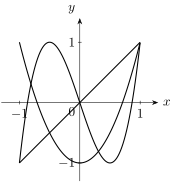
The Chebyshev polynomial TnT_{n} is the polynomial defined on the interval [−1,1]\left[-1,1\right] by the equality

Tn(x)=cos⁡(narccos⁡x)(n=0,1,2,…) T_{n}(x)=\cos (n \arccos x) \quad (n=0,1,2, \ldots )

(the graphs of TnT_{n} for n=1,2,3n=1,2,3 are shown in Fig. 4, and for n=8n=8 in Fig. 5).

Fig. 4Fig. 4

Fig. 5Fig. 5

Prove that

?
(a)

TnT_{n} is a polynomial of degree nn;

(b)

for n∈Nn \in \mathbb {N} the leading coefficient of TnT_{n} equals 2n−12^{n-1};

(c)

the Chebyshev polynomials satisfy the recurrence relation Tn+1(x)=2xTn(x)−Tn−1(x)(n∈N)T_{n+1}(x)=2 x T_{n}(x)-T_{n-1}(x) \quad (n \in \mathbb {N});

(d)

the Chebyshev polynomials satisfy the differential equation (1−x2)y′′−xy′+n2y=0\left(1-x^{2}\right) y^{\prime \prime }-x y^{\prime }+n^{2} y=0;

(e)

for ∣x∣⩾1\left|x\right| \geqslant 1 the Chebyshev polynomials satisfy the equality Tn(x)=12((x+x2−1)n+(x−x2−1)n);T_{n}(x)=\frac{1}{2}\left(\left(x+\sqrt{x^{2}-1}\right)^{n}+\left(x-\sqrt{x^{2}-1}\right)^{n}\right) ;

(f)

the fraction 1−tx1−2tx+t2\frac{1-t x}{1-2 t x+t^{2}} is a generating function for the Chebyshev polynomials, i.e.

1−tx1−2tx+t2=∑n⩾0tnTn(x) for x,t∈(−1,1). \frac{1-t x}{1-2 t x+t^{2}}=\sum _{n \geqslant 0} t^{n} T_{n}(x) \quad \text{ for } \quad x, t \in (-1,1) .
Remark.
?

More detailed information on Chebyshev polynomials can be found in the book [ Pa].

Problem I.2.21

This problem uses the Chebyshev polynomials Tn(x)=cos⁡(narccos⁡x)T_{n}(x)=\cos (n \arccos x) (see problem 2.20). Prove the extremal property of Chebyshev polynomials: if PP is an algebraic polynomial of degree nn (with real or complex coefficients) and ∣P(x)∣⩽1\left|P(x)\right| \leqslant 1 for all x∈[−1,1]x \in [-1,1], then ∣P(j)(x)∣⩽∣Tn(j)(x)∣\left|P^{(j)}(x)\right| \leqslant \left|T_{n}^{(j)}(x)\right| for all j=0,1,…,nj=0,1, \ldots , n and x∈R,∣x∣>1x \in \mathbb {R},\left|x\right|>1. The inequality is strict if P≠cTnP \neq c T_{n}, where c∈C,∣c∣=1c \in \mathbb {C},\left|c\right|=1.

In particular, for j=0j=0 we obtain ∣P(x)∣⩽∣Tn(x)∣\left|P(x)\right| \leqslant \left|T_{n}(x)\right| outside the interval [−1,1]\left[-1,1\right], and the inequality for j=nj=n implies that the leading coefficient of the polynomial PP is, in absolute value, at most 2n−12^{n-1}, with equality possible only for P=cTnP=c T_{n}, where c∈C,∣c∣=1c \in \mathbb {C},\left|c\right|=1.

?
Problem I.2.22

This problem uses the Chebyshev polynomials Tn(x)=cos⁡(narccos⁡x)T_{n}(x)=\cos (n \arccos x) (see problem 2.20). Let P(φ)=a0+∑k=1n(akcos⁡kφ+bksin⁡kφ)P(\varphi )=a_{0}+\sum_{k=1}^{n}\left(a_{k} \cos k \varphi +b_{k} \sin k \varphi \right) be a trigonometric polynomial of order nn with real coefficients a0,a1,…,ana_{0}, a_{1}, \ldots , a_{n} and b1,…,bnb_{1}, \ldots , b_{n}. Set M=max⁡φ∈R∣P(φ)∣M=\max_{\varphi \in \mathbb {R}}\left|P(\varphi )\right|. Prove Bernstein's inequality:

∣P′(φ)∣⩽nM for all φ∈R. \left|P^{\prime }(\varphi )\right| \leqslant n M \quad \text{ for all } \quad \varphi \in \mathbb {R} .

Deduce from this Bernstein's inequality for algebraic polynomials:

∣P′(x)∣⩽nM1−x2 for all x∈(−1,1), \left|P^{\prime }(x)\right| \leqslant \frac{n M}{\sqrt{1-x^{2}}} \quad \text{ for all } \quad x \in (-1,1),

where PP is an algebraic polynomial of degree nn with real coefficients, M=max⁡∣x∣⩽1∣P(x)∣M=\max_{\left|x\right| \leqslant 1}\left|P(x)\right|.

In which cases do these inequalities turn into equalities at at least one point?

?
Problem I.2.23

Let n∈Nn \in \mathbb {N}. Prove the inequalities

?
(a)

x2n2e−x<e−x−(1−xn)n⩽x2ne−x\frac{x^{2}}{n^{2}} e^{-x}<e^{-x}-\left(1-\frac{x}{n}\right)^{n} \leqslant \frac{x^{2}}{n} e^{-x} \quad for x∈[0,n],n>1x \in [0, n], n>1;

(b)

x24ne−x⩽(1+xn)−n−e−x⩽x2ne−x\frac{x^{2}}{4 n} e^{-x} \leqslant \left(1+\frac{x}{n}\right)^{-n}-e^{-x} \leqslant \frac{x^{2}}{n} e^{-x} for x∈[0,n]x \in [0, \sqrt{n}].

Problem I.2.24

Let n∈Nn \in \mathbb {N} and φn(x)=e−x22n−ex(1−xn)n\varphi_{n}(x)=e^{-\frac{x^{2}}{2 n}}-e^{x}\left(1-\frac{x}{n}\right)^{n}. Prove that the function φn\varphi_{n} is nonnegative on the interval [0,n]\left[0, n\right] and

14en⩽max⁡[0,n]φn⩽1en \frac{1}{4 \sqrt{e n}} \leqslant \max _{\left[0, n\right]} \varphi _{n} \leqslant \frac{1}{\sqrt{e n}}

The next problem considers relations that supplement the classical inequalities

sin⁡x<x<tg⁡x,ln⁡(1+x)<x<ex−1,arctg⁡x<x<arcsin⁡x. \sin x<x<\operatorname {tg} x, \quad \ln (1+x)<x<e^{x}-1, \quad \operatorname {arctg} x<x<\arcsin x .
?
Problem I.2.25

Prove the inequalities

?
(a)

(1+x)ln⁡2(1+x)<x2(1+x) \ln^{2}(1+x)<x^{2} \quad for x>−1,x≠0x>-1, x \neq 0;

(b)

x1+2πx<arctg⁡x\frac{x}{1+\frac{2}{\pi } x}<\operatorname {arctg} x \quad for x>0x>0;

(c)

x2<ln⁡(1+tg⁡2x)<sin⁡xtg⁡xx^{2}<\ln \left(1+\operatorname {tg}^{2} x\right)<\sin x \operatorname {tg} x \quad for x∈(0,π2)x \in \left(0, \frac{\pi }{2}\right);

(d)

3x−x3<2sin⁡(π2x)3 x-x^{3}<2 \sin \left(\frac{\pi }{2} x\right) \quad for x∈(0,1)x \in (0,1);

(e)

x3<sin⁡2xtg⁡xx^{3}<\sin^{2} x \operatorname {tg} x \quad for x∈(0,π2)x \in \left(0, \frac{\pi }{2}\right).

(f)

Does the inequality x3+ε<sin⁡2+εxtg⁡xx^{3+\varepsilon }<\sin^{2+\varepsilon } x \operatorname {tg} x hold on (0,π2)(0, \frac{\pi }{2}) for some fixed ε>0\varepsilon >0?

Problem I.2.26

Prove that on the interval [−1,1]\left[-1,1\right] the inequalities hold

?
(a)

(1−x2)(1−14x2)⩽cos⁡π2x⩽(1−x2)(1−15x2)\left(1-x^{2}\right)\left(1-\frac{1}{4} x^{2}\right) \leqslant \cos \frac{\pi }{2} x \leqslant \left(1-x^{2}\right)\left(1-\frac{1}{5} x^{2}\right);

(b)

(1−x2)(1−23x2)⩽sin⁡πxπx⩽(1−x2)(1−12x2)\left(1-x^{2}\right)\left(1-\frac{2}{3} x^{2}\right) \leqslant \frac{\sin \pi x}{\pi x} \leqslant \left(1-x^{2}\right)\left(1-\frac{1}{2} x^{2}\right).

Problem I.2.27

Prove the inequalities

?
(a)

(ex−1)ln⁡(1+x)>x2\left(e^{x}-1\right) \ln (1+x)>x^{2} \quad for x>0x>0;

(b)

tg⁡xarctg⁡x>x2\operatorname {tg} x \operatorname {arctg} x>x^{2} \quad for x∈(0,π2)x \in \left(0, \frac{\pi }{2}\right);

(c)

((1+x)p−1)((1+x)1/p−1)>x2\left((1+x)^{p}-1\right)\left((1+x)^{1 / p}-1\right)>x^{2} for x>0,p>0,p≠1x>0, p>0, p \neq 1.

What happens for p<0p<0?

(d)

((1−x)p−1)(1−(1+x)1/p)>x2\left((1-x)^{p}-1\right)\left(1-(1+x)^{1 / p}\right)>x^{2} for x∈(0,1),p<−1x \in (0,1), p<-1.

What happens for p∈(−1,0)p \in (-1,0)?

Problem I.2.28

Prove the inequalities

2πsin⁡(π2x)arcsin⁡x<x2<sin⁡xarcsin⁡x for x∈(0,1). \frac{2}{\pi } \sin \left(\frac{\pi }{2} x\right) \arcsin x<x^{2}<\sin x \arcsin x \quad \text{ for } \quad x \in (0,1) .
?
Problem I.2.29

Prove that for any x∈Rx \in \mathbb {R} and n∈Nn \in \mathbb {N} the inequalities hold

?
(a)

∣(sin⁡xx)(n)∣⩽1n+1\left|\left(\frac{\sin x}{x}\right)^{(n)}\right| \leqslant \frac{1}{n+1};

(b)

∣(1−cos⁡xx2)(n)∣⩽1(n+1)(n+2)\left|\left(\frac{1-\cos x}{x^{2}}\right)^{(n)}\right| \leqslant \frac{1}{(n+1)(n+2)};

(c)

∣(11+x2)(n)∣⩽n!(1+x2)n+12\left|\left(\frac{1}{1+x^{2}}\right)^{(n)}\right| \leqslant \frac{n!}{\left(1+x^{2}\right)^{\frac{n+1}{2}}}.

Problem I.2.30

Prove that ∣(sin⁡xx)′∣⩽1kπ\left|\left(\frac{\sin x}{x}\right)^{\prime }\right| \leqslant \frac{1}{k \pi } for x∈[kπ,kπ+π](k∈N)x \in [k \pi , k \pi +\pi ](k \in \mathbb {N}).

?
Problem I.2.31

Prove that for any x∈[0,1]x \in [0,1] the following inequalities hold

?
(a)

2⩽(1+x)p+(1−x)p⩽2p(p⩾1)2 \leqslant (1+x)^{p}+(1-x)^{p} \leqslant 2^{p} \quad (p \geqslant 1);

(b)

2(1+xp)⩽(1+x)p+(1−x)p⩽2p−1(1+xp)(p⩾2)2\left(1+x^{p}\right) \leqslant (1+x)^{p}+(1-x)^{p} \leqslant 2^{p-1}\left(1+x^{p}\right) \quad (p \geqslant 2);

(c)

(1+x)p+(1−x)p⩽2(1+(p−1)x2)p2(p⩾2)\quad (1+x)^{p}+(1-x)^{p} \leqslant 2\left(1+(p-1) x^{2}\right)^{\frac{p}{2}} \quad (p \geqslant 2);

(d)

(1+x)p+(1−x)p⩽2(1+xpp−1)p−1(p⩾2)\quad (1+x)^{p}+(1-x)^{p} \leqslant 2\left(1+x^{\frac{p}{p-1}}\right)^{p-1} \quad (p \geqslant 2).

In the case 1⩽p⩽21 \leqslant p \leqslant 2, the signs of the inequalities in (b)-(d) are reversed.

Problem I.2.32

Let f,g∈C([0,1])f, g \in C(\left[0,1\right]), where the function ff is nondecreasing and 0⩽f,g⩽10 \leqslant f, g \leqslant 1 on [0,1]\left[0,1\right]. Prove the inequality

∫01f(g(x))dx⩽∫01f(x)dx+∫01g(x)dx \int _{0}^{1} f(g(x)) d x \leqslant \int _{0}^{1} f(x) d x+\int _{0}^{1} g(x) d x
?
Problem I.2.33

The integral inequalities considered here have obvious summation analogues; their proofs can be obtained either by passing to the limit in the summation inequality, or by modifying the proofs used in the discrete case. Let the function ff be integrable on the interval [a,b]\left[a, b\right] and 0<m=inf⁡f,M=sup⁡f0<m=\inf f, M=\sup f. Then the following inequalities hold:

2mM(b−a)⩽1M∫abf(x)dx+m∫abdxf(x)⩽(1+mM)(b−a)(b−a)2⩽∫abf(x)dx∫abdxf(x)⩽(m+M)24mM(b−a)2 \begin{aligned} 2 \sqrt{\frac{m}{M}}(b-a) & \leqslant \frac{1}{M} \int _{a}^{b} f(x) d x+m \int _{a}^{b} \frac{d x}{f(x)} \leqslant \left(1+\frac{m}{M}\right)(b-a) \\ (b-a)^{2} & \leqslant \int _{a}^{b} f(x) d x \int _{a}^{b} \frac{d x}{f(x)} \leqslant \frac{(m+M)^{2}}{4 m M}(b-a)^{2} \end{aligned}
?
Problem I.2.34

The integral inequalities considered here have obvious summation analogues; their proofs can be obtained either by passing to the limit in the summation inequality, or by modifying the proofs used in the discrete case. By means of passage to the limit these inequalities carry over to the case of improper integrals over the interval [a,+∞)[a,+\infty ). Let the functions ff and gg be integrable on the interval [a,b]\left[a, b\right], with f↓,f⩾0f \downarrow , f \geqslant 0. For x∈[a,b]x \in [a, b] set G(x)=∫axg(t)dtG(x)=\int_{a}^{x} g(t) d t. Then the following inequalities hold:

?
(a)

f(a)inf⁡a⩽x⩽bG(x)⩽∫abf(x)g(x)dx⩽f(a)sup⁡a⩽x⩽bG(x)f(a) \inf_{a \leqslant x \leqslant b} G(x) \leqslant \int_{a}^{b} f(x) g(x) d x \leqslant f(a) \sup_{a \leqslant x \leqslant b} G(x);

(b)

∣∫abf(x)g(x)dx∣⩽f(a)sup⁡a⩽x⩽b∣G(x)∣\left|\int_{a}^{b} f(x) g(x) d x\right| \leqslant f(a) \sup_{a \leqslant x \leqslant b}\left|G(x)\right|;

(c)

(inf⁡a<x⩽bG(x)x−a)∫abf(x)dx⩽∫abf(x)g(x)dx⩽\left(\inf_{a<x \leqslant b} \frac{G(x)}{x-a}\right) \int_{a}^{b} f(x) d x \leqslant \int_{a}^{b} f(x) g(x) d x \leqslant

⩽(sup⁡a<x⩽bG(x)x−a)∫abf(x)dx \leqslant \left(\sup _{a<x \leqslant b} \frac{G(x)}{x-a}\right) \int _{a}^{b} f(x) d x
Problem I.2.35

The integral inequality considered here has an obvious summation analogue; its proof can be obtained either by passing to the limit in the summation inequality, or by modifying the proof used in the discrete case. Let the functions ff and gg be integrable on the interval [a,b]\left[a, b\right], with f↓f \downarrow and 0⩽g⩽10 \leqslant g \leqslant 1. Set c=∫abg(x)dxc=\int_{a}^{b} g(x) d x. Then

∫b−cbf(x)dx⩽∫abf(x)g(x)dx⩽∫aa+cf(x)dx \int _{b-c}^{b} f(x) d x \leqslant \int _{a}^{b} f(x) g(x) d x \leqslant \int _{a}^{a+c} f(x) d x
?
Problem I.2.36

The integral inequality considered here has an obvious summation analogue; its proof can be obtained either by passing to the limit in the summation inequality, or by modifying the proof used in the discrete case. Let f∈C1([a,b]),δ=min⁡[a,b]∣f′∣,Δ=max⁡[a,b]∣f′∣f \in C^{1}(\left[a, b\right]), \delta =\min_{\left[a, b\right]}\left|f^{\prime }\right|, \Delta =\max_{\left[a, b\right]}\left|f^{\prime }\right|. Then

δ212(b−a)2⩽1b−a∫abf2(x)dx−(1b−a∫abf(x)dx)2⩽Δ212(b−a)2 \frac{\delta ^{2}}{12}(b-a)^{2} \leqslant \frac{1}{b-a} \int _{a}^{b} f^{2}(x) d x-\left(\frac{1}{b-a} \int _{a}^{b} f(x) d x\right)^{2} \leqslant \frac{\Delta ^{2}}{12}(b-a)^{2}

Equality holds only for linear functions.

?
Problem I.2.37

The integral inequalities considered here have obvious summation analogues; their proofs can be obtained either by passing to the limit in the summation inequality, or by modifying the proofs used in the discrete case. If a continuously differentiable function ff is nondecreasing and convex (or nonincreasing and concave) on the interval [0,1]\left[0,1\right], then

13∫01(1−x)3(f′(x))2dx⩽∫01f2(x)dx−(∫01f(x)dx)2⩽⩽13∫01x3(f′(x))2dx \begin{aligned} \frac{1}{3} \int _{0}^{1}(1-x)^{3}\left(f^{\prime }(x)\right)^{2} d x \leqslant \int _{0}^{1} f^{2}(x) d x-\left(\int _{0}^{1} f(x) d x\right)^{2} & \leqslant \\ & \leqslant \frac{1}{3} \int _{0}^{1} x^{3}\left(f^{\prime }(x)\right)^{2} d x \end{aligned}

For a nondecreasing concave (or nonincreasing convex) function the signs of the inequalities are reversed. Equality is possible only for a linear function.

?
Problem I.2.38

The integral inequalities considered here have obvious summation analogues; their proofs can be obtained either by passing to the limit in the summation inequality, or by modifying the proofs used in the discrete case. Let the functions ff and gg be positive and integrable on the interval [a,b]\left[a, b\right]. Then the following inequalities hold:

?
(a)

exp⁡(1b−a∫abln⁡f(x)dx)⩽1b−a∫abf(x)dx\exp \left(\frac{1}{b-a} \int_{a}^{b} \ln f(x) d x\right) \leqslant \frac{1}{b-a} \int_{a}^{b} f(x) d x (an analogue of the Cauchy inequality between the arithmetic mean and the geometric mean);

(b)

exp⁡(1b−a∫abln⁡f(x)dx)+exp⁡(1b−a∫abln⁡g(x)dx)⩽\exp \left(\frac{1}{b-a} \int_{a}^{b} \ln f(x) d x\right)+\exp \left(\frac{1}{b-a} \int_{a}^{b} \ln g(x) d x\right) \leqslant

⩽exp⁡(1b−a∫abln⁡(f(x)+g(x))dx) \leqslant \exp \left(\frac{1}{b-a} \int _{a}^{b} \ln (f(x)+g(x)) d x\right)

(an analogue of the Minkowski inequality — see problem 2.7 (b)).

Problem I.2.39

The integral inequality considered here has an obvious summation analogue; its proof can be obtained either by passing to the limit in the summation inequality, or by modifying the proof used in the discrete case. Let the functions ff and gg be monotonic on the interval [a,b]\left[a, b\right], and let the function hh be nonnegative and integrable on it. If the monotonicity of the functions f,gf, g is of the same type, then the following inequality holds:

∫abf(x)h(x)dx∫abg(x)h(x)dx⩽∫abh(x)dx∫abf(x)g(x)h(x)dx, \int _{a}^{b} f(x) h(x) d x \int _{a}^{b} g(x) h(x) d x \leqslant \int _{a}^{b} h(x) d x \int _{a}^{b} f(x) g(x) h(x) d x,

while if the monotonicity is of different types, then the sign of the inequality is reversed.

?
Problem I.2.40
  1. Let f∈C1([0,π])f \in C^{1}(\left[0, \pi \right]), with f(0)=f(π)=0f(0)=f(\pi )=0. Prove the inequality

    ∫0πf2(x)dx⩽∫0π(f′(x))2dx \int _{0}^{\pi } f^{2}(x) d x \leqslant \int _{0}^{\pi }\left(f^{\prime }(x)\right)^{2} d x

    by representing the difference of these integrals as an integral of a nonnegative function.

  2. Prove that the inequality remains valid if, instead of the condition f(0)=f(π)=0f(0)=f(\pi )=0, we assume that f(0)=f(π)f(0)=f(\pi ) and ∫0πf(x)dx=0\int_{0}^{\pi } f(x) d x=0.

  3. Let f∈C1([0,2π]),f(0)=f(2π)f \in C^{1}(\left[0,2 \pi \right]), f(0)=f(2 \pi ) and ∫02πf(x)dx=0\int_{0}^{2 \pi } f(x) d x=0. Prove that

    ∫02πf2(x)dx⩽∫02π(f′(x))2dx \int _{0}^{2 \pi } f^{2}(x) d x \leqslant \int _{0}^{2 \pi }\left(f^{\prime }(x)\right)^{2} d x

For which functions do these inequalities become equalities?

?
Problem I.2.41

Let a smooth closed curve of length LL bound a plane figure of area SS. Using the natural parametrization of the curve and Wirtinger's inequality, prove the isoperimetric inequality: 4πS⩽L24 \pi S \leqslant L^{2}. Use it to determine the maximal area of a figure that can be bounded by a curve of length LL, lying in a half-plane, with endpoints on the boundary of the half-plane — "Dido's problem"∗){ }^{*)}.

?
Remark.
?

∗){ }^{*)} According to legend, the ship of Dido, fleeing the persecution of her brother, the Tyrian king Pygmalion, landed on the African shore. The local king Iarbas, in response to the fugitives' request for land to settle on, allowed them to occupy a plot on the seashore of the size of an ox hide. Dido ordered the hide to be cut into thin strips and used them to enclose a plot of land on which she founded Carthage.