Measures
[95/16%]Prove that if and are subsets of and , then .
Suppose and . Let . Prove that .
Assume that is defined to be 0.
Prove that if and , then .
Suppose is a subset of with the property that every open cover of has a finite subcover. Prove that is closed and bounded.
Suppose is a set of closed subsets of such that . Prove that if contains at least one bounded set, then there exist and such that .
Prove that if and , then
Suppose are real numbers with and . Prove that
Prove that if and , then .
Prove that for all .
Prove that .
Prove that if is a disjoint sequence of open intervals, then
Suppose is a sequence that contains every rational number. Let
Show that is a closed subset of .
Prove that if is an interval contained in , then contains at most one element.
Prove that .
Suppose . Prove that there exists a subset of such that is closed, every element of is an irrational number, and .
Consider the following figure, which is drawn accurately to scale.
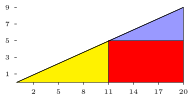
Show that the right triangle whose vertices are , and has area 90.
Show that the yellow (lower) right triangle has area 27.5.
Show that the red rectangle has area 45.
Show that the blue (upper) right triangle has area 18.
Add the results of parts (b), (c), and (d), showing that the area of the colored region is 90.5.
Seeing the figure above, most people expect parts (a) and (e) to have the same result. Yet in part (a) we found area 90, and in part (e) we found area 90.5. Explain why these results differ.
Regarding (a): we have not defined area yet, but just use the elementary formulas for the areas of triangles and rectangles that you learned long ago.
Regarding (f): you may be tempted to think that what we have here is a two-dimensional example similar to the result about the nonadditivity of outer measure (2.18). However, genuine examples of nonadditivity require much more complicated sets than in this example.
Show that is a -algebra on .
Verify both bullet points in Example 2.28.
Example 2.28 (smallest -algebra):
-
Suppose is a set and is the set of subsets of that consist of exactly one element: . Then the smallest -algebra on containing is the set of all subsets of such that is countable or is countable, as you should verify.
-
Suppose . Then the smallest -algebra on containing is , as you should verify.
Suppose is the smallest -algebra on containing . Prove that is the collection of Borel subsets of .
Suppose is the smallest -algebra on containing . Prove that is the collection of Borel subsets of .
Suppose is the smallest -algebra on containing . Prove that is the collection of Borel subsets of .
Suppose is the smallest -algebra on containing . Prove that is the collection of Borel subsets of .
Prove that the collection of Borel subsets of is translation invariant. More precisely, prove that if is a Borel set and , then is a Borel set.
Prove that the collection of Borel subsets of is dilation invariant. More precisely, prove that if is a Borel set and , then (which is defined to be ) is a Borel set.
Give an example of a measurable space and a function such that is -measurable but is not -measurable.
Show that the set of real numbers that have a decimal expansion with the digit 5 appearing infinitely often is a Borel set.
Suppose is a -algebra on a set and . Let .
Show that .
Show that is a -algebra on .
Suppose is a function.
For , let
Prove that is an open subset of for each .
Prove that the set of points at which is continuous equals .
Conclude that the set of points at which is continuous is a Borel set.
Suppose is a measurable space, are disjoint subsets of , and are distinct nonzero real numbers. Prove that is an -measurable function if and only if .
Suppose is a sequence of functions from a set to . Explain why
Suppose is a measurable space and is a sequence of measurable functions from to . Prove that
is an -measurable subset of .
Suppose is a set and is a disjoint sequence of subsets of such that . Let .
Show that is a -algebra on .
Prove that a function from to is -measurable if and only if the function is constant on for every .
Suppose is a -algebra on a set and . Let
Prove that is a -algebra on .
Suppose is a function. Prove that is measurable with respect to if and only if is measurable with respect to and is constant on .
Suppose is a Borel subset of and is a function such that is a countable set. Prove is a Borel measurable function.
Suppose is differentiable at every element of . Prove that is a Borel measurable function from to .
Suppose is a nonempty set and is the -algebra on consisting of all subsets of that are either countable or have a countable complement in . Give a characterization of the -measurable real-valued functions on .
Suppose is a measurable space and are -measurable functions. Prove that if for all , then (which is the function whose value at equals ) is an -measurable function.
Prove 2.52.
2.52 (condition for measurable function): Suppose is a measurable space and is a function such that for all . Then is an -measurable function.
Suppose and is an increasing function. Prove that is continuous at every element of except for a countable subset of .
Suppose is a strictly increasing function. Prove that the inverse function is a continuous function.
Note that this exercise does not have as a hypothesis that is continuous.
Suppose is a strictly increasing function and is a Borel set. Prove that is a Borel set.
Suppose and is an increasing function. Prove that there exists a sequence of strictly increasing functions from to such that
for every .
Suppose and is a bounded increasing function. Prove that there exists an increasing function such that for all .
Prove or give a counterexample: If is a measurable space and
is a function such that for every , then is an -measurable function.
Suppose is a Borel measurable function. Define by
Prove that is a Borel measurable function.
Give an example of a measurable space and a family such that each is an -measurable function from to , but the function defined by
is not -measurable.
Compare this exercise to 2.53, where the index set is rather than .
Show that
for every .
This example is due to Henri Lebesgue.
Explain why there does not exist a measure space with the property that .
Let denote the -algebra on consisting of all subsets of . Suppose is a measure on . Prove that there is a sequence in such that
for every set .
Give an example of a measure on such that
Give an example of a measure space such that
Suppose is a measure space such that . Prove that if is a set of disjoint sets in such that for every , then is a countable set.
Find all such that there exists a measure space with
Give an example of a measure space such that
Give an example of a set , a -algebra of subsets of , a set of subsets of such that the smallest -algebra on containing is , and two measures and on such that for all and , but .
Suppose and are measures on a measurable space . Prove that is a measure on .
Here is the usual sum of two functions: if , then .
Give an example of a measure space and a decreasing sequence of sets in such that
Suppose is a measure space and are such that
Find and prove a formula for in terms of , , and .
Suppose is a set and is the -algebra of all subsets of such that is countable or is countable. Give a complete description of the set of all measures on .
Show that the set consisting of those numbers in that have a decimal expansion containing one hundred consecutive 4s is a Borel subset of .
What is the Lebesgue measure of the set in part (a)?
Prove that there exists a bounded set such that for every closed set .
Prove that there exists a set such that for every open set that contains .
The phrase nontrivial interval is used to denote an interval of that contains more than one element. Recall that an interval might be open, closed, or neither.
Prove that the union of each collection of nontrivial intervals of is the union of a countable subset of that collection.
Prove that the union of each collection of nontrivial intervals of is a Borel set.
Prove that there exists a collection of closed intervals of whose union is not a Borel set.
Prove that if is Lebesgue measurable, then there exists an increasing sequence of closed sets contained in such that
Suppose and . Prove that is Lebesgue measurable if and only if for every there exists a set that is the union of finitely many disjoint bounded open intervals such that .
Prove that if is Lebesgue measurable, then there exists a decreasing sequence of open sets containing such that
Prove that the collection of Lebesgue measurable subsets of is translation invariant. More precisely, prove that if is Lebesgue measurable and , then is Lebesgue measurable.
Prove that the collection of Lebesgue measurable subsets of is dilation invariant. More precisely, prove that if is Lebesgue measurable and , then (which is defined to be ) is Lebesgue measurable.
Prove that if and are disjoint subsets of and is Lebesgue measurable, then .
Prove that if and , then there exists a subset of that is not Lebesgue measurable.
Suppose and . Prove that is Lebesgue measurable if and only if .
Suppose . Prove that is Lebesgue measurable if and only if
for every .
Show that and are both in the Cantor set.
Show that is not in the Cantor set.
List the eight open intervals whose union is in the definition of the Cantor set (2.74).
Let denote the Cantor set. Prove that .
Prove that every open interval of contains either infinitely many or no elements in the Cantor set.
Evaluate , where is the Cantor function.
Evaluate each of the following:
;
.
Find each of the following sets:
;
.
Suppose is a rational number in . Explain why is rational.
Suppose is such that is rational. Explain why is rational.
Show that there exists a function such that the image under of every nonempty open interval is .
For , the quantity
is called the inner measure of .
Show that if is a Lebesgue measurable subset of , then the inner measure of equals the outer measure of .
Show that inner measure is not a measure on the -algebra of all subsets of .
Suppose is a finite set. Explain why a sequence of functions from to that converges pointwise on also converges uniformly on .
Give an example of a sequence of functions from to that converges pointwise on but does not converge uniformly on .
Give an example of a sequence of continuous functions from to that converges pointwise to a function that is not a bounded function.
Prove or give a counterexample: If and is a sequence of uniformly continuous functions from to that converges uniformly to a function , then is uniformly continuous on .
Give an example to show that Egorov's Theorem can fail without the hypothesis that .
Suppose is a measure space with . Suppose is a sequence of -measurable functions from to such that for each . Prove that for every , there exists a set such that and converges uniformly to on (meaning that for every , there exists such that for all integers and all ).
The exercise above is an Egorov-type theorem for sequences of functions that converge pointwise to .
Suppose is a closed bounded subset of and is an increasing sequence of continuous real-valued functions on (thus for all ) such that for each . Define a real-valued function on by
Prove that is continuous on if and only if converges uniformly on to .
The result above is called Dini's Theorem.
Suppose is the measure on defined by
Prove that for every , there exists a set with such that converges uniformly on for every sequence of functions from to that converges pointwise on .
This result does not follow from Egorov's Theorem because here we are asking for to depend only on . In Egorov's Theorem, depends on and on the sequence .
Suppose are disjoint closed subsets of . Prove that if
is a function such that is a continuous function for each , then is a continuous function.
Suppose is such that every continuous function from to can be extended to a continuous function from to . Prove that is a closed subset of .
Prove or give a counterexample: If is such that every bounded continuous function from to can be extended to a continuous function from to , then is a closed subset of .
Give an example of a Borel measurable function from to such that there does not exist a set such that and is a continuous function on .
Prove or give a counterexample: If is a Borel measurable function for each and is defined by
then is a Borel measurable function.
Suppose is a sequence of real numbers. Define by
Prove that .
This exercise is a variation of a problem originally considered by Borel. If contains all the rational numbers, then it is not even obvious that .
Suppose is a Borel set and is a Lebesgue measurable function. Show that there exists a Borel measurable function such that