Outer Measure on
[14/0%]Prove that if and are subsets of and , then .
Suppose and . Let . Prove that .
Assume that is defined to be 0.
Prove that if and , then .
Suppose is a subset of with the property that every open cover of has a finite subcover. Prove that is closed and bounded.
Suppose is a set of closed subsets of such that . Prove that if contains at least one bounded set, then there exist and such that .
Prove that if and , then
Suppose are real numbers with and . Prove that
Prove that if and , then .
Prove that for all .
Prove that .
Prove that if is a disjoint sequence of open intervals, then
Suppose is a sequence that contains every rational number. Let
Show that is a closed subset of .
Prove that if is an interval contained in , then contains at most one element.
Prove that .
Suppose . Prove that there exists a subset of such that is closed, every element of is an irrational number, and .
Consider the following figure, which is drawn accurately to scale.
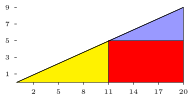
Show that the right triangle whose vertices are , and has area 90.
Show that the yellow (lower) right triangle has area 27.5.
Show that the red rectangle has area 45.
Show that the blue (upper) right triangle has area 18.
Add the results of parts (b), (c), and (d), showing that the area of the colored region is 90.5.
Seeing the figure above, most people expect parts (a) and (e) to have the same result. Yet in part (a) we found area 90, and in part (e) we found area 90.5. Explain why these results differ.
Regarding (a): we have not defined area yet, but just use the elementary formulas for the areas of triangles and rectangles that you learned long ago.
Regarding (f): you may be tempted to think that what we have here is a two-dimensional example similar to the result about the nonadditivity of outer measure (2.18). However, genuine examples of nonadditivity require much more complicated sets than in this example.