Basic properties of compact sets
[14/86%]Let be topological spaces, and let the set be compact. Prove that:
any closed subset of is compact;
if is Hausdorff, then is closed;
if is Hausdorff, and the map is continuous, then is compact in ;
every infinite subset of has a limit point .
Let be a compact set in a topological space , and a continuous bijective map of onto a Hausdorff space . Prove that the inverse map is also continuous, i.e., is a homeomorphism of М and .
Suppose in a linear topological space the set is closed, and the set is compact. Is it true that the set is closed?
Define quotient map.
Show that if is compact, is Hausdorff and is continuous and onto, then is a closed map.
Show that if satisfies the condition of (b) then is a quotient map.
Let be an -sheeted covering projection, . Suppose that is compact. Prove that is compact.
A set of a metric space is said to be bounded if it is contained in some ball . Show that a subset of a metric space which is compact must be bounded.
Show that a finite union of compact sets is compact.
Decide whether or not the following subsets of are compact:
;
;
.
A topological space is called Hausdorff if given there are disjoint open sets with , .
Show that in a Hausdorff space, compact sets are closed.
In a general topological space, a set will be open if given , then there is an open set with ; for then we can write as the union of the sets as ranges over the points of , and the union of open sets is open. With this criterion for a set to be open, the proof in the metric case can be modified to prove the result.
Consider the function given by .
Show that is a bijection that is continuous but is not a homeomorphism.
Consider the open set and its image.
Give an example of a closed, bounded subset of a metric space that is not compact.
Consider the metric space itself to be a bounded noncompact subset of and .
Let be a continuous map of the compact metric space to the metric space . Show that is uniformly continuous.
Use the Lebesgue number of the covering of .
Consider the space , where and . The space is called the topologist's sine curve. This and the next two exercises show that is connected but not path connected.
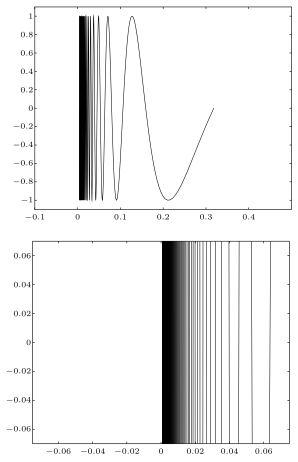 The topologist’s sine curve—two views.
Show that .
For each of the following subsets of indicate which of the following properties it possesses, namely, (i) compact; (ii) connected; (iii) path connected; (iv) open; (v) closed:
;
;
;
;
.