Supplementary exercises
[97/100%]A collection of subsets of is called a basis and its elements are called basis elements if the following properties are satisfied:
every is contained in some ;
if , , then there is a basis element with .
The topology determined by the basis is defined as follows: a set is open if, for every , there is a basis element with .
Verify that satisfies the three properties required of a topology.
Show that the set of balls is a basis for the topology of a metric space ; that is, show that it is a basis and the topology it determines is the metric topology.
Show that any open set in (the topology determined by a basis ) is a union of basis elements.
For , choose a basis element with .
Suppose the topology for is determined by a basis. Show that is continuous iff, for each basis element of , is open.
Show that the open intervals give a basis for the topology of .
Combine the last two exercises to show that a map to is continuous iff, for each open interval , we have is open. Formulate and prove an analogous statement for maps to a metric space in terms of balls.
Let be a metric space with metric and let be a subset of . Show that the metric topology on given by is the same as the subspace topology.
Suppose , and has the subspace topology. Show that, if is open in and is open in , then is open in .
If , let . Which of the three properties of a metric does satisfy?
On , write each point in polar coordinates as , where . Define . Show that this gives a metric on but the topology formed is not the usual topology.
A point is called a limit point of a set if every open set containing intersects in a nonempty set; that is, for open, . Denote the limit points of by .
Show that a set is closed iff it contains all of its limit points.
Find the limit points of the following subsets of :
;
, the rationals;
.
Let be a metric space and . Show that is a limit point of iff every ball contains infinitely many points of .
Show that, in a Hausdorff space with subset , is a limit point of iff every open set containing contains infinitely many points of .
Show that if is a closed set containing , then .
Show that if is an open set contained in , then .
Show that is closed iff , and is open iff .
Show that , where denotes the set of limit points of .
Show that in we have and .
By using the discrete topology, show that this does not hold generally in a metric space.
A topological space is called limit point compact if every infinite set has a limit point.
Show that a compact space is limit point compact.
A topological space is called limit point compact if every infinite set has a limit point.
Show that if is a metric space, then is limit point compact iff it is sequentially compact iff it is compact.
Show that if is continuous at and is a sequence converging to , then converges to .
Show that a map between metric spaces is continuous at iff for every sequence which converges to , the sequence converges to .
Show that, in a Hausdorff space, the limit of a sequence is well defined; that is, if converges to and to , then .
Show that, in a Hausdorff space, if converges to , then is the only limit point of the set of all of values . Is the converse true? Give a proof or counterexample.
Show that a finite set in a Hausdorff space is closed.
A Hausdorff space is called regular if, given and a closed set with , then there are disjoint open sets and with and .
Show that a compact Hausdorff space is regular.
Use the fact that a closed subset of a compact space is compact. Get an open cover of the closed, hence compact, set where there is an open set for each point with and an open set so that with .
Suppose , where is regular and is open. Show that there is an open set with .
Consider the point and the disjoint closed set .
A Hausdorff space is called normal if, whenever are disjoint closed subsets, then there are disjoint open sets with , .
Show that a compact Hausdorff space is normal.
Apply the conclusion of Exercise 1.9.26 to pairs , where and use the compactness of .
Suppose , where is normal, is closed and is open. Then show that there is an open set with .
and are disjoint closed sets.
Show that a metric space is normal.
If are disjoint closed subsets, then cover by balls disjoint from and cover by balls disjoint from . Then show that and are disjoint open sets containing and .
Let be a subset of a metric space . For each , define the distance from to by .
Show that . Show that if is closed and , then .
Let be a subset of a metric space , and the distance from to .
Show that , where , is an open set containing .
Let be a subset of a metric space , and the distance from to .
Show that the function given by is continuous.
Look at the inverse image of an interval.
Suppose are disjoint closed sets in a metric space . Use the notion of the distance from a point to a set (i.e. ) to define in terms of for . Give an example to show that this distance could be . Show that if is compact, then the distance must be positive.
Suppose is a metric space and are disjoint closed sets. Show that the function
is a continuous real-valued function with , . The existence of a function from to which is on and on is called Urysohn's Lemma and holds in the more general situation of a normal space.
Suppose is a metric space and is a closed subset, with a continuous function . This exercise leads through a proof that there is a continuous extension . This result is called the Tietze extension theorem and holds in the more general situation of a normal space.
Reduce to the case where is bounded by considering the composition of with a homeomorphism from to .
Because of (a), we assume from now on that . We inductively define continuous maps from to which give better and better approximations to on . Let , and . Show that are disjoint closed subsets of . Apply Exercise 1.9.35 to show that there is a continuous map with , and . Show that on .
Repeat the construction in (b) applied to defined on to construct so that
and .
Use induction to construct a sequence of maps so that if , then on and .
Define . Show that converges uniformly to a continuous function which is an extension of ; that is, for .
Urysohn's lemma states that for a normal space with disjoint closed sets , there is a continuous function with and . The Tietze extension theorem states that for a normal space with a closed subset and a continuous function , there is a continuous function with for .
Show that Urysohn's lemma is equivalent to the Tietze extension theorem.
Use the argument in Exercise 1.9.36 to show that Urysohn's lemma implies the Tietze extension theorem.
Show that is dense in , and hence is separable (i.e. has a countable dense subset).
A space is called first countable if, for each , there is a countable basis of open sets containing ; that is, there is a collection of open sets containing so that, if is an open set containing , then there is a set . This is called a neighborhood basis.
Show that a metric space is first countable.
A space is called first countable if, for each , there is a countable basis of open sets containing so that, if is an open set containing , then there is a set .
Show that, if is first countable and is a limit point of , then there is a sequence which converges to .
A space is called first countable if, for each , there is a countable basis of open sets containing so that, if is an open set containing , then there is a set .
Show that if is first countable, Hausdorff, and compact, then is sequentially compact.
Adapt the proof given in Section 1.5 for metric spaces.
A space is called second countable if there is a countable basis for the topology of . A metric space is called separable if there is a countable set so that every open set contains at least one (we say is dense in and is a countable dense subset).
Show that a metric space is separable iff it is second countable.
If it is separable, use balls about the countable dense subset to get a countable basis. A countable number of countable sets is still countable. If it is second countable, select a countable set by choosing one point from each basis element.
A space is called countably compact if every countable open cover has a finite subcover. A space is called second countable if there is a countable basis for the topology of .
Show that compactness implies countable compactness, and that the converse holds in a second countable space.
In a second countable space show that for each open covering there is a covering by basis elements so that each basis element is contained in an element of the given covering .
Consider the space , where and . The space is called the topologist's sine curve. This and the next two exercises show that is connected but not path connected.
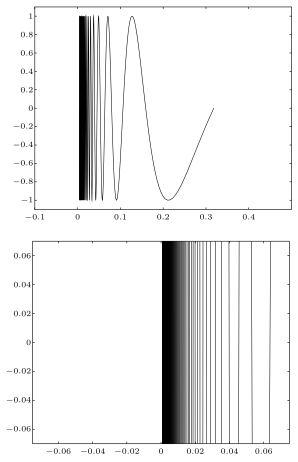 The topologist’s sine curve—two views.
Show that .
Consider the space , where and (the topologist's sine curve; see the figure in Exercise 1.9.44).
Show that the closure of a connected set is connected, thus implying that is connected.
Consider the space , where and (the topologist's sine curve; see the figure in Exercise 1.9.44). We show here that is not path connected. Suppose were path connected. Let be a path with and . Consider the set . Let be .
Show that is nonempty, is bounded from above, and has a least upper bound .
Show that .
Show that there is a neighborhood of consisting of an infinite number of separated arcs, and a neighborhood of with .
Show that there is , with .
Show that there are disjoint open sets with , , and ; that is, is separated by .
By looking at , arrive at a contradiction.
A topological space is called locally path connected at if for each open set containing , there is a path connected open set with . It is called locally path connected if it is locally path connected at each . It is called locally connected at if, for each open set containing , there is a connected open set with . It is called locally connected if it is locally connected for each .
Show that a locally path connected space is locally connected.
Show that the topologist's sine curve (see the figure in Exercise 1.9.44) is not locally connected, where a space is locally connected at if for each open set containing , there is a connected open set with .
Show that an open set in is locally path connected, where a space is locally path connected at if for each open set containing , there is a path connected open set with .
Show that the path components of a locally path connected space are open sets, where a space is locally path connected at if for each open set containing , there is a path connected open set with .
Show that if is locally path connected and connected, then is path connected.
Modify the proof that a connected open set in is path connected.
Give an example of a path connected space which is not locally path connected.
Define an equivalence relation on by if there is a connected set containing both and . The equivalence classes are called the components of .
Verify that this is an equivalence relation.
Show that each component is connected, that any two components are equal or disjoint, and that the union of the components is .
Show that any connected subset of intersects at most one component and is a subset of that component.
Show that each path component is contained in a component, and that a component is a disjoint union of path components.
Show that a component is a closed set.
Show that a space is locally connected iff, for each open set , each component of is open in .
Show that a space is locally path connected iff, for each open set , each path component of is open in .
A collection of subsets of is said to satisfy the finite intersection property (F.I.P.) if for every finite subcollection of , the intersection . Show that is compact iff for every collection of closed sets satisfying the F.I.P., the intersection of all of the elements of is nonempty.
If not, consider the covering of by the complements .
Let be a compact metric space, and continuous. is called a fixed point of if . is called a contraction if there is a number such that for all . Show that a contraction has a unique fixed point. This result is known as the contraction mapping principle and plays a key role in analysis.
Consider , where denotes the -fold composition of with itself, and use the finite intersection property from the previous exercise.
is called locally compact at if there is an open set and a compact set with . It is called locally compact if it is locally compact at each .
Show that a compact space is locally compact.
Show that is locally compact, where a space is locally compact at if there is an open set and a compact set with .
Show that if is Hausdorff and locally compact at , then there is an open set containing so that is compact.
Suppose is a locally compact Hausdorff space. Show that if , open, then there exists an open set containing such that is compact and .
Use the preceding exercise and the argument of Exercise 1.9.27.
Suppose that is a locally compact Hausdorff space. Form a new space , called the one-point compactification of , as , the disjoint union of and an added point . A set is called open if (1) is an open set in , or (2) and is a compact set in .
Show that this definition of open set satisfies the three properties of a topology.
Show that the subspace topology on is the same as its usual topology.
Show that is a compact Hausdorff space.
Show that if is a locally compact Hausdorff space and is a compact Hausdorff space with , then , where denotes the one-point compactification of .
Show that the one-point compactification of is homeomorphic to .
Show that the one-point compactification of is homeomorphic to .
Show that the one-point compactification of is homeomorphic to .
For part (b), use projection from the point to get a homeomorphism from to .
Show that, if is compact, the one-point compactification of is , where the set is an open set in the disjoint union.
Consider the space , which is the product of a countably infinite number of copies of . This is given the product topology with basis the sets which are a product of a finite number of intervals with a product of copies of the reals:
Show that this space is not locally compact.
Look at basic open sets and show that they do not have compact closure.
Show that the following two subsets of are not homeomorphic: , .
Show that is homeomorphic to , where denotes the one-point compactification of .
Show that (the figure-eight curve) is not homeomorphic to O (the circle).
Consider where the crossing point of could go under a homeomorphism.
The next four exercises concern the homeomorphism type of the letters of the alphabet. In each case, assume the letter is written in the sans serif style, with no adornments: .
Show that the letter X is not homeomorphic to the letter Y, but that the letter Y is homeomorphic to the letter T.
The letters of the alphabet are written in the sans serif style, with no adornments: .
Construct a homeomorphism between the letter D and the letter O.
The letters of the alphabet are written in the sans serif style, with no adornments: .
Prove that the letter A is not homeomorphic to the letter B.
The letters of the alphabet are written in the sans serif style, with no adornments: .
Group the letters of the alphabet into equivalence classes so that equivalent letters are homeomorphic and nonequivalent letters are not homeomorphic.
Prove that if an open set is path connected, then any two points in can actually be connected by a polygonal path in .
For each of the following subsets of indicate which of the following properties it possesses, namely, (i) compact; (ii) connected; (iii) path connected; (iv) open; (v) closed:
;
;
;
;
.
Show that the torus is not homeomorphic to an open set in .
Use the properties of compactness and connectedness.
Show that if with , then is not homeomorphic to .
Put an equivalence relation on by saying that two points are equivalent if they both lie on the circle of radius about the origin. Show that , with the quotient topology, is homeomorphic to .
Identify all points in the lower hemisphere of the sphere . Show that the resulting quotient space is homeomorphic to .
Identify points on the boundary circles of an annulus between the circles of radius 1 and radius 2 that lie on the same ray from the origin. Show that the resulting quotient space is homeomorphic to the torus .
Identify the points on the outer circle of an annulus to one point and the points on the inner circle to a (different) point. Show that is homeomorphic to . Describe what space you would get if you identified the points on both circles to a single point.
Consider the quotient space formed from two copies of using by , , . Decide whether is homeomorphic to the annulus or the Möbius band, and prove your assertion.
Show that the upper hemisphere of is homeomorphic to and similarly for the lower hemisphere. Use this to show is homeomorphic to for and determine .
Show that , where is , and is homeomorphic to .
First choose a homeomorphism from to where . Use this to get a homeomorphism , where is .
Construct a homeomorphism between a square and a diamond.
Construct a homeomorphism between the two regions in the figure below.
 Annular regions.
Show that any two rectangles in the plane are homeomorphic.
Construct a homeomorphism between the inside of a square and the star in the figure below.
 Star.
Star.
Show that there is no homeomorphism of the plane to itself which sends the unit circle to itself and sends to .
Construct an example of a simple closed curve in the plane where a horizontal line intersects the curve in an infinite number of points but the curve contains no horizontal line segments.
Show that the complement of two disjoint polygonal simple closed curves in the plane consists of three disjoint open, path connected sets.
This and the next two exercises concern the figure below, showing two pairs of circles (an annulus-like pair, with on the outer circle ) and (two externally tangent-looking circles, with on the larger circle ).
 Two pairs of circles.
Show that there is a homeomorphism sending to .
Consider the two pairs of circles and from the figure in Exercise 1.9.90, with and the marked points.
Show that any homeomorphism sending to which sends to must send homeomorphically to and homeomorphically to .
Consider the two pairs of circles and from the figure in Exercise 1.9.90.
Show that there does not exist a homeomorphism of the plane sending to .
Consider the regions bounded by and .
Consider a polygonal path that is not closed and does not intersect itself. Show that is path connected using a polygonal path.
Use induction on the number of segments in the path.
Show directly that the triangle with vertices , , separates the plane into two nonempty disjoint open path connected sets, one of which is bounded and the other not.
Consider the shaded region in the figure below (which is not homeomorphic to a disk). Analyze how the region changes as we move upward past the special vertices.
 A polygonal annular region.
Show that the region in the figure from Exercise 1.9.95 (a polygonal annular region) is homeomorphic to the region enclosed between the squares and . Do this both by a direct argument and by breaking each region into two regions to which we can apply the polygonal Schönflies theorem.
Describe a homeomorphism between the region in the figure below (a curvy disk) and a disk.
 A curvy disk.