Exercises
[9/100%]ᴬ Answer all parts for the following DFA and give reasons for your answers.
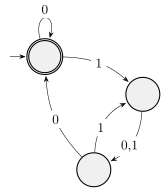
Is ?
Is ?
Is ?
Is ?
Is ?
Is ?
Consider the problem of determining whether a DFA and a regular expression are equivalent. Express this problem as a language and show that it is decidable.
Let . Show that is decidable.
Let . Show that is decidable.
ᴬ Let . Show that , the complement of , is Turing-recognizable.
Let be the set and be the set . We describe the functions and in the following tables. Answer each part and give a reason for each negative answer.
| 1 | 6 |
| 2 | 7 |
| 3 | 6 |
| 4 | 7 |
| 5 | 6 |
| 1 | 10 |
| 2 | 9 |
| 3 | 8 |
| 4 | 7 |
| 5 | 6 |
ᴬ Is one-to-one?
Is onto?
Is a correspondence?
ᴬ Is one-to-one?
Is onto?
Is a correspondence?
Let be the set of all infinite sequences over . Show that is uncountable using a proof by diagonalization.
Let . Show that is countable.
Review the way that we define sets to be the same size in Definition 4.12 (page 203). Show that "is the same size" is an equivalence relation.