Decidability
[32/97%]ᴬ Answer all parts for the following DFA and give reasons for your answers.
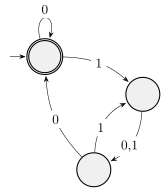
Is ?
Is ?
Is ?
Is ?
Is ?
Is ?
Consider the problem of determining whether a DFA and a regular expression are equivalent. Express this problem as a language and show that it is decidable.
Let . Show that is decidable.
Let . Show that is decidable.
ᴬ Let . Show that , the complement of , is Turing-recognizable.
Let be the set and be the set . We describe the functions and in the following tables. Answer each part and give a reason for each negative answer.
| 1 | 6 |
| 2 | 7 |
| 3 | 6 |
| 4 | 7 |
| 5 | 6 |
| 1 | 10 |
| 2 | 9 |
| 3 | 8 |
| 4 | 7 |
| 5 | 6 |
ᴬ Is one-to-one?
Is onto?
Is a correspondence?
ᴬ Is one-to-one?
Is onto?
Is a correspondence?
Let be the set of all infinite sequences over . Show that is uncountable using a proof by diagonalization.
Let . Show that is countable.
Review the way that we define sets to be the same size in Definition 4.12 (page 203). Show that "is the same size" is an equivalence relation.
ᴬ Let . Show that is decidable.
Let . Show that is decidable.
ᴬ Let . Show that is decidable.
Let . Show that is decidable.
ᴬ Let . Show that the problem of determining whether a CFG generates some string in is decidable. In other words, show that
is a decidable language.
- Show that the problem of determining whether a CFG generates all strings in is decidable. In other words, show that is a decidable language.
Let . Show that is decidable.
Prove that is decidable by testing the two DFAs on all strings up to a certain size. Calculate a size that works.
- Let be a language. Prove that is Turing-recognizable iff a decidable language exists such that .
- Prove that the class of decidable languages is not closed under homomorphism.
Let and be two disjoint languages. Say that language separates and if and . Show that any two disjoint co-Turing-recognizable languages are separable by some decidable language.
Let . Show that is decidable.
Let . Show that is decidable. Why does a similar approach fail to show that is decidable?
- ᴬ Say that an NFA is ambiguous if it accepts some string along two different computation branches. Let . Show that is decidable. (Suggestion: One elegant way to solve this problem is to construct a suitable DFA and then run on it.)
A useless state in a pushdown automaton is never entered on any input string. Consider the problem of determining whether a pushdown automaton has any useless states. Formulate this problem as a language and show that it is decidable.
- ᴬ Let . Show that is decidable. (Hint: Theorems about CFLs are helpful here.)
- Let . Show that is decidable. (Hint: Theorems about CFLs are helpful here.)
- Let . Show that is decidable. (Hint: Theorems about CFLs are helpful here.)
Let . Show that is decidable. (Hint: An elegant solution to this problem uses the decider for .)
Let . Show that is decidable.
Let be a Turing-recognizable language consisting of descriptions of Turing machines, , where every is a decider. Prove that some decidable language is not decided by any decider whose description appears in . (Hint: You may find it helpful to consider an enumerator for .)
Say that a variable in CFL is usable if it appears in some derivation of some string . Given a CFG and a variable , consider the problem of testing whether is usable. Formulate this problem as a language and show that it is decidable.
The proof of Lemma 2.41 says that is a looping situation for a DPDA if when is started in state with on the top of the stack, it never pops anything below and it never reads an input symbol. Show that is decidable, where .