Iterations of Interval Transformations
[79/94%]Suppose that for a function , the inequality holds for every . Prove that for every .
Does there exist a continuous function satisfying the equation in the following cases:
;
;
?
Let us denote by (or simply Id) the identity map of a set onto itself (i.e., for every in ). A map will be called an involution if .
Let . Find two involutions and such that the relations hold.
Let us denote by (or simply Id) the identity map of a set onto itself (i.e., for every in ). A map will be called an involution if .
Prove that every bijection of a set onto itself is the composition of two involutions.
A map is called an involution if , where is the identity map of . A fixed point of a map is a point in its domain of definition such that .
Prove that a continuous map , where is some interval, has a fixed point in each of the following cases:
;
;
is an involution.
A fixed point of a map is a point in its domain of definition such that . Let a function be increasing, . Prove that for every the sequence () converges to a fixed point. Does this hold if is a decreasing function?
A fixed point of a map is a point in its domain of definition such that . Let . For , set . Prove that if for some the sequence is bounded, then has a fixed point. Does this hold for continuous maps ?
A fixed point of a map is a point in its domain of definition such that .
Prove that a finite group of affine transformations of the plane has a fixed point (common to all transformations of the group).
Maps and ( being intervals on the line) are called topologically conjugate if there exists a continuous bijection (homeomorphism) such that (i.e., ). In this case we write and call the conjugating map. It is assumed that the maps are continuous, defined on intervals, and map them into themselves.
Prove that the relation of topological conjugacy is an equivalence relation, i.e.
;
if and only if ;
if , then .
Maps and ( being intervals on the line) are called topologically conjugate if there exists a continuous bijection (homeomorphism) such that (i.e., ). In this case we write and call the conjugating map. It is assumed that the maps are continuous, defined on intervals, and map them into themselves.
Prove that topologically conjugate maps simultaneously possess or fail to possess the following properties:
injectivity;
monotonicity of a definite type;
one-sided boundedness (without specifying its type);
boundedness.
Maps and ( being intervals on the line) are called topologically conjugate if there exists a continuous bijection (homeomorphism) such that (i.e., ). In this case we write and call the conjugating map. It is assumed that the maps are continuous, defined on intervals, and map them into themselves.
Prove that topologically conjugate maps have
the same number of intervals of monotonicity;
the same number of fixed points.
Maps and ( being intervals on the line) are called topologically conjugate if there exists a continuous bijection (homeomorphism) such that (i.e., ). In this case we write and call the conjugating map. It is assumed that the maps are continuous, defined on intervals, and map them into themselves.
Prove that if , then the intervals on which the inequality holds are carried by the conjugating map into intervals on which (depending on the character of the monotonicity of ) the same or the opposite strict inequality holds for the map . Prove that if the maps and are defined on and one of them is odd, then the conjugating bijection can be chosen to be increasing.
Maps and ( being intervals on the line) are called topologically conjugate if there exists a continuous bijection (homeomorphism) such that (i.e., ). In this case we write and call the conjugating map.
Determine whether the maps and defined on are topologically conjugate in the following cases:
,
, ;
, ;
, ;
, .
Maps and ( being intervals on the line) are called topologically conjugate if there exists a continuous bijection (homeomorphism) such that (i.e., ). In this case we write and call the conjugating map.
Let . For which and are the functions topologically conjugate
and ;
and ;
and ?
Maps and ( being intervals on the line) are called topologically conjugate if there exists a continuous bijection (homeomorphism) such that (i.e., ). In this case we write and call the conjugating map.
Let . Describe the set of pairs for which .
For which can one find such that the maps and are topologically conjugate? Describe the set of all numbers that arise in this way.
Prove that the maps and , are not topologically conjugate.
For which and which interval is the map , topologically conjugate to the map of the form ?
Maps and ( being intervals on the line) are called topologically conjugate if there exists a continuous bijection (homeomorphism) such that (i.e., ). In this case we write and call the conjugating map.
Prove the topological conjugacy of the continuous maps , given as follows:
;
is the ``sawtooth'' map taking values at the points , and linear on the intervals between them (Fig. 14), and is the -th Chebyshev polynomial, defined by the equality (see Problem I.2.20 and Fig. 15);
 Fig. 14
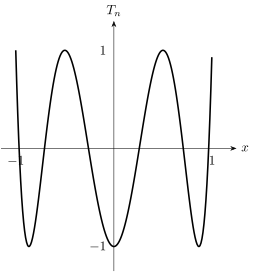 Fig. 15
prove that the functions from part a) are conjugate as maps from to .
Maps and ( being intervals on the line) are called topologically conjugate if there exists a continuous bijection (homeomorphism) such that (i.e., ). In this case we write and call the conjugating map.
Let be homeomorphisms of intervals having no fixed interior points. Prove that . Verify that the statement remains valid if the closed intervals are replaced by open intervals.
Maps and ( being intervals on the line) are called topologically conjugate if there exists a continuous bijection (homeomorphism) such that (i.e., ). In this case we write and call the conjugating map.
Classify, up to topological conjugacy, the homeomorphisms of an interval onto itself having a finite set of fixed points, among which are the endpoints of the interval.
Let be a map of an interval into itself, , , for . We say that the method of successive approximations with initial point converges if the limit exists, where .
Let the function be increasing. Prove that the method of successive approximations converges for any initial point , if
for ;
for .
Let be a map of an interval into itself, , , for . We say that the method of successive approximations with initial point converges if the limit exists, where .
Prove the convergence of the method of successive approximations for any starting point and find for the following maps :
;
;
;
;
;
;
.
Let be a map of an interval into itself, , , for . We say that the method of successive approximations with initial point converges if the limit exists, where .
Determine for which starting points in the domain of definition of the map the method of successive approximations converges, and find , if
;
;
;
;
We call a fixed point of the map attracting if for all taken from some neighborhood of the point , the sequence converges to the point . If for some neighborhood of the fixed point and an arbitrary point , there is an index such that , then the point is called repelling.
Let be a fixed point of the map , and suppose is differentiable at . Prove that
if , then is attracting;
if , then is repelling;
show by examples that a fixed point may be neither attracting nor repelling.
For which values of the parameter and for which does the sequence of iterates converge, if
;
;
;
.
Let be a differentiable function defined on an interval , and the map defined at those points where by . The fixed points of coincide with the roots of . We say that Newton's iterative process with initial point converges to if .
Let for . Prove that if the point is sufficiently close to , then
Newton's iterative process, started at , converges to ;
"superconvergence" holds: , where , (cf. problem II.3.10).
Let be a differentiable function defined on an interval , and the map defined at those points where by . The fixed points of coincide with the roots of . We say that Newton's iterative process with initial point converges to if .
Prove that if , then for initial points sufficiently close to , Newton's iterative process converges to , and moreover .
Let be a differentiable function defined on an interval , and the map defined at those points where by . The fixed points of coincide with the roots of . We say that Newton's iterative process with initial point converges to if .
Let be a function such that on and (or ). Verify that for any initial point from , Newton's iterative process converges to a root of .
Let be a differentiable function defined on an interval , and the map defined at those points where by . We say that Newton's iterative process with initial point converges to if .
Let be a polynomial having only simple real roots. Prove that if is an inflection point of (i.e. ), then Newton's iterative process, started at the point , converges to a root of . In a similar way, by varying the inflection points, one can find all the roots except the minimal and maximal ones.
The set is called the trajectory of the point . If the trajectory is finite, then there exists such that the points are pairwise distinct, while ; in this case is called a periodic point, the number its period, and the tuple an -cycle.
Let -cycle of the map be given. Prove that
if , then for taken from some neighborhood of , the relation
holds;
if , then for some and any , there is an index such that for all .
Let be a continuous map of a segment into itself, and let be a finite or infinite sequence of segments, with for every . Prove that
there exists a sequence of segments , such that ;
there exists a point for which for every .
The set is called the trajectory of the point . If the trajectory is finite, then there exists such that the points are pairwise distinct, while ; in this case is called a periodic point, the number its period, and the tuple an -cycle.
Prove that if a continuous map of a segment into itself has a 4-cycle, then it also has a 2-cycle.
The set is called the trajectory of the point . If the trajectory is finite, then there exists such that the points are pairwise distinct, while ; in this case is called a periodic point, the number its period, and the tuple an -cycle.
Let be a continuous map of a segment into itself. Prove that the following statements are equivalent:
-
there exists a point such that the points , satisfy the inequalities or ;
-
in there exists a point having period three;
-
for any , in there exists a point having period .
The implication b) ⇒ c) and problem 1.30 are special cases of A.N. Sharkovsky's theorem [Sh]. Let be a continuous map . Consider the natural numbers ordered as follows:
If stands to the left of in this sequence and has a -cycle, then also has a -cycle.
The set is called the trajectory of the point . If the trajectory is finite, then there exists such that the points are pairwise distinct, while ; in this case is called a periodic point, the number its period, and the tuple an -cycle.
Prove that for the Chebyshev polynomial (see problems I.2.20 and 1.16 b)), defined on , has cycles of arbitrary order.
A fixed point of a map is called attracting if for all from some neighborhood of the sequence converges to , and repelling if for some neighborhood of it and every point , , there is an index such that . If the points , where , are pairwise distinct while , then the tuple is called an -cycle and the period of ; the -cycle is called attracting if is an attracting fixed point of , and repelling if is a repelling fixed point of .
Find the values of the parameter for which the map has
a 2-cycle;
a 4-cycle;
a 3-cycle,
and determine when these cycles are attracting.
A fixed point of a map is called attracting if for all from some neighborhood of the sequence converges to , and repelling if for some neighborhood of it and every point , , there is an index such that . If the points , where , are pairwise distinct while , then the tuple is called an -cycle and the period of ; the -cycle is called attracting if is an attracting fixed point of , and repelling if is a repelling fixed point of .
Let . Determine for which values of the parameter an attracting fixed point and an attracting 2-cycle exist. Find the "birth moments" of the 2-, 4- and 3-cycles (i.e., the lower bounds on the values of for which these cycles exist).
A fixed point of a map is called attracting if for all from some neighborhood of the sequence converges to , and repelling if for some neighborhood of it and every point , , there is an index such that . If the points , where , are pairwise distinct while , then the tuple is called an -cycle and the period of ; the -cycle is called attracting if is an attracting fixed point of , and repelling if is a repelling fixed point of .
Let . Find the lower bound of the values of the parameter for which has
an attracting 2-cycle;
a repelling 2-cycle;
a 4-cycle;
a 3-cycle.
The set is called the trajectory of the point . If the trajectory is finite, then there exists such that the points are pairwise distinct, while ; in this case is called a periodic point, the number its period, and the tuple an -cycle.
Let be a fixed point of a continuous map . Prove that if the one-sided derivatives are negative and , then has a 2-cycle. In particular, a 2-cycle exists if .
The set is called the trajectory of the point . If the trajectory is finite, then there exists such that the points are pairwise distinct, while ; in this case is called a periodic point, the number its period, and the tuple an -cycle.
Let be a piecewise smooth map of the interval into itself. Prove that if at all points where the derivative exists, then has a -cycle for every . Show by an example that this fails if the smoothness of the map is violated on a countable set of points.
We consider maps of an interval into itself such that and the Schwarzian derivative (see Problems VII.2.25, VII.2.26 and the definition preceding them) is negative at those points that are not critical points of (i.e., where ). We denote the class of such maps by the symbol . If the points , where , are pairwise distinct while , then the tuple is called an -cycle.
Let and let the set of critical points of be finite. Prove that for every the transformation can have only finitely many -cycles.
We consider maps of an interval into itself such that and the Schwarzian derivative (see Problems VII.2.25, VII.2.26 and the definition preceding them) is negative at those points that are not critical points of (i.e., where ). We denote the class of such maps by the symbol .
Let be consecutive fixed points of the map . Prove that if the interval contains no critical points of , then .
We consider maps of an interval into itself such that and the Schwarzian derivative (see Problems VII.2.25, VII.2.26 and the definition preceding them) is negative at those points that are not critical points of (i.e., where ). We denote the class of such maps by the symbol . A fixed point of a map is called attracting if for all from some neighborhood of the sequence converges to . If the points , where , are pairwise distinct while , then the tuple is called an -cycle; the -cycle is called attracting if is an attracting fixed point of . The set is called the trajectory of the point .
Let the map have a unique critical point . Prove that every attracting cycle of the map attracts the trajectory of one of the points , and consequently can have at most three attracting cycles.
A fixed point of a map is called attracting if for all from some neighborhood of the sequence converges to , and repelling if for some neighborhood of it and every point , , there is an index such that . If the points , where , are pairwise distinct while , then the tuple is called an -cycle and the period of ; the -cycle is called attracting if is an attracting fixed point of , and repelling if is a repelling fixed point of .
Prove that a map of the form , for , cannot have more than one attracting cycle, while for it has an -cycle for every , but none of them is attracting.
The set is called the trajectory of the point . If the trajectory is finite, then there exists such that the points are pairwise distinct, while ; in this case is called a periodic point, the number its period, and the tuple an -cycle.
Let be a continuous map of the circle into itself having a fixed point and a 3-cycle.
Prove that also has -cycles for all .
Must have a 2-cycle?
Let be a continuous increasing function on the line satisfying the condition . Prove that
the map defines a homeomorphism of the circle , preserving the cyclic order of any three points, and that an arbitrary orientation-preserving homeomorphism of the circle can be defined in this way;
if the limit exists for some , then it also exists for every ;
if the map has a fixed point for some , then the limit exists and is a rational number;
if no power of has a fixed point, then the limit exists and is an irrational number;
if two distinct functions and define the same homeomorphism , then the corresponding limits and differ by an integer.
The number defined in this way for an arbitrary orientation-preserving homeomorphism is called the rotation number of this homeomorphism. This notion was introduced by H. Poincare.
Check that the following transformations preserve Lebesgue measure:
;
;
.
Check that the transformation
(the ``baker's transformation'') preserves Lebesgue measure .
Let be an integer matrix with . Define the transformation by the formulas for , where
Prove that
is one-to-one;
preserves Lebesgue measure.
The map lets us identify with the torus and with an automorphism of as a group. This gives us the right to call the transformation an automorphism of the torus.
Let the map be the same as in the previous problem, but with . Such a map (no longer one-to-one) is called an endomorphism of the torus. Prove that it preserves Lebesgue measure.
Recall the fundamental result: on every compact group there exists a nontrivial finite Borel measure invariant under translations:
where . In the case of a metrizable group this measure is uniquely determined (up to a constant factor) and is called Haar measure. Its uniqueness can be used in solving this problem.
Check that the map preserves the measure .
Find an absolutely continuous invariant measure
for the map , where is the Chebyshev polynomial (see problems I.2.20 and 1.16 b));
for the map , where .
Prove that a transformation has an invariant (respectively, finite invariant, absolutely continuous invariant) measure if and only if some power of it has this property.
Let be a strictly monotone continuous transformation. Prove that it has an absolutely continuous invariant measure (in general, an infinite one).
Let the transformation be piecewise monotone and smooth. Prove that if it has an attracting cycle (see 1), then does not preserve any finite measure equivalent to Lebesgue measure.
Does there exist a nonzero measure on invariant with respect to all
homotheties ;
affine transformations ?
In the case of an affirmative answer, give an example.
Does there exist a nontrivial measure on invariant with respect to all transformations of the form
;
In the case of an affirmative answer, give an example.
A measure on is called quasi-invariant with respect to shifts if for every the condition is equivalent to the condition .
Prove that
if a measure on is equivalent to Lebesgue measure , then is quasi-invariant with respect to shifts;
if is quasi-invariant with respect to shifts, and the measure of every bounded set is finite, then is equivalent to .
Let be a transformation of a set into itself such that the image of the measure is absolutely continuous with respect to , and let be an arbitrary summable function on . Prove the following statements:
There exists a function such that
and is uniquely determined up to values on a set of measure zero.
The correspondence is called the Perron-Frobenius operator associated with .
If is a domain, is a smooth one-to-one mapping, with , then
If is piecewise differentiable and the set is finite (), then
at all points at which the right-hand side of the equality is defined.
If and is piecewise monotone, then
In order for the measure to be invariant with respect to , it is necessary and sufficient that for almost all the equality hold.
Let . Consider the nonnegative functions on that are constant on the intervals . Each such function is given by a vector of the values it takes on . For clarity, let us denote such a function by the symbol . Denote the set of nonnegative vectors in by .
Let be an arbitrary transformation.
Prove that for every function of the form there exists a unique function satisfying the equalities
and moreover the vector has the form , where is a certain matrix determined by the mapping .
The mapping is the discrete (finite-dimensional) analogue of the Perron-Frobenius operator.
Find the matrix and prove that and .
Prove that there exists a vector , such that (to this end, consider the sequence of vectors .
Let . A nonnegative function on that is constant on the intervals and takes the values on is denoted by , where .
Let .
Find the general form of an absolutely continuous measure invariant with respect to , if
Indicate some absolutely continuous measure invariant with respect to , if
Let . Find the fixed point for the discrete Perron-Frobenius operator (for even ) and prove the absence of an invariant finite absolutely continuous measure for . What do the measures converge to as , if they are normalized by the condition ?
Let . Find an absolutely continuous measure invariant under all conformal automorphisms of , i.e., transformations , where and .
Let . For each point define the transformations and of the half-plane into itself:
Find absolutely continuous measures and on invariant under all transformations and , respectively.
Note that the transformations in question correspond to the left and right shift transformations on the group (under multiplication) of matrices
i.e., to the transformations . The measures and are called the Haar measures (left and right) for this group.
Prove that if a transformation preserves some finite absolutely continuous measure, then is topologically conjugate to some transformation of the same interval preserving Lebesgue measure.
Prove that if is a homeomorphism of the circle with irrational rotation number (see problem 1.43), then is related to the rotation of the circle by the angle (i.e., as follows: for some continuous mapping .
The existence of an invariant measure (not necessarily absolutely continuous) is often established by means of the following Bogolyubov-Krylov theorem [KSF]: for every continuous mapping of a compact set into itself there exists a finite invariant measure.
The measure is assumed to be finite and to satisfy the normalization condition (such measures are called probability measures). Let be a transformation of the set . A set is called invariant if . A transformation preserving the measure is called ergodic if for every invariant set one of the following two holds: either , or .
A measurable function defined on a set with measure is called invariant under a transformation if for almost all . Prove that for to be ergodic it is necessary and sufficient that every invariant measurable function coincide with a constant almost everywhere.
The measure is assumed to be finite and to satisfy the normalization condition (such measures are called probability measures). Let be a transformation of the set . A set is called invariant if . A transformation preserving the measure is called ergodic if for every invariant set one of the following two holds: either , or .
Are the following transformations ergodic:
;
;
is Lebesgue measure on the circle ;
is an automorphism of the torus (see problem 2.3);
is an endomorphism of the torus (see problem 2.4)?
The measure is assumed to be finite and to satisfy the normalization condition (such measures are called probability measures). Let be a transformation of the set . A set is called invariant if . A transformation preserving the measure is called ergodic if for every invariant set one of the following two holds: either , or .
Let be a set in that is the closure of the set of its interior points, a transformation of preserving Lebesgue measure. Prove that if is ergodic, then for almost every the trajectory of the point is everywhere dense.
The measure is assumed to be finite and to satisfy the normalization condition (such measures are called probability measures). Let be a transformation of the set . A set is called invariant if . A transformation preserving the measure is called ergodic if for every invariant set one of the following two holds: either , or .
Let be the -dimensional torus the shift given by the formula , . For which values of is the shift ergodic?
The measures are assumed to be finite and normalized (probability measures): .
Prove that the maps of the segment into itself given by the formulas
are metrically conjugate. (Maps and preserving measures and respectively are called metrically conjugate if there exists a measurable map such that and for almost all .)
The measure is assumed to be finite and to satisfy the normalization condition (such measures are called probability measures). Let be a transformation of the set . A set is called invariant if . A transformation preserving the measure is called ergodic if for every invariant set one of the following two holds: either , or .
Prove that the map of the segment into itself, preserving the measure , is ergodic if
;
;
is the Chebyshev polynomial (see 1.16b)), .
A measure is called a probability measure if it is finite and .
Prove that if is a transformation preserving a probability measure , and is a positive function, then for almost all (with respect to ) .
The measure is assumed to be finite and to satisfy the normalization condition (such measures are called probability measures). Let be a transformation of the set . A set is called invariant if . A transformation preserving the measure is called ergodic if for every invariant set one of the following two holds: either , or .
Let be an ergodic transformation preserving a probability measure a measurable subset of .
Let if , and if . Prove that for almost all the limit exists (the average number of hits of the trajectory into the set ), and find it.
The Birkhoff--Khinchin ergodic theorem (see [Bi], [KSF]): let be a transformation of a set preserving a probability measure , and let be a measurable function such that . Then for almost every (with respect to the measure ) the limit
exists, called the mean value of the function along the trajectory of the point . Moreover the function is invariant and . If is ergodic, then turns out to be a constant (see problem 2.20), equal to (i.e. the mean value of on ).
A measure is called a probability measure if it is finite and . Let be a transformation of the set . A set is called invariant if . A transformation preserving the measure is called ergodic if for every invariant set one of the following two holds: either , or . Probability measures on are called mutually singular if there exists a set such that and .
Let and be two probability measures on a transformation ergodic with respect to both and . Prove that the measures and either coincide or are mutually singular.
The measure is assumed to be finite and to satisfy the normalization condition (such measures are called probability measures). Let be a transformation of the set . A set is called invariant if . A transformation preserving the measure is called ergodic if for every invariant set one of the following two holds: either , or .
Consider the irrational shift
It is ergodic by 2.21a). By the ergodic theorem, for any summable function on and for almost all the equality
holds.
Prove that if , then for the shift one can assert more, namely that equality (1) holds for every . (First assume that , and then consider the general case.)
Prove that if for , for , then
for all .
If is replaced by an arbitrary sequence , then property b) is called uniform distribution of this sequence (see [PS], [KN]).
For a uniformly distributed sequence and a function continuous on , a relation analogous to (1) holds:
In particular,
This condition is not only necessary but also sufficient for uniform distribution. The latter statement is called Weyl's criterion (cf. problem I.3.9).
The Birkhoff--Khinchin ergodic theorem (see [Bi], [KSF]): let be a transformation of a set preserving a probability measure , and let be a measurable function such that . Then for almost every (with respect to the measure ) the limit
exists, called the mean value of the function along the trajectory of the point . Moreover the function is invariant and . If is ergodic, then turns out to be a constant (see problem 2.20), equal to (i.e. the mean value of on ).
Two points move along a circle, jumping once a second by the same angle, which is incommensurable with . What fraction of a sufficiently long time interval will both points simultaneously lie on some (fixed in advance) semicircle, if at the initial moment the angle between the points was equal to ?
Answer the same question if every second one point moves by an angle , and the other by an angle , where the numbers , are linearly independent over (see the definition at the beginning of 4 of Chapter VII).
Let be the binary expansion of a number . Using the ergodicity of the doubling transformation (see problem 2.21b)), prove that for almost all the limit exists (the frequency of occurrence of the digit one), and find it. Solve the analogous problem for expansions in a base- fraction (cf. problems IX.2.14, IX.2.16).
Prove that if a transformation preserving a probability measure has the property
(the mixing property with respect to the measure ), then is ergodic.
Prove that the transformation
is mixing, while the irrational rotation (see problem 2.29) is not mixing with respect to Lebesgue measure.
Let be the measure on the interval defined as follows: if and
(here is the binary expansion of the number ), then
and the measure is extended to the remaining intervals by additivity. Verify that
-
the transformation is mixing with respect to the measure (see problem 2.32);
-
;
-
the measures and are mutually singular for ;
-
is mutually singular with for .
Let be the first digit of the decimal representation of the number , i.e., What is the frequency of occurrence of the digit in this sequence?
As is well known, every number from the interval can be uniquely represented as a continued fraction
which is also written as , where , are natural numbers. Such a fraction contains finitely many terms only when is rational. The finite continued fraction is uniquely written as an irreducible fraction . The value of an infinite continued fraction is understood as the limit of the finite ones:
the number is called the convergent. It is easily verified that
A variety of information about continued fractions can be gleaned from the book . Associated with the expansion of numbers into continued fractions is the Gauss transformation
Indeed, let . Then , from which it follows that . Using , the numbers are written as follows:
The Gauss transformation preserves the measure (see problem 2.5). The measure is a probability measure for . The reader can learn about interesting applications of ergodic theory to number theory and continued fractions in [Po].
For the Gauss transformation , establish the validity, for some , of the inequality
where . Deduce from this the ergodicity of the transformation .
Prove that for almost all the following four statements hold:
-
the relative frequency with which the number occurs among the numbers equals ;
-
;
-
;
-
, where is the denominator of the -th convergent.