Section VII.4

Almost Periodic Functions and Sequences

[27/93%]
Show
LaTeX
Problem VII.4.1

Prove that if λ\lambda is an irrational number, then for any a∈[0,1)a \in [0,1) and ε>0\varepsilon >0 there exists n∈Zn \in \mathbb {Z} such that nλ=εa( mod 1)n \lambda \stackrel{\varepsilon }{=} a(\bmod 1). Verify that the set of such nn is relatively dense on the line (compare with problem I.3.2).

?
Problem VII.4.2

a) Prove that if λ1,λ2≠0\lambda_{1}, \lambda_{2} \neq 0 and the ratio λ1/λ2\lambda_{1} / \lambda_{2} is irrational, then for any a1,a2∈[0,1)a_{1}, a_{2} \in [0,1) and ε>0\varepsilon >0 there exists t∈Rt \in \mathbb {R} such that

λ1t=εa1( mod 1),λ2t=εa2( mod 1).(1) \lambda _{1} t \stackrel{\varepsilon }{=} a_{1}(\bmod 1), \quad \lambda _{2} t \stackrel{\varepsilon }{=} a_{2}(\bmod 1) . \tag {1}

Conversely, if system (1) is solvable for tt for any a1a_{1}, a2,εa_{2}, \varepsilon, then the ratio λ1/λ2\lambda_{1} / \lambda_{2} is irrational. b) Prove that if λ1\lambda_{1} and λ2\lambda_{2} are independent over Q\mathbb {Q} modulo 1, then there exists a relatively dense set of integer solutions of system (1) on the line.

?
Problem VII.4.3

What condition must the real numbers λ1,…,λk\lambda_{1}, \ldots , \lambda_{k} satisfy so that for any ε>0\varepsilon >0 the system of equations

λjt=ε0( mod 1),j=1,2,…,k, \lambda _{j} t \stackrel{\varepsilon }{=} 0(\bmod 1), \quad j=1,2, \ldots , k,

has a solution tt satisfying ∣t∣>∣λj∣−1\left|t\right|>\left|\lambda_{j}\right|^{-1} for some jj?

?
Problem VII.4.4

What condition must the real numbers λ1,…,λk\lambda_{1}, \ldots , \lambda_{k} satisfy so that for any a1,…,ak∈[0,1)a_{1}, \ldots , a_{k} \in [0,1) and ε>0\varepsilon >0 the system of equations

λjt=εaj( mod 1),j=1,2,…,k, \lambda _{j} t \stackrel{\varepsilon }{=} a_{j}(\bmod 1), \quad j=1,2, \ldots , k,

has

?
(a)

a real solution tt;

(b)

a relatively dense set of solutions?

Problem VII.4.5

What condition must the real numbers λ1,…,λk\lambda_{1}, \ldots , \lambda_{k} satisfy so that for any a1,…,ak∈[0,1)a_{1}, \ldots , a_{k} \in [0,1) and ε>0\varepsilon >0 the system of equations

λjm=εaj( mod 1),j=1,2,…,k, \lambda _{j} m \stackrel{\varepsilon }{=} a_{j}(\bmod 1), \quad j=1,2, \ldots , k,

has

?
(a)

an integer solution mm;

(b)

a relatively dense set of integer solutions?

Problem VII.4.6

Let f(x)=sin⁡(ax+b)+sin⁡(cx+d),x∈Rf(x)=\sin (a x+b)+\sin (c x+d), x \in \mathbb {R}, where ac≠0a c \neq 0. Prove that if the function ff is not identically zero, then it takes values of different signs.

?
Problem VII.4.7

Prove that every quasi-trigonometric polynomial

f(x)=∑1⩽k⩽nakeiλkx(λk∈R,ak∈C) f(x)=\sum _{1 \leqslant k \leqslant n} a_{k} e^{i \lambda _{k} x} \quad \left(\lambda _{k} \in \mathbb {R}, a_{k} \in \mathbb {C}\right)

possesses the property of uniform almost periodicity. Verify that the polynomial ff is periodic if and only if the factors λ1,…,λn\lambda_{1}, \ldots , \lambda_{n} are pairwise commensurable (i.e. their ratios are rational).

?
Remark.
?

A complex-valued function ff defined on R\mathbb {R} is called uniformly almost periodic (u.a.p.) if for any ε>0\varepsilon >0 there exists a number L=L(ε)>0L=L(\varepsilon )>0 such that every interval of length LL contains at least one number τ\tau (an ε\varepsilon-almost period) for which

∣f(x+τ)−f(x)∣<ε for all x∈R. \left|f(x+\tau )-f(x)\right|<\varepsilon \quad \text{ for all } x \in \mathbb {R} .
Problem VII.4.8

Let f∈C(Rn)f \in C\left(\mathbb {R}^{n}\right) be a function having period 1 in each argument, α1,…,αn∈R\alpha_{1}, \ldots , \alpha_{n} \in \mathbb {R} numbers linearly independent over Q\mathbb {Q}, β1,…,βn∈R\beta_{1}, \ldots , \beta_{n} \in \mathbb {R}. Prove that the function

φ(t)=f(α1t−β1,…,αnt−βn),t∈R, \varphi (t)=f\left(\alpha _{1} t-\beta _{1}, \ldots , \alpha _{n} t-\beta _{n}\right), \quad t \in \mathbb {R},

is uniformly almost periodic.

?
Remark.
?

A complex-valued function ff defined on R\mathbb {R} is called uniformly almost periodic (u.a.p.) if for any ε>0\varepsilon >0 there exists a number L=L(ε)>0L=L(\varepsilon )>0 such that every interval of length LL contains at least one number τ\tau (an ε\varepsilon-almost period) for which

∣f(x+τ)−f(x)∣<ε for all x∈R. \left|f(x+\tau )-f(x)\right|<\varepsilon \quad \text{ for all } x \in \mathbb {R} .
Problem VII.4.9

Prove that if ff is a continuous u.a.p. function and its ε\varepsilon-almost periods are bounded for small ε\varepsilon, then ff is periodic.

?
Remark.
?

A complex-valued function ff defined on R\mathbb {R} is called uniformly almost periodic (u.a.p.) if for any ε>0\varepsilon >0 there exists a number L=L(ε)>0L=L(\varepsilon )>0 such that every interval of length LL contains at least one number τ\tau (an ε\varepsilon-almost period) for which

∣f(x+τ)−f(x)∣<ε for all x∈R. \left|f(x+\tau )-f(x)\right|<\varepsilon \quad \text{ for all } x \in \mathbb {R} .
Problem VII.4.10

Prove that a u.a.p.function continuous on R\mathbb {R} is uniformly continuous on the line and bounded. Do unbounded nonperiodic u.a.p.functions exist? Does continuity follow from boundedness?

?
Remark.
?

A complex-valued function ff defined on R\mathbb {R} is called uniformly almost periodic (u.a.p.) if for any ε>0\varepsilon >0 there exists a number L=L(ε)>0L=L(\varepsilon )>0 such that every interval of length LL contains at least one number τ\tau (an ε\varepsilon-almost period) for which

∣f(x+τ)−f(x)∣<ε for all x∈R. \left|f(x+\tau )-f(x)\right|<\varepsilon \quad \text{ for all } x \in \mathbb {R} .
Problem VII.4.11

Prove that the limit of a uniformly convergent (on R\mathbb {R}) sequence of u.a.p.functions is a u.a.p.function.

?
Remark.
?

A complex-valued function ff defined on R\mathbb {R} is called uniformly almost periodic (u.a.p.) if for any ε>0\varepsilon >0 there exists a number L=L(ε)>0L=L(\varepsilon )>0 such that every interval of length LL contains at least one number τ\tau (an ε\varepsilon-almost period) for which

∣f(x+τ)−f(x)∣<ε for all x∈R. \left|f(x+\tau )-f(x)\right|<\varepsilon \quad \text{ for all } x \in \mathbb {R} .
Problem VII.4.12

Prove that if a u.a.p.function has a derivative that exists and is uniformly continuous, then it is also a u.a.p.function.

?
Remark.
?

A complex-valued function ff defined on R\mathbb {R} is called uniformly almost periodic (u.a.p.) if for any ε>0\varepsilon >0 there exists a number L=L(ε)>0L=L(\varepsilon )>0 such that every interval of length LL contains at least one number τ\tau (an ε\varepsilon-almost period) for which

∣f(x+τ)−f(x)∣<ε for all x∈R. \left|f(x+\tau )-f(x)\right|<\varepsilon \quad \text{ for all } x \in \mathbb {R} .
Problem VII.4.13

Prove that if the antiderivative FF of a continuous u.a.p.function ff is bounded, then it is also a u.a.p.function.

?
Remark.
?

A complex-valued function ff defined on R\mathbb {R} is called uniformly almost periodic (u.a.p.) if for any ε>0\varepsilon >0 there exists a number L=L(ε)>0L=L(\varepsilon )>0 such that every interval of length LL contains at least one number τ\tau (an ε\varepsilon-almost period) for which

∣f(x+τ)−f(x)∣<ε for all x∈R. \left|f(x+\tau )-f(x)\right|<\varepsilon \quad \text{ for all } x \in \mathbb {R} .
Problem VII.4.14

Let f∈C(R),h∈R,fh(x)=f(x+h)f \in C(\mathbb {R}), h \in \mathbb {R}, f_{h}(x)=f(x+h). Prove that the function ff has the u.a.p.property if and only if, for every numerical sequence {hn}\left\{ h_{n}\right\}, one can choose from the sequence {fhn}\left\{ f_{h_{n}}\right\} a subsequence that converges uniformly on R\mathbb {R} (compactness of the family of shifts).

?
Remark.
?

A complex-valued function ff defined on R\mathbb {R} is called uniformly almost periodic (u.a.p.) if for any ε>0\varepsilon >0 there exists a number L=L(ε)>0L=L(\varepsilon )>0 such that every interval of length LL contains at least one number τ\tau (an ε\varepsilon-almost period) for which

∣f(x+τ)−f(x)∣<ε for all x∈R. \left|f(x+\tau )-f(x)\right|<\varepsilon \quad \text{ for all } x \in \mathbb {R} .
Problem VII.4.15

Prove that the sum and product of continuous u.a.p.functions are again a u.a.p.function.

?
Remark.
?

A complex-valued function ff defined on R\mathbb {R} is called uniformly almost periodic (u.a.p.) if for any ε>0\varepsilon >0 there exists a number L=L(ε)>0L=L(\varepsilon )>0 such that every interval of length LL contains at least one number τ\tau (an ε\varepsilon-almost period) for which

∣f(x+τ)−f(x)∣<ε for all x∈R. \left|f(x+\tau )-f(x)\right|<\varepsilon \quad \text{ for all } x \in \mathbb {R} .
Problem VII.4.16

Prove that for every u.a.p.function ff there exists a mean value

M(f)=lim⁡T→+∞12T∫−TTf(x)dx M(f)=\lim _{T \rightarrow +\infty } \frac{1}{2 T} \int _{-T}^{T} f(x) d x
?
Remark.
?

A complex-valued function ff defined on R\mathbb {R} is called uniformly almost periodic (u.a.p.) if for any ε>0\varepsilon >0 there exists a number L=L(ε)>0L=L(\varepsilon )>0 such that every interval of length LL contains at least one number τ\tau (an ε\varepsilon-almost period) for which

∣f(x+τ)−f(x)∣<ε for all x∈R. \left|f(x+\tau )-f(x)\right|<\varepsilon \quad \text{ for all } x \in \mathbb {R} .
Problem VII.4.17

Let ⟨f,g⟩=M(fgˉ)\langle f, g\rangle =M(f \bar{g}), where f,gf, g are continuous u.a.p.functions, and the functional MM is defined in the previous problem. Prove that

?
(a)

⟨f,g⟩\langle f, g\rangle has the properties of an inner product (in particular, ⟨f,f⟩=0\langle f, f\rangle =0 if and only if f≡0f \equiv 0);

(b)

the functions φλ(x)=eiλx,λ∈R\varphi_{\lambda }(x)=e^{i \lambda x}, \lambda \in \mathbb {R}, form an uncountable family orthogonal with respect to this inner product;

(c)

the quantities cλ=M(fφλ‾)c_{\lambda }=M\left(f \overline{\varphi_{\lambda }}\right), for pairwise distinct real numbers λ1,…,λn\lambda_{1}, \ldots , \lambda_{n}, satisfy the inequality

∑1⩽k⩽n∣cλk∣2⩽M(∣f∣2) \sum _{1 \leqslant k \leqslant n}\left|c_{\lambda _{k}}\right|^{2} \leqslant M\left(\left|f\right|^{2}\right)

(Bessel's inequality for the system {φλ}\left\{ \varphi_{\lambda }\right\}). Deduce from this that cλ≠0c_{\lambda } \neq 0 only for an at most countable set of values of λ\lambda. Can this set be an arbitrary countable subset of R\mathbb {R}?

Remark.
?

A complex-valued function ff defined on R\mathbb {R} is called uniformly almost periodic (u.a.p.) if for any ε>0\varepsilon >0 there exists a number L=L(ε)>0L=L(\varepsilon )>0 such that every interval of length LL contains at least one number τ\tau (an ε\varepsilon-almost period) for which

∣f(x+τ)−f(x)∣<ε for all x∈R. \left|f(x+\tau )-f(x)\right|<\varepsilon \quad \text{ for all } x \in \mathbb {R} .
Problem VII.4.18

Let {an},an∈{0,1,2}\left\{ a_{n}\right\} , a_{n} \in \left\{ 0,1,2\right\}, be a nonperiodic sequence. Define the sequences {bn}\left\{ b_{n}\right\} and {cn}\left\{ c_{n}\right\} as follows:

bn={0, if an=0,1, if an≠0;cn={1, if an=2,0, if an≠2. b_{n}=\begin{cases} 0, & \text{ if } a_{n}=0, \\ 1, & \text{ if } a_{n} \neq 0 ; \end{cases} \quad c_{n}=\begin{cases} 1, & \text{ if } a_{n}=2, \\ 0, & \text{ if } a_{n} \neq 2 . \end{cases}

Prove that at least one of the sequences {bn},{cn}\left\{ b_{n}\right\} ,\left\{ c_{n}\right\} is nonperiodic.

?
Problem VII.4.19

Let {εk}k∈Z\left\{ \varepsilon_{k}\right\}_{k \in \mathbb {Z}} be an almost periodic sequence, f(x)=ε[x](x∈R,[x]f(x)=\varepsilon_{\left[x\right]}(x \in \mathbb {R},\left[x\right] the integer part of the number x)x). Is ff a u.a.p.function?

?
Remark.
?

Let us call a binary sequence ε={εk}\varepsilon =\left\{ \varepsilon_{k}\right\} almost periodic if, for every "word" (εk+1,…,εk+l\varepsilon_{k+1}, \ldots , \varepsilon_{k+l}) contained in it — we shall also write εk+1εk+2…εk+l\varepsilon_{k+1} \varepsilon_{k+2} \ldots \varepsilon_{k+l} — there exists a number L∈NL \in \mathbb {N} such that the set

{n∈N∣εn+j=εk+j,j=1,…,l} \left\{ n \in \mathbb {N} \mid \varepsilon _{n+j}=\varepsilon _{k+j}, j=1, \ldots , l\right\}

intersects every segment of the natural sequence of length LL. Almost periodicity for two-sided sequences is defined analogously.

A complex-valued function ff defined on R\mathbb {R} is called uniformly almost periodic (u.a.p.) if for any ε>0\varepsilon >0 there exists a number L=L(ε)>0L=L(\varepsilon )>0 such that every interval of length LL contains at least one number τ\tau (an ε\varepsilon-almost period) for which

∣f(x+τ)−f(x)∣<ε for all x∈R. \left|f(x+\tau )-f(x)\right|<\varepsilon \quad \text{ for all } x \in \mathbb {R} .
Problem VII.4.20

Is it true that for every almost periodic sequence {εk}k∈Z\left\{ \varepsilon_{k}\right\}_{k \in \mathbb {Z}} there exists a limit of the Cesàro means lim⁡12n+1∑−n⩽k⩽nεk?\lim \frac{1}{2 n+1} \sum_{-n \leqslant k \leqslant n} \varepsilon_{k} ?

?
Remark.
?

Let us call a binary sequence ε={εk}\varepsilon =\left\{ \varepsilon_{k}\right\} almost periodic if, for every "word" (εk+1,…,εk+l\varepsilon_{k+1}, \ldots , \varepsilon_{k+l}) contained in it — we shall also write εk+1εk+2…εk+l\varepsilon_{k+1} \varepsilon_{k+2} \ldots \varepsilon_{k+l} — there exists a number L∈NL \in \mathbb {N} such that the set

{n∈N∣εn+j=εk+j,j=1,…,l} \left\{ n \in \mathbb {N} \mid \varepsilon _{n+j}=\varepsilon _{k+j}, j=1, \ldots , l\right\}

intersects every segment of the natural sequence of length LL. Almost periodicity for two-sided sequences is defined analogously.

Problem VII.4.21

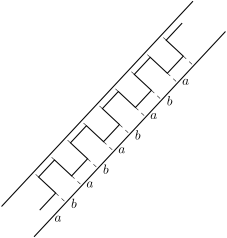
Let k>0k>0 be an irrational number, S={(x,y)∣kx⩽y<k(x+1)+1}S=\left\{ (x, y) \mid k x \leqslant y<k(x+1)+1\right\} a strip in R2\mathbb {R}^{2}, and Σ=S∩Z2\Sigma =S \cap \mathbb {Z}^{2} the set of integer points in SS. Verify that the orthogonal projections of the points of Σ\Sigma onto the side of the strip (Fig. 10) divide it into segments whose lengths take only two values: aa and bb. Numbering the segments by integers in the order of their location on the line, set εi=0\varepsilon_{i}=0 if the ii-th segment has length aa, and εi=1\varepsilon_{i}=1 otherwise. Prove that the sequence {εi}i∈Z\left\{ \varepsilon_{i}\right\}_{i \in \mathbb {Z}} is almost periodic.

Fig. 10Fig. 10

?
Remark.
?

Let us call a binary sequence ε={εk}\varepsilon =\left\{ \varepsilon_{k}\right\} almost periodic if, for every "word" (εk+1,…,εk+l\varepsilon_{k+1}, \ldots , \varepsilon_{k+l}) contained in it — we shall also write εk+1εk+2…εk+l\varepsilon_{k+1} \varepsilon_{k+2} \ldots \varepsilon_{k+l} — there exists a number L∈NL \in \mathbb {N} such that the set

{n∈N∣εn+j=εk+j,j=1,…,l} \left\{ n \in \mathbb {N} \mid \varepsilon _{n+j}=\varepsilon _{k+j}, j=1, \ldots , l\right\}

intersects every segment of the natural sequence of length LL. Almost periodicity for two-sided sequences is defined analogously.

Problem VII.4.22

Consider the Morse sequence

ε={εk}=0=01110110011100101110…, \varepsilon =\left\{ \varepsilon _{k}\right\} =0=01110110011100101110 \ldots ,

defined by the equalities ε1=0,ε2=1,εk=1−εk−2n\varepsilon_{1}=0, \quad \varepsilon_{2}=1, \quad \varepsilon_{k}=1-\varepsilon_{k-2^{n}} \quad for 2n<k⩽2n+1(n∈N)2^{n}<k \leqslant 2^{n+1}(n \in \mathbb {N}). Prove that it is almost periodic.

?
Remark.
?

Let us call a binary sequence ε={εk}\varepsilon =\left\{ \varepsilon_{k}\right\} almost periodic if, for every "word" (εk+1,…,εk+l\varepsilon_{k+1}, \ldots , \varepsilon_{k+l}) contained in it — we shall also write εk+1εk+2…εk+l\varepsilon_{k+1} \varepsilon_{k+2} \ldots \varepsilon_{k+l} — there exists a number L∈NL \in \mathbb {N} such that the set

{n∈N∣εn+j=εk+j,j=1,…,l} \left\{ n \in \mathbb {N} \mid \varepsilon _{n+j}=\varepsilon _{k+j}, j=1, \ldots , l\right\}

intersects every segment of the natural sequence of length LL. Almost periodicity for two-sided sequences is defined analogously.

Problem VII.4.23

For a finite sequence ("word")

A=ε1ε2…εn A=\varepsilon _{1} \varepsilon _{2} \ldots \varepsilon _{n}

of zeros and ones, let A0A^{0} denote AA, and A1=εˉ1εˉ2…εˉnA^{1}=\bar{\varepsilon }_{1} \bar{\varepsilon }_{2} \ldots \bar{\varepsilon }_{n}, where εˉk=1−εk\bar{\varepsilon }_{k}=1-\varepsilon_{k}. Define a sequence ε\varepsilon by specifying its initial segments ApA_{p}, which are defined recursively: A0A_{0} is any word, A0=ε1ε2…εnA_{0}=\varepsilon_{1} \varepsilon_{2} \ldots \varepsilon_{n},

A1=A0A0ξ1A0ξ2…A0ξI A_{1}=A_{0} A_{0}^{\xi _{1}} A_{0}^{\xi _{2}} \ldots A_{0}^{\xi _{I}}

where ξ1…ξl\xi_{1} \ldots \xi_{l} is some word of zeros and ones,

A2=A1A1η1A1η2…A1ηm,ηk∈{0,1}, A_{2}=A_{1} A_{1}^{\eta _{1}} A_{1}^{\eta _{2}} \ldots A_{1}^{\eta _{m}}, \quad \eta _{k} \in \left\{ 0,1\right\} ,

and so on. Thus A0A_{0} serves as the beginning of A1A_{1}, A1A_{1} as the beginning of A2A_{2}, and so on. The infinite sequence {Ap}\left\{ A_{p}\right\} defines a certain sequence ε\varepsilon. Prove that it is periodic or almost periodic.

?
Remark.
?

Let us call a binary sequence ε={εk}\varepsilon =\left\{ \varepsilon_{k}\right\} almost periodic if, for every "word" (εk+1,…,εk+l\varepsilon_{k+1}, \ldots , \varepsilon_{k+l}) contained in it — we shall also write εk+1εk+2…εk+l\varepsilon_{k+1} \varepsilon_{k+2} \ldots \varepsilon_{k+l} — there exists a number L∈NL \in \mathbb {N} such that the set

{n∈N∣εn+j=εk+j,j=1,…,l} \left\{ n \in \mathbb {N} \mid \varepsilon _{n+j}=\varepsilon _{k+j}, j=1, \ldots , l\right\}

intersects every segment of the natural sequence of length LL. Almost periodicity for two-sided sequences is defined analogously.

Problem VII.4.24

A folding sequence is a sequence s={sn}s=\left\{ s_{n}\right\} of zeros and ones whose initial segments AnA_{n} of length 2k−1(k=2n)2 k-1\left(k=2^{n}\right) have the form

s1s2…sk−1sksˉk−1…sˉ1( where sˉj=1−sj). s_{1} s_{2} \ldots s_{k-1} s_{k} \bar{s}_{k-1} \ldots \bar{s}_{1} \quad \left(\text{ where } \quad \bar{s}_{j}=1-s_{j}\right) .

The name of the sequence is explained by the fact that the word AnA_{n} can be associated with the sequence of folds of a paper strip formed on it as a result of folding it (n+1)(n+1) times (first in half, then in half again, and so on). If, moving along the strip, we assign a one to each fold resulting in a turn to the left, and a zero to a "turn right" fold, we obtain AnA_{n} (Fig. 11). The sequence is uniquely determined by specifying the numbers s2n,n=0,1,2,…s_{2^{n}}, n=0,1,2, \ldots
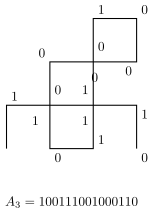
Fig. 11Fig. 11

Prove that every folding sequence is almost periodic but not periodic, even if we restrict to terms with arbitrarily large indices.

?
Remark.
?

Let us call a binary sequence ε={εk}\varepsilon =\left\{ \varepsilon_{k}\right\} almost periodic if, for every "word" (εk+1,…,εk+l\varepsilon_{k+1}, \ldots , \varepsilon_{k+l}) contained in it — we shall also write εk+1εk+2…εk+l\varepsilon_{k+1} \varepsilon_{k+2} \ldots \varepsilon_{k+l} — there exists a number L∈NL \in \mathbb {N} such that the set

{n∈N∣εn+j=εk+j,j=1,…,l} \left\{ n \in \mathbb {N} \mid \varepsilon _{n+j}=\varepsilon _{k+j}, j=1, \ldots , l\right\}

intersects every segment of the natural sequence of length LL. Almost periodicity for two-sided sequences is defined analogously.

Problem VII.4.25

Prove that fold sequences (see Problem 4.24) have the following property (Besicovitch almost periodicity): for every ε>0\varepsilon >0 there exist a number L>0L>0 and numbers τm∈N(m∈N)\tau_{m} \in \mathbb {N}(m \in \mathbb {N}) such that

  1. if ν(Δ)\nu (\Delta ) is the number of those τm\tau_{m} that fall into the interval Δ⊂R+\Delta \subset \mathbb {R}_{+}, then v(Δ1)<2v(Δ2)v\left(\Delta_{1}\right)<2 v\left(\Delta_{2}\right) for all intervals Δ1,Δ2\Delta_{1}, \Delta_{2} of length LL;

  2. lim‾⁡n1n∑1⩽j⩽n∣sj+τm−sj∣<ε\varlimsup_{n} \frac{1}{n} \sum_{1 \leqslant j \leqslant n}\left|s_{j+\tau_{m}}-s_{j}\right|<\varepsilon for every m∈Nm \in \mathbb {N};

  3. lim‾⁡nlim‾⁡p1np∑1⩽j⩽n∑1⩽m⩽p∣sj+τm−sj∣<ε\varlimsup_{n} \varlimsup_{p} \frac{1}{n p} \sum_{1 \leqslant j \leqslant n} \sum_{1 \leqslant m \leqslant p}\left|s_{j+\tau_{m}}-s_{j}\right|<\varepsilon.

?
Problem VII.4.26

Prove that if xn=(−1)sn,n∈Nx_{n}=(-1)^{s_{n}}, n \in \mathbb {N}, where {sn}\left\{ s_{n}\right\} is a fold sequence, then for any t∈Rt \in \mathbb {R} the limit

ct=lim⁡1n∑1⩽k⩽nxke−2πikt c_{t}=\lim \frac{1}{n} \sum _{1 \leqslant k \leqslant n} x_{k} e^{-2 \pi i k t}

exists (the "Fourier coefficient"), and moreover

ct=−i(−1)l12m+1x2m, if t=2l+12m+2,m⩾0 c_{t}=-i(-1)^{l} \frac{1}{2^{m+1}} x_{2^{m}}, \quad \text{ if } \quad t=\frac{2 l+1}{2^{m+2}}, \quad m \geqslant 0

and ct=0c_{t}=0 otherwise. Verify that the "Parseval equality" holds:

lim⁡1n∑1⩽k⩽n∣xk∣2=∑0⩽t<1∣ct∣2. \lim \frac{1}{n} \sum _{1 \leqslant k \leqslant n}\left|x_{k}\right|^{2}=\sum _{0 \leqslant t<1}\left|c_{t}\right|^{2} .
?
Problem VII.4.27

Consider the binary sequence

{rn}=00010010000111010001001011100010… \left\{ r_{n}\right\} =00010010000111010001001011100010 \ldots

(the Rudin-Shapiro sequence), whose initial segments AnA_{n} of length 2n2^{n} have the form An=CnDnA_{n}=C_{n} D_{n}, where CnC_{n} and DnD_{n} are words of length 2n−12^{n-1}, with A1=C1D1=00A_{1}=C_{1} D_{1}=00, and for n>1n>1 the words An,Cn,DnA_{n}, C_{n}, D_{n} are defined recursively:

Cn=An−1,Dn=Cn−1Dn−11,An=CnDn C_{n}=A_{n-1}, \quad D_{n}=C_{n-1} D_{n-1}^{1}, \quad A_{n}=C_{n} D_{n}

(Dn−11D_{n-1}^{1} is obtained from Dn−1D_{n-1} by swapping 0↔10 \leftrightarrow 1). Prove the almost periodicity of this sequence.

Note that the sequence {(−1)rn}\left\{ (-1)^{r_{n}}\right\} is the sequence of coefficients of the Rudin-Shapiro polynomials (see Problem IX.4.25).

?
Remark.
?

Let us call a binary sequence ε={εk}\varepsilon =\left\{ \varepsilon_{k}\right\} almost periodic if, for every "word" (εk+1,…,εk+l\varepsilon_{k+1}, \ldots , \varepsilon_{k+l}) contained in it — we shall also write εk+1εk+2…εk+l\varepsilon_{k+1} \varepsilon_{k+2} \ldots \varepsilon_{k+l} — there exists a number L∈NL \in \mathbb {N} such that the set

{n∈N∣εn+j=εk+j,j=1,…,l} \left\{ n \in \mathbb {N} \mid \varepsilon _{n+j}=\varepsilon _{k+j}, j=1, \ldots , l\right\}

intersects every segment of the natural sequence of length LL. Almost periodicity for two-sided sequences is defined analogously.