Functions (continued)
[118/96%]Prove that a function convex on an interval satisfies Jensen's inequality for all .
A function is called convex (strictly convex) if for all points , and numbers , the inequality
holds. If the function is convex, then the function is called concave.
Let the function be defined on an interval , and let be points of . Consider the three chords joining the pairs of points of the graph of with abscissas and and and . The slopes of these chords are, respectively, . Prove that for the convexity of the function it is necessary and sufficient that for any triple of points of the inequalities
hold (the three-chord lemma, see Fig. 8).
 Fig. 8
Check that this double inequality is equivalent to
Let the function , defined on an interval , satisfy the inequality for all . Prove that
satisfies Jensen's inequality
for any rational ;
if the function is continuous, then it is convex.
Prove that the continuity condition in problem 1.3 b) can be replaced by the following: the function is bounded above on some nonempty interval (or even on ).
Prove that for a function the following three statements are equivalent:
-
is convex;
-
the epigraph of the function
is a convex set;
-
through every point of the graph of one can draw a supporting line for the epigraph (i.e., a line such that all points of the epigraph lie not below it).
Prove that if a function defined on an interval is locally convex, then it is convex.
Let be a function convex on the interval . Prove that then
the function decreases on ;
the function increases on for any .
Let the function be concave on the interval . Prove that for all the inequality
holds.
Prove that if the function is convex and strictly monotone, then is either convex or concave.
Let the function be convex, and the function be convex and increasing. Prove that if the composition makes sense, then it is convex.
Let . Prove that then the functions are convex or not simultaneously.
Let the function be convex on . Prove that the limit exists, and moreover .
Prove that a convex function , defined on the interval , is continuous on and has there finite increasing one-sided derivatives , and exists everywhere except at no more than a countable set of points. Prove that for any closed interval .
Prove that a function is convex if and only if for all the inequality
holds.
In particular, if for all , then is a linear function; if is twice differentiable on , then it is convex if and only if on .
Let . Prove that for the convexity of the function it is necessary and sufficient that for all and such that , the inequality
hold.
Let the function be convex on and . Prove that is constant.
The following problem often allows one, when proving various statements about convex functions, to additionally assume their smoothness (in particular, some of the preceding problems can be solved this way).
Prove that every continuous function convex on is the limit of a uniformly convergent decreasing sequence of:
piecewise linear convex functions;
twice continuously differentiable convex functions.
Prove that if the function is differentiable, concave, and nonnegative, then for all .
Let the function be convex and increasing on the interval . Prove that for any numbers the inequality
holds.
A sequence is called convex if , i.e., for any . Prove that if the sequence is convex, then
;
the sequence is monotone, or there exists an index such that
Let be a bounded convex sequence (see problem 1.20). Prove that
;
;
.
Let . Set ,
Prove that if the function is concave, then
;
;
;
,
and moreover the coefficients in these inequalities cannot be improved. All the inequalities have a simple mechanical meaning. For example, the inequalities of a) mean that among subgraphs of concave functions of equal area, the smallest and largest static moments about the -axis belong to triangles, while the inequalities of d) mean that among such figures the smallest and largest moments of inertia about the -axis belong, respectively, to the triangle and the rectangle.
We keep the notation of the previous problem, but we shall consider not concave but convex functions.
Prove that the fractions and can take any values from the interval .
Prove that for the fractions and can likewise take any values from the interval .
Refine the upper bound in the case when the quantities and are fixed.
Let the function be nondecreasing on and on . Prove that for any function convex on the inequality
holds.
Let the functions be nonnegative and convex on the interval , with one of the endpoints of the interval being a root of both functions. Prove the inequality
Let the functions and be nonnegative and concave on the interval . Prove the inequality
Let be the set of all nonnegative nonincreasing functions on the interval such that
Prove that for any functions and from the inequality
holds.
For which functions is equality attained?
Let the function be integrable on the interval . Prove that the nonnegativity of the integral for any function convex on is equivalent to the function satisfying three conditions:
-
;
-
;
-
for any .
Let the function decrease to zero on and . Prove that , and if is convex, then . In both cases equality is possible only for .
Let . Prove that is a convex function on .
A positive function is called logarithmically convex if the function is convex. Prove that a logarithmically convex function is convex and that the sum of logarithmically convex functions is logarithmically convex.
Prove that the Euler Gamma function is logarithmically convex on .
Let be a logarithmically convex solution on of the functional equation . Prove that for all .
Let . Prove that the system of inequalities
where and are arbitrary positive numbers, is satisfied only by the power function with exponent , and if both inequality signs are replaced by , then only by the power function with exponent . Verify that this is not the case if the sign is replaced only in the second inequality.
Let . Prove Hölder's inequality
Let . Set
Prove that
is increasing;
;
;
;
the function is logarithmically convex on the interval .
State the analogues of these statements, replacing by the expression , where is a continuous positive function on .
Let the piecewise continuous functions and on satisfy the conditions , and let the function be convex on . Prove that
;
;
if , then
Let be the vertices of a convex polygon inscribed in a circle, with the vertices and fixed. For a given , how should one choose the points so that
the perimeter;
the area of the polygon
are the largest?
A light source placed at the point , illuminates a region that is the subgraph of a nonnegative convex function . Light rays are reflected from the graph of and from the abscissa axis according to the known law. Will the entire region be illuminated if ?
Let the function be convex, let be the interval , and let be the interval , where the infimum and supremum are taken over the set of points at which exists.
The Legendre transform of the function is the function
The quantity shows how far one must shift vertically the line through the origin with slope so that it becomes a supporting line to the epigraph of the function (Fig. 9).
 Fig. 9
Prove that
the function is convex;
if the point does not lie on the boundary of , then
, if does not belong to the boundary of ;
Young's inequality holds:
the function is finite on the interval , and for the supremum in the definition of is attained;
if , then is linear on the interval ; if is linear on the interval , then is not differentiable at the point ;
if , and is strictly convex and differentiable on , then is continuous on , is differentiable on the interval , and moreover the functions and are mutually inverse;
if , then .
Prove that if the function is strictly increasing and continuous on , , , then for and the inequality
holds.
Find the Legendre transform and write Young's inequality (see problem 1.37 d)) for the following functions:
;
;
the graph of is a convex broken line;
.
Consider the collection of pairs of functions convex on satisfying the condition for all . Call a pair extremal if the relations imply . Prove that the pair () is extremal if and only if , .
Give examples of functions for which . Prove that the only function coinciding with its own Legendre transform is the function .
Prove that if the function is times differentiable on the interval and , then
where (for the definition of see problem III.3.1).
Let the function be times differentiable on and for . Prove that for some the inequality
holds.
Let the function be continuous on , and suppose there exist real numbers such that
Prove that if for all , then is a polynomial.
Let , where are real polynomials, . Prove that if , then has a finite number of zeros.
Let , . Prove that for each the function vanishes.
Let and , as . Prove that as .
Let be an interval, , .
Prove that in the case the inequality
holds, and that the constant cannot be decreased.
Obtain an analogous inequality in the case where .
Prove that if and , then (the estimate is sharp).
Investigate the question for an arbitrary interval .
Let and . Prove the inequalities:
;
.
Are they sharp?
Find subject to the condition that , .
Let and for all . Prove the inequalities:
. For which functions is equality attained?
, if . Can the right-hand side be decreased?
Let . Prove that if the function vanishes on some nonempty interval, then
Does there exist a point such that ?
Let . Prove that if the sequence of derivatives is bounded at every point , then it is uniformly bounded: , where does not depend on or .
Let and suppose that everywhere on the finite limit exists. Prove that the function has the form const .
Prove that if at every point of the real line at least one of the derivatives of an infinitely differentiable function vanishes, then this function is a polynomial.
Prove that any function of the form
is infinitely differentiable on and that by an appropriate choice of the numbers one can arrange for all its derivatives at the point to take any prescribed values in advance (Borel's theorem).
Let . Prove that if , then can be represented in the form
where .
Let and let be a mapping of the set into , satisfying three conditions (): 1) ; 2) ; 3) .
Prove that for some .
Let be nonnegative continuous functions defined on . Prove that if for some number the inequality
holds, then
(Gronwall's inequality). Deduce from this that if the function and the number are such that and for , then .
Let . Prove that
the function is positive definite;
the function , where , is conditionally positive definite.
A function is called positive definite if
for any vectors and any . A function is called conditionally positive definite if inequality (1) holds under the additional condition .
Prove that if is a finite measure on , then the function
(the Fourier transform of the measure ) is positive definite.
A function is called positive definite if
for any vectors and any . A function is called conditionally positive definite if inequality (1) holds under the additional condition .
Prove that the functions
are positive definite.
A function is called positive definite if
for any vectors and any . A function is called conditionally positive definite if inequality (1) holds under the additional condition .
Prove that
the function is conditionally positive definite;
for the functions are conditionally positive definite.
A function is called positive definite if
for any vectors and any . A function is called conditionally positive definite if inequality (1) holds under the additional condition .
Prove that if the function is positive definite, then
is positive definite;
is bounded;
continuity at zero implies uniform continuity of .
A function is called positive definite if
for any vectors and any . A function is called conditionally positive definite if inequality (1) holds under the additional condition .
Prove that if the function is positive definite for all , then the function is conditionally positive definite.
A function is called positive definite if
for any vectors and any . A function is called conditionally positive definite if inequality (1) holds under the additional condition .
Let . The Schwarzian derivative (Schwarzian) of the function is defined by the formula
Verify that for real functions satisfying the conditions listed above, the following statements hold:
if the composition is defined, then
if and the composition is defined, then
if on and , then for any also on , where ( times);
if , then at the point ;
for the inequality to hold, it is necessary and sufficient that the function be convex;
if for all , then the function has no strictly positive local minimum on (the minimum modulus principle).
Why it is precisely negativity (and not positivity) of the Schwarzian that matters can be learned from problems X.1.38-41.
Verify that the functions , satisfy the condition wherever , while the functions , do not .
Verify that any polynomial of degree , all of whose zeros are real, satisfies the condition wherever .
Let . The Schwarzian derivative (Schwarzian) of the function is defined by the formula
Let pairwise distinct numbers). Prove that if is piecewise monotone and for any points belonging to the same interval of monotonicity of the function , the inequality
holds, then the function has no strictly positive local minimum at interior points of the interval .
Here .
Let For set
Prove that
;
Let . For set
Prove that
;
;
.
Let . The polynomial
is called the Bernstein polynomial of the function .
Find the Bernstein polynomials of the following functions:
;
.
Let . The polynomial
is called the Bernstein polynomial of the function .
Let the function be defined on the interval . Prove that
and ;
for all .
Let . The polynomial
is called the Bernstein polynomial of the function .
Prove that
if the function is increasing (decreasing) on the interval , then the Bernstein polynomial is increasing (decreasing) on ;
if the function is convex (concave) on , then is a convex (concave) polynomial on .
Let . The polynomial
is called the Bernstein polynomial of the function .
Let the function be defined and bounded above on the interval . Prove that
for all and ;
if the interval is contained in the interval , then for all ;
if the intervals and are such that and , then one can specify a sufficiently large number such that for all and .
Let . The polynomial
is called the Bernstein polynomial of the function .
Let the functions and be bounded on the interval and coincide in a neighborhood of the point . Prove that the sequences and converge or diverge simultaneously, and in case of convergence have a common limit.
Let . The polynomial
is called the Bernstein polynomial of the function .
Let the function be bounded on the interval . Prove that
if is continuous at the point , then ;
if is continuous at every point of the closed interval , , then on ;
if is a point of discontinuity of the first kind of the function , then
Let . Prove that
if for , then ;
if for all , then is a linear function.
Let and for every function vanishing in neighborhoods of the points 0 and 1. Prove that is a linear function.
Let and . Prove that there exists a trigonometric polynomial of the form such that for all .
Let . For and set
Prove that on as .
Let and . Prove that there exists a trigonometric polynomial of the form
such that for all .
Let . The polynomial
is called the Bernstein polynomial of the function .
Let . Prove that on .
Let . The polynomial
is called the Bernstein polynomial of the function .
Let . Prove that for all and the inequality
holds, where is some positive constant depending only on the function .
Let and . Prove that for all the inequality
holds.
Let . The polynomial
is called the Bernstein polynomial of the function .
Let the function be convex on the interval . Prove that for all .
Let and for all and . Prove that is convex on .
Let . The polynomial
is called the Bernstein polynomial of the function .
Let . Prove that
where the sequence of functions converges to zero uniformly on (E. V. Voronovskaya's formula).
Let . The polynomial
is called the Bernstein polynomial of the function .
Let and let the function be zero outside the interval (), where . Prove that
Let . The polynomial
is called the Bernstein polynomial of the function .
Prove that the function is linear if
Let . Prove that and being integers is equivalent to the function being the limit of a uniformly convergent (on ) sequence of algebraic polynomials with integer coefficients.
Let . The polynomial
is called the Bernstein polynomial of the function .
Let the function be defined on the interval . Prove that
where . In particular, if is a polynomial, then the degree of does not exceed the degree of .
Let . The polynomial
is called the Bernstein polynomial of the function .
Let Prove that
on any finite interval;
for any .
Let . The polynomial
is called the Bernstein polynomial of the function .
Let for , where . Prove that
on any interval , if ;
if for every , then on and on .
Prove that for fixed the polynomials , form a basis in the space of polynomials of degree not exceeding .
Prove that the coefficients of the expansion of a polynomial of degree with respect to such bases for , forming the table
satisfy the equalities
(compare with the equalities for the binomial coefficients ).
Prove that the condition for is necessary and sufficient for the numbers , , to be, for sufficiently large , not simultaneously zero and nonnegative.
Prove that if is an irrational number, then for any and there exists such that . Verify that the set of such is relatively dense on the line (compare with problem I.3.2).
a) Prove that if and the ratio is irrational, then for any and there exists such that
Conversely, if system (1) is solvable for for any , , then the ratio is irrational. b) Prove that if and are independent over modulo 1, then there exists a relatively dense set of integer solutions of system (1) on the line.
What condition must the real numbers satisfy so that for any the system of equations
has a solution satisfying for some ?
What condition must the real numbers satisfy so that for any and the system of equations
has
a real solution ;
a relatively dense set of solutions?
What condition must the real numbers satisfy so that for any and the system of equations
has
an integer solution ;
a relatively dense set of integer solutions?
Let , where . Prove that if the function is not identically zero, then it takes values of different signs.
Prove that every quasi-trigonometric polynomial
possesses the property of uniform almost periodicity. Verify that the polynomial is periodic if and only if the factors are pairwise commensurable (i.e. their ratios are rational).
A complex-valued function defined on is called uniformly almost periodic (u.a.p.) if for any there exists a number such that every interval of length contains at least one number (an -almost period) for which
Let be a function having period 1 in each argument, numbers linearly independent over , . Prove that the function
is uniformly almost periodic.
A complex-valued function defined on is called uniformly almost periodic (u.a.p.) if for any there exists a number such that every interval of length contains at least one number (an -almost period) for which
Prove that if is a continuous u.a.p. function and its -almost periods are bounded for small , then is periodic.
A complex-valued function defined on is called uniformly almost periodic (u.a.p.) if for any there exists a number such that every interval of length contains at least one number (an -almost period) for which
Prove that a u.a.p.function continuous on is uniformly continuous on the line and bounded. Do unbounded nonperiodic u.a.p.functions exist? Does continuity follow from boundedness?
A complex-valued function defined on is called uniformly almost periodic (u.a.p.) if for any there exists a number such that every interval of length contains at least one number (an -almost period) for which
Prove that the limit of a uniformly convergent (on ) sequence of u.a.p.functions is a u.a.p.function.
A complex-valued function defined on is called uniformly almost periodic (u.a.p.) if for any there exists a number such that every interval of length contains at least one number (an -almost period) for which
Prove that if a u.a.p.function has a derivative that exists and is uniformly continuous, then it is also a u.a.p.function.
A complex-valued function defined on is called uniformly almost periodic (u.a.p.) if for any there exists a number such that every interval of length contains at least one number (an -almost period) for which
Prove that if the antiderivative of a continuous u.a.p.function is bounded, then it is also a u.a.p.function.
A complex-valued function defined on is called uniformly almost periodic (u.a.p.) if for any there exists a number such that every interval of length contains at least one number (an -almost period) for which
Let . Prove that the function has the u.a.p.property if and only if, for every numerical sequence , one can choose from the sequence a subsequence that converges uniformly on (compactness of the family of shifts).
A complex-valued function defined on is called uniformly almost periodic (u.a.p.) if for any there exists a number such that every interval of length contains at least one number (an -almost period) for which
Prove that the sum and product of continuous u.a.p.functions are again a u.a.p.function.
A complex-valued function defined on is called uniformly almost periodic (u.a.p.) if for any there exists a number such that every interval of length contains at least one number (an -almost period) for which
Prove that for every u.a.p.function there exists a mean value
A complex-valued function defined on is called uniformly almost periodic (u.a.p.) if for any there exists a number such that every interval of length contains at least one number (an -almost period) for which
Let , where are continuous u.a.p.functions, and the functional is defined in the previous problem. Prove that
has the properties of an inner product (in particular, if and only if );
the functions , form an uncountable family orthogonal with respect to this inner product;
the quantities , for pairwise distinct real numbers , satisfy the inequality
(Bessel's inequality for the system ). Deduce from this that only for an at most countable set of values of . Can this set be an arbitrary countable subset of ?
A complex-valued function defined on is called uniformly almost periodic (u.a.p.) if for any there exists a number such that every interval of length contains at least one number (an -almost period) for which
Let , be a nonperiodic sequence. Define the sequences and as follows:
Prove that at least one of the sequences is nonperiodic.
Let be an almost periodic sequence, the integer part of the number . Is a u.a.p.function?
Let us call a binary sequence almost periodic if, for every "word" () contained in it — we shall also write — there exists a number such that the set
intersects every segment of the natural sequence of length . Almost periodicity for two-sided sequences is defined analogously.
A complex-valued function defined on is called uniformly almost periodic (u.a.p.) if for any there exists a number such that every interval of length contains at least one number (an -almost period) for which
Is it true that for every almost periodic sequence there exists a limit of the Cesàro means
Let us call a binary sequence almost periodic if, for every "word" () contained in it — we shall also write — there exists a number such that the set
intersects every segment of the natural sequence of length . Almost periodicity for two-sided sequences is defined analogously.
Let be an irrational number, a strip in , and the set of integer points in . Verify that the orthogonal projections of the points of onto the side of the strip (Fig. 10) divide it into segments whose lengths take only two values: and . Numbering the segments by integers in the order of their location on the line, set if the -th segment has length , and otherwise. Prove that the sequence is almost periodic.
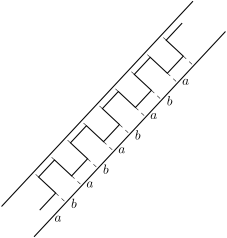 Fig. 10
Let us call a binary sequence almost periodic if, for every "word" () contained in it — we shall also write — there exists a number such that the set
intersects every segment of the natural sequence of length . Almost periodicity for two-sided sequences is defined analogously.
Consider the Morse sequence
defined by the equalities for . Prove that it is almost periodic.
Let us call a binary sequence almost periodic if, for every "word" () contained in it — we shall also write — there exists a number such that the set
intersects every segment of the natural sequence of length . Almost periodicity for two-sided sequences is defined analogously.
For a finite sequence ("word")
of zeros and ones, let denote , and , where . Define a sequence by specifying its initial segments , which are defined recursively: is any word, ,
where is some word of zeros and ones,
and so on. Thus serves as the beginning of , as the beginning of , and so on. The infinite sequence defines a certain sequence . Prove that it is periodic or almost periodic.
Let us call a binary sequence almost periodic if, for every "word" () contained in it — we shall also write — there exists a number such that the set
intersects every segment of the natural sequence of length . Almost periodicity for two-sided sequences is defined analogously.
A folding sequence is a sequence of zeros and ones whose initial segments of length have the form
The name of the sequence is explained by the fact that the word can be associated with the sequence of folds of a paper strip formed on it as a result of folding it times (first in half, then in half again, and so on). If, moving along the strip, we assign a one to each fold resulting in a turn to the left, and a zero to a "turn right" fold, we obtain (Fig. 11). The sequence is uniquely determined by specifying the numbers
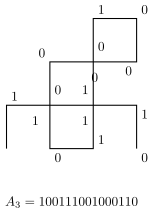 Fig. 11
Prove that every folding sequence is almost periodic but not periodic, even if we restrict to terms with arbitrarily large indices.
Let us call a binary sequence almost periodic if, for every "word" () contained in it — we shall also write — there exists a number such that the set
intersects every segment of the natural sequence of length . Almost periodicity for two-sided sequences is defined analogously.
Prove that fold sequences (see Problem 4.24) have the following property (Besicovitch almost periodicity): for every there exist a number and numbers such that
-
if is the number of those that fall into the interval , then for all intervals of length ;
-
for every ;
-
.
Prove that if , where is a fold sequence, then for any the limit
exists (the "Fourier coefficient"), and moreover
and otherwise. Verify that the "Parseval equality" holds:
Consider the binary sequence
(the Rudin-Shapiro sequence), whose initial segments of length have the form , where and are words of length , with , and for the words are defined recursively:
( is obtained from by swapping ). Prove the almost periodicity of this sequence.
Note that the sequence is the sequence of coefficients of the Rudin-Shapiro polynomials (see Problem IX.4.25).
Let us call a binary sequence almost periodic if, for every "word" () contained in it — we shall also write — there exists a number such that the set
intersects every segment of the natural sequence of length . Almost periodicity for two-sided sequences is defined analogously.