Homotopy type and CW complexes
[14/100%]Let be a topological space and a continuous function. Let be the quotient space formed from the disjoint union by identifying with .
Show that if is homotopic to via a homotopy with , , then there is a continuous function which is the identity on . See Figure 5.6.
 Figure for Exercise 5.3.1.
Analogously, find a continuous function .
Show that is a homotopy equivalence with homotopy inverse .
Suppose that is a homotopy equivalence with homotopy inverse ; that is, is homotopic to and is homotopic to . Name the homotopies , , , , and , , , . Let (notation of Exercise 5.3.1) for a fixed attaching map , and similarly , .
 Figure for Exercise 5.3.2.
Consider the map , which is given by on and the identity on , and , which is defined by on and the identity on . Show that they are continuous (see Figure 5.7).
Use Exercise 5.3.1 to show that there is a homotopy equivalence .
Show that is a left homotopy inverse to ; that is, is homotopic to the identity.
Show that has a left homotopy inverse.
In a group, show that whenever , then . That is, whenever there is a left inverse and a right inverse to , then is invertible and the inverse is . Conclude that a left inverse for an invertible element is also a right inverse.
Starting with , use the fact that is a homotopy equivalence to show that and conclude that has a right homotopy inverse. From this and part (e), conclude that is a homotopy equivalence, and then that is a homotopy equivalence.
The dunce hat is the space obtained from a single triangle (a -simplex) by identifying all three of its edges together in the same direction (so that, reading around the boundary of the triangle, all three edges are labeled with the same letter traversed the same way).
Show that the dunce hat is homeomorphic to a CW complex with one -cell, one -cell, and one -cell. Show that is homeomorphic to the circle, and the attaching map of the -cell is homotopic to the reflection.
Use Exercise 5.3.1 to show that the dunce hat is homotopy equivalent to the disk.
Show that the dunce hat is not homeomorphic to the disk by examining neighborhoods of edge points and looking at the fundamental group when the point is deleted.
Suppose is a two-dimensional CW complex with at least two -cells. Show that if is connected, at least one of the -cells must have its boundary attached to two different -cells.
Assume that is a -cell with boundary attached to two different -cells and . Show that is homeomorphic to a -disk. Use Exercise 5.3.2 to show that is homotopy equivalent to a CW complex where is replaced by a single -cell and there are corresponding -cells, -cells, and -cells to the other cells of .
Use induction to show that a connected two-dimensional CW complex is homotopy equivalent to a CW decomposition with a single -cell.
A subcomplex of a connected -skeleton which contains all of the vertices and deformation-retracts to any one of its -cells (through a process of collapsing -cells one edge at a time) is called a maximal tree in . Such a maximal tree can always be shown to exist by induction on the number of -cells: if there is only one -cell, it is itself the maximal tree; otherwise, choosing a -cell and a maximal subcomplex of not containing (with, say, path components, each of which has a maximal tree connecting its -cells by the inductive hypothesis), adding a -cell from to each path component of gives a maximal tree in .
Use Exercise 5.3.2 and a maximal tree in to show that there is a homotopy-equivalent CW complex with a single -cell.
Consider the CW complex whose -skeleton is pictured in Figure 5.10. Here denote -cells and are -cells. Suppose that there are two -cells attached to , which can be described in terms of the -cells that are traversed by and .
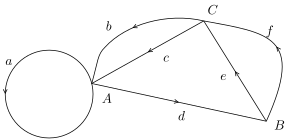 Figure for Exercise 5.3.6.
Find homotopy equivalent to so has a single -cell.
Find homotopy equivalent to so the -skeleton is and use it to compute the fundamental group of .
Consider a handle decomposition of a surface. The -handles deformation-retract to a collection of points. When we attach a -handle, the composition of the attaching maps with the deformation retraction sends these intervals to one or two points. Use this idea to show that the union of the -handles and -handles is homotopy equivalent to a CW complex with -cells and -cells, where is the number of -handles.
Show that if a surface (possibly with boundary) has a handle decomposition with -handles, -handles, and -handles, then there is a corresponding CW complex with -cells, -cells, and -cells to which it is homotopy equivalent.
Show that a connected surface (possibly with boundary) is homotopy equivalent to a CW complex with a single -cell.
For Figure 5.11(a), give a CW decomposition and then get a homotopy-equivalent CW complex with a single -cell. Use this to compute the fundamental group.
 Figure for Exercises 5.3.10 and 5.3.11.
For Figure 5.11(b) (shown together with Figure 5.11(a) above, in Exercise 5.3.10), give a CW decomposition and then get a homotopy-equivalent CW complex with a single -cell. Use this to compute the fundamental group.
Using the notation established in Exercise 5.1.4 (where is the CW complex , with each -cell's boundary divided into an upper half arc and a lower half arc , identified respectively with and ), consider the CW complex where but , and is identified via sending to as before but sending to by reversing the direction. Geometrically, think of as on the -axis, with the map being a vertical projection. Identify geometrically what the quotient space will be. Show that is homotopy equivalent, but not homeomorphic, to , with the homotopy equivalence coming from collapsing to a point.
Suppose is a CW complex and is a subcomplex of ; then is built from by attaching -cells for various , which allows arguments to reduce to the case of attaching a single cell. The homotopy extension theorem states: suppose is a subcomplex, , and there is a homotopy of the restriction , that is, a map with . Then there is a homotopy with for and .
To see why this should be true, assume , where is continuous. The homotopy extension property asserts that a map defined on extends to a continuous map from ; the key is to reduce to the case , .
Lemma. Consider . There is a deformation retraction of onto .
(Idea of the lemma's proof, illustrated for : let and consider rays from . For , the ray from to meets in an interval with first point on and last point ; for a point , moving along its own such interval to its endpoint defines the deformation retraction , and gives a continuous map with .)
Now suppose and there is a homotopy with for . Consider the composition given by for , and for . The lemma allows extending to by composing with the deformation retraction.
By applying the lemma and using how is formed as a quotient space, show that there is an extension of .
Use an inductive argument, with induction over the number of cells of , to prove the homotopy extension theorem (stated in Exercise 5.3.13): if is a subcomplex, , and is a homotopy of with , then there is a homotopy extending with .