CW complexes
[59/100%]Recall the general definition: a finite two-dimensional CW complex structure for expresses as being built in stages . Here is a finite discrete set of points called -cells. is formed from by attaching finitely many -cells (copies of a -disk) via continuous maps from their boundary into . Finally is formed from by attaching finitely many -cells via continuous maps from their boundary into .
The -sphere has the structure of a CW complex with a single point and (there are no -cells). Then is formed by using the constant map sending to the point . Verify that is homeomorphic to this CW complex .
For the torus , think of it as formed from a square by identifying , . The four corners are identified to a single -cell . The edge (identified with ) forms a -cell , and the edge (identified with ) forms a second -cell ; is homeomorphic to the one-point union of two circles. Finally forms a -cell whose boundary maps to by running over the first circle, then the second, then backwards over the first, then backwards over the second -- the word .
The surface (genus- orientable surface) can be thought of as coming from a regular -gon whose boundary is identified via the pattern . This gives the structure of a CW complex with one -cell (from the identified vertices), -cells (from the edges, identified in pairs, whose boundaries are sent to the single -cell), and a single -cell coming from the -gon, whose boundary is mapped into according to the identification pattern; here is homeomorphic to a wedge of circles.
Similarly (the connected sum of projective planes) has a CW decomposition with a single -cell, -cells, and a single -cell expressed as a regular -gon whose boundary is identified according to the pattern ; here is homeomorphic to the wedge of circles.
Verify that is homeomorphic to the CW complex as described above.
Verify that is homeomorphic to the CW complex with a single -cell, -cells, and a single -cell as described above.
Verify that is homeomorphic to the CW complex with a single -cell, -cells, and a single -cell as described above.
The projective plane is formed from a -disk by identifying to on the boundary circle. It has a CW decomposition , where . The pseudoprojective plane is formed from the disk by identifying to on the boundary circle. Give a similar CW decomposition for with one cell in each dimension and identify the attaching map for the -cell.
Consider the CW complex
Here each -cell is attached to by identifying its boundary to . Orient each -cell and identify by sending to and to . Similarly, identify by sending to and to . To attach the -cells, identify the boundary with and divide it into the upper half arc and lower half arc . Then identify the boundary of with by identifying the upper half arc with and the lower half arc with . Identify the boundary of using the same map. This is expressed by saying that (see Figure 5.1).
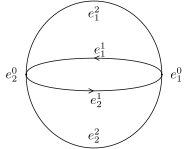 A CW decomposition of the sphere.
Show that is homeomorphic to .
Show that is homeomorphic to .
Show that is homeomorphic to .
More generally, a finite CW complex of dimension is built up in stages , where is obtained from by attaching -cells (each an -dimensional disk with boundary , attached via a continuous map ); a set is open (closed) in iff its inverse image in each cell is open (closed). The subset is called the -skeleton of . Show that the -skeleton is a closed subset of .
Show that a finite CW complex is a compact Hausdorff space.
A subcomplex of a CW complex is a collection of cells of which is itself a CW complex -- that is, when attaching a cell of , the image of its attaching map lies within . Using the CW decomposition of from Exercise 5.1.4, show that the upper hemisphere is a subcomplex.
Show that a subcomplex (Exercise 5.1.7) is a closed subset of .
The -sphere has a CW complex description with one -cell and one -cell, attached by the constant map from to the -cell. Under the CW topology, the space is the same as taking and identifying all of its boundary points to a single point. Verify that the -sphere is homeomorphic to the space with this CW decomposition.
Give a CW decomposition for by using the product decomposition of the CW decompositions of (one -cell, one -cell) and (one -cell, one -cell), where the product of an -cell and a -cell is homeomorphic to an -cell. Your description should identify how the skeleta are built up in the product.
Give a CW decomposition for by using the product decomposition of the CW decompositions of (one -cell, one -cell) and (one cell in each dimension and , per Exercise 5.1.3 with ). Your description should identify how the skeleta are built up in the product.
Give a CW decomposition for by using the product decomposition of the CW decompositions of (Exercise 5.1.2(a)) and . Your description should identify how the skeleta are built up in the product.
Give a CW decomposition for by using the product decomposition of the CW decomposition of (Exercise 5.1.1). Your description should identify how the skeleta are built up in the product.
Give a CW decomposition for by using the product decomposition of the CW decomposition of (Exercise 5.1.3 with ). Your description should identify how the skeleta are built up in the product.
Real projective -space is formed from the -sphere by identifying antipodal points . Since has trivial fundamental group for , it is the universal cover of , so has fundamental group . Inductively, going from to corresponds to going from to by attaching the upper and lower hemispheres, each homeomorphic to via vertical projection, attached consistently (the upper hemisphere via vertical projection, the lower hemisphere by composing that attaching map with the antipodal map): , where is the identity map of and is the antipodal map of . Passing to the quotient identifies the two -cells to give , where is the quotient map. This leads to a CW decomposition of with -cells, one in each dimension between and .
Complex projective -space , denoted , is defined analogously: starting from , introduce the equivalence relation for a unit complex number, and form as the quotient . For this identifies all points of the circle to a point, so is a point. For , one finds , where is the upper hemisphere of (homeomorphic to ) and is the quotient map -- exactly the CW decomposition of from Exercise 5.1.1, so is homeomorphic to . The same idea shows that is built from by attaching a -cell.
Fill in the details of the above argument to show that has a CW decomposition with one cell in each even dimension between and .
Fix an integer and let . Let be the group of th roots of unity, acting on by for . The quotient space is called a lens space.
We describe the CW decomposition for the case in detail; the general case follows the same pattern. Sitting inside is the circle where the second coordinate is . Give a CW decomposition consistent with the -action: use the points as -cells, and -cells , where is mapped via its characteristic map to the arc joining and , and are the compositions of this map with multiplication by respectively. Taking the quotient by identifies the -cells to a single -cell and the -cells to a single -cell, and the quotient is homeomorphic to .
Next consider the upper hemisphere , thought of as a -cell , attached to so that its boundary is the sum of the three -cells above. Letting act on gives two more -cells (disjoint from except along the shared boundary circle). Taking the quotient by identifies these three -cells, so the quotient has a single -cell, a single -cell, and a single -cell, with the -cell attached so that it runs three times over the formed by the -cell and -cell -- that is, this part of the quotient is where ; this space is the pseudoprojective plane of Exercise 5.1.3.
The -cells and intersect only along their shared boundary circle, and together (up to homeomorphism) enclose a region homeomorphic to a three-dimensional disk , forming a -cell ; all of lies in this -cell or its image under multiplication by or , giving two more -cells . Taking the quotient identifies these three -cells, so has a single cell in each dimension between and .
By replacing with throughout the above, give a description of the CW decomposition of the lens space .
Consider a two-dimensional CW complex with a single -cell , which serves as the base point. Adding the -cells forms a wedge of circles, so the attaching map of each -cell can be described, up to homotopy (assuming is mapped to the base point), by a word in the free group .
Suppose that there is a single -cell. Use the Seifert--van Kampen theorem to show that the fundamental group of is isomorphic to the quotient of the free group by the relation given by the word used in attaching the -cell, which is given by , where is the generator of .
Show that if is a two-dimensional CW complex and we attach a -cell to by a map sending to , then , where is the normal subgroup generated by the word in determined by the image of the generator of under .
Show that the fundamental group of a two-dimensional CW complex with a single -cell is isomorphic to the group with one generator for each -cell and one relation for each -cell coming as in part (a) from the word in , which is the image of the generator under .
In the following exercises (5.2.3-5.2.6), spaces are described as quotients of polygons by indicating identifications of edges; these spaces have natural decompositions as CW complexes, all with a single -cell coming from the vertices. Use these decompositions to compute the fundamental groups, find the abelianizations, and (for those which are surfaces) determine which surface the space is homeomorphic to from the abelianization, checking the result using Euler characteristics.
Find the fundamental groups of the two spaces (a), (b) in Figure 5.2, find their abelianizations, and from this determine which surface each space is homeomorphic to.
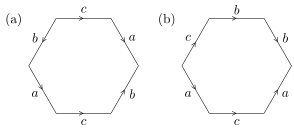 Figure for Exercise 5.2.3.
The space obtained from the polygon labeled (a) in Figure 5.2.
The space obtained from the polygon labeled (b) in Figure 5.2.
Find the fundamental groups of the two spaces (a), (b) in Figure 5.3 (identifications of the edges of a pentagon, using the same conventions as Exercise 5.2.3).
 Figure for Exercise 5.2.4.
The space obtained from the polygon labeled (a) in Figure 5.3.
The space obtained from the polygon labeled (b) in Figure 5.3.
Find the fundamental groups of the two spaces (a), (b) in Figure 5.4 (identifications of the edges of a pentagon, using the same conventions as Exercise 5.2.3).
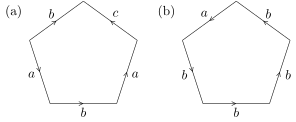 Figure for Exercise 5.2.5.
The space obtained from the polygon labeled (a) in Figure 5.4. This is a surface with boundary; identify it.
The space obtained from the polygon labeled (b) in Figure 5.4.
Find the fundamental groups of the two spaces (a), (b) in Figure 5.5 (identifications of the edges of an octagon, using the same conventions as Exercise 5.2.3).
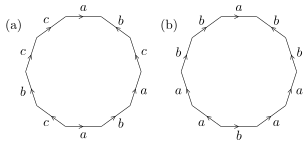 Figure for Exercise 5.2.6.
The space obtained from the polygon labeled (a) in Figure 5.5.
The space obtained from the polygon labeled (b) in Figure 5.5.
Use the Seifert--van Kampen theorem to show that, for a connected CW complex , . Thus the fundamental group only detects information about the -skeleton .
Use Exercise 5.2.7 to show that for , since it has a CW decomposition with one -cell and one -cell.
Use the CW decomposition for from Exercise 5.1.10 to compute the fundamental group. Compare your answer with the general result for the fundamental group of a product space.
Use the CW decomposition for from Exercise 5.1.11 to compute the fundamental group. Compare your answer with the general result for the fundamental group of a product space.
Use the CW decomposition for from Exercise 5.1.12 to compute the fundamental group. Compare your answer with the general result for the fundamental group of a product space.
Use the CW decomposition for from Exercise 5.1.13 to compute the fundamental group. Compare your answer with the general result for the fundamental group of a product space.
Use the CW decomposition for from Exercise 5.1.14 to compute the fundamental group. Compare your answer with the general result for the fundamental group of a product space.
Give the fundamental group of , , using its CW decomposition (Exercise 5.1.15).
Show that the fundamental group of the pseudoprojective plane of Exercise 5.1.3 is .
Show that is the universal covering space of the lens space (Exercise 5.1.16) and use this to give the fundamental group. Then use the CW decomposition from Exercise 5.1.16 to compute the fundamental group in another way.
Let be a topological space and a continuous function. Let be the quotient space formed from the disjoint union by identifying with .
Show that if is homotopic to via a homotopy with , , then there is a continuous function which is the identity on . See Figure 5.6.
 Figure for Exercise 5.3.1.
Analogously, find a continuous function .
Show that is a homotopy equivalence with homotopy inverse .
Suppose that is a homotopy equivalence with homotopy inverse ; that is, is homotopic to and is homotopic to . Name the homotopies , , , , and , , , . Let (notation of Exercise 5.3.1) for a fixed attaching map , and similarly , .
 Figure for Exercise 5.3.2.
Consider the map , which is given by on and the identity on , and , which is defined by on and the identity on . Show that they are continuous (see Figure 5.7).
Use Exercise 5.3.1 to show that there is a homotopy equivalence .
Show that is a left homotopy inverse to ; that is, is homotopic to the identity.
Show that has a left homotopy inverse.
In a group, show that whenever , then . That is, whenever there is a left inverse and a right inverse to , then is invertible and the inverse is . Conclude that a left inverse for an invertible element is also a right inverse.
Starting with , use the fact that is a homotopy equivalence to show that and conclude that has a right homotopy inverse. From this and part (e), conclude that is a homotopy equivalence, and then that is a homotopy equivalence.
The dunce hat is the space obtained from a single triangle (a -simplex) by identifying all three of its edges together in the same direction (so that, reading around the boundary of the triangle, all three edges are labeled with the same letter traversed the same way).
Show that the dunce hat is homeomorphic to a CW complex with one -cell, one -cell, and one -cell. Show that is homeomorphic to the circle, and the attaching map of the -cell is homotopic to the reflection.
Use Exercise 5.3.1 to show that the dunce hat is homotopy equivalent to the disk.
Show that the dunce hat is not homeomorphic to the disk by examining neighborhoods of edge points and looking at the fundamental group when the point is deleted.
Suppose is a two-dimensional CW complex with at least two -cells. Show that if is connected, at least one of the -cells must have its boundary attached to two different -cells.
Assume that is a -cell with boundary attached to two different -cells and . Show that is homeomorphic to a -disk. Use Exercise 5.3.2 to show that is homotopy equivalent to a CW complex where is replaced by a single -cell and there are corresponding -cells, -cells, and -cells to the other cells of .
Use induction to show that a connected two-dimensional CW complex is homotopy equivalent to a CW decomposition with a single -cell.
A subcomplex of a connected -skeleton which contains all of the vertices and deformation-retracts to any one of its -cells (through a process of collapsing -cells one edge at a time) is called a maximal tree in . Such a maximal tree can always be shown to exist by induction on the number of -cells: if there is only one -cell, it is itself the maximal tree; otherwise, choosing a -cell and a maximal subcomplex of not containing (with, say, path components, each of which has a maximal tree connecting its -cells by the inductive hypothesis), adding a -cell from to each path component of gives a maximal tree in .
Use Exercise 5.3.2 and a maximal tree in to show that there is a homotopy-equivalent CW complex with a single -cell.
Consider the CW complex whose -skeleton is pictured in Figure 5.10. Here denote -cells and are -cells. Suppose that there are two -cells attached to , which can be described in terms of the -cells that are traversed by and .
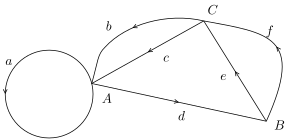 Figure for Exercise 5.3.6.
Find homotopy equivalent to so has a single -cell.
Find homotopy equivalent to so the -skeleton is and use it to compute the fundamental group of .
Consider a handle decomposition of a surface. The -handles deformation-retract to a collection of points. When we attach a -handle, the composition of the attaching maps with the deformation retraction sends these intervals to one or two points. Use this idea to show that the union of the -handles and -handles is homotopy equivalent to a CW complex with -cells and -cells, where is the number of -handles.
Show that if a surface (possibly with boundary) has a handle decomposition with -handles, -handles, and -handles, then there is a corresponding CW complex with -cells, -cells, and -cells to which it is homotopy equivalent.
Show that a connected surface (possibly with boundary) is homotopy equivalent to a CW complex with a single -cell.
For Figure 5.11(a), give a CW decomposition and then get a homotopy-equivalent CW complex with a single -cell. Use this to compute the fundamental group.
 Figure for Exercises 5.3.10 and 5.3.11.
For Figure 5.11(b) (shown together with Figure 5.11(a) above, in Exercise 5.3.10), give a CW decomposition and then get a homotopy-equivalent CW complex with a single -cell. Use this to compute the fundamental group.
Using the notation established in Exercise 5.1.4 (where is the CW complex , with each -cell's boundary divided into an upper half arc and a lower half arc , identified respectively with and ), consider the CW complex where but , and is identified via sending to as before but sending to by reversing the direction. Geometrically, think of as on the -axis, with the map being a vertical projection. Identify geometrically what the quotient space will be. Show that is homotopy equivalent, but not homeomorphic, to , with the homotopy equivalence coming from collapsing to a point.
Suppose is a CW complex and is a subcomplex of ; then is built from by attaching -cells for various , which allows arguments to reduce to the case of attaching a single cell. The homotopy extension theorem states: suppose is a subcomplex, , and there is a homotopy of the restriction , that is, a map with . Then there is a homotopy with for and .
To see why this should be true, assume , where is continuous. The homotopy extension property asserts that a map defined on extends to a continuous map from ; the key is to reduce to the case , .
Lemma. Consider . There is a deformation retraction of onto .
(Idea of the lemma's proof, illustrated for : let and consider rays from . For , the ray from to meets in an interval with first point on and last point ; for a point , moving along its own such interval to its endpoint defines the deformation retraction , and gives a continuous map with .)
Now suppose and there is a homotopy with for . Consider the composition given by for , and for . The lemma allows extending to by composing with the deformation retraction.
By applying the lemma and using how is formed as a quotient space, show that there is an extension of .
Use an inductive argument, with induction over the number of cells of , to prove the homotopy extension theorem (stated in Exercise 5.3.13): if is a subcomplex, , and is a homotopy of with , then there is a homotopy extending with .
We say that a subset is a neighborhood deformation retract if there is an open set containing and a deformation retraction of onto (a map with so that is homotopic to the identity, with the homotopy restricting to the constant homotopy on ). If is a pair of sets, we say the pair is a neighborhood deformation retract if there are open sets with , so that deformation-retracts to , deformation-retracts to , and deformation-retracts to .
Show that if is a neighborhood deformation retract of , then are all path connected iff are all path connected.
Recall (Exercise 5.4.1) that a pair is a neighborhood deformation retract of if are open sets with , , deformation-retracts to , deformation-retracts to , and deformation-retracts to . Show that if are path connected and is a neighborhood deformation retract of , then if , there is an isomorphism between and .
Show that if , where are path connected, , and is a neighborhood deformation retract (Exercise 5.4.1), then there is an isomorphism .
Show that if is the wedge of two copies of the circle and , , then is a neighborhood deformation retract (Exercise 5.4.1). Use Exercise 5.4.3 to show that . Here is the wedge point.
Use induction to show that if is the wedge of copies of , then .
Suppose is a path-connected surface which is the union of two path-connected surfaces with boundary which intersect along a circle . Suppose there is a neighborhood of so that is homeomorphic to .
Show that is a neighborhood deformation retract (Exercise 5.4.1).
Show that .
Apply Exercise 5.4.5 to compute
,
.
Suppose is a two-dimensional CW complex and is a subcomplex of , so that can be formed from by inductively attaching cells of dimensions . Using an inductive argument, show that is a neighborhood deformation retract (Exercise 5.4.1).
Suppose that are subcomplexes of the two-dimensional CW complex . Show that is a neighborhood deformation retract (Exercise 5.4.1). (This, together with Exercise 5.4.7, in fact holds without the two-dimensional hypothesis.)
Prove the following theorem (the Seifert--van Kampen theorem for CW complexes): suppose are path-connected subcomplexes of the CW complex so that is path connected with . Then .
A simplicial complex is a special case of a CW complex where the -cells are identified with -dimensional simplices (the affine span of affinely independent vertices), each simplex embedded in , with each -dimensional face of an -simplex identified with one of the -simplices of the complex.
Thinking of the projective plane as a quotient of a rectangle with identifications as you go around the four edges in the counterclockwise direction, subdivide this to make it a simplicial complex.
For the surface thought of as an octagon with identifications on the boundary , give a decomposition as a simplicial complex (Exercise 5.5.1).
A -complex is built up like a CW complex from cells having the structure of simplices as in a simplicial complex, where each simplex is determined by an ordered set of vertices (with in the chosen order), and the boundary identifications use the unique affine, order-preserving, linear maps between faces.
For example, the torus has a -complex structure with one vertex, three -simplices, and two -simplices: starting from the square with and , label the corners , , , (all identified to a single vertex in the quotient). The -simplices are , , and ; the -simplices are , . Similarly, the Klein bottle , formed from a rectangle with and , gets a -complex structure by ordering the vertices , , , (all identified to a single vertex ), with -simplices , , , and -simplices , . These are illustrated in Figure 5.16.
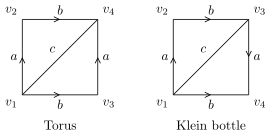 \Delta -complex structures for T, K.
Give a -complex structure to using two triangles.
Give a -complex structure to (the projective plane) using two triangles.