Parabolic Equations
[16/100%]Consider the Cauchy problem for the Heat Operator in :
u_t = u_xx (-< x < , t > 0) u(x,0) = f(x) (-< x < ),
where is bounded, continuous, and satisfies
Show that there exists a constant such that
for all , .
Let be an open set with smooth boundary and suppose is a solution of the equation
with on . Assume that
Let
Prove that as .
Consider the Cauchy problem
u_t = u_xx (-< x < , t > 0), u(x,0) = f(x),
where is bounded and continuous.
Using the Fourier Transform, construct explicitly a fundamental solution for this problem, and write down the solution .
State a maximum principle for this problem. Why is the Tychanov non-uniqueness example possible?
Suppose in addition that . Show that
Show how to solve the problem
u_t = u_xx (x > 0, t > 0) u(x,0) = f(x) (x > 0) u(0,t) = 0 (t > 0)
by using (a) and an appropriate extension of .
Consider the problem
u_t = u_xx (x R, t > 0) u(x,0) = u_0(x) L^2(R).
Find a bound on in .
For the indicated domain (interior of the parabola) let denote the points with and . Let denote the open line-segment forming the top of , and let . Let with be a solution of
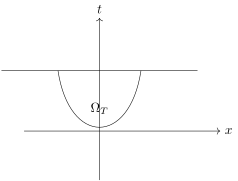
with . Show that if , in , then every non-constant solution assumes its negative minimum (if one exists) on . What can you say if , in ?
Consider the boundary-value problem
u_xx + u_t = 0 (0 x and t > 0), B.C. u(0,t) = 0, u_x(,t) = 0, I.C. u(x,0) = f(x).
Use the sequence and an appropriate space of continuous functions to decide whether this problem is well-posed.
In Probability Theory one encounters the Ornstein-Uhlenbeck process, in which the particles of Brownian motion are subjected to an elastic force. One is required to solve
u_t = u_xx - xu_x (x R, t > 0) u(x,0) = u_0(x).
Assume and find . (You should be able to find explicitly; if not, leave your result in the form of a one-dimensional integral.)
Let be the usual heat operator
let , and let be a fixed point of . Consider the problem
(Lu)(x,t) = u(x-h,t), x R^n, t > 0, u(x,0) = (x), x R^n
for an unknown function .
Derive an explicit representation for a solution of the above problem in terms of the initial data. (You should prove that your is well-defined, but you need not prove that it represents a smooth solution.)
Assume that is the Fourier transform of a function which vanishes in the ball of radius centered at the origin. Show then that the solution satisfies
Let be a bounded domain and assume is a function with , which solves the equation
(heat conduction with heat loss due to radiation) with the boundary condition . Prove that we can find a constant such that
regardless of the initial value .
Let
satisfy
with continuous and . Prove that on .
Let be a solution to the problem
where is a smooth bounded domain in .
Prove that
Prove that
Prove that the solution to this boundary value problem is unique.
Show that for , the following bound also holds:
For each , let be a real positive definite matrix with entries . Assume . Let be a bounded open set. Prove (from first principles) the following comparison principle:
Let and be solutions to the inequalities
and
respectively. Suppose, furthermore, that and are continuous on and satisfy the condition on the parabolic boundary
Then on .
For bounded and open, let . Assume and are continuous functions of their arguments and assume that
where is a positive function. Suppose satisfies the inequality
Prove that for any
where .
Let be a bounded open set of with smooth boundary . Let , with continuous on , be a solution of the initial-boundary problem
u_t - u = (u) for x , t > 0 u(x,t) = 0 for x u(x,0) = f(x) for x .
Show that if , then for all .
Consider the Cauchy problem for Burger's equation:
u_t - u_xx + uu_x = 0, R (0,), u(x,0) = g(x)
where . Derive the explicit formula of the solution for the Cauchy problem.
Consider the rectangle .
By separation of variables, compute the first eigenvalue and the first eigenfunction of the Laplacian operator on :
Let be a smooth function that vanishes on the boundary . Assuming that , prove that the solution of the parabolic problem
u_t = u + u t > 0, x Q u(0,x) = g(x), x Q u(t,x) = 0, x Q
converges to zero uniformly on , as .