Part 6

Partial Differential Equations

[77/100%]
Show
LaTeX
Problem 6.1.1
?
(a)

Let A=(aij)i,j=1nA = (a_{ij})_{i,j=1}^{n} be a real matrix. Show that

∫∣x∣<1(x,Ax) dx=ωnn(n+2)trace⁡A. \int _{\left|x\right|<1} (x, Ax)\, dx = \frac{\omega _n}{n(n+2)} \operatorname {trace} A.

Here (⋅,⋅)(\cdot , \cdot ) is the dot product of vectors in Rn\mathbb {R}^{n} and ωn\omega_n is the area of the unit sphere in Rn\mathbb {R}^{n}.

(b)

Show that u∈C02(Rn)u \in C_0^2(\mathbb {R}^{n}) implies

∫Rn(Δu)2 dx=∑i,j=1n∫Rn∣Diju∣2 dx. \int _{\mathbb {R}^{n}} (\Delta u)^2\, dx = \sum _{i,j=1}^{n} \int _{\mathbb {R}^{n}} \left|D_{ij} u\right|^2\, dx.
Problem 6.1.2

Let TT be a distribution on R\mathbb {R} and suppose that T′=0T' = 0 on R\mathbb {R}. Show that T=const⁡T = \operatorname {const}; i.e., show that there is a number aa such that

T(ϕ)=∫Raϕ dxfor all ϕ∈C0∞(R). T(\phi ) = \int _{\mathbb {R}} a \phi \, dx \quad \text{for all } \phi \in C_0^{\infty }(\mathbb {R}).
?
Problem 6.1.3

Let u∈Hs(Rn)u \in H^s(\mathbb {R}^{n}) with s>n/2s > n/2. Show that lim⁡∣x∣→∞u(x)=0\lim_{\left|x\right| \to \infty } u(x) = 0.

?
Problem 6.1.4

Let uu be defined for f∈D((0,1))f \in \mathcal{D}((0,1)) by

⟨u,f⟩=∑n=0∞f(n)(1n). \langle u, f \rangle = \sum _{n=0}^{\infty } f^{(n)}\left(\frac{1}{n}\right).

Determine whether uu is a distribution on (0,1)(0,1), and support your answer.

?
Problem 6.1.5

Let

B={(x,y)∣x2+y2<1}. B = \left\{ (x,y) \mid x^2 + y^2 < 1\right\} .

For which p≥1p \geq 1 does the function

u(x,y)=xx2+y2 u(x,y) = \frac{x}{\sqrt{x^2+y^2}}

belong to W1,p(B)W^{1,p}(B)?

?
Problem 6.1.6

Let Σ\Sigma be a smooth hypersurface dividing Rn\mathbb {R}^{n} into two disjoint open regions Ω1\Omega_1 and Ω2\Omega_2. Denote by ν=ν(x)\nu = \nu (x) the unit normal to Σ\Sigma pointing into Ω2\Omega_2. Suppose v:Rn→Rnv : \mathbb {R}^{n} \to \mathbb {R}^{n} solves the equation

div⁡v(x)=b(x)for x∈Rn−Σ(*) \operatorname {div} v(x) = b(x) \quad \text{for } x \in \mathbb {R}^{n} - \Sigma \tag {*}

in the classical (C1C^1) sense where bb is a continuous function. Assume furthermore that vv lies in both C0(Ω1‾)C^0(\overline{\Omega_1}) and C0(Ω2‾)C^0(\overline{\Omega_2}) (but not necessarily C0(Rn)C^0(\mathbb {R}^{n})!!) with

v+(x0)≡lim⁡x→x0x∈Ω1v(x),v−(x0)≡lim⁡x→x0x∈Ω2v(x) v^{+}(x_0) \equiv \lim _{\substack {x \to x_0 \\ x \in \Omega _1}} v(x), \qquad v^{-}(x_0) \equiv \lim _{\substack {x \to x_0 \\ x \in \Omega _2}} v(x)

for each x0∈Σx_0 \in \Sigma. Derive a necessary and sufficient condition in terms of v+v^+, v−v^- and ν\nu for vv to be a distribution solution of (*) on all of Rn\mathbb {R}^{n}.

?
Problem 6.1.7

Recall the definition of the curl operator in two dimensions acting on a vector field U(x,y)=(u(x,y),v(x,y))U(x,y) = (u(x,y), v(x,y)):

∇×U≡uy−vx. \nabla \times U \equiv u_y - v_x.
?
(a)

Give a definition of what it means for a (not necessarily continuous) vector field UU to have curl zero in the sense of distributions.

(b)

Suppose UU takes the form

U(x,y)≡{U1,(x,y)∈Ω1,U2,(x,y)∈Ω2, U(x,y) \equiv \begin{cases} U_1, & (x,y) \in \Omega _1, \\ U_2, & (x,y) \in \Omega _2, \end{cases}

where Ω1\Omega_1 and Ω2\Omega_2 are open sets such that Ω1‾∪Ω2‾=R2\overline{\Omega_1} \cup \overline{\Omega_2} = \mathbb {R}^{2}, Γ≡∂Ω1∩∂Ω2\Gamma \equiv \partial \Omega_1 \cap \partial \Omega_2 is a smooth curve, and U1U_1 and U2U_2 are (different) constant vectors. If UU has curl zero in R2\mathbb {R}^{2} in the sense of distributions, describe as completely as possible the curve Γ\Gamma.

Problem 6.1.8

Let pp be a polynomial in nn variables, and assume that the set {x:p(ix)=0}\left\{ x : p(ix) = 0\right\} is bounded. Prove that there exists a tempered distribution EE on Rn\mathbb {R}^{n} such that p(D)E−δ∈Sp(D)E - \delta \in S. Here SS is the Schwartz class of rapidly decreasing functions, and δ\delta is the Dirac distribution defined by δ⋅ϕ=ϕ(0)\delta \cdot \phi = \phi (0).

?
Problem 6.1.9

Let P(D)P(D) be an mm-th order linear constant coefficient partial differential operator on Rn\mathbb {R}^{n}; i.e.,

P(D)=∑∣α∣≤mCαDα P(D) = \sum _{\left|\alpha \right| \leq m} C_{\alpha } D^{\alpha }

where α\alpha denotes a multi-index α=(α1,α2,…,αn)\alpha = (\alpha_1, \alpha_2, \ldots , \alpha_n) and the CαC_{\alpha } are constants. Suppose

P(iξ)≡∑∣α∣≤mCα(iξ)α≠0for all ξ∈Rn−{0}. P(i\xi ) \equiv \sum _{\left|\alpha \right| \leq m} C_{\alpha } (i\xi )^{\alpha } \neq 0 \quad \text{for all } \xi \in \mathbb {R}^{n} - \left\{ 0\right\} .

If u∈S′u \in S' satisfies P(D)u=0P(D)u = 0, prove that uu must be a polynomial. (Here S′S' denotes the space of tempered distributions on Rn\mathbb {R}^{n}.)

?
Problem 6.1.10
?
(a)

Show that

lim⁡t→0+14πte−x2/4t=δ(x) \lim _{t \to 0^+} \frac{1}{\sqrt{4\pi t}} e^{-x^2/4t} = \delta (x)

in D′\mathcal{D}'.

(b)

Show how to define 1x\frac{1}{x} as a distribution (i.e., define the Cauchy Principle Value and show that it is in D′\mathcal{D}').

(c)

Calculate rigorously the derivative of log⁡∣x∣\log \left|x\right| and express the result in terms of your answer to (b).

(d)

Calculate the Fourier transform of the distribution 1x\frac{1}{x}.

Problem 6.1.11
?
(a)

Let

Lu(x)=∑∣α∣≤maαDαu(x),x∈Rn Lu(x) = \sum _{\left|\alpha \right| \leq m} a_{\alpha } D^{\alpha } u(x), \quad x \in \mathbb {R}^{n}

where the aαa_{\alpha }'s are constants, and α\alpha is a multi-index. What is a fundamental solution of LL? When is it unique?

(b)

If I+I_+ denotes the Heaviside step function,

I+(ξ)={1,ξ≥0,0,ξ<0, I_+(\xi ) = \begin{cases} 1, & \xi \geq 0, \\ 0, & \xi < 0, \end{cases}

show that

F(x,t)=12I+(t)I+(t−∣x∣) F(x,t) = \frac{1}{2} I_+(t) I_+(t - \left|x\right|)

is a fundamental solution of the wave operator W(u)=utt−uxxW(u) = u_{tt} - u_{xx} on R2\mathbb {R}^{2}.

(c)

Express the solution of the Cauchy problem

u_tt - u_xx = (x,t), -< x < , t > 0 u(x,0) = f(x), u_t(x,0) = g(x), -< x <

(f,g,ϕf, g, \phi sufficiently nice) in terms of the above fundamental solution. Simplify your result to obtain D'Alembert's solution of this problem.

Problem 6.1.12

Let uu be the solution of the initial problem

u_tt = -u_x_j x_j x_k x_k, x R^3, t > 0, u(x,0) = 0, u_t(x,0) = (x),

where summation is understood in the pde, and ϕ\phi is a C∞C^{\infty } function on R3\mathbb {R}^{3} with compact support. Assume that there is a constant CC such that

∥u(⋅,t)∥L2(R3)≤Ct1/4/log⁡t, \left\| u(\cdot ,t)\right\| _{L^2(\mathbb {R}^{3})} \leq C t^{1/4} / \log t,

and prove that

∫ϕ(x) dx=0. \int \phi (x)\, dx = 0.
?
Problem 6.1.13

Given ϕ∈S\phi \in S (rapidly decreasing functions) over R1\mathbb {R}^{1}, consider the solution uu of the Schrodinger equation

iu_t + u_xx = 0 (x R^1, t > 0), u(x,0) = (x).

Show that

lim⁡t→∞∫∣x∣<t∣u(x,t)∣2 dx=∫∣ξ∣<12∣ϕ^(ξ)∣2 dξ. \lim _{t \to \infty } \int _{\left|x\right|<t} \left|u(x,t)\right|^2\, dx = \int _{\left|\xi \right|<\frac{1}{2}} \left|\hat{\phi }(\xi )\right|^2\, d\xi .

Here ϕ^\hat{\phi } denotes the Fourier Transform of ϕ\phi.

?
Problem 6.1.14

Suppose uu is a smooth solution of the following problem

u_xxt + u_xx - u^3 = 0, in [0,1] [0,), u(0,t) = u(1,t) = 0 for t [0,)

with initial data u(x,0)=x(x−1)u(x,0) = x(x-1). Derive a differential inequality for w:=∫01∣ux(x,t)∣2 dxw := \int_0^1 \left|u_x(x,t)\right|^2\, dx, and show that u(x,t)u(x,t) uniformly tends to zero as t→∞t \to \infty.

?
Problem 6.1.15

Assume that g∈L2(R)g \in L^2(\mathbb {R}) and consider the Cauchy problem

ut+ux=εuxxx,u(0,x)=g(x).(CP)ε) u_t + u_x = \varepsilon u_{xxx}, \quad u(0,x) = g(x). \tag {$CP$)$_{\varepsilon }$}
?
(a)

For every ε\varepsilon, write a formula for the solution uε(t,x)u^{\varepsilon }(t,x) using Fourier transform. Show that

∥uε(t,⋅)∥L2(R)=∥g∥L2(R)∀t≥0. \left\| u^{\varepsilon }(t,\cdot )\right\| _{L^2(\mathbb {R})} = \left\| g\right\| _{L^2(\mathbb {R})} \quad \forall t \geq 0.
(b)

Prove that, as ε→0\varepsilon \to 0, the solutions uεu^{\varepsilon } of (CP)ε(CP)_{\varepsilon } converge to the function v(t,x)=g(x−t)v(t,x) = g(x-t). More precisely, show that ∥uε(t)−v(t)∥L2(R)→0\left\| u^{\varepsilon }(t) - v(t)\right\|_{L^2(\mathbb {R})} \to 0, for every fixed time tt.

Problem 6.2.1

Let u≢0u \not\equiv 0 satisfy u∈C2(Rn)u \in C^2(\mathbb {R}^{n}), Δu=0\Delta u = 0 on Rn\mathbb {R}^{n}. Show that

∫Rnu2 dx \int _{\mathbb {R}^{n}} u^2\, dx

does not exist.

?
Problem 6.2.2

Let u∈C0(Ω)u \in C^0(\Omega ) be weakly harmonic in an open set Ω\Omega, i.e., the relation

∫ΩuΔϕ dx=0 \int _{\Omega } u \Delta \phi \, dx = 0

holds for all ϕ∈C02(Ω)\phi \in C_0^2(\Omega ). Show that uu is then harmonic in Ω\Omega.

?
Problem 6.2.3

Let f(x,y)f(x,y) be a locally bounded function, harmonic in x∈R2x \in \mathbb {R}^{2} and continuous in y∈R2y \in \mathbb {R}^{2}. Show that ff is continuous in (x,y)(x,y), i.e., as a function on R4\mathbb {R}^{4}.

?
Problem 6.2.4

Suppose uu is a function defined on Rn\mathbb {R}^{n} such that

?
(a)

uu is bounded and continuous on the half-space xn≥0x_n \geq 0 of Rn\mathbb {R}^{n},

(b)

u=0u = 0 on xn=0x_n = 0,

(c)

uu is harmonic in xn>0x_n > 0.

Prove that u=0u = 0 on xn≥0x_n \geq 0.

Problem 6.2.5

Let u(x)u(x) be C2C^2 on the half-space R+n={x:xn>0}\mathbb {R}^{n}_+ = \left\{ x : x_n > 0\right\} and continuous on the boundary ∂R+n={x:xn=0}\partial \mathbb {R}^{n}_+ = \left\{ x : x_n = 0\right\}, and let g(x)g(x) be a compactly supported, C1C^1 function on ∂R+n={x:xn=0}\partial \mathbb {R}^{n}_+ = \left\{ x : x_n = 0\right\}. If uu, bounded, satisfies

{Δu=0,xn>0,u=g,xn=0,(3) \begin{cases} \Delta u = 0, & x_n > 0, \\ u = g, & x_n = 0, \end{cases} \tag {3}

show that its ``tangential'' derivatives ∂u∂xj\dfrac {\partial u}{\partial x_j}, j=1,…,n−1j = 1, \ldots , n-1, are bounded in magnitude by max⁡∣∇g∣\max \left|\nabla_g\right| on all of R+n={x:xn>0}\mathbb {R}^{n}_+ = \left\{ x : x_n > 0\right\}. (Warning. You must justify any assumptions of regularity you make on the solution uu.)

?
Problem 6.2.6

Show that the problem

u = -1 for x < 1, y < 1, u = 0 for x = 1, - = 0 for y = 1

has at most one solution. (Here u=u(x,y)u = u(x,y) is a function of two variables xx and yy, and is a classical solution.)

?
Problem 6.2.7

Let Ω\Omega be a bounded normal domain in R3\mathbb {R}^{3}, and suppose α\alpha is such that a non-trivial solution exists to

{−∇2u=α2uin Ω,u=0on ∂Ω.(*) \begin{cases} -\nabla ^2 u = \alpha ^2 u & \text{in } \Omega , \\ u = 0 & \text{on } \partial \Omega . \end{cases} \tag {*}
?
(a)

Show that α\alpha is a real number, and that uu can be chosen to be real-valued.

(b)

Suppose α1≠α2\alpha_1 \neq \alpha_2 are such that non-trivial real solutions u1u_1 and u2u_2 satisfy (*). Show that

∫Ωu1(r→)u2(r→) dv=0. \int _{\Omega } u_1(\overrightarrow {r}) u_2(\overrightarrow {r})\, dv = 0.
Problem 6.2.8

Let Ω⊂Rn\Omega \subset \mathbb {R}^{n} be an open set. Let uu be a continuous function on Ω\Omega. Prove the equivalence of these two notions of ``subharmonic''.

?
(a)

For every x∈Ωx \in \Omega and r>0r > 0 such that the ball B(x,r)B(x,r) centered at xx with radius rr satisfies B(x,r)⊂⊂ΩB(x,r) \subset \subset \Omega one has

u(x)≤1ωnrn−1∫∂B(x,r)u(y) dSy. u(x) \leq \frac{1}{\omega _n r^{n-1}} \int _{\partial B(x,r)} u(y)\, dS_y.

(Here ωn\omega_n denotes the surface area of the unit sphere in Rn\mathbb {R}^{n} and B(x,r)⊂⊂ΩB(x,r) \subset \subset \Omega means that the closure of BB is contained within Ω\Omega.)

(b)

For every ball B⊂⊂ΩB \subset \subset \Omega and every harmonic function h∈C0(B‾)h \in C^0(\overline{B}) such that u≤hu \leq h on ∂B\partial B, one has u≤hu \leq h in BB.

Problem 6.2.9

Let Ω⊆Rn\Omega \subseteq \mathbb {R}^{n} be an open set, and let uu be harmonic in Ω\Omega and continuous in Ω‾\overline{\Omega }.

?
(a)

Show that ∂u∂xi\dfrac {\partial u}{\partial x_i} is harmonic in Ω\Omega for each ii.

(b)

Let B⊂ΩB \subset \Omega, where BB is the open ball centered at xx of radius rr. Show that

∣∇u(x)∣≤nrsup⁡{∣u(y)∣:∣x−y∣=r}. \left|\nabla u(x)\right| \leq \frac{n}{r} \sup \left\{ \left|u(y)\right| : \left|x-y\right| = r\right\} .
(c)

Show that, if Ω\Omega is bounded and x∈Ωx \in \Omega,

∣∇u(x)∣≤nd(x)sup⁡{∣u(y)∣:y∈Ω} \left|\nabla u(x)\right| \leq \frac{n}{d(x)} \sup \left\{ \left|u(y)\right| : y \in \Omega \right\}

where d(x)=dist⁡(x,∂Ω)d(x) = \operatorname {dist}(x, \partial \Omega ).

Problem 6.2.10

Let Ω⊆R3\Omega \subseteq \mathbb {R}^{3} be bounded and open with smooth boundary. Let u∈C1(Ω‾)∩C2(Ω)u \in C^1(\overline{\Omega }) \cap C^2(\Omega ) solve

Δu+k2u=0in Ω  (k>0). \Delta u + k^2 u = 0 \quad \text{in } \Omega \; (k > 0).

Derive an appropriate mean-value property for the solution.

?
Problem 6.2.11

Let u∈C2(R2)u \in C^2(\mathbb {R}^{2}) satisfy

Δu=u+1.(1) \Delta u = u + 1. \tag {1}

Prove that its spherical mean, defined by

v(x)=12π∣x∣∫∂B(0,∣x∣)u(y) dSy,x≠0 v(x) = \frac{1}{2\pi \left|x\right|} \int _{\partial B(0,\left|x\right|)} u(y)\, dS_y, \quad x \neq 0

and v(0)=u(0)v(0) = u(0), also satisfies (1), for x≠0x \neq 0. Here, B(0,r)B(0,r) denotes the ball of radius rr, dSydS_y the element of arc length.

?
Problem 6.2.12

Let B={(x,y)∣x2+y2<1}B = \left\{ (x,y) \mid x^2 + y^2 < 1\right\}. Prove that the problem

Δu=1x2+y2 in B,u=0 on ∂B \Delta u = \frac{1}{\sqrt{x^2+y^2}} \text{ in } B, \quad u = 0 \text{ on } \partial B

has exactly one weak solution uu in H01(B)H_0^1(B).

?
Problem 6.2.13
?
(a)

Let Ω\Omega be a bounded domain in Rn\mathbb {R}^{n} with smooth boundary ∂Ω\partial \Omega, and f∈L2(Ω)f \in L^2(\Omega ), and g∈L2(∂Ω)g \in L^2(\partial \Omega ) be given. Consider the problem

∫Ω(grad⁡u)⋅(grad⁡v)+λuv dx=∫Ωfv dx+∫∂Ωgv dσ∀v∈W1,2(Ω)(1) \int _{\Omega } (\operatorname {grad} u) \cdot (\operatorname {grad} v) + \lambda uv\, dx = \int _{\Omega } fv\, dx + \int _{\partial \Omega } gv\, d\sigma \quad \forall v \in W^{1,2}(\Omega ) \tag {1}

where λ>0\lambda > 0. Show that the problem (1) has a unique solution u∈W1,2(Ω)u \in W^{1,2}(\Omega ).

(b)

Will the conclusion of part (a) be valid if λ=0\lambda = 0? Explain.

(c)

Suppose that f,gf, g and ∂Ω\partial \Omega are sufficiently smooth, write problem (1) in the classical form.

Problem 6.2.14

Let Ω\Omega be a unit ball in Rn\mathbb {R}^{n} centered at zero. Consider the following problem.

Find u∈H01(Ω)u \in H_0^1(\Omega ) such that

∫Ω∇u⋅∇ϕ dx=∫Ω∩{xn=0}ϕ dx′,∀ϕ∈H01(Ω), \int _{\Omega } \nabla u \cdot \nabla \phi \, dx = \int _{\Omega \cap \left\{ x_n=0\right\} } \phi \, dx', \quad \forall \phi \in H_0^1(\Omega ),

where Rn∋x=(x1,…,xn−1,xn)=(x′,xn)\mathbb {R}^{n} \ni x = (x_1, \ldots , x_{n-1}, x_n) = (x', x_n). Prove the existence of a unique solution of that problem.

Denote u+=u∣Ω∩{xn>0}u^+ = u|_{\Omega \cap \left\{ x_n>0\right\} } and u−=u∣Ω∩{xn<0}u^- = u|_{\Omega \cap \left\{ x_n<0\right\} }, and assume that u±u^{\pm } are regular enough. Show that Δu±=0\Delta u^{\pm } = 0 and that

∂u−∂xn−∂u+∂xn=1on Ω∩{xn=0}. \frac{\partial u^-}{\partial x_n} - \frac{\partial u^+}{\partial x_n} = 1 \quad \text{on } \Omega \cap \left\{ x_n=0\right\} .
?
Problem 6.2.15
?
(a)

Let u∈W01,2(Ω)u \in W_0^{1,2}(\Omega ) satisfy

∫Ω∇u⋅∇ϕ dx≥0∀ϕ∈W01,2(Ω),ϕ≥0.(I) \int _{\Omega } \nabla u \cdot \nabla \phi \, dx \geq 0 \quad \forall \phi \in W_0^{1,2}(\Omega ), \phi \geq 0. \tag {I}

Show that u≥0u \geq 0 a.e. in Ω\Omega.

(b)

Let u∈W1,2(Ω)u \in W^{1,2}(\Omega ) satisfy (I) above, show that

inf⁡Ωu≥inf⁡∂Ωu(ess inf⁡) \inf _{\Omega } u \geq \inf _{\partial \Omega } u \quad (\operatorname {ess\, inf})
Problem 6.2.16

Consider functions un,vn,w∈W2,2(Ω)∩W01,2(Ω)u_n, v_n, w \in W^{2,2}(\Omega ) \cap W_0^{1,2}(\Omega ), such that

-v_n + u_n = w, -u_n - n v_n = 0,

in Ω\Omega. Prove that un→wu_n \to w strongly in L2(Ω)L^2(\Omega ), as n→+∞n \to +\infty.

?
Problem 6.2.17

Assume Ω⊂Rn\Omega \subset \mathbb {R}^{n} is a bounded open set with smooth boundary and let f∈Cc∞(Ω)f \in C_c^{\infty }(\Omega ). Suppose uk∈C∞(Ω)u_k \in C^{\infty }(\Omega ) satisfies Δuk+uk=f\Delta u_k + u_k = f and has the property that for some positive number MM,

∫Ωuk(x)2 dx≤M \int _{\Omega } u_k(x)^2\, dx \leq M

for k=1,2,…k = 1, 2, \ldots. Prove that there exist a function u∈C∞(Ω)u \in C^{\infty }(\Omega ) satisfying Δu+u=f\Delta u + u = f and a subsequence {ukj}\left\{ u_{k_j}\right\} such that ukju_{k_j} converges uniformly to uu on each compact subset of Ω\Omega.

?
Problem 6.2.18

Let Ω\Omega be a bounded Lipschitz domain in Rn\mathbb {R}^{n}, and

I(v)=12∫Ω∣∇v∣2 dx, I(v) = \frac{1}{2} \int _{\Omega } \left|\nabla v\right|^2\, dx, A={v∈H01(Ω):h1≤v≤h2 a.e. in Ω}, \mathcal{A} = \left\{ v \in H_0^1(\Omega ) : h_1 \leq v \leq h_2 \text{ a.e. in } \Omega \right\} ,

where h1,h2:Ω→Rh_1, h_2 : \Omega \to \mathbb {R} are given smooth functions.

?
(a)

Show that if A≠∅\mathcal{A} \neq \emptyset, there exists u∈Au \in \mathcal{A} satisfying

I(u)=min⁡v∈AI(v). I(u) = \min _{v \in \mathcal{A}} I(v).
(b)

Show that

∫Ω∇u∇(v−u) dx≥0∀v∈A. \int _{\Omega } \nabla u \nabla (v-u)\, dx \geq 0 \quad \forall v \in \mathcal{A}.
Problem 6.2.19

Let Ω⊂Rn\Omega \subset \mathbb {R}^{n}, n>1n > 1, be a bounded domain with smooth boundary. Let u∈C1(Ω‾)u \in C^1(\overline{\Omega }) be harmonic in Ω\Omega.

?
(a)

Prove that

max⁡Ω‾∣∇u∣=max⁡∂Ω∣∇u∣. \max _{\overline{\Omega }} \left|\nabla u\right| = \max _{\partial \Omega } \left|\nabla u\right|.
(b)

Suppose there exist functions Φ1,Φ2∈C2(Ω)∩C1(Ω‾)\Phi_1, \Phi_2 \in C^2(\Omega ) \cap C^1(\overline{\Omega }) such that

ΔΦ1≤0,ΔΦ2≥0,Φ1=u=Φ2on ∂Ω. \Delta \Phi _1 \leq 0, \quad \Delta \Phi _2 \geq 0, \quad \Phi _1 = u = \Phi _2 \quad \text{on } \partial \Omega .

Prove that

max⁡Ω‾∣∇u∣≤max⁡(max⁡∂Ω∣∇Φ1∣,max⁡∂Ω∣∇Φ2∣). \max _{\overline{\Omega }} \left|\nabla u\right| \leq \max \left(\max _{\partial \Omega } \left|\nabla \Phi _1\right|, \max _{\partial \Omega } \left|\nabla \Phi _2\right|\right).
Remark.
?

In both parts (a) and (b) of this question, you may cite, without proof, any standard maximum principles you are using.

Problem 6.2.20

Let Ω\Omega be an open subset of Rn\mathbb {R}^{n}. Suppose u∈C2(Ω‾)u \in C^2(\overline{\Omega }) is a solution of the equation Δu=u3\Delta u = u^3 with the property that ∣∇u(x)∣≤1\left|\nabla u(x)\right| \leq 1 for each x∈∂Ωx \in \partial \Omega. Prove that ∣∇u(x)∣≤1\left|\nabla u(x)\right| \leq 1 for all x∈Ωx \in \Omega.

?
Problem 6.2.21

Consider (a nonlinear) equation

-u = u^2(1-u) in , u = 0 on , 1

where λ>0\lambda > 0 is a parameter, and ∂Ω\partial \Omega sufficiently smooth.

?
(a)

Prove that for any solution uu of (1), 0≤u≤10 \leq u \leq 1.

(b)

Show that if λ>0\lambda > 0 is sufficiently small, the only solution of (1) is u≡0u \equiv 0.

Problem 6.2.22

Let Ω\Omega be a bounded normal domain in Rn\mathbb {R}^{n} with smooth boundary ∂Ω\partial \Omega. Let n→\overrightarrow {n} be the exterior unit normal on ∂Ω\partial \Omega. Show that the only solution of the boundary value problem for the biharmonic equation:

(u) = 0 in u = 0 on , = 0 on ,

is the trivial one u≡0u \equiv 0. Assume u∈C4(Ω‾)u \in C^4(\overline{\Omega }).

?
Problem 6.2.23

Let Ω\Omega be a bounded domain in Rn\mathbb {R}^{n} with smooth boundary ∂Ω\partial \Omega and assume u∈C2(Ω‾)u \in C^2(\overline{\Omega }) satisfies the following

Δu=f in Ω,u=ϕ on ∂Ω, \Delta u = f \text{ in } \Omega , \quad u = \phi \text{ on } \partial \Omega ,

where f∈C0(Ω‾)f \in C^0(\overline{\Omega }) and ϕ∈C0(∂Ω‾)\phi \in C^0(\partial \overline{\Omega }). Let BR(O)B_R(O) be the smallest ball centered at the origin OO such that Ω⊂BR(O)\Omega \subset B_R(O). Show that

sup⁡Ω∣u∣≤sup⁡∂Ω∣ϕ∣+R22n⋅sup⁡Ω∣f∣. \sup _{\Omega } \left|u\right| \leq \sup _{\partial \Omega } \left|\phi \right| + \frac{R^2}{2n} \cdot \sup _{\Omega } \left|f\right|.

Also give an example to demonstrate that the estimate is sharp, i.e., the equality sign can be attained in your example.

?
Problem 6.2.24

Inside unit disc Ω={x∈R2,∣x∣≤1}\Omega = \left\{ x \in \mathbb {R}^{2}, \left|x\right| \leq 1\right\}, construct two solutions u1,u2u_1, u_2 of the Hamilton-Jacobi equation

u^2 - 1 = 0 for a.e. x u = 0 for x = 1,

with u1≥0u_1 \geq 0 while u2≤0u_2 \leq 0. Prove that the negative solution u2u_2 can not be obtained as a limit of parabolic (elliptic) approximation. Indeed, if uεu^{\varepsilon } denotes a solution to

u^^2 - 1 = u^ for x u^ = 0 for x = 1,

then uεu^{\varepsilon } cannot converge to u2u_2 as ε→+0\varepsilon \to +0.

?
Problem 6.3.1

Consider the Cauchy problem for the Heat Operator in R1\mathbb {R}^{1}:

u_t = u_xx (-< x < , t > 0) u(x,0) = f(x) (-< x < ),

where ff is bounded, continuous, and satisfies

∫−∞∞∣f(x)∣2 dx<∞. \int _{-\infty }^{\infty } \left|f(x)\right|^2\, dx < \infty .

Show that there exists a constant CC such that

∣u(x,t)∣≤Ct14 \left|u(x,t)\right| \leq \frac{C}{t^{\frac{1}{4}}}

for all −∞<x<∞-\infty < x < \infty, t>0t > 0.

?
Problem 6.3.2

Let Ω⊂Rn\Omega \subset \mathbb {R}^{n} be an open set with smooth boundary and suppose u∈C∞(Ω×[0,∞))u \in C^{\infty }(\Omega \times [0,\infty )) is a solution of the equation

ut−Δu=f u_t - \Delta u = f

with u=0u = 0 on ∂Ω×[0,∞)\partial \Omega \times [0,\infty ). Assume that

lim⁡t→∞∫Ωf(x,t)2 dx=0. \lim _{t \to \infty } \int _{\Omega } f(x,t)^2\, dx = 0.

Let

ψ(t)=∫Ωu(x,t)2 dx. \psi (t) = \int _{\Omega } u(x,t)^2\, dx.

Prove that ψ(t)→0\psi (t) \to 0 as t→+∞t \to +\infty.

?
Problem 6.3.3

Consider the Cauchy problem

u_t = u_xx (-< x < , t > 0), u(x,0) = f(x),

where ff is bounded and continuous.

?
(a)

Using the Fourier Transform, construct explicitly a fundamental solution for this problem, and write down the solution uu.

(b)

State a maximum principle for this problem. Why is the Tychanov non-uniqueness example possible?

(c)

Suppose in addition that f∈L1(R)f \in L^1(\mathbb {R}). Show that

lim⁡x→∞u(x,t)=0. \lim _{x \to \infty } u(x,t) = 0.
(d)

Show how to solve the problem

u_t = u_xx (x > 0, t > 0) u(x,0) = f(x) (x > 0) u(0,t) = 0 (t > 0)

by using (a) and an appropriate extension of ff.

Problem 6.3.4

Consider the problem

u_t = u_xx (x R, t > 0) u(x,0) = u_0(x) L^2(R).

Find a bound on ∫−∞∞∣ux(x,t)∣2 dx\int_{-\infty }^{\infty } \left|u_x(x,t)\right|^2\, dx in t>0t > 0.

?
Problem 6.3.5

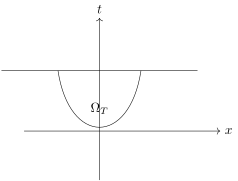
For the indicated domain Ω\Omega (interior of the parabola) let ΩT\Omega_T denote the points (x,t)(x,t) with x∈Ωx \in \Omega and t<Tt < T. Let B1B_1 denote the open line-segment forming the top of ∂ΩT\partial \Omega_T, and let B2=∂ΩT∖B1B_2 = \partial \Omega_T \setminus B_1. Let u(x,t)∈C0(ΩT‾)u(x,t) \in C^0(\overline{\Omega_T}) with uxx,ut∈C0(ΩT∪B1)u_{xx}, u_t \in C^0(\Omega_T \cup B_1) be a solution of

uxx−ut+a(x,t)u=f(x,t) u_{xx} - u_t + a(x,t) u = f(x,t)

with a,f∈C0(Ω‾)a, f \in C^0(\overline{\Omega }). Show that if a<0a < 0, f≤0f \leq 0 in ΩT\Omega_T, then every non-constant solution uu assumes its negative minimum (if one exists) on B2B_2. What can you say if a<0a < 0, f≥0f \geq 0 in ΩT\Omega_T?

?
Problem 6.3.6

Consider the boundary-value problem

u_xx + u_t = 0 (0 x and t > 0), B.C. u(0,t) = 0, u_x(,t) = 0, I.C. u(x,0) = f(x).

Use the sequence {fn(x)=2n+1sin⁡(n+12x)}\left\{ f_n(x) = \dfrac {2}{n+1} \sin \left(\dfrac {n+1}{2}x\right)\right\} and an appropriate space of continuous functions to decide whether this problem is well-posed.

?
Problem 6.3.7

In Probability Theory one encounters the Ornstein-Uhlenbeck process, in which the particles of Brownian motion are subjected to an elastic force. One is required to solve

u_t = u_xx - xu_x (x R, t > 0) u(x,0) = u_0(x).

Assume u0∈Su_0 \in S and find uu. (You should be able to find uu explicitly; if not, leave your result in the form of a one-dimensional integral.)

?
Problem 6.3.8

Let LL be the usual heat operator

L=∂∂t−(∂2∂x12+⋯+∂2∂xn2), L = \frac{\partial }{\partial t} - \left(\frac{\partial ^2}{\partial x_1^2} + \cdots + \frac{\partial ^2}{\partial x_n^2}\right),

let ϕ∈D(Rn)\phi \in D(\mathbb {R}^{n}), and let hh be a fixed point of Rn\mathbb {R}^{n}. Consider the problem

(Lu)(x,t) = u(x-h,t), x R^n, t > 0, u(x,0) = (x), x R^n

for an unknown function u(x,t)u(x,t).

?
(a)

Derive an explicit representation for a solution u(x,t)u(x,t) of the above problem in terms of the initial data. (You should prove that your uu is well-defined, but you need not prove that it represents a smooth solution.)

(b)

Assume that ϕ\phi is the Fourier transform of a function which vanishes in the ball of radius R≥0R \geq 0 centered at the origin. Show then that the solution uu satisfies

∥u(⋅,t)∥L2(Rn)≤e(1−R2)t∥ϕ∥L2(Rn). \left\| u(\cdot ,t)\right\| _{L^2(\mathbb {R}^{n})} \leq e^{(1-R^2)t} \left\| \phi \right\| _{L^2(\mathbb {R}^{n})}.
Problem 6.3.9

Let Ω⊂Rn\Omega \subset \mathbb {R}^{n} be a bounded domain and assume u(x,t)≥0u(x,t) \geq 0 is a function with u∈C2(Ω‾×[0,∞))u \in C^2(\overline{\Omega } \times [0,\infty )), which solves the equation

ut−Δu=−u4 u_t - \Delta u = -u^4

(heat conduction with heat loss due to radiation) with the boundary condition u∣∂Ω=0u|_{\partial \Omega } = 0. Prove that we can find a constant CC such that

E(1)=∫Ωu2(x,1) dx≤C E(1) = \int _{\Omega } u^2(x,1)\, dx \leq C

regardless of the initial value u(x,0)u(x,0).

?
Problem 6.3.10

Let

u∈C2(B(0,r)×(0,T])∩C(B(0,r)‾×[0,T]) u \in C^2(B(0,r) \times (0,T]) \cap C(\overline{B(0,r)} \times [0,T])

satisfy

{ut+u3+sin⁡(u)=Δxu,B(0,r)×(0,T],u=h,∂B(0,r)×(0,T],u=g,B(0,r)‾×{0} \begin{cases} u_t + u^3 + \sin (u) = \Delta _x u, & B(0,r) \times (0,T], \\ u = h, & \partial B(0,r) \times (0,T], \\ u = g, & \overline{B(0,r)} \times \left\{ 0\right\} \end{cases}

with g,hg,h continuous and g,h<1g,h < 1. Prove that max⁡u<1\max u < 1 on B(0,r)‾×[0,T]\overline{B(0,r)} \times [0,T].

?
Problem 6.3.11

Let u∈C2(Ω×(0,T))∩C0(Ω‾×[0,T])u \in C^2(\Omega \times (0,T)) \cap C^0(\overline{\Omega } \times [0,T]) be a solution to the problem

{ut=Δu−u3x∈Ω,t>0,u=0x∈∂Ω,t>0,u(x,0)=f(x)x∈Ω, \begin{cases} u_t = \Delta u - u^3 & x \in \Omega , t > 0, \\ u = 0 & x \in \partial \Omega , t > 0, \\ u(x,0) = f(x) & x \in \Omega , \end{cases}

where Ω\Omega is a smooth bounded domain in Rn\mathbb {R}^{n}.

?
(a)

Prove that

∥u∥L2(Ω)(t)≤∥f∥L2(Ω)for all t∈(0,T]. \left\| u\right\| _{L^2(\Omega )}(t) \leq \left\| f\right\| _{L^2(\Omega )} \quad \text{for all } t \in (0,T].
(b)

Prove that

∥u∥L∞(Ω)(t)≤∥f∥L∞(Ω)for all t∈(0,T]. \left\| u\right\| _{L^{\infty }(\Omega )}(t) \leq \left\| f\right\| _{L^{\infty }(\Omega )} \quad \text{for all } t \in (0,T].
(c)

Prove that the solution to this boundary value problem is unique.

(d)

Show that for f∈L4(Ω)∩H1(Ω)f \in L^4(\Omega ) \cap H^1(\Omega ), the following bound also holds:

∥u∥L4(Ω)4(t)+∥u∥H1(Ω)2(t)≤∥f∥L4(Ω)4+∥f∥H1(Ω)2. \left\| u\right\| _{L^4(\Omega )}^4(t) + \left\| u\right\| _{H^1(\Omega )}^2(t) \leq \left\| f\right\| _{L^4(\Omega )}^4 + \left\| f\right\| _{H^1(\Omega )}^2.
Problem 6.3.12

For each p∈Rnp \in \mathbb {R}^{n}, let A(p)A(p) be a real positive definite n×nn \times n matrix with entries aij(p)a_{ij}(p). Assume A∈C1(Rn)A \in C^1(\mathbb {R}^{n}). Let Ω⊂Rn\Omega \subset \mathbb {R}^{n} be a bounded open set. Prove (from first principles) the following comparison principle:

Let uu and vv be C2C^2 solutions to the inequalities

ut≤aij(∇u)uxixjfor (x,t)∈Ω×(0,∞) u_t \leq a_{ij}(\nabla u) u_{x_ix_j} \quad \text{for } (x,t) \in \Omega \times (0,\infty )

and

vt≥aij(∇v)vxixjfor (x,t)∈Ω×(0,∞), v_t \geq a_{ij}(\nabla v) v_{x_ix_j} \quad \text{for } (x,t) \in \Omega \times (0,\infty ),

respectively. Suppose, furthermore, that uu and vv are continuous on Ω‾×[0,∞)\overline{\Omega } \times [0,\infty ) and satisfy the condition u≤vu \leq v on the parabolic boundary

(Ω×{0})∪(∂Ω×[0,∞)). (\Omega \times \left\{ 0\right\} ) \cup (\partial \Omega \times [0,\infty )).

Then u≤vu \leq v on Ω‾×[0,∞)\overline{\Omega } \times [0,\infty ).

?
Problem 6.3.13

For Ω⊂Rn\Omega \subset \mathbb {R}^{n} bounded and open, let u∈C2(Ω‾×[0,∞))u \in C^2(\overline{\Omega } \times [0,\infty )). Assume aij(x,t,z,p)a_{ij}(x,t,z,p) and bi(x,t,z)b_i(x,t,z) are continuous functions of their arguments and assume that

∑i,j=1naij(x,t,z,p)ξiξj≥λ(x,t,z,p)∣ξ∣2>0for every ξ∈Rn−{0}, \sum _{i,j=1}^n a_{ij}(x,t,z,p) \xi _i \xi _j \geq \lambda (x,t,z,p) \left|\xi \right|^2 > 0 \quad \text{for every } \xi \in \mathbb {R}^{n} - \left\{ 0\right\} ,

where λ\lambda is a positive function. Suppose uu satisfies the inequality

ut−∑i,j=1naij(x,t,u,∇u)uxixj−∑i=1nbi(x,t,u)uxi≥0for x∈Ω,t>0. u_t - \sum _{i,j=1}^n a_{ij}(x,t,u,\nabla u) u_{x_ix_j} - \sum _{i=1}^n b_i(x,t,u) u_{x_i} \geq 0 \quad \text{for } x \in \Omega , t > 0.

Prove that for any T>0T > 0

min⁡Ω‾×[0,T]u(x,t)=min⁡Qu(x,t) \min _{\overline{\Omega } \times [0,T]} u(x,t) = \min _Q u(x,t)

where Q=(Ω×{0})∪(∂Ω×[0,T])Q = (\Omega \times \left\{ 0\right\} ) \cup (\partial \Omega \times [0,T]).

?
Problem 6.3.14

Let Ω\Omega be a bounded open set of Rn\mathbb {R}^{n} with smooth boundary ∂Ω\partial \Omega. Let u∈C2(Ω×(0,∞))u \in C^2(\Omega \times (0,\infty )), with uu continuous on Ω×[0,∞)\Omega \times [0,\infty ), be a solution of the initial-boundary problem

u_t - u = (u) for x , t > 0 u(x,t) = 0 for x u(x,0) = f(x) for x .

Show that if f(x)≤1f(x) \leq 1, then u(x,t)≤etu(x,t) \leq e^t for all x∈Ω,t>0x \in \Omega , t > 0.

?
Problem 6.3.15

Consider the Cauchy problem for Burger's equation:

u_t - u_xx + uu_x = 0, R (0,), u(x,0) = g(x)

where g∈L∞∩L1(−∞,∞)g \in L^{\infty } \cap L^1(-\infty ,\infty ). Derive the explicit formula of the solution for the Cauchy problem.

?
Problem 6.3.16

Consider the rectangle Q=[0,a]×[0,b]⊂R2Q = [0,a] \times [0,b] \subset \mathbb {R}^{2}.

?
(a)

By separation of variables, compute the first eigenvalue λ1\lambda_1 and the first eigenfunction ϕ1\phi_1 of the Laplacian operator −Δ-\Delta on QQ:

Δu+λu=0, on Q,u=0 on ∂Q. \Delta u + \lambda u = 0, \text{ on } Q, \quad u = 0 \text{ on } \partial Q.
(b)

Let gg be a smooth function that vanishes on the boundary ∂Q\partial Q. Assuming that κ<λ1\kappa < \lambda_1, prove that the solution of the parabolic problem

u_t = u + u t > 0, x Q u(0,x) = g(x), x Q u(t,x) = 0, x Q

converges to zero uniformly on QQ, as t→∞t \to \infty.

Problem 6.4.1

Assume that gg is smooth and in L1(Rn)L^1(\mathbb {R}^{n}), nn arbitrary. Let u^(ξ,t)\hat{u}(\xi ,t) be the Fourier transform (with respect to xx) of the solution to the nn-dimensional wave equation:

u_tt - c^2 u = 0, u(x,0) = 0, u_t(x,0) = g(x).

Show that the LpL^p norm of u(⋅,t)u(\cdot ,t) at time tt for p>np > n is bounded by a constant times t1−n/pt^{1-n/p}.

?
Problem 6.4.2

Consider the Cauchy problem for the wave equation

u_tt - u = 0, u = u(x,t), x R^n, t > 0 u(x,0) = u_0(x), u_t(x,0) = u_1(x).

Assume u0,u1∈Su_0, u_1 \in S.

?
(a)

Use the Fourier-transform to show that the total energy at time tt

E(t)=12∫Rnut2(x,t)+∣∇xu(x,t)∣2 dx E(t) = \frac{1}{2} \int _{\mathbb {R}^{n}} u_t^2(x,t) + \left|\nabla _x u(x,t)\right|^2\, dx

is constant in time.

(b)

Let E0E_0 denote the constant energy in (a), i.e., E(t)≡E0E(t) \equiv E_0. Show that

lim⁡t→∞∫Rnut2(x,t) dx=lim⁡t→∞∫Rn∣∇xu(x,t)∣2 dx=E0. \lim _{t \to \infty } \int _{\mathbb {R}^{n}} u_t^2(x,t)\, dx = \lim _{t \to \infty } \int _{\mathbb {R}^{n}} \left|\nabla _x u(x,t)\right|^2\, dx = E_0.
Problem 6.4.3

Consider the initial problem for the wave equation in three space variables:

u_x_1x_1 + u_x_2x_2 + u_x_3x_3 - u_tt = 0; x R^3, t > 0, u(x,0) = (x); x R^3, u_t(x,0) = (x); x R^3.

?
(a)

Write down the formula for the solution of the problem.

(b)

If ϕ\phi and ψ\psi vanish outside a ball of radius 3 centered at the origin, find the set of points in R3\mathbb {R}^{3} where you are sure that uu vanishes when t=10t = 10.

(c)

If ϕ\phi vanishes everywhere in R3\mathbb {R}^{3}, and

ψ(x)={0,∣x∣<1,k,1≤∣x∣≤2,0,2<∣x∣, \psi (x) = \begin{cases} 0, & \left|x\right| < 1, \\ k, & 1 \leq \left|x\right| \leq 2, \\ 0, & 2 < \left|x\right|, \end{cases}

where kk is a constant, find u(0,t)u(0,t) for all t≥0t \geq 0. (Your answer should be explicit, no integrals.)

Problem 6.4.4

Let Ω\Omega be the upper-half space in Rn\mathbb {R}^{n}

Ω={(x1,x2,x3)∈R3;x3>0}. \Omega = \left\{ (x_1,x_2,x_3) \in \mathbb {R}^{3}; x_3 > 0\right\} .

Consider the initial-boundary value problem

      • = 0; x , t > 0, u(x,0) = (x), u_t(x,0) = (x); x , u(x,t) = 0, x , t 0.
?
(a)

Write down a formula for the value u(x,t)u(x,t) of the solution at (x,t)(x,t), x∈Ωx \in \Omega, when

t<x3. t < x_3.
(b)

Find a formula for the value u(x,t)u(x,t) of the solution at (x,t)(x,t), x∈Ωx \in \Omega for all t>0t > 0.

Problem 6.4.5

Let u(x,t)u(x,t) be a solution of class C2C^2 to the Cauchy problem

u_tt = u (x R^n, t > 0), u(x,0) = (x), u_t(x,0) = (x); , C^,

with compact support. Define the local energy by

ER(u(t))=12∫∣x∣<R(ut2+∣∇u∣2) dx. E_R(u(t)) = \frac{1}{2} \int _{\left|x\right|<R} (u_t^2 + \left|\nabla u\right|^2)\, dx.
?
(a)

Use the energy identity to show that

ER−T(u(0))≤ER(u(t))≤ER+T(u(0)). E_{R-T}(u(0)) \leq E_R(u(t)) \leq E_{R+T}(u(0)).

Conclude that the total energy E∞(u(t))E_{\infty }(u(t)) is conserved.

(b)

When n=3n = 3, evaluate lim⁡t→∞ER(u(t))\lim_{t \to \infty } E_R(u(t)).

(c)

Do (b) above when n=1n = 1.

(d)

Let n=2n = 2, ϕ≡0\phi \equiv 0 and suppose that ψ≡0\psi \equiv 0 for ∣x∣≥k\left|x\right| \geq k, where x=(x1,x2)x = (x_1,x_2). Show that uu satisfies

∣u(x,t)∣≤c(t−r+2k)−1/2(t+r+2k)−1/2∫∣x∣≤k∣ψ(x)∣ dx \left|u(x,t)\right| \leq c(t-r+2k)^{-1/2}(t+r+2k)^{-1/2} \int _{\left|x\right| \leq k} \left|\psi (x)\right|\, dx

for some constant cc, on the set r<t−4kr < t - 4k. (Here r=∣x∣r = \left|x\right|.)

Problem 6.4.6

Let Ω⊂Rn\Omega \subset \mathbb {R}^{n} be a bounded domain and assume u(x,t)u(x,t) is a function with u∈C2(Ω‾×[0,∞))u \in C^2(\overline{\Omega } \times [0,\infty )), which solves the equation

utt−Δu=u u_{tt} - \Delta u = u

with the boundary condition u∣∂Ω=0u|_{\partial \Omega } = 0. With

E(t)=12∫Ωut2(x,t)+∣∇xu(x,t)∣2 dx E(t) = \frac{1}{2} \int _{\Omega } u_t^2(x,t) + \left|\nabla _x u(x,t)\right|^2\, dx

prove that there is a C<∞C < \infty such that

E(t)≤exp⁡(Ct)E(0) E(t) \leq \exp (Ct) E(0)

for all t≥0t \geq 0.

?
Problem 6.4.7
?
(a)

Find the explicit form of the solution of the initial value problem

^2 u = u_tt, x R^3, t > 0, u(x,0) = , x R^3, u_t(x,0) = -, x R^3,

where r2=x12+x22+x32r^2 = x_1^2 + x_2^2 + x_3^2, and f(η)f(\eta ) is a C3C^3 function on the real line with compact support such that

f() = 0, 0, _0^ (f')^2 + (f' - f)^2 d= 1,

where f′(η)f'(\eta ) is the derivative of ff with respect to η\eta.

(b)

What is its energy at time t=10t = 10.

Problem 6.4.8

Consider the wave equation in R3\mathbb {R}^{3}:

u_tt - u = 0 for x R^3, t > 0, u(x,0) = 0, u_t(x,0) = g(x),

where g∈C0∞(R3)g \in C_0^{\infty }(\mathbb {R}^{3}). Prove that there exists a constant CC depending only on the given data such that

sup⁡x∈R3∣u(x,t)∣≤Ct,t>0. \sup _{x \in \mathbb {R}^{3}} \left|u(x,t)\right| \leq \frac{C}{t}, \quad t > 0.
?
Problem 6.4.9

Let u∈C2(Rn+1(x,t))u \in C^2(\mathbb {R}^{n+1}(x,t)) be a solution of the equation utt−Δu=0u_{tt} - \Delta u = 0. Suppose also that u=ut=0u = u_t = 0 on the ball B={(x,0):∣x∣≤t0}B = \left\{ (x,0) : \left|x\right| \leq t_0\right\} in the plane t=0t = 0. Prove that uu vanishes in the conical region

D={(x,t):0≤t≤t0 and ∣x∣≤t0−t}. D = \left\{ (x,t) : 0 \leq t \leq t_0 \text{ and } \left|x\right| \leq t_0 - t\right\} .
?
Problem 6.4.10

Let u(x,t)u(x,t) be a solution of the Cauchy problem

u_tt = u (x R^3, t > 0), u(x,0) = f(x), u_t(x,0) = g(x).

Assume that f,g∈C0∞(R3)f, g \in C_0^{\infty }(\mathbb {R}^{3}).

Prove that if

lim⁡t→∞∫R3u2 dx=0, \lim _{t \to \infty } \int _{\mathbb {R}^{3}} u^2\, dx = 0,

then

∫R3g dx=0. \int _{\mathbb {R}^{3}} g\, dx = 0.
?
Problem 6.4.11

Consider the solution of the wave equation

utt=Δu(x∈R3,t>0) u_{tt} = \Delta u \quad (x \in \mathbb {R}^{3}, t > 0)

with data u(x,0)=0u(x,0) = 0, ut(x,0)=ψ(x)∈C0∞u_t(x,0) = \psi (x) \in C_0^{\infty }.

?
(a)

Use Fourier transform to show that there is a positive constant cc such that

lim⁡t→∞∫u2 dx=c. \lim _{t \to \infty } \int u^2\, dx = c.
(b)

Show that there is a positive constant C1C_1 such that

t⋅max⁡x∣u∣≥C1 t \cdot \max _x \left|u\right| \geq C_1

for all sufficiently large tt.

Problem 6.4.12

Consider the Cauchy problem for the wave equation

u_tt - u = 0 (x R^n, t > 0), u(x,0) = (x), u_t(x,0) = (x).

?
(a)

Let n=3n = 3; ϕ,ψ∈C0∞(R3)\phi , \psi \in C_0^{\infty }(\mathbb {R}^{3}). Let θ<1\theta < 1. Determine the large time behavior of the integral

∫∣x∣≤θtu4(x,t) dx. \int _{\left|x\right| \leq \theta t} u^4(x,t)\, dx.
(b)

Let n=2n = 2, ϕ≡0\phi \equiv 0, ψ∈C0∞(R2)\psi \in C_0^{\infty }(\mathbb {R}^{2}). Show that for any θ<1\theta < 1, we have

sup⁡∣x∣≤θt∣u(x,t)∣=O(t−1)as t→∞. \sup _{\left|x\right| \leq \theta t} \left|u(x,t)\right| = O(t^{-1}) \quad \text{as } t \to \infty .
Problem 6.4.13

The linear transport equation is following PDE for a scalar function ff of seven variables x,v,tx, v, t (x∈R3x \in \mathbb {R}^{3}, v∈R3v \in \mathbb {R}^{3}, t∈R+1t \in \mathbb {R}^{1}_+):

ft+v⋅∇xf=0. f_t + v \cdot \nabla _x f = 0.

Consider the initial-value problem for this; i.e., let

f(x,v,0)=f∘(x,v);f∘ given,f∘∈C1. f(x,v,0) = \overset {\circ }{f}(x,v); \quad \overset {\circ }{f} \text{ given}, \overset {\circ }{f} \in C^1.
?
(a)

Show that, if f∘≥0\overset {\circ }{f} \geq 0 for all x,vx, v, then the same is true for ff at all later times.

(b)

Define the local density ρ\rho by

ρ(x,t)=∫R3f(x,v,t) dv. \rho (x,t) = \int _{\mathbb {R}^{3}} f(x,v,t)\, dv.

Suppose that 0≤f∘(x,v)≤h(x)0 \leq \overset {\circ }{f}(x,v) \leq h(x), where h∈L1(R3)h \in L^1(\mathbb {R}^{3}). Show that

sup⁡xρ=O(t−3)as t→∞. \sup _x \rho = O(t^{-3}) \quad \text{as } t \to \infty .
Problem 6.4.14

Solve the Cauchy problem

xu_x + yuu_y = -xy (x > 0) u = 5 on xy = 1,

if a solution exists.

?
Problem 6.4.15

Compute an explicit solution u(x,t)u(x,t) to the initial-value problem

u_t + (u_x)^2 = 0, u(x,0) = x^2.

?
Problem 6.4.16

Solve the following initial value problem.

u_t + uu_x = 0, x R, t > 0, u(x,0) = 1, x < 0, 1-x, 0 x 1, 0, x > 1.

Show that the continuous solution exists only for a finite time, and find the discontinuous entropy solution, giving explicitly the discontinuity curve and the Rankine-Hugoniot jump condition along it.

?
Problem 6.4.17
?
(a)

Let u(x,t)u(x,t) be a smooth solution of

∂u∂t+a(x,u)∂u∂x−bu=0for 0<t<T, \frac{\partial u}{\partial t} + a(x,u) \frac{\partial u}{\partial x} - bu = 0 \quad \text{for } 0 < t < T,

where bb is a constant and aa is smooth. Show that if

α≤u(x,0)≤βfor all x, \alpha \leq u(x,0) \leq \beta \quad \text{for all } x,

then

αebt≤u(x,t)≤βebt \alpha e^{bt} \leq u(x,t) \leq \beta e^{bt}

for all xx and all t∈(0,T)t \in (0,T).

(b)

Let u(x,t)u(x,t) be smooth solution of

  • a(u) = 0 for 0 < t < T, u(x,0) = u_0(x),

where u0u_0 and aa are smooth. Show that, if x(t,y)x(t,y) is the characteristic through (y,0)(y,0), then

ux(x(t,y),t)=ux(y,0)(ddxa(u0(x))∣x=y)t+1. u_x(x(t,y),t) = \frac{u_x(y,0)}{\left(\dfrac {d}{dx} a(u_0(x))\Big|_{x=y}\right) t + 1}.
  1. Use this to compute the largest TT for which a smooth solution can exist up to time TT.

  2. Show that, if 0≤t1<t2<T0 \leq t_1 < t_2 < T, then

    ∫−∞∞∣ux(x,t2)∣ dx=∫−∞∞∣ux(x,t1)∣ dx. \int _{-\infty }^{\infty } \left|u_x(x,t_2)\right|\, dx = \int _{-\infty }^{\infty } \left|u_x(x,t_1)\right|\, dx.
Problem 6.4.18

(Uniqueness of weak solutions) Consider the Cauchy problem

{ut+ux=0,on R×[0,T],u(x,0)=u0(x),on R×{0}.(2) \begin{cases} u_t + u_x = 0, & \text{on } \mathbb {R} \times [0,T], \\ u(x,0) = u_0(x), & \text{on } \mathbb {R} \times \left\{ 0\right\} . \end{cases} \tag {2}

A function u∈Lp(R×[0,T])u \in L^p(\mathbb {R} \times [0,T]) is defined to be a weak solution of (2) iff

∫0T∫−∞+∞u(y,s)(−ϕt(y,s)−ϕx(y,s)) dy ds+∫−∞∞u0(y)ϕ(y,0) dy=0 \begin{align} & \int _0^T \int _{-\infty }^{+\infty } u(y,s)(-\phi _t(y,s) - \phi _x(y,s))\, dy\, ds \\ & \quad + \int _{-\infty }^{\infty } u_0(y) \phi (y,0)\, dy = 0 \tag {2’} \end{align}

for all test functions ϕ(x,t)∈C∞(R×[0,T])\phi (x,t) \in C^{\infty }(\mathbb {R} \times [0,T]) which are compactly supported and vanish on {t=T}\left\{ t=T\right\}.

If u0(x)≡0u_0(x) \equiv 0, prove that the only LpL^p solution of (2') is u≡0u \equiv 0.

?
Problem 6.4.19

Consider the Cauchy problem for a function u=u(x,t)u = u(x,t), where x∈Rx \in \mathbb {R} and t>0t > 0.

{ut+a(x,t)ux=b(x,t),u(x,0)=u0(x)∈C(R). \begin{cases} u_t + a(x,t) u_x = b(x,t), \\ u(x,0) = u_0(x) \in C(\mathbb {R}). \end{cases}
?
(a)

Show that if b≡0b \equiv 0, then TV(u(⋅,t))≤TV(u0(⋅))TV(u(\cdot ,t)) \leq TV(u_0(\cdot )) for each t>0t > 0 (where TV=TV = ``total variation'').

(b)

Show that when b≢0b \not\equiv 0, one still has the bound

TV(u(⋅,t))≤TV(u0)+∫0tTV(b(⋅,s)) ds. TV(u(\cdot ,t)) \leq TV(u_0) + \int _0^t TV(b(\cdot ,s))\, ds.
Problem 6.4.20

Suppose that u(x,t)u(x,t) is a smooth solution of

u_t + uu_x = 0 for x R, t > 0 u(x,0) = f(x) for x R.

Assume that ff is a C1C^1 function such that

f(x)={0,for x<01,for x>1 f(x) = \begin{cases} 0, & \text{for } x < 0 \\ 1, & \text{for } x > 1 \end{cases}

and f′(x)>0f'(x) > 0, for ∣x∣<1\left|x\right| < 1. Show that for t>0t > 0

lim⁡r→∞u(rx,rt)={0for x<0x/t,for 0<x<t1for x>t. \lim _{r \to \infty } u(rx,rt) = \begin{cases} 0 & \text{for } x < 0 \\ x/t, & \text{for } 0 < x < t \\ 1 & \text{for } x > t. \end{cases}
?
Problem 6.4.21

Consider the Cauchy problem for conservation law

ut+(u22)x=0,u(0,x)=g(x), u_t + \left(\frac{u^2}{2}\right)_x = 0, \quad u(0,x) = g(x),

where gg is a (nontrivial) smooth function with bounded support.

?
(a)

Prove that the solution develops a shock in finite time.

(b)

At a fixed time tt, let x(t)x(t) be the position of a shock and let u−,u+u^-, u^+ be the left and right states across the shock. Using the divergence theorem on a suitable triangle with vertex at (t,x(t))(t,x(t)), prove the identity

∫x(t)−tu−x(t)−tu+g(x) dx=t((u−)22−(u+)22). \int _{x(t)-tu^-}^{x(t)-tu^+} g(x)\, dx = t\left(\frac{(u^-)^2}{2} - \frac{(u^+)^2}{2}\right).
Problem 6.4.22

Consider the first order system of equations

ut+∑j=1nAjuxj=0, u_t + \sum _{j=1}^n A_j u_{x_j} = 0,

where u(x,t)=(u1(x,t),…,um(x,t))u(x,t) = (u_1(x,t),\ldots ,u_m(x,t)), (x,t)∈Rn×R(x,t) \in \mathbb {R}^{n} \times \mathbb {R}, and the AjA_j's are symmetric m×mm \times m matrices with constant real entries. Use an energy argument to show that the domain of dependence of (x0,t0)(x^0,t^0), t0>0t^0 > 0, for a solution of the system is contained in the cone

{∣x−x0∣≤Λ(t0−t)} \left\{ \left|x-x^0\right| \leq \Lambda (t^0-t)\right\}

where Λ=max⁡∣ξ∣=1,1≤l≤m∣λl(ξ)∣\Lambda = \max_{\left|\xi \right|=1, 1 \leq l \leq m} \left|\lambda_l(\xi )\right|, and λl(ξ)\lambda_l(\xi ), l=1,…,ml=1,\ldots ,m, are the eigenvalues of the matrix A(ξ)=∑j=1nξjAjA(\xi ) = \sum_{j=1}^n \xi_j A_j.

?