Inner Product Spaces
[22/14%]Let denote the vector space of bounded continuous functions from to . Let be a list of the rational numbers. For , define
Show that is an inner product on .
Prove that if is a measure and , then
Suppose and are elements of an inner product space and
Prove that if , then and are orthogonal.
Give an example to show that if , then and can satisfy the equation above without being orthogonal.
Find such that is a scalar multiple of is orthogonal to , and .
Prove that
for all positive numbers , with equality if and only if .
Prove that the square of the average of each finite list of real numbers containing at least two distinct real numbers is less than the average of the squares of the numbers in that list.
Suppose and are elements of an inner product space and and . Prove that
Suppose and are nonzero elements of . Prove that
where is the angle between and (thinking of as the vector whose initial point is the origin and whose end point is , and similarly for ).
The angle between two vectors (thought of as arrows with initial point at the origin) in or can be defined geometrically. However, geometry is not as clear in for . Thus the angle between two nonzero vectors is defined to be
where the motivation for this definition comes from the previous exercise. Explain why the Cauchy-Schwarz inequality is needed to show that this definition makes sense.
Suppose and are elements of a real inner product space. Prove that and have the same norm if and only if is orthogonal to .
Use part (a) to show that the diagonals of a parallelogram are perpendicular to each other if and only if the parallelogram is a rhombus.
Suppose and are elements of an inner product space. Prove that if and only if for all .
Suppose and are elements of an inner product space and and . Prove that .
Suppose and are elements of a real inner product space. Prove that
Suppose and are elements of a complex inner product space. Prove that
Suppose are elements of an inner product space. Prove that
Prove that a norm satisfying the parallelogram equality comes from an inner product. In other words, show that if is a normed vector space whose norm satisfies the parallelogram equality, then there is an inner product on such that for all .
Let denote Lebesgue measure on .
Prove that if is Borel measurable, then
Describe the set of Borel measurable functions such that the inequality in part (a) is an equality.
Suppose is a measure. For , define by
Using the inequality
verify that the integral above makes sense and the map sending to defines an inner product on (without using Hölder's inequality).
Show that the Cauchy-Schwarz inequality implies that
for all (again, without using Hölder's inequality).
Suppose are inner product spaces. Show that the equation
defines an inner product on .
Each of the inner product spaces may have a different inner product, even though the same inner product notation is used on all these spaces.
Suppose is an inner product space. Make an inner product space as in the exercise above. Prove that the function that takes an ordered pair to the inner product is a continuous function from to .
Suppose .
Show the norm on comes from an inner product if and only if .
Show the norm on comes from an inner product if and only if .
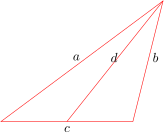
Use inner products to prove Apollonius's identity: In a triangle with sides of length , and , let be the length of the line segment from the midpoint of the side of length to the opposite vertex. Then