Hilbert Spaces
[73/26%]Let denote the vector space of bounded continuous functions from to . Let be a list of the rational numbers. For , define
Show that is an inner product on .
Prove that if is a measure and , then
Suppose and are elements of an inner product space and
Prove that if , then and are orthogonal.
Give an example to show that if , then and can satisfy the equation above without being orthogonal.
Find such that is a scalar multiple of is orthogonal to , and .
Prove that
for all positive numbers , with equality if and only if .
Prove that the square of the average of each finite list of real numbers containing at least two distinct real numbers is less than the average of the squares of the numbers in that list.
Suppose and are elements of an inner product space and and . Prove that
Suppose and are nonzero elements of . Prove that
where is the angle between and (thinking of as the vector whose initial point is the origin and whose end point is , and similarly for ).
The angle between two vectors (thought of as arrows with initial point at the origin) in or can be defined geometrically. However, geometry is not as clear in for . Thus the angle between two nonzero vectors is defined to be
where the motivation for this definition comes from the previous exercise. Explain why the Cauchy-Schwarz inequality is needed to show that this definition makes sense.
Suppose and are elements of a real inner product space. Prove that and have the same norm if and only if is orthogonal to .
Use part (a) to show that the diagonals of a parallelogram are perpendicular to each other if and only if the parallelogram is a rhombus.
Suppose and are elements of an inner product space. Prove that if and only if for all .
Suppose and are elements of an inner product space and and . Prove that .
Suppose and are elements of a real inner product space. Prove that
Suppose and are elements of a complex inner product space. Prove that
Suppose are elements of an inner product space. Prove that
Prove that a norm satisfying the parallelogram equality comes from an inner product. In other words, show that if is a normed vector space whose norm satisfies the parallelogram equality, then there is an inner product on such that for all .
Let denote Lebesgue measure on .
Prove that if is Borel measurable, then
Describe the set of Borel measurable functions such that the inequality in part (a) is an equality.
Suppose is a measure. For , define by
Using the inequality
verify that the integral above makes sense and the map sending to defines an inner product on (without using Hölder's inequality).
Show that the Cauchy-Schwarz inequality implies that
for all (again, without using Hölder's inequality).
Suppose are inner product spaces. Show that the equation
defines an inner product on .
Each of the inner product spaces may have a different inner product, even though the same inner product notation is used on all these spaces.
Suppose is an inner product space. Make an inner product space as in the exercise above. Prove that the function that takes an ordered pair to the inner product is a continuous function from to .
Suppose .
Show the norm on comes from an inner product if and only if .
Show the norm on comes from an inner product if and only if .
Use inner products to prove Apollonius's identity: In a triangle with sides of length , and , let be the length of the line segment from the midpoint of the side of length to the opposite vertex. Then
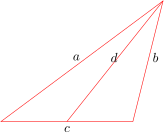
Show that each of the inner product spaces in Example 8.23 is not a Hilbert space.
Example 8.23:
-
The inner product space , where , is not a Hilbert space because the associated norm is not complete on .
-
The inner product space of continuous -valued functions on the interval , where , is not a Hilbert space because the associated norm is not complete on .
Prove or disprove: The inner product space in Exercise 1 in Section 8A is a Hilbert space.
Suppose are Hilbert spaces. Let
Show that the equation
defines an inner product on that makes a Hilbert space.
Each of the Hilbert spaces may have a different inner product, even though the same notation is used for the norm and inner product on all these Hilbert spaces.
Suppose is a real Hilbert space. The complexification of is the complex vector space defined by , but we write a typical element of as instead of . Addition and scalar multiplication are defined on by
and
for and . Show that
defines an inner product on that makes into a complex Hilbert space.
Prove that if is a normed vector space, , and , then the open ball centered at with radius is convex.
Suppose is an inner product space and is the open unit ball in (thus ). Prove that if is a subset of such that , then is convex.
Give an example to show that the result in part (a) can fail if the phrase inner product space is replaced by Banach space.
Suppose is a normed vector space and is a closed subset of . Prove that is convex if and only if
Prove that if is a convex subset of a normed vector space, then is also convex.
Prove that if is a convex subset of a normed vector space, then the interior of is also convex.
The interior of is the set .
Suppose is a Hilbert space, is a nonempty closed convex subset of , and is the unique element of with smallest norm (obtained by taking in 8.28). Prove that
for all .
Suppose is a Hilbert space. A closed half-space of is a set of the form
for some and some . Prove that every closed convex subset of is the intersection of all the closed half-spaces that contain it.
Give an example of a nonempty closed subset of the Hilbert space and such that there does not exist with .
By 8.28, U cannot be a convex subset of .
In the real Banach space with norm defined by , give an example of a closed convex set and such that there exist infinitely many choices of with .
Suppose and are elements of an inner product space. Prove that if and only if
for all .
Suppose is a closed subspace of a Hilbert space and . Prove that , with equality if and only if .
This exercise asks you to prove .
Suppose is a Hilbert space and is a linear map such that and for every . Prove that there exists a closed subspace of such that .
Suppose is a subspace of a Hilbert space . Suppose also that is a Banach space and is a bounded linear map. Prove that there exists a bounded linear map such that and .
If , then this result is just the Hahn-Banach Theorem (6.69) for Hilbert spaces. The result here is stronger because it allows to be an arbitrary Banach space instead of requiring to be . Also, the proof in this Hilbert space context does not require use of Zorn's Lemma or the Axiom of Choice.
Suppose and are subspaces of a Hilbert space . Prove that if and only if .
Suppose and are closed subspaces of a Hilbert space. Prove that if and only if for all and all .
Verify the assertions in Example 8.46.
Example 8.46: suppose is the closed subspace of defined by . Then . Furthermore, if , then and .
Show that every inner product space is a subspace of some Hilbert space.
Prove that if is a Hilbert space and is a bounded linear map such that the dimension of range is , then there exist such that
for all .
Give an example of a Banach space and a bounded linear functional on such that for all .
Show there does not exist an example in part (a) where is a Hilbert space.
Suppose and are bounded linear functionals on a Hilbert space such that . Prove that one of is a scalar multiple of the other.
Give an example to show that part (a) can fail if the hypothesis that is a Hilbert space is replaced by the hypothesis that is a Banach space.
Suppose that is a finite measure, , and is a bounded linear functional on . Prove that there exists such that for every .
Same as part (a), but with the hypothesis that is a finite measure replaced by the hypothesis that is a measure, and assume that .
See 7.25, which along with this exercise shows that we can identify the dual of with for . See 9.42 for an extension to all .
Prove that if is an infinite-dimensional Hilbert space, then the Banach space is nonseparable.
Verify that the family as defined in the third bullet point of Example 8.51 is an orthonormal family in . The following formulas should help:
Example 8.51 (third bullet point): for , define by
Suppose is a family in and for each . Prove the unordered sum converges if and only if
Furthermore, prove that if converges then it equals the supremum above.
Suppose is an orthonormal family in an inner product space . Prove that if , then is a countable set.
Suppose and are families in a normed vector space such that and converge. Prove that converges and
Suppose is a family in a normed vector space such that converges. Prove that if , then converges and
Suppose is a family in . Prove that the unordered sum converges if and only if .
Suppose is a family in a normed vector space and . Prove that the unordered sum equals if and only if the usual ordered sum equals for every injective and surjective function .
Explain why 8.58 implies that if is a finite set and is an orthonormal family in a Hilbert space , then is a closed subspace of .
Suppose is an infinite-dimensional Hilbert space. Prove that there does not exist a basis of that is an orthonormal family.
Show that the orthonormal family given in the first bullet point of Example 8.51 is an orthonormal basis of .
Show that the orthonormal family given in the second bullet point of Example 8.51 is an orthonormal basis of .
Show that the orthonormal family given in the fourth bullet point of Example 8.51 is not an orthonormal basis of .
Show that the orthonormal family given in the fifth bullet point of Example 8.51 is not an orthonormal basis of .
Example 8.51:
First bullet point: for , let be the sequence all of whose coordinates are except for the th coordinate, which is . Then is an orthonormal family in .
Second bullet point: for a nonempty set , with for counting measure on , define for by if and if . Then is an orthonormal family in .
Fourth bullet point: for a nonnegative integer, define (a Rademacher function) by if for some odd integer , and if is in such an interval for some even integer . Then is an orthonormal family in .
Fifth bullet point: for a nonnegative integer and , define by translating the function from the fourth bullet point by : if for some odd integer , if is in such a translated interval for some even integer , and if . Then is an orthonormal family in .
Suppose is a -finite measure on and is a -finite measure on . Suppose also that is an orthonormal basis of and is an orthonormal basis of for some countable set . For and , define by
Prove that is an orthonormal basis of .
Prove the converse of Parseval's identity. More specifically, prove that if is an orthonormal family in a Hilbert space and
for every , then is an orthonormal basis of .
Show that the Hilbert space is separable.
Show that the Hilbert space is separable.
Show that the Banach space is not separable.
Prove that every subspace of a separable normed vector space is separable.
Suppose is an infinite-dimensional Hilbert space. Prove that there does not exist a translation invariant measure on the Borel subsets of that assigns positive but finite measure to each open ball in .
A subset of is called a Borel set if it is in the smallest -algebra containing all the open subsets of . A measure on the Borel subsets of is called translation invariant if for every and every Borel set of .
Find the polynomial of degree at most that minimizes .
Prove that each orthonormal family in a Hilbert space can be extended to an orthonormal basis of the Hilbert space. Specifically, suppose is an orthonormal family in a Hilbert space . Prove that there exists a set containing and an orthonormal basis of such that for every .
Prove that every vector space has a basis.
Find the polynomial of degree at most 4 such that
for every polynomial of degree at most 4.
Suppose is a nonempty open subset of C. The Bergman space is defined to be the set of analytic functions such that
where is the usual Lebesgue measure on , which is identified with . For , define to be .
Show that is a Hilbert space.
Show that if , then is a bounded linear functional on .
Let denote the open unit disk in ; thus
Find an orthonormal basis of .
Suppose has Taylor series
for . Find a formula for in terms of .
Suppose . By the previous exercise and the Riesz Representation Theorem (8.47 and 8.76), there exists such that
Find an explicit formula for .
Suppose is the annulus defined by
Find an orthonormal basis of .
Suppose has Laurent series
for . Find a formula for in terms of .
Prove that if , then has a removable singularity at 0 (meaning that can be extended to a function that is analytic on ).
The Dirichlet space is defined to be the set of analytic functions such that
For , define to be .
Show that is a Hilbert space.
Show that if , then is a bounded linear functional on .
Find an orthonormal basis of .
Suppose has Taylor series
for . Find a formula for in terms of
Suppose . Find an explicit formula for such that
Prove that the Dirichlet space is contained in the Bergman space .
Prove that there exists a function such that is uniformly continuous on and .