Connected sums of surfaces
[14/100%]Show by induction that if are disjoint disks in the interior of a connected surface , and is another collection of disjoint disks in the interior of , then there is a homeomorphism which is the identity on sending to .
This is the ``disk lemma'': for disks in the interior of a connected surface (with boundary) , there is a homeomorphism , fixed on , with .
Construct a homeomorphism from onto which fixes pointwise .
Show that , where denotes boundary connected sum of surfaces with boundary (Exercise 2.5.1).
Show that .
Show that , where denotes boundary connected sum (Exercise 2.5.1) and is the closed disk.
Write as , where are rectangles joined along a segment in their boundaries, and use the idea of Exercise 2.5.2.
If is a surface without boundary, and denotes with disjoint disks removed from its interior, show that , where is the -sphere and denotes boundary connected sum (Exercise 2.5.1).
Consider first the case .
Show that , where is the -sphere.
Think about what is removed and what is filled in when we form the connected sum with . Alternatively, use Exercise 2.5.7 together with the fact that , where denote with one disk removed, is boundary connected sum, and the final -handle fills in the one remaining boundary circle.
If is the Klein bottle, use (where is the projective plane) to show that , where the subscript denotes removing one disk and is boundary connected sum (Exercise 2.5.1).
Show that , where is boundary connected sum and the subscript denotes removing one disk. Use this to show that the boundary connected sum of copies of is homeomorphic to the connected sum of copies of with one disk removed; that is, denoting the connected sum of copies of by , show that ( copies).
Then show that ( copies of ), where is the -sphere. (This space is denoted .)
Show that , where denotes boundary connected sum.
Show that .
Write the surfaces in Figure 2.71 as connected sums, or boundary connected sums, of other surfaces, none of which is a disk or a sphere. Indicate in the figure what the two pieces are and which of the standard surfaces (with boundary) each is homeomorphic to.
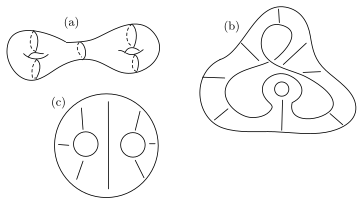 Connected sums.
In each of the surfaces with boundary in Figure 2.72, find an arc joining two points on the boundary so that if we cut the surface along the arc and open it up (equivalently, remove a neighborhood of the arc), we get two surfaces, neither of which is homeomorphic to a disk. Relate this to a boundary connected-sum decomposition.
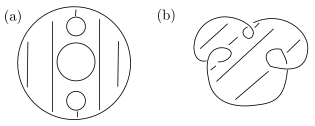 Separating arcs and boundary sums.
In each of the surfaces in Figure 2.73, find an embedded circle which separates the surface so that if we cut the surface along the circle (equivalently, remove a neighborhood of the circle), we get two surfaces, neither of which is homeomorphic to (a sphere with some disks removed). Relate this to a connected-sum decomposition.
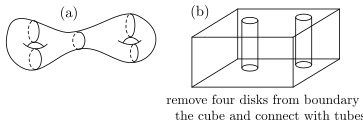 Separating circles and connected sums.
Identify the surface obtained by taking the connected sum of two disks. Identify the surface obtained by taking the boundary connected sum of two disks.