Classification theorem for closed surfaces
[25/100%]A closed surface is a compact, connected metrizable 2-manifold without boundary.
State the Classification Theorem for closed surfaces. Include a definition of ``connected sum''.
Three surfaces with boundary are shown below. If 2-disks are attached to each component of their boundaries, closed surfaces result. Identify these 3 closed surfaces among the model surfaces given in your statement of the Classification Theorem.

$$$$-0.5em] Three surfaces with boundary (PDF p.168)
Let be the Möbius band. Construct a model of (the connected sum of with the torus ) and show that it is homeomorphic to (the connected sum of with the Klein bottle ).
It will help if the cylinder used to form the connected sum is attached symmetrically, one-fourth and three-fourths of the way across the strip representing .
Here denotes the boundary connected sum of copies of the projective plane with one disk removed, and similarly for copies of the torus . Show that . Conclude from this that .
For each of the orientable surfaces (given by handle decompositions with a single -handle and disjoint -handles attached to its boundary) in Figure 2.46, use handle sliding to put it in standard form and identify the surface. Check your answer using the classification theorem (Theorem 2.6.2: a connected, orientable handlebody with - and -handles and Euler characteristic and boundary circles is homeomorphic to the standard model for or , where ).
 Surfaces for Exercise 2.6.3.
First find a torus pair (a pair of linked -handles which together create when attached to a disk) and slide the other handles off of it.
For each of the nonorientable surfaces in Figure 2.47, use handle sliding to put it in standard form and identify the surface. Check your answer using the classification theorem (Theorem 2.6.2: a connected, nonorientable handlebody with - and -handles and Euler characteristic and boundary circles is homeomorphic to the standard model for , where ).
 Surfaces for Exercise 2.6.4.
First find a twisted handle (a -handle attached to a single boundary circle in a way that creates a Möbius band from the disk) and slide the other handles off of it.
Consider the step in the proof of the classification theorem (Theorem 2.6.2) for the orientable case where a new torus pair (a pair of linked -handles) is created by adding a new -handle to a handlebody already in standard form , giving . Show that, if we regard the -handle together with this new torus pair as giving us the torus-with-one-hole , then we can remove this piece from the surface and replace it by a consistently oriented disk with the same boundary, to which the other handles (those of besides its -handle) are attached. Considering this disk as the new -handle and the other -handles as attached to its boundary, forming a handlebody , show that . Then use induction to show that when .
Consider the step in the proof of the classification theorem (Theorem 2.6.2) for the orientable case where a new -handle is attached to a single boundary circle of a handlebody (already in standard form) to form . Show that if is homeomorphic to , then we can add a -handle to so that . Thus, removing this -handle shows that .
Consider the step in the proof of the classification theorem (Theorem 2.6.2) for the nonorientable case where we attach a new -handle to form from a handlebody , which, by induction, may be assumed to be either or and already in standard form. Show that we can assume in either case that is attached away from the torus pairs or twisted handles of , so it may be regarded as attached to (the disk with trivial handles). In the case where is orientable, will necessarily be attached to so that is nonorientable. Show that this is not necessarily the case when is nonorientable.
Show that if a -handle is attached to a single boundary circle of as a twisted handle to form , then the union of the -handle and forms a Möbius band . Form a new handlebody by replacing by a disk with the same boundary and then attaching the other -handles (those of besides its -handle) to it. Show that and .
Show that if a -handle is attached to two boundary circles of in a twisted fashion to form , and we choose another -handle so that forms an annulus whose boundary consists of these two circles, then is a Klein bottle with a disk removed, . Form a new handlebody by removing and replacing it with a disk (the new -handle), then adding in all of the other handles of the original standard handle decomposition of . Show that and .
Deduce the general induction step for the nonorientable case of the classification theorem (Theorem 2.6.2) from the constructions of the last three exercises (2.6.7--2.6.9), considering separately:
the case where the handle is attached to in an orientable fashion;
the case where the handle is attached to in a nonorientable fashion.
Identify the surface depicted in Figure 2.57.
 Surface for Exercise 2.7.8.
First fill in the obvious holes. Then find a handle decomposition of what is left. Also, you might try breaking it into a connected sum of pieces that are easier to identify.
In this and the following problems, you are asked to identify surfaces; that is, tell which one of the standard model surfaces , , the given surface is homeomorphic to.
Which surface is the surface of a coffee cup (with a handle) homeomorphic to?
Identify the following surface. Take an empty box (with thickness) and poke a small hole in each of its six faces. The surface is the surface of the box after the holes are poked.
Identify the surfaces in Figure 2.69 (see Exercise 2.9.41).
 Finding a Möbius band.
Identify the surfaces in Figure 2.70 (see Exercise 2.9.43).
 Decompositions with a single 0-handle.
Identify the surfaces in Figure 2.71 (see Exercise 2.9.47).
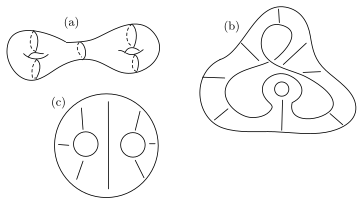 Connected sums.
Identify the surfaces in Figure 2.72 (see Exercise 2.9.48).
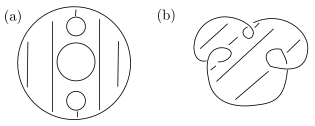 Separating arcs and boundary sums.
Identify the surfaces in Figure 2.73 (see Exercise 2.9.49).
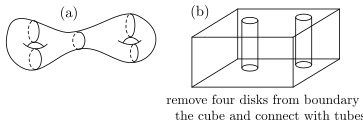 Separating circles and connected sums.
Identify the surface in Figure 2.78.
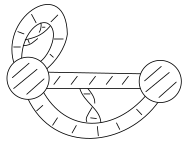 Surface for Exercise 2.9.70.
Identify the surface in Figure 2.79.
 Surface for Exercise 2.9.71.
Identify the surface in Figure 2.80.
 Surface for Exercise 2.9.72.
Show that the genus of is .
Suppose is a functor from topological spaces and continuous maps to finitely generated abelian groups and homomorphisms so that for compact connected surfaces (without boundary) , . For finitely generated abelian groups, it is true that is isomorphic to iff . Show that this implies that is the trivial group, where denotes the sphere. Show that if is not , where denotes the torus, then distinguishes , ; that is, is not isomorphic to , for , .
Compute for the surfaces in the figure below, and use your results and the number of boundary components, to classify the surfaces.
 Surfaces for Exercise 3.9.7.