Conjugacy of one-dimensional maps
[12/67%]Maps and ( being intervals on the line) are called topologically conjugate if there exists a continuous bijection (homeomorphism) such that (i.e., ). In this case we write and call the conjugating map. It is assumed that the maps are continuous, defined on intervals, and map them into themselves.
Prove that the relation of topological conjugacy is an equivalence relation, i.e.
;
if and only if ;
if , then .
Maps and ( being intervals on the line) are called topologically conjugate if there exists a continuous bijection (homeomorphism) such that (i.e., ). In this case we write and call the conjugating map. It is assumed that the maps are continuous, defined on intervals, and map them into themselves.
Prove that topologically conjugate maps simultaneously possess or fail to possess the following properties:
injectivity;
monotonicity of a definite type;
one-sided boundedness (without specifying its type);
boundedness.
Maps and ( being intervals on the line) are called topologically conjugate if there exists a continuous bijection (homeomorphism) such that (i.e., ). In this case we write and call the conjugating map. It is assumed that the maps are continuous, defined on intervals, and map them into themselves.
Prove that topologically conjugate maps have
the same number of intervals of monotonicity;
the same number of fixed points.
Maps and ( being intervals on the line) are called topologically conjugate if there exists a continuous bijection (homeomorphism) such that (i.e., ). In this case we write and call the conjugating map. It is assumed that the maps are continuous, defined on intervals, and map them into themselves.
Prove that if , then the intervals on which the inequality holds are carried by the conjugating map into intervals on which (depending on the character of the monotonicity of ) the same or the opposite strict inequality holds for the map . Prove that if the maps and are defined on and one of them is odd, then the conjugating bijection can be chosen to be increasing.
Maps and ( being intervals on the line) are called topologically conjugate if there exists a continuous bijection (homeomorphism) such that (i.e., ). In this case we write and call the conjugating map.
Determine whether the maps and defined on are topologically conjugate in the following cases:
,
, ;
, ;
, ;
, .
Maps and ( being intervals on the line) are called topologically conjugate if there exists a continuous bijection (homeomorphism) such that (i.e., ). In this case we write and call the conjugating map.
Let . For which and are the functions topologically conjugate
and ;
and ;
and ?
Maps and ( being intervals on the line) are called topologically conjugate if there exists a continuous bijection (homeomorphism) such that (i.e., ). In this case we write and call the conjugating map.
Let . Describe the set of pairs for which .
For which can one find such that the maps and are topologically conjugate? Describe the set of all numbers that arise in this way.
Prove that the maps and , are not topologically conjugate.
For which and which interval is the map , topologically conjugate to the map of the form ?
Maps and ( being intervals on the line) are called topologically conjugate if there exists a continuous bijection (homeomorphism) such that (i.e., ). In this case we write and call the conjugating map.
Prove the topological conjugacy of the continuous maps , given as follows:
;
is the ``sawtooth'' map taking values at the points , and linear on the intervals between them (Fig. 14), and is the -th Chebyshev polynomial, defined by the equality (see Problem I.2.20 and Fig. 15);
 Fig. 14
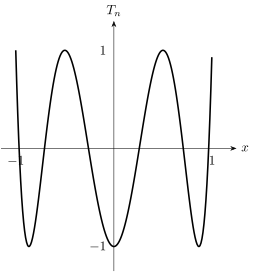 Fig. 15
prove that the functions from part a) are conjugate as maps from to .
Maps and ( being intervals on the line) are called topologically conjugate if there exists a continuous bijection (homeomorphism) such that (i.e., ). In this case we write and call the conjugating map.
Let be homeomorphisms of intervals having no fixed interior points. Prove that . Verify that the statement remains valid if the closed intervals are replaced by open intervals.
Maps and ( being intervals on the line) are called topologically conjugate if there exists a continuous bijection (homeomorphism) such that (i.e., ). In this case we write and call the conjugating map.
Classify, up to topological conjugacy, the homeomorphisms of an interval onto itself having a finite set of fixed points, among which are the endpoints of the interval.
Prove that if a transformation preserves some finite absolutely continuous measure, then is topologically conjugate to some transformation of the same interval preserving Lebesgue measure.
Given two manifolds and , a bijective map from to is called a diffeomorphism if both and its inverse are differentiable. Let be given by the analytic function
and the analytic function be given by
Can one find a diffeomorphism such that
Consider the diffeomorphism
Calculate .