Extraction of regular branches
[27/30%]Show that there is a unique analytic branch outside the unit circle of the function such that is positive when .
Using the branch determined in Part 1, calculate the integral
where is the positively oriented circle and .
Let be the plane with the segment deleted. For which of the multi-valued functions
,
,
can we choose single-valued branches which are holomorphic in . Which of these branches are (is) the derivative of a single-valued holomorphic function in . Why?
Let , where .
Give a single-valued definition for in .
Why should there exist a sequence of polynomials such that
for all in ?
Can the polynomials be chosen so that there exists a constant with for all and all ? Justify your answer.
Show that the function is single-valued in the plane with cuts along the real axis for and . Find the values of at and , given that on the upper edge of the right-hand cut is positive.
Prove that there exists a unique function , continuous on the entire complex plane with a cut along the positive part of the real axis, satisfying the conditions:
Prove that this function is regular in its domain of definition.
Let the function be regular in a domain with . Let the function be a continuous branch of the multivalued function . Prove that is a regular function.
Does the multivalued function admit regular branches in the domain ?
Does the multivalued function admit regular branches in the domain ?
Does the multivalued function admit regular branches in the domain ?
Does the multivalued function admit regular branches in the domain ?
Does the multivalued function admit regular branches in the domain ?
Does the multivalued function admit regular branches in the domain ?
Prove that the following multivalued functions admit the extraction of regular branches in the domains indicated in parentheses:
;
;
;
.
Let the function be regular in a domain and satisfy there the condition . Prove that the following multivalued functions admit the extraction of regular branches in the domain :
;
.
Let the function be regular in a domain and not take there values lying on the ray , where . Prove that the multivalued function admits the extraction of regular branches in the domain , and that there exists a unique branch satisfying the condition .
Let the function be regular in a domain and not take values lying on a curve , going from the point to the point while remaining in the left half-plane. Prove that the multivalued function admits the extraction of regular branches in the domain , and that there exists a branch for which the inequality holds
Prove that the following multivalued functions admit the extraction of regular branches in the domains indicated in parentheses:
;
;
;
;
.
Prove that the multivalued function
admits the extraction of regular branches in the entire complex plane with cuts along the non-intersecting straight-line segments , .
Prove that the following multivalued functions admit the extraction of regular branches in the indicated domains:
(the plane with cuts along the segments shown in Fig. 17.1);
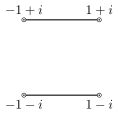 Fig. 17.1
(the plane with cuts along the segments shown in Fig. 17.2);
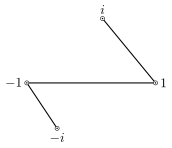 Fig. 17.2
(the plane with cuts along the segments shown in Fig. 17.3);
 Fig. 17.3
;
;
.
Prove that the multivalued function does not admit the extraction of a regular branch in the domain .
Determine whether the multivalued functions given below admit the extraction of regular branches in the domains indicated in parentheses:
;
;
;
.
Determine, for what relationship between the numbers and , the multivalued function
admits the extraction of a regular branch in the domain .
Determine, for what relationship between the numbers and , the multivalued function
admits the extraction of a regular branch in the domain .
Prove that in the plane with a cut along the negative part of the real axis there exists a regular branch of the multivalued function , satisfying the condition .
Verify that the following multivalued functions admit the extraction of regular branches in the annulus , and expand all the regular branches in a Laurent series in powers of in the annulus (the point and the annulus are indicated in parentheses):
;
;
;
.
Let be a regular branch of the multivalued function in the domain such that . Prove that the multivalued function splits in into regular branches.
Let be a regular branch of the function in such that . Compute the integral .
Let be a regular branch of the multivalued function in the domain such that . Prove that the multivalued function splits in into regular branches.
Let be a regular branch of the function in such that . Compute the integral .