Linear Equations
[47/85%]Let
Find the solutions of the system of linear equations .
Let . Solve the system of linear equations
Let and
Find the condition on so that there is a solution of .
Consider the system of three linear equations
with . Find the condition on so that there is a solution.
Find all solutions of the system of linear equations
with . What type of equation is this?
Find all solutions of the system of linear equations
Let and . Consider the linear equation . Show that it can be written as , i.e. find .
If the system of linear equations admits no solution we call the equations inconsistent. If there is a solution, the equations are called consistent. Let be a system of linear equations in unknowns and suppose that the rank of is . Show that in this case is consistent.
Find all solutions of the linear system of three equations and four unknowns
Solve the linear equation
Find such that
Show that the curve fitting problem
by a quadratic polynomial of the form leads to an overdetermined linear system.
Consider the overdetermined linear system . Find an such that
with the residual vector and denotes the Euclidean norm.
Consider the overdetermined linear system with
Solve this linear system in the least squares sense (see the previous problem) by the normal equations method.
An underdetermined linear system is either inconsistent or has infinitely many solutions. Consider the underdetermined linear system , where is an matrix with and
Assume that has infinitely many solutions. Let be the matrix
We define . Find
subject to the constraint . Assume that exists for all . Apply the Lagrange multiplier method.
Show that solving the system of nonlinear equations with the unknowns
leads to a linear underdetermined system. Solve this system with respect to , and .
Let be an matrix over . We define
is called the kernel of and is called the nullity of . If only contains the zero vector, then .
Let
Find and .
Let
Find and .
Let . Find all solutions of the system of linear equations
Find all positive solutions.
Consider the inhomogeneous linear integral equation
for the unknown function , and
Thus and are continuous in and likewise for and . We define
and
where . Show that the integral equation can be cast into a system of linear equations for and . Solve this system of linear equations and thus find a solution of the integral equation.
Consider the area-preserving map of the two-dimensional torus (modulo 1)
where (area-preserving). Consider a rational point on the torus
where is a prime number (except 2, 3, 5) and , are integers between 0 and . One finds that the orbit has the following property. It is periodic and its period depends on alone. Consider , , . Find the orbit and the period .
Let be an matrix over and be an -vector in .
Let
Find out whether system (1) or system (2) has a solution.
Let
Find out whether system (1) or system (2) has a solution.
Gordan's theorem tells us the following. Then exactly one of the following systems has a solution: System 1: for some . System 2: and for some .
Let
Find out whether system (1) or system (2) has a solution.
Farkas' theorem tells us the following. Let be an matrix over and be an -vector in . Then exactly one of the following systems has a solution: System 1: and for some . System 2: and for some .
Let be an matrix. Consider the linear equation . If the matrix has rank , then there are linearly independent solutions of . Let and
Find the rank of and the linearly independent solutions.
Consider the curve described by the equation
relative to the natural basis (standard basis , ).
Write the equation in matrix form.
Find an orthogonal change of basis so that the equation relative to the new basis has no crossterms, i.e. no term. This change of coordinate system does not change the origin.
Consider the matrix
with and positive determinant, i.e. . Solve the equation
for the vector with a given vector .
Let be a vector space over a field . Let be a subspace of . We define an equivalence relation on by stating that if . The quotient space is the set of equivalence classes where . Thus we can say that is equivalent to modulo if for some . Let
and the subspace
Is
Give the quotient space .
Suppose that is a vector space over a field and is a subspace. We define an equivalence relation on by iff . Let . Define addition and scalar multiplication on by , , where and
Show that these operations do not depend on which representative we choose.
Let and the subspace . Find .
Let . Consider the system of linear equations
Let , , , , , . Find .
Let matrices over . Consider the system of matrix equations , . Assume that has an inverse. Eliminate the matrix and solve the system for .
For the three-body problem the following linear transformation plays a role
Find the inverse transformation.
Introduce polar coordinates , and
Express , , using these three coordinates.
Let . Find all solutions of the linear equation
Thus and depend on .
Consider the partial differential equation (Laplace equation)
with the boundary conditions
Apply the central difference scheme
and then solve the linear equation. Consider the cases and .
The equation of a line in the Euclidean space passing through the points and is given by
Apply this equation to the points in given by , . Consider the unit square with the corner points , , , and the map
We can consider this as a 2 input AND-gate. Show that the line constructed above classifies this map.
The equation of a plane in passing through the points , , in is given by
Apply this equations to the points , , . Consider the unit cube in with the corner points (vertices)
and the map where all corner points are mapped to 0 except for which is mapped to 1. We can consider this as a 3 input AND-gate. Show that the plane constructed in (i) separates these solutions.
Find the system of linear equations for and given by
Solve the system of linear equations.
Let and , . Solve .
Consider the polynomial . Find from the conditions , , .
Let with and .
Show that the matrix is invertible.
We set . Show that is a projection matrix, i.e. and .
Let and . Find the solution of the system of linear equations
Let be an invertible matrix over . Consider the system of linear equation or
Let . This is called a splitting of the matrix and is the defect matrix of the splitting. Consider the iteration
Let
The iteration converges if , where denotes the spectral radius of . Show that . Perform the iteration.
Let be an matrix over and let . Consider the linear equation . Assume that for . We define the diagonal matrix . Then the linear equation can be written as
with , . The Jacobi method for the solution of the linear equation is given by
where is any initial vector in . The sequence converges if
where is the spectral radius of . Let
Show that the Jacobi method can applied for this matrix.
Find the solution of the linear equation with .
Kirchhoff’s current law states that the algebraic sum of all the currents flowing into a junction is 0. Kirchhoff’s voltage law states that the algebraic sum of all the voltages around a closed circuit is 0. Use Kirchhoff's laws and Ohm’s law () to setting up the system of linear equations for the circuit depicted in the figure.
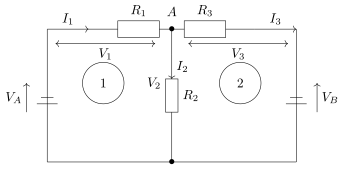 Circuit for Problem 2.1.39
Given the voltages , and the resistors , , . Find , , .
Write a C++ program that implements Gauss elimination to solve linear equations. Apply it to the system
Let and be vectors in with . The set of all vectors in which satisfy the equation is called a hyperplane through the point . We call a normal vector for the hyperplane and call a normal equation for the hyperplane. Find and in such that we obtain the hyperplane given by
Any hyperplane of the Euclidean space has exactly two unit normal vectors.
The hyperplanes , in do not intersect. Find the shortest distance.
Find the solutions of the equation
Find the solutions of the equation
Let be a given matrix over with . Is the transformation
invertible? If so find the inverse.
Consider the linear equation written in matrix form
The determinant of the matrix is nonzero () and the inverse matrix is
Apply two different methods (Gauss elimination and the Leverrier's method) to find the solution. Compare the two methods and discuss.
Apply the Gauss-Seidel method to solve the linear system
and show that the solution is given by
Show that the solution of the system of linear equations
is given by , , .
Given the matrix . Find all matrices such that . From we obtain
Thus we obtain the four equations
Show that the solution of the equation
is given by , .
Let . Solve the system of linear equations