Regression toward the Mean
[36/100%]Police in the United Kingdom installed speed cameras at locations where there had been a jump in traffic accidents. This policy has been justified by the fact that, after the installation of speed cameras at these dangerous locations, there was usually a decline in traffic accidents. Explain why the benefits are most likely overstated.
While working as a consultant for the Israeli Air Force in the late 1960s, Daniel Kahnemann was told by the flight instructors that students improved after being yelled at following poor performances. How do you think Kahnemann explained this contradiction of his strong belief that instructors should offer positive encouragement?
A psychology experiment had participants pretend they were teachers dealing with students who sometimes showed up late for class. Almost all the participants chose to punish those who were late and were pleased that tardy students were more punctual after being punished. However, each student's arrival time had been randomly set before the experiment began. How do you explain the results?
Explain why you either agree or disagree with this explanation of regression toward the mean by a trust investment officer:
Key financial ratios of companies tend, over time, to revert to the mean for the market as a whole. High returns invite new entrants, driving down profitability, while poor returns cause the exit of competitors, leaving a more profitable industry for the survivors.
Explain why you either agree or disagree with Peter Bernstein, Against the Gods: "Regression to the mean... is what motivates the gambler's dream that a long string of losses is bound to give way to a long string of winnings."
Peter Bernstein, author of Against the Gods, gives this example of regression toward the mean: "Joseph had this preordained sequence of events in mind when he predicted that seven years of famine would follow seven years of plenty." Is this a good example of regression toward the mean?
Since 1937, the Gallup polling organization has been asking Americans, "Do you approve or disapprove of the way XYZ is handling his job as president?" Of the people elected president since 1937, all have had lower favorability ratings at the end of their first term than at the beginning. Provide a statistical explanation.
Sir Francis Galton observed that the adult children of unusually tall parents tended to be somewhat shorter than their parents while the reverse was true of the children of unusually short parents. Does this imply that we will all soon be the same height?
Suppose that you meet a 25 -year-old man who is 6 feet, 2 inches tall and he tells you that he has two brothers, one 23 years old and the other 27 years old. If you had to guess whether he is the shortest, tallest, or in-between of these three brothers, which would you select? Explain your reasoning.
Sports Illustrated's cover on November 18, 1957 had a picture of the Oklahoma football team, which had not lost in 47 games, with the caption "Why Oklahoma is Unbeatable." The Saturday after this issue appeared, Oklahoma lost to Notre Dame 7-0, starting the legend of the Sports Illustrated cover jinx-the performance of an individual or team usually declines after they are pictured on the cover of Sports Illustrated. What statistical argument could explain the Sports Illustrated cover jinx?
Give a statistical explanation for the fact that (as of May 2023), a total of 230 golfers have won at least one of the four major men's golf championships, but of these golfers only won once.
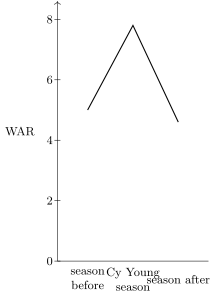
Cy Young Awards are given each year to the best pitcher in Major League Baseball's American League and National League. LaMarr Hoyt won a Cy Young Award in 1983 and complained in 1984 that he had been jinxed: "I'll tell you, there have been a lot of times this season I've felt jinxed. A lot happened to me that is unexplainable." An article reporting his grievance noted that the four previous Cy Young winners all had disappointing seasons the year after winning the award.
A modern tool for assessing baseball players is wins above replacement (WAR)—the higher, the better. The figure below shows the average WAR for all Cy Young winners 2000-2023 during their award-winning season and during the seasons before and after they won the award. Are these data consistent with the jinx theory? How would you explain these data?
In the board game Settlers of Catan, a pair of sixsided dice are rolled on each turn to determine how new resources are distributed to each player. When Jim plays Settlers, he records every dice roll and inevitably finds that some numbers have come up more often than expected, while other numbers have come up less often than expected. For example, numbers 6 and 8 are equally likely, but they almost never come up equally often.
Explain why numbers 6 and 8 are equally likely.
Explain why you either are or are not surprised that numbers 6 and 8 seldom come up equally often.
When a number that is advantageous for Jim (say, 8) comes up far less often than expected, he switches to a different pair of dice. Explain why you think that, going forward, 8 will or will not come up more frequently than it came up with the previous dice?
This is a true story.
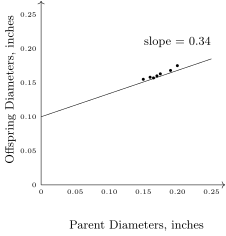
Thousands of pea seeds were divided into seven size categories and, for each category, the average size of the seeds of the offspring plants were recorded. A scatterplot compared the pea seed diameters (hundredths of an inch) of the parent plants and offspring plants. How would you explain the fact that the fitted line does not go through the origin with a slope of one?
In speed climbing competitions, two climbers scramble up identical 15-meter walls, racing to be the first to touch a button at the top. Elite runner times average around 5 seconds. In tournament play, four climbers make it through the preliminary rounds to the semifinals. The winners of each of the two-person semifinal races advance to the "Big Final" where they compete for first and second place. The losers of the two semifinal races compete against each other in the "Small Final" for third and fourth place.
The first-, second-, and third-place finishers are "podium" places and win the majority of the prize money. A researcher hypothesized that the qualitative difference between third and fourth place incentivizes the climbers in the Small Final to exert more effort. His study of tournament data found that the two climbers competing for first and second place in the Big Final typically do not do as well as they did in their semifinal round while the two climbers competing for third and fourth place in the Small Final typically do better than they did in their semifinal round. Provide a purely statistical explanation for how this could happen even if each climber exerts the same amount of effort in each climb.
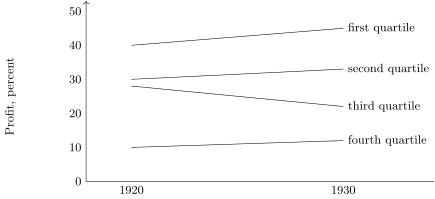
One hundred firms were grouped into quartiles based on their 1930 profits (return on assets): the top 25, second 25, third 25, and bottom 25. The average profits in 1930 and 1920 were then calculated for the firms in each of these 1930 quartiles. How would you explain the graph?
The John Bates Clark Medal is awarded annually to the top American economist under the age of 40. The 2021 medal was given to Isaiah Andrews. One of his interests is the "winner's curse," which was described by The Economist this way: when it comes to choosing between policies: the policy that performed best in a trial...will later be doomed to disappoint. To illustrate this the researchers turn to a trial that assesses the most effective ways of encouraging people to donate to charity, by combining requests for specific donations with promises to match the initial contribution. The researchers find that if the charity chooses the method that does best in a trial, it will always overestimate its donations. Explain the winner's curse statistically.
A study of the 30 stocks in the Dow Jones Industrial Average over a 10-year period reported these estimates:
where: > firm's percent rate of return on assets that year > firm's percent return on assets the previous year
Is there evidence of regression toward the mean? How do you know whether there is or isn't?
A statistics professor made a scatter plot of her students' midterm and final exam scores (each on a scale of ), with midterm scores on the X-axis, and found that the least squares slope was less than 1.
How would you explain this?
If she had put final exam scores on the X-axis, do you think the slope would be less than or larger than 1?
How would you explain the broadcaster jinx?
Sports fans never like it when broadcasters bring up a lengthy positive streak belonging to their favorite team. Why jinx a free-throw shooter who's made 28 straight? A field goal kicker who hasn't missed from inside 40 the last three seasons? "There's no reason to tempt fate!" we yell from our couches and dens.
Considering that, fans of the Cleveland Browns had to cringe on Sunday when CBS put up a graphic noting their team hadn't turned the ball over in 99 trips to the red zone. They had to mutter when the broadcasting team of Andrew Catalon and Steve Beuerlein praised the Browns for their error-free ways. And they definitely had to be cursing as running back Isaiah Crowell immediately coughed up the ball just seconds later.
Use a specific example to explain why regression toward the mean is or is not the same as the law of averages.
For golfers who played the final two rounds of the 2015 and 2016 Masters golf tournaments, the correlation between their 2015 and 2016 scores was .38. For the top 15 golfers, the correlation between their 2015 and 2016 scores was .04. This is an example of
the law of averages.
the law of large numbers.
the central limit theorem.
self-selection bias.
the paradox of luck and skill.
What statistical pattern would you use to explain the fact that most movie sequels are not as good as the original?
Use one statistical argument to explain these two aphorisms: "The grass is always greener on the other side of the fence." "Familiarity breeds contempt."
Evergreen Day School, a selective suburban private school with a reputation for academic excellence, uses Educational Records Bureau (ERB) tests as an important component of the admissions process.
After admission to first grade, ERB tests are given each year to assess each student's progress. The following table uses percentiles to compare the ERB scores of students admitted to Evergreen in 2008 to the scores of suburban public schools. For example, the Evergreen first-graders scored, on average, in the 91.2 percentile compared to suburban public schools. The same Evergreen students took ERB tests as first, third, and fifth graders.
| Grade | Reading | |
|---|---|---|
| Comprehension | Mathematics | |
| 1 | 91.2 | 90.2 |
| 3 | 67.9 | 73.2 |
| 5 | 66.1 | 72.5 |
How might a statistician explain these data, other than Evergreen is not as good as public schools? Explain your reasoning in words that the headmaster can understand.
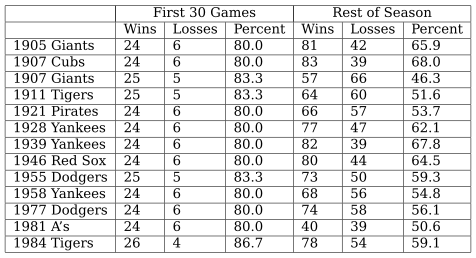
A 2016 Sports Illustrated article noted that the Chicago Cubs had won 24 of their first 30 Major League Baseball games, and that only 13 teams had done so well in the modern baseball era. As a statistician, what pattern do you see in these data and how would you explain it?
Explain why you agree or disagree with this argument:
Regression toward the mean follows directly from the law of large numbers, which states that as the number of trials increases, the observed frequency with which an event occurs will converge to its probability. For example, in a large number of dice rolls, the above-average numbers (4,5, and 6) will occur half the time and the below-average numbers (1, 2, and 3) will occur half the time. Thus, an above-average roll (like a 5) must be offset by a below-average roll (like a 2), which is regression toward the mean.
In the 1930s, Horace Secrist, a statistics professor at the Northwestern University, wrote a book with the provocative title The Triumph of Mediocrity in Business. Secrist had found that businesses with exceptional profits in any given year tend to have smaller profits the following year, while firms with very low profits generally do somewhat better the next year. From this evidence he concluded that strong companies were getting weaker, and the weak stronger, so that soon all would be mediocre. How might a statistician explain these data, without making any economic assumptions?
A farmer sold some California land that she had been farming for 20 years and bought some farmland in the Midwest after investigating 20 different properties in five different states, spending one day at each property. Give a purely statistical explanation for why the property that appears to be the most attractive is probably not as good as it appears to be. Explain your reasoning carefully.
Marcus Lee suggested a betting strategy based on the logic of regression toward the mean and data on how professional football teams had done in recent weeks. Do you think he recommended betting for or against teams that had been doing poorly? Explain your reasoning.
Explain this observation by Nobel Laureate Daniel Kahneman: "As I understood clearly only when I taught statistics some years later, the idea that predictions should be less extreme than the information on which they are based is deeply counterintuitive."
In 2017, a famous economist argued that the ratio of the price of oil to the price of gold was a "golden constant":
The idea being that, if the price of oil changes dramatically, the oil-gold price ratio will change and move away from its long-term value. Forces will then be set in motion to move supply and demand so that the price of oil changes and the long-term oil-gold price ratio is reestablished. This represents nothing more than a reversion to the mean.
Explain why you believe that this either is or is not an example of the regression-toward-the-mean principle.
Data were collected for golf scores on the first and second rounds of Professional Golf Association (PGA) tournaments for the years
2002-2018. The first-round scores in each tournament were sorted into better-than-average ("good") and worse-than-average ("bad"). The average round 1 and round 2 scores were then calculated for the good golfers and the bad golfers.
In the "Sort by Round 1" data in the table, D1 is the average difference between the round 1 scores of the Bad golfers and the Good golfers; D2 is the average difference between the round 2 scores of the round 1 Bad golfers and the round 1 Good golfers. (These are positive because low scores are good in golf.) The "Sort by Round 2" data in the table shows the same calculations when the golfers are sorted by how well they did in round 2.
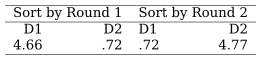
How do you explain the fact that D2 is less than D1 when the golfers are sorted by round 1 scores but the opposite is true when the data are sorted by round 2 performance?
A book and book review, both written by prominent economists, argued that the economic growth rates of nations converge over time. Milton Friedman wrote an apt commentary titled, "Do Old Fallacies Ever Die?"
I find it surprising that the reviewer and the authors, all of whom are distinguished economists, thoroughly conversant with modern statistical methods, should have failed to recognize that they were guilty of the... fallacy.... However, surprise may not be justified in light of the ubiquity of the fallacy both in popular discussion and in academic studies.
What fallacy is Friedman referring to?
Provide a purely statistical explanation for this observation: "Highly intelligent women tend to marry men who are less intelligent than they are."
In educational testing, a student's ability is defined as the student's (theoretical) average score on a large number of tests that are similar with respect to subject matter and difficulty. The student's score on a particular test is equally likely to be above or below the student's ability. Suppose that a group of 100 students takes two similar tests and the scores on each test have a mean of 65 with a standard deviation of 14. If a student's score on the second test is 52, do you predict that this student's score on the first test was: (a) below 52, (b) 52; (c) between 52 and 65; (d) 65; or (e) above 65? Explain your reasoning.