Introduction
[15/87%]Examine the following formal descriptions of sets so that you understand which members they contain. Write a short informal English description of each set.
Write formal descriptions of the following sets.
The set containing the numbers 1, 10, and 100
The set containing all integers that are greater than 5
The set containing all natural numbers that are less than 5
The set containing the string aba
The set containing the empty string
The set containing nothing at all
Let be the set and be the set .
Is a subset of ?
Is a subset of ?
What is ?
What is ?
What is ?
What is the power set of ?
If has elements and has elements, how many elements are in ? Explain your answer.
If is a set with elements, how many elements are in the power set of ? Explain your answer.
Let be the set and be the set . The unary function and the binary function are described in the following tables.
| 1 | 6 |
| 2 | 7 |
| 3 | 6 |
| 4 | 7 |
| 5 | 6 |
| 6 | 7 | 8 | 9 | 10 | |
|---|---|---|---|---|---|
| 1 | 10 | 10 | 10 | 10 | 10 |
| 2 | 7 | 8 | 9 | 10 | 6 |
| 3 | 7 | 7 | 8 | 8 | 9 |
| 4 | 9 | 8 | 7 | 6 | 10 |
| 5 | 6 | 6 | 6 | 6 | 6 |
What is the value of ?
What are the range and domain of ?
What is the value of ?
What are the range and domain of ?
What is the value of ?
For each part, give a relation that satisfies the condition.
Reflexive and symmetric but not transitive
Reflexive and transitive but not symmetric
Symmetric and transitive but not reflexive
Consider the undirected graph where , the set of nodes, is and , the set of edges, is . Draw the graph . What are the degrees of each node? Indicate a path from node 3 to node 4 on your drawing of .
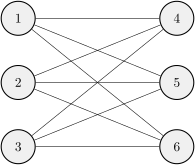
Write a formal description of the following graph.
Find the error in the following proof that . Consider the equation . Multiply both sides by to obtain . Subtract from both sides to get . Now factor each side, , and divide each side by to get . Finally, let and equal 1, which shows that .
Let be the sum of the first natural numbers and let be the sum of the first cubes. Prove the following equalities by induction on , to arrive at the curious conclusion that for every .
.
.
Find the error in the following proof that all horses are the same color. Claim: In any set of horses, all horses are the same color. Proof: By induction on . Basis: For . In any set containing just one horse, all horses clearly are the same color. Induction step: For , assume that the claim is true for and prove that it is true for . Take any set of horses. We show that all the horses in this set are the same color. Remove one horse from this set to obtain the set with just horses. By the induction hypothesis, all the horses in are the same color. Now replace the removed horse and remove a different one to obtain the set . By the same argument, all the horses in are the same color. Therefore, all the horses in must be the same color, and the proof is complete.
Show that every graph with two or more nodes contains two nodes that have equal degrees.
- ᴬ Ramsey's theorem. Let be a graph. A clique in is a subgraph in which every two nodes are connected by an edge. An anti-clique, also called an independent set, is a subgraph in which every two nodes are not connected by an edge. Show that every graph with nodes contains either a clique or an anti-clique with at least nodes.
ᴬ Use Theorem 0.25 to derive a formula for calculating the size of the monthly payment for a mortgage in terms of the principal , the interest rate , and the number of payments . Assume that after payments have been made, the loan amount is reduced to 0. Use the formula to calculate the dollar amount of each monthly payment for a 30 -year mortgage with 360 monthly payments on an initial loan amount of $100,000 with a 5 annual interest rate.