Chapter 6

Conformal Mappings

[114/49%]
Show
LaTeX
Problem 25.1

Let a ray {z:arg⁡(z−z0)=φ}\left\{ z: \arg \left(z-z_{0}\right) = \varphi \right\} emanating from the point z0z_{0} be given. Find the coefficient of linear stretching R(φ)R(\varphi ) at the point z0z_{0} and the angle of rotation α(φ)\alpha (\varphi ) at the point z0z_{0} for this ray under the following mappings:

?
(1)

w=z2,z0=1w = z^{2}, z_{0} = 1;

(2)

w=zˉ2,z0=iw = \bar{z}^{2}, z_{0} = i;

(3)

w=ie2z,z0=0w = i e^{2 z}, z_{0} = 0;

(4)

w=2z+izˉ,z0=0w = 2 z+i \bar{z}, \quad z_{0} = 0;

(5)

w=z−z0z+z0(z0≠0)w = \frac{z-z_{0}}{z+z_{0}}\left(z_{0} \neq 0\right);

(6)

w=1−iz1+iz,z0=−iw = \frac{1-i z}{1+i z}, \quad z_{0} = -i.

Problem 25.2

Find the sets of all points z0z_{0} at which the coefficient of linear stretching equals one for the following mappings:

?
(1)

w=z2w = z^{2};

(2)

w=z3w = z^{3};

(3)

w=z2−2zw = z^{2}-2 z;

(4)

w=1zw = \frac{1}{z};

(5)

w=1+iz1−izw = \frac{1+i z}{1-i z}.

Problem 25.3

Find the set of all points z0z_{0} at which the angle of rotation is zero for the following mappings:

?
(1)

w=iz2w = i z^{2};

(2)

w=−z3w = -z^{3};

(3)

w=z2−2zw = z^{2}-2 z;

(4)

w=izw = \frac{i}{z};

(5)

w=1+iz1−izw = \frac{1+i z}{1-i z}.

Problem 25.4

Let the function w(z)w(z) be regular at the point z0z_{0}, and let the smooth curves Γ1\Gamma_{1} and Γ2\Gamma_{2}, passing through the point z0z_{0}, have the property that

Re(w(z))=Re(w)(z0)(z∈Γ1)Im(w(z))=Im(w)(z0)(z∈Γ2) \begin{array}{ll} \mathrm{Re}\left(w(z)\right) = \mathrm{Re}\left(w\right)\left(z_{0}\right) & \left(z \in \Gamma _{1}\right) \\ \mathrm{Im}\left(w(z)\right) = \mathrm{Im}\left(w\right)\left(z_{0}\right) & \left(z \in \Gamma _{2}\right) \end{array}

Prove that if w′(z0)≠0w^{\prime }\left(z_{0}\right) \neq 0, then the curves Γ1\Gamma_{1} and Γ2\Gamma_{2} intersect at a right angle.

?
Problem 25.5

Let the function w(z)w(z) be regular at the point z0z_{0}, and let the smooth curves Γ1\Gamma_{1} and Γ2\Gamma_{2}, passing through the point z0z_{0}, have the property that

∣w(z)∣=∣w(z0)∣(z∈Γ1);Re(w(z))=Re(w)(z0)(z∈Γ2). \begin{aligned} \left|w(z)\right| & = \left|w\left(z_{0}\right)\right| \quad \left(z \in \Gamma _{1}\right) ; \\ \mathrm{Re}\left(w(z)\right) & = \mathrm{Re}\left(w\right)\left(z_{0}\right) \quad \left(z \in \Gamma _{2}\right). \end{aligned}

Prove that if w′(z0)≠0w^{\prime }\left(z_{0}\right) \neq 0, then the curves Γ1\Gamma_{1} and Γ2\Gamma_{2}, upon intersecting at the point z0z_{0}, form angles ±arg⁡w(z0)+kπ\pm \arg w\left(z_{0}\right)+k \pi.

?
Problem 25.6

Find the lengths of the images of the following curves Г under the indicated mappings:

?
(1)

Γ={z:z=it+1,0⩽t⩽1},w=z2\Gamma = \left\{ z: z = i t+1,0 \leqslant t \leqslant 1\right\} , w = z^{2};

(2)

Γ={z:z=it,0⩽t⩽2π},w=ez\Gamma = \left\{ z: z = i t, 0 \leqslant t \leqslant 2 \pi \right\} , w = e^{z};

(3)

Γ={z:z=(1+i)t,0⩽t⩽2π},w=ez\Gamma = \left\{ z: z = (1+i) t, 0 \leqslant t \leqslant 2 \pi \right\} , w = e^{z};

(4)

Γ={z:z=(1+i)t,0⩽t⩽1},w=zm(m=1,2,…)\Gamma = \left\{ z: z = (1+i) t, 0 \leqslant t \leqslant 1\right\} , w = z^{m}(m = 1,2, \ldots ).

Problem 25.7

Find the areas of the images of the domains DD under the indicated mappings:

?
(1)

D={z:2<∣z∣<3,∣arg⁡z∣<π4},w=z2;D = \left\{ z: 2 < \left|z\right| < 3,\left|\arg z\right| < \frac{\pi }{4}\right\} , w = z^{2} ;

(2)

D={z:0<∣Re(z)∣<1,∣Im(z)∣<π},w=ezD = \left\{ z: 0 < \left|\mathrm{Re}\left(z\right)\right| < 1,\left|\mathrm{Im}\left(z\right)\right| < \pi \right\} , w = e^{z};

(3)

D={z:0<∣Re(z)∣<1,1<∣Im(z)∣<2}D = \left\{ z: 0 < \left|\mathrm{Re}\left(z\right)\right| < 1,1 < \left|\mathrm{Im}\left(z\right)\right| < 2\right\}, w=z−1z+1w = \frac{z-1}{z+1}.

Problem 25.8

Find the region onto which the function w=ezw = e^{z} maps the rectangle

D={1<x<2,0<y<8}. D = \left\{ 1 < x < 2,0 < y < 8\right\} .

Compute the area of the region w(D)w(D) using formula (4) and explain why this formula gives an incorrect answer.

Formula (4): if a function ff is regular and univalent in a region DD and maps it onto a region G=f(D)G = f(D), then the area of GG equals S(G)=∬D∣f′(z)∣2 dx dyS(G) = \iint_{D}\left|f^{\prime }(z)\right|^{2} \, dx \, dy.

?
Problem 25.9

Let

P(z)=a0+a1z+…+anzn P(z) = a_{0}+a_{1} z+\ldots +a_{n} z^{n}

Denote by L(r)L(r) the length of the image of the circle {z:∣z∣=r}\left\{ z:\left|z\right| = r\right\} under the mapping w=P(z)w = P(z), and by S(r)S(r) the area of the image of the disk {z:∣z∣<r}\left\{ z:\left|z\right| < r\right\} under the same mapping. Prove that:

?
(1)

the inequality S(r)⩾πr2∣P′(0)∣2S(r) \geqslant \pi r^{2}\left|P^{\prime }(0)\right|^{2} holds;

(2)

the inequality

∫0rL2(t)tdt⩽2πS(r) \int _{0}^{r} \frac{L^{2}(t)}{t} d t \leqslant 2 \pi S(r)
(3)

the inequality L(r)⩾2πr∣P′(0)∣L(r) \geqslant 2 \pi r\left|P^{\prime }(0)\right| holds.

Hint. First prove the formulas

12π∫02πP′(reiφ)dφ=P′(0);∬∣z∣<r∣P′(z)∣2dxdy=π∑m=0nm∣am∣2r2m \frac{1}{2 \pi } \int _{0}^{2 \pi } P^{\prime }\left(r e^{i \varphi }\right) d \varphi = P^{\prime }(0) ; \quad \iint _{\left|z\right| < r}\left|P^{\prime }(z)\right|^{2} d x d y = \pi \sum _{m = 0}^{n} m\left|a_{m}\right|^{2} r^{2 m}
Problem 25.10

Let Q(z)=z+∑k=1nckz−kQ(z) = z+\sum_{k = 1}^{n} c_{k} z^{-k}. Find the area of the image of the annulus {z:r<∣z∣<R}\left\{ z: r < \left|z\right| < R\right\} under the mapping w=Q(z)w = Q(z), counting the area of each elementary patch centered at the point w0w_{0} as many times as the function Q(z)Q(z) takes the value w0w_{0} in the annulus {z:r<∣z∣<R}\left\{ z: r < \left|z\right| < R\right\}.

?
Problem 25.11

Let the function w(z)w(z) be regular in the domain DD, and let its mapping w=w(z)w = w(z) preserve the Euclidean distance between points, i.e., for any pair of points z1∈Dz_{1} \in D and z2∈Dz_{2} \in D the equality holds

∣w(z2)−w(z1)∣=∣z2−z1∣ \left|w\left(z_{2}\right)-w\left(z_{1}\right)\right| = \left|z_{2}-z_{1}\right|

Prove that w(z)=eiφz+aw(z) = e^{i \varphi } z+a, where φ\varphi is a real and aa a complex constant.

?
Problem 26.1

Determine whether the mapping f(z)f(z) is conformal in the domains DD indicated in parentheses:

?
(1)

f(z)=az+bcz+d,ad−bc≠0(D=C)f(z) = \frac{a z+b}{c z+d}, a d-b c \neq 0(D = \mathbb {C});

(2)

f(z)=z2(D={z:1<∣z∣<2,0<arg⁡z<3π2})f(z) = z^{2}\left(D = \left\{ z: 1 < \left|z\right| < 2,0 < \arg z < \frac{3 \pi }{2}\right\} \right);

(3)

f(z)=z+1z(D={z:∣z∣<1})f(z) = z+\frac{1}{z}(D = \left\{ z:\left|z\right| < 1\right\} );

(4)

f(z)=ez(D={z:∣z∣<4})f(z) = e^{z} \quad (D = \left\{ z:\left|z\right| < 4\right\} );

(5)

f(z)=z2(D={z:3<∣z+2∣<4,0<arg⁡(z+2)<3π2})f(z) = z^{2}\left(D = \left\{ z: 3 < \left|z+2\right| < 4,0 < \arg (z+2) < \frac{3 \pi }{2}\right\} \right);

(6)

f(z)=ez(D={z:∣Re((1+i)z)∣<π})f(z) = e^{z} \quad (D = \left\{ z:\left|\mathrm{Re}\left((1+i) z\right)\right| < \pi \right\} );

(7)

f(z)=z+1z(D={z:∣z−i∣<2})f(z) = z+\frac{1}{z} \quad (D = \left\{ z:\left|z-i\right| < \sqrt{2}\right\} ).

Problem 26.2

Prove the following statements:

?
(1)

the mapping z2z^{2} is conformal in the domain DD if and only if the domains DD and −D-D have no common points;

(2)

the mapping 12(z+1z)\frac{1}{2}\left(z+\frac{1}{z}\right) is conformal in the domain DD if and only if the domains DD and 1D\frac{1}{D} have no common points;

(3)

the mapping eze^{z} is conformal in the domain DD if and only if the domains DD and D+2πiD+2 \pi i have no common points;

(4)

the mapping tg⁡z\operatorname {tg} z is conformal in the domain DD if and only if the domains DD and D+πD+\pi have no common points;

(5)

the mapping cos⁡z\cos z is conformal in the domain DD if and only if the domains D,−D,D+2π,−D+2πD,-D, D+2 \pi ,-D+2 \pi have no pairwise common points.

Problem 26.3

Let n⩾2n \geqslant 2 be an integer, and let α\alpha be an arbitrary real number. Prove that the mapping zn+neiαzz^{n}+n e^{i \alpha } z is conformal in the disk {z:∣z∣<1}\left\{ z:\left|z\right| < 1\right\}.

?
Problem 26.4

Prove that the mapping z2+azz^{2}+a z is conformal in the half-plane {z:Im(z)>0}\left\{ z: \mathrm{Im}\left(z\right) > 0\right\} if and only if the inequality Im(a)⩾0\mathrm{Im}\left(a\right) \geqslant 0 holds.

?
Problem 26.5

Prove that none of the branches of the function z5\sqrt{z^{5}} that are regular in the half-plane {z:Im(z)>0}\left\{ z: \mathrm{Im}\left(z\right) > 0\right\} defines a conformal mapping of this half-plane.

?
Problem 26.6

Prove that if the function Ln⁡z\operatorname {Ln} z admits the isolation of a regular branch in the domain DD, then this regular branch defines a conformal mapping of the domain DD.

?
Problem 26.7

Let nn be a positive integer. Prove that if the function zn\sqrt[n]{z} admits the isolation of a regular branch in the domain DD, then this regular branch defines a conformal mapping of the domain DD.

?
Problem 26.8

Let the mapping f(z)f(z) be conformal on the set EE, and let the mapping g(ζ)g(\zeta ) be defined on the set E′E^{\prime } of values of f(z)f(z). Prove that the mapping g(f(z))g(f(z)) is conformal on the set EE if and only if g(ζ)g(\zeta ) is conformal on the set E′E^{\prime }.

?
Problem 26.9

Let the function f(z)f(z) be regular and define a conformal mapping of the disk {z:∣z∣<1}\left\{ z:\left|z\right| < 1\right\}, with f(0)=0f(0) = 0. Prove that the multivalued mapping {f(zn)n}\left\{ \sqrt[n]{f\left(z^{n}\right)}\right\} in the disk {z:∣z∣<1}\left\{ z:\left|z\right| < 1\right\} splits into nn functions that are regular and define conformal mappings in the disk.

?
Problem 26.10

Prove that for the quadratic trinomial az2+bz+ca z^{2}+b z+c to be conformal in a convex domain DD, it is necessary and sufficient that this trinomial be conformal at every point of the domain DD.

?
Problem 26.11

Let a,ba, b and z0z_{0} be given complex numbers. Find the largest value of RR for which the mapping z2+az+bz^{2}+a z+b is conformal in the disk {z:∣z−z0∣<R}\left\{ z:\left|z-z_{0}\right| < R\right\}.

?
Problem 26.12

Prove that the mapping z2+az+bz^{2}+a z+b is conformal in every domain DD lying on one side of some line passing through the point z=−a2z = -\frac{a}{2}.

?
Problem 26.13

Prove that the polynomial anzn+…+a1z+a0a_{n} z^{n}+\ldots +a_{1} z+a_{0} can be a conformal mapping in the half-plane {z:Im(z)>0}\left\{ z: \mathrm{Im}\left(z\right) > 0\right\} only if its degree is no higher than the second.

?
Problem 26.14

Verify that the following mappings are not conformal in the indicated domains DD, although they are conformal at every point of these domains:

?
(1)

z2(D:={z:1<∣z∣<2})z^{2}(D: = \left\{ z: 1 < \left|z\right| < 2\right\} );

(2)

z3(D:={z:Im(z)>0})z^{3}(D: = \left\{ z: \mathrm{Im}\left(z\right) > 0\right\} );

(3)

ez(D:={z:∣z∣<4})e^{z}(D: = \left\{ z:\left|z\right| < 4\right\} ).

Problem 26.15

Prove the conformality of the mapping z3−3zz^{3}-3 z in the domain

{z:(Re(z))2>1+(Im(z))2,Re(z)>0}. \left\{ z:(\mathrm{Re}\left(z\right))^{2} > 1+(\mathrm{Im}\left(z\right))^{2}, \mathrm{Re}\left(z\right) > 0\right\} .
?
Problem 26.16

Prove the conformality of the mapping z+ezz+e^{z} in the half-plane {z:Re(z)<0}\left\{ z: \mathrm{Re}\left(z\right) < 0\right\}.

?
Problem 26.17

Let −∞<a1<…<an<+∞-\infty < a_{1} < \ldots < a_{n} < +\infty. Prove that any regular branch of the multivalued function f(z)=(z−a1)…(z−an)nf(z) = \sqrt[n]{\left(z-a_{1}\right) \ldots \left(z-a_{n}\right)} in the half-plane {z:Im(z)>0}\left\{ z: \mathrm{Im}\left(z\right) > 0\right\} defines a mapping that is conformal in this half-plane.

?
Problem 26.18

Let −∞<a1<a2<a3<a4<+∞,0<α<1-\infty < a_{1} < a_{2} < a_{3} < a_{4} < +\infty , 0 < \alpha < 1. Prove that any regular branch of the multivalued function

f(z)=∫0z(ζ−a1)α−1(ζ−a2)−α(ζ−a3)α−1(ζ−a4)−αdζ f(z) = \int _{0}^{z}\left(\zeta -a_{1}\right)^{\alpha -1}\left(\zeta -a_{2}\right)^{-\alpha }\left(\zeta -a_{3}\right)^{\alpha -1}\left(\zeta -a_{4}\right)^{-\alpha } d \zeta

in the half-plane {z:Im(z)>0}\left\{ z: \mathrm{Im}\left(z\right) > 0\right\} defines a conformal mapping of this half-plane.

?
Problem 26.19

Let the function f(z)f(z) be regular in the domain DD bounded by a simple closed curve Γ\Gamma, and continuous in the closure of this domain. Prove that if the image of the curve Γ\Gamma under the mapping w=f(z)w = f(z) is a simple closed curve, then the mapping f(z)f(z) is conformal in the domain DD.

?
Problem 27.1

Let x=Re(z),y=Im(z)x = \mathrm{Re}\left(z\right), y = \mathrm{Im}\left(z\right), and let CC be a positive constant. Find the images of each line of the indicated families under the mapping w=1zw = \frac{1}{z}:

?
(1)

the family of circles {(x,y):x2+y2=Cx}\left\{ (x, y): x^{2}+y^{2} = C x\right\};

(2)

the family of lines {(x,y):y=x+C}\left\{ (x, y): y = x+C\right\};

(3)

the family of lines {(x,y):y=Cx}\left\{ (x, y): y = C x\right\}.

Problem 27.2

Let x=Re(z),y=Im(z)x = \mathrm{Re}\left(z\right), \quad y = \mathrm{Im}\left(z\right). Find the images of each domain of the indicated families under the mapping w=1zw = \frac{1}{z}:

?
(1)

the family of disks {(x,y):x2+y2<Cx}\left\{ (x, y): x^{2}+y^{2} < C x\right\} (here CC is a positive constant);

(2)

the family of disks {(x,y):x2+y2<Cx}\left\{ (x, y): x^{2}+y^{2} < C x\right\} (here CC is a negative constant);

(3)

the family of disks {(x,y):x2+y2<Cy}\left\{ (x, y): x^{2}+y^{2} < C y\right\} (CC is a positive constant);

(4)

the family of half-planes {(x,y):y>Cx}\left\{ (x, y): y > C x\right\} (CC is a positive constant);

(5)

the family of disks {z:∣z−a∣<R}\left\{ z:\left|z-a\right| < R\right\}, where aa is a fixed point, and the positive constant RR satisfies the condition R<∣a∣R < \left|a\right|;

(6)

the family of disks {z:∣z−a∣<R}\left\{ z:\left|z-a\right| < R\right\}, where aa is a fixed point, and the constant RR satisfies the condition R>∣a∣R > \left|a\right|.

Problem 27.3

Find the image of the disk {z:∣z−1∣<2}\left\{ z:\left|z-1\right| < 2\right\} under the following mappings:

?
(1)

w=1−2izw = 1-2 i z;

(2)

w=2izz+3w = \frac{2 i z}{z+3};

(3)

w=z+1z−2w = \frac{z+1}{z-2};

(4)

w=z−12z−6w = \frac{z-1}{2 z-6}.

Problem 27.4

Find the image of the half-plane {z:Re(z)<1}\left\{ z: \mathrm{Re}\left(z\right) < 1\right\} under the following mappings:

?
(1)

w=(1+i)z+1w = (1+i) z+1;

(2)

w=zz−1+iw = \frac{z}{z-1+i};

(3)

w=zz−2w = \frac{z}{z-2};

(4)

w=4zz+1w = \frac{4 z}{z+1};

(5)

w=z−3+iz+1+iw = \frac{z-3+i}{z+1+i}.

Problem 27.5

Find the images of the indicated domains DD under the indicated mappings:

?
(1)

D={z:∣z∣<1,Im(z)>0},w=1−z1+zD = \left\{ z:\left|z\right| < 1, \mathrm{Im}\left(z\right) > 0\right\} , w = \frac{1-z}{1+z};

(2)

D={z:z∉[−2,1]},w=z+21−zD = \left\{ z: z \notin [-2,1]\right\} , w = \frac{z+2}{1-z};

(3)

D={z:∣z−i∣>1,Im(z)>0},w=1zD = \left\{ z:\left|z-i\right| > 1, \mathrm{Im}\left(z\right) > 0\right\} , w = \frac{1}{z};

(4)

D={z:1<∣z∣<2},w=2z−1D = \left\{ z: 1 < \left|z\right| < 2\right\} , w = \frac{2}{z-1}.

Problem 27.6

Find linear-fractional functions w(z)w(z) satisfying the conditions:

?
(1)

w(0)=4,w(1+i)=2+2i,w(2i)=0w(0) = 4, w(1+i) = 2+2 i, w(2 i) = 0;

(2)

w(0)=0,w(1+i)=2+2i,w(2i)=4w(0) = 0, w(1+i) = 2+2 i, w(2 i) = 4;

(3)

w(0)=0,w(1+i)=∞,w(2i)=2iw(0) = 0, w(1+i) = \infty , w(2 i) = 2 i.

Find the image of the disk {z:∣z−i∣<1}\left\{ z:\left|z-i\right| < 1\right\} under the mappings given by these functions.

Problem 27.7

Find linear-fractional functions w(z)w(z) satisfying the conditions:

?
(1)

w(i)=2,w(∞)=1+i,w(−i)=0w(i) = 2, w(\infty ) = 1+i, w(-i) = 0;

(2)

w(i)=0,w(∞)=1,w(−i)=∞w(i) = 0, w(\infty ) = 1, w(-i) = \infty;

(3)

w(i)=−2,w(∞)=2i,w(−i)=2w(i) = -2, w(\infty ) = 2 i, w(-i) = 2.

Find the image of the half-plane {z:Re(z)>0}\left\{ z: \mathrm{Re}\left(z\right) > 0\right\} under the mappings given by these functions.

Problem 27.8

Find a function w(z)w(z) that conformally maps the domain DD onto the domain D1D_{1} and satisfies the indicated conditions:

?
(1)

D={z:∣z∣<1},D1={w:∣w∣<1},w(z0)=0,arg⁡w′(z0)=α(∣z0∣<1)D = \left\{ z:\left|z\right| < 1\right\} , \quad D_{1} = \left\{ w:\left|w\right| < 1\right\} , \quad w\left(z_{0}\right) = 0, \quad \arg w^{\prime }\left(z_{0}\right) = \alpha \left(\left|z_{0}\right| < 1\right);

(2)

D={z:∣z∣<1},D1={w:∣w∣<1},w(z0)=w0,arg⁡w′(z0)=α(∣z0∣<1,∣w0∣<1)D = \left\{ z:\left|z\right| < 1\right\} , D_{1} = \left\{ w:\left|w\right| < 1\right\} , w\left(z_{0}\right) = w_{0}, \arg w^{\prime }\left(z_{0}\right) = \alpha \left(\left|z_{0}\right| < 1,\left|w_{0}\right| < 1\right);

(3)

D={z:∣Im(z)∣>0},D1={w:∣w∣<1},w(z0)=0,arg⁡w′(z0)=α(Im(z0)>0)D = \left\{ z:\left|\mathrm{Im}\left(z\right)\right| > 0\right\} , D_{1} = \left\{ w:\left|w\right| < 1\right\} , w\left(z_{0}\right) = 0, \arg w^{\prime }\left(z_{0}\right) = \alpha \left(\mathrm{Im}\left(z_{0}\right) > 0\right);

(4)

D={z:∣Im(z)∣>0},D1={w:∣w∣<1},w(z0)=w0,arg⁡w′(z0)=α(Im(z0)>0,∣w0∣<1)D = \left\{ z:\left|\mathrm{Im}\left(z\right)\right| > 0\right\} , D_{1} = \left\{ w:\left|w\right| < 1\right\} , w\left(z_{0}\right) = w_{0}, \arg w^{\prime }\left(z_{0}\right) = \alpha \left(\mathrm{Im}\left(z_{0}\right) > 0,\left|w_{0}\right| < 1\right);

(5)

D={z:∣Im(z)∣>0},D1={w:Im(w)>0},w(z0)=w0D = \left\{ z:\left|\mathrm{Im}\left(z\right)\right| > 0\right\} , D_{1} = \left\{ w: \mathrm{Im}\left(w\right) > 0\right\} , w\left(z_{0}\right) = w_{0}, arg⁡w′(z0)=α(Im(z0)>0,Im(w0)>0);\arg w^{\prime }\left(z_{0}\right) = \alpha \left(\mathrm{Im}\left(z_{0}\right) > 0, \mathrm{Im}\left(w_{0}\right) > 0\right) ;

(6)

D={z:∣z∣<1},D1={w:∣w∣<1},w(1)=1,w(i)=3i−45D = \left\{ z:\left|z\right| < 1\right\} , D_{1} = \left\{ w:\left|w\right| < 1\right\} , w(1) = 1, w(i) = \frac{3 i-4}{5}, w(−1)=−1w(-1) = -1;

(7)

D={z:∣z∣<1},D1={w:∣w∣<1},w(i)=i,w(i2)=4i5D = \left\{ z:\left|z\right| < 1\right\} , D_{1} = \left\{ w:\left|w\right| < 1\right\} , w(i) = i, w\left(\frac{i}{2}\right) = \frac{4 i}{5};

(8)

D={z:∣z∣<1},D1={w:∣w∣<1},w(12)=12D = \left\{ z:\left|z\right| < 1\right\} , D_{1} = \left\{ w:\left|w\right| < 1\right\} , w\left(\frac{1}{2}\right) = \frac{1}{2}, arg⁡w′(12)=π2\arg w^{\prime }\left(\frac{1}{2}\right) = \frac{\pi }{2};

(9)

D={z:Im(z)>0},D1={w:∣w∣<1},w(0)=i,w(−1)=1D = \left\{ z: \mathrm{Im}\left(z\right) > 0\right\} , D_{1} = \left\{ w:\left|w\right| < 1\right\} , w(0) = i, w(-1) = 1, w(∞)=−1w(\infty ) = -1;

(10)

D={z:Im(z)>0},D1={w:∣w∣<1},w(0)=−i,w(2i)=i3D = \left\{ z: \mathrm{Im}\left(z\right) > 0\right\} , D_{1} = \left\{ w:\left|w\right| < 1\right\} , w(0) = -i, w(2 i) = \frac{i}{3};

(11)

D={z:Im(z)>0},D1={w:∣w∣<1},w(1+i)=0D = \left\{ z: \mathrm{Im}\left(z\right) > 0\right\} , \quad D_{1} = \left\{ w:\left|w\right| < 1\right\} , \quad w(1+i) = 0, arg⁡w′(1+i)=π\arg w^{\prime }(1+i) = \pi;

(12)

D={z:Im(z)>0},D1={w:Im(w)>0},w(−1)=0,w(0)=2D = \left\{ z: \mathrm{Im}\left(z\right) > 0\right\} , D_{1} = \left\{ w: \mathrm{Im}\left(w\right) > 0\right\} , w(-1) = 0, w(0) = 2, w(1)=∞w(1) = \infty;

(13)

D={z:Im(z)>0},D1={w:Im(w)>0},w(−1)=−2D = \left\{ z: \mathrm{Im}\left(z\right) > 0\right\} , D_{1} = \left\{ w: \mathrm{Im}\left(w\right) > 0\right\} , w(-1) = -2, w(−2+i)=1+3i;w(-2+i) = 1+3 i ;

(14)

D={z:Im(z)>0},D1={w:Im(w)>0},w(1+i)=iD = \left\{ z: \mathrm{Im}\left(z\right) > 0\right\} , \quad D_{1} = \left\{ w: \mathrm{Im}\left(w\right) > 0\right\} , \quad w(1+i) = i, arg⁡w′(1+i)=π2\arg w^{\prime }(1+i) = \frac{\pi }{2};

(15)

D={z:∣z−1−i∣<2},D1={w:∣w∣<1},w(i)=0,arg⁡w′(i)=π2D = \left\{ z:\left|z-1-i\right| < 2\right\} , D_{1} = \left\{ w:\left|w\right| < 1\right\} , w(i) = 0, \arg w^{\prime }(i) = \frac{\pi }{2};

(16)

D={z:Re(z)>−1},D1={w:∣w∣<1},w(0)=0,arg⁡w′(0)=πD = \left\{ z: \mathrm{Re}\left(z\right) > -1\right\} , D_{1} = \left\{ w:\left|w\right| < 1\right\} , w(0) = 0, \arg w^{\prime }(0) = \pi.

Problem 27.9

Find the general form of the conformal mapping of the following domains onto the annulus {w:1<∣w∣<R}\left\{ w: 1 < \left|w\right| < R\right\}:

?
(1)

{z:∣z−3∣>9,∣z−8∣<16}\left\{ z:\left|z-3\right| > 9,\left|z-8\right| < 16\right\};

(2)

{z:∣z−5∣>4, Re z>0}\left\{ z:\left|z-5\right| > 4\text{, Re }z > 0\right\}.

Problem 27.10

Let w(z)w(z) be an arbitrary linear-fractional function, and let z1,z2,z3,z4z_{1}, z_{2}, z_{3}, z_{4} be four pairwise distinct points of the extended complex plane. Denote

wk=w(zk),k=1,2,3,4. w_{k} = w\left(z_{k}\right), \quad k = 1,2,3,4.

Prove that

w4−w1w4−w2:w3−w1w3−w2=z4−z1z4−z2:z3−z1z3−z2. \frac{w_{4}-w_{1}}{w_{4}-w_{2}}: \frac{w_{3}-w_{1}}{w_{3}-w_{2}} = \frac{z_{4}-z_{1}}{z_{4}-z_{2}}: \frac{z_{3}-z_{1}}{z_{3}-z_{2}}.
?
Problem 27.11

Prove that the level lines of the modulus of a linear-fractional function are circles or straight lines.

?
Problem 27.12

Prove that the level lines of the real part of a linear-fractional function are circles or straight lines.

?
Problem 27.13

Find the condition that the points z1,z1∗,z2,z2∗z_{1}, z_{1}^{*}, z_{2}, z_{2}^{*} must satisfy for there to exist a circle (or line) with respect to which the points zkz_{k} are symmetric to the points zk∗(k=1,2)z_{k}^{*}(k = 1,2).

?
Problem 27.14

Let the function w(z)w(z) be meromorphic in the domain DD. Prove the following statements:

?
(1)

if under the mapping w=w(z)w = w(z) the image of any line segment (lying in the domain DD) is a line segment, then w(z)w(z) is a linear function;

(2)

if under the mapping w=w(z)w = w(z) the image of any line segment (lying in the domain DD) is an arc of a circle or a line segment, then w=w(z)w = w(z) is a linear-fractional function.

Remark.
?

A point a∈C‾a \in \overline{\mathbb {C}} is called a fixed point of the linear-fractional transformation ff if f(a)=af(a) = a. This term is used in problems 27.15-27.17 below.

Problem 27.15

Prove the statements:

?
(1)

every linear-fractional transformation has at least one fixed point (finite or infinite);

(2)

every linear-fractional transformation other than the identity has at most two fixed points (finite and infinite).

Problem 27.16

Prove that a linear-fractional transformation ff with a unique fixed point a∈C‾a \in \overline{\mathbb {C}} satisfies the equation

1f(z)−a=1z−a+A,A∈C \frac{1}{f(z)-a} = \frac{1}{z-a}+A, \quad A \in \mathbb {C}

for a≠∞a \neq \infty, while for a=∞a = \infty it has the form

f(z)=z+A,A∈C. f(z) = z+A, \quad A \in \mathbb {C}.
?
Problem 27.17

Prove that a linear-fractional transformation ff with two distinct finite fixed points aa and bb satisfies the equation

f(z)−af(z)−b=A⋅z−az−b,A∈C \frac{f(z)-a}{f(z)-b} = A \cdot \frac{z-a}{z-b}, \quad A \in \mathbb {C}
?
Problem 28.1

Find the images under the mapping w=z2w = z^{2} of the following lines:

?
(1)

{z:arg⁡z=α}(−π<α⩽π)\left\{ z: \arg z = \alpha \right\} \quad (-\pi < \alpha \leqslant \pi );

(2)

{z:Re(z)=a}(a>0)\left\{ z: \mathrm{Re}\left(z\right) = a\right\} (a > 0);

(3)

{z:Im(z)=a}(a>0)\left\{ z: \mathrm{Im}\left(z\right) = a\right\} (a > 0);

(4)

{z:∣z∣=ρ,∣arg⁡z∣<π4}\left\{ z:\left|z\right| = \rho ,\left|\arg z\right| < \frac{\pi }{4}\right\}.

Problem 28.2

Find the images under the mapping w=z2w = z^{2} of the following domains:

?
(1)

{z:Im(z)>0}\left\{ z: \mathrm{Im}\left(z\right) > 0\right\};

(2)

{z:Re(z)>0}\left\{ z: \mathrm{Re}\left(z\right) > 0\right\};

(3)

{z:π<arg⁡z<3π2}\left\{ z: \pi < \arg z < \frac{3 \pi }{2}\right\};

(4)

{z:∣z∣<1,5π4π<arg⁡z<3π2}\left\{ z:\left|z\right| < 1, \frac{5 \pi }{4} \pi < \arg z < \frac{3 \pi }{2}\right\};

(5)

{z:Im(z)<−1}\left\{ z: \mathrm{Im}\left(z\right) < -1\right\};

(6)

{z:Re(z)>1}\left\{ z: \mathrm{Re}\left(z\right) > 1\right\};

(7)

{z:∣z∣<2,0<arg⁡z<π2}\left\{ z:\left|z\right| < 2,0 < \arg z < \frac{\pi }{2}\right\};

(8)

{z:∣z∣>12,Re(z)>0}\left\{ z:\left|z\right| > \frac{1}{2}, \mathrm{Re}\left(z\right) > 0\right\}.

Problem 28.3

Find the images of the following domains DD under the mapping by the regular branch f(z)f(z) of the function {z:z}\left\{ z: \sqrt{z}\right\}, singled out by its value at the indicated point:

?
(1)

D={z:Im(z)>0},g(i)=−1+i2D = \left\{ z: \mathrm{Im}\left(z\right) > 0\right\} , g(i) = -\frac{1+i}{\sqrt{2}};

(2)

D={z:Re(z)>0},g(1)=1D = \left\{ z: \mathrm{Re}\left(z\right) > 0\right\} , g(1) = 1;

(3)

D={z:z∉[0,+∞]},g(−1)=−iD = \left\{ z: z \notin [0,+\infty ]\right\} , g(-1) = -i;

(4)

D={z:z∉[−∞,−1]},g(4)=2D = \left\{ z: z \notin [-\infty ,-1]\right\} , g(4) = 2;

(5)

D={z:∣z∣<1,Im(z)>0},g(i/2)=1+i2D = \left\{ z:\left|z\right| < 1, \mathrm{Im}\left(z\right) > 0\right\} , g(i / 2) = \frac{1+i}{2};

(6)

D={z:∣z∣>1,3π4<arg⁡z<5π4},g(−1)=iD = \left\{ z:\left|z\right| > 1, \frac{3 \pi }{4} < \arg z < \frac{5 \pi }{4}\right\} , g(-1) = i;

(7)

D={z:(Im(z))2>2Re(z)+1},g(−1)=−iD = \left\{ z:(\mathrm{Im}\left(z\right))^{2} > 2 \mathrm{Re}\left(z\right)+1\right\} , g(-1) = -i;

(8)

D={z:Im(z)>0,(Im(z))2>4Re(z)+4},g(−1)=iD = \left\{ z: \mathrm{Im}\left(z\right) > 0,(\mathrm{Im}\left(z\right))^{2} > 4 \mathrm{Re}\left(z\right)+4\right\} , g(-1) = i.

Problem 28.4

Find the images of the sets EE under the indicated mappings:

?
(1)

E={z:arg⁡z=π4},w=z3;E = \left\{ z: \arg z = \frac{\pi }{4}\right\} , w = z^{3} ;

(2)

E={z:∣z∣=2,n8<arg⁡z<π4},w=z4E = \left\{ z:\left|z\right| = 2, \frac{n}{8} < \arg z < \frac{\pi }{4}\right\} , w = z^{4};

(3)

E={z:∣z∣<1,Im(z)>0},w=z3/2,w(i2)=1−i4E = \left\{ z:\left|z\right| < 1, \mathrm{Im}\left(z\right) > 0\right\} , w = z^{3 / 2}, w\left(\frac{i}{2}\right) = \frac{1-i}{4};

(4)

E={z:∣z∣>4, Re(z)>0},w=z−3/2,w(9)=−127E = \left\{ z:\left|z\right| > 4\text{, }\mathrm{Re}\left(z\right) > 0\right\} , w = z^{-3 / 2}, w(9) = -\frac{1}{27};

(5)

E={z:∣arg⁡z∣<π8,z∈[0,1]},w=z8E = \left\{ z:\left|\arg z\right| < \frac{\pi }{8}, z \in [0,1]\right\} , w = z^{8}.

Problem 28.5

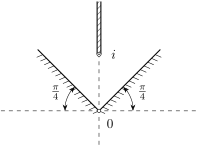
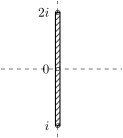
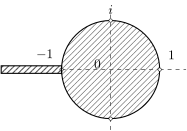
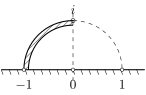
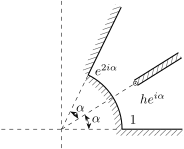
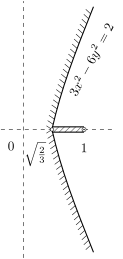
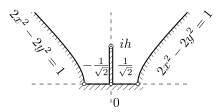
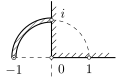
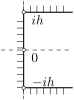
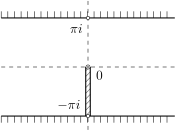
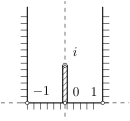
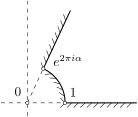
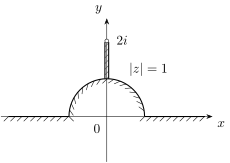
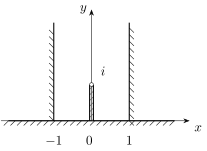
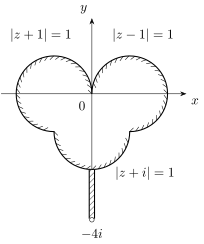
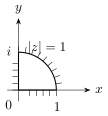
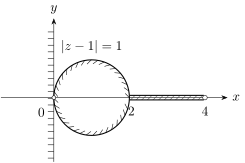
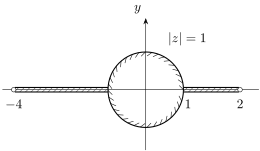
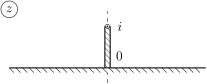
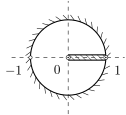
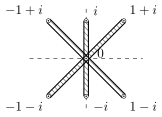
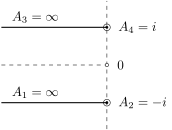
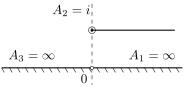
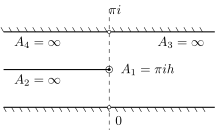
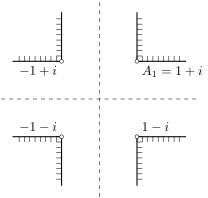
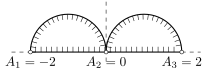
Find some functions w(z)w(z) that realize conformal mappings of the domains depicted in Fig. 28.31-28.45 onto the half-plane {w:Im(w)>0}\left\{ w: \mathrm{Im}\left(w\right) > 0\right\}.

?
(1)

Fig. 28.31Fig. 28.31

(2)

Fig. 28.32Fig. 28.32

(3)

Fig. 28.33Fig. 28.33

(4)

Fig. 28.34Fig. 28.34

(5)

Fig. 28.35Fig. 28.35

(6)

Fig. 28.36Fig. 28.36

(7)

Fig. 28.37Fig. 28.37

(8)

Fig. 28.38Fig. 28.38

(9)

Fig. 28.39Fig. 28.39

(10)

Fig. 28.40Fig. 28.40

(11)

Fig. 28.41Fig. 28.41

(12)

Fig. 28.42Fig. 28.42

(13)

Fig. 28.43Fig. 28.43

(14)

Fig. 28.44Fig. 28.44

(15)

Fig. 28.45Fig. 28.45

Problem 28.6

Find a function w(z)w(z) that conformally maps the domain

{(x,y):y2>4(x+1)}(x=Re(z),y=Im(z)) \left\{ (x, y): y^{2} > 4(x+1)\right\} (x = \mathrm{Re}\left(z\right), y = \mathrm{Im}\left(z\right))

onto the disk {w:∣w∣<1}\left\{ w:\left|w\right| < 1\right\} and satisfies the conditions

w(−4)=0,arg⁡w′(−4)=0. w(-4) = 0, \quad \arg w^{\prime }(-4) = 0.
?
Problem 28.7

Find a function w(z)w(z) that conformally maps the angle {z:∣arg⁡z∣<π4}\left\{ z:\left|\arg z\right| < \frac{\pi }{4}\right\} onto the disk {w:∣w∣<1}\left\{ w:\left|w\right| < 1\right\} and satisfies the conditions

w(1)=0,arg⁡w′(1)=π. w(1) = 0, \quad \arg w^{\prime }(1) = \pi .
?
Problem 28.8

Find the images of the following domains DD under the mapping by the regular branch of the function w=z+z2−1w = z+\sqrt{z^{2}-1}, singled out by its value at the indicated point (in the inequalities defining the domain, it is assumed that x=Re(z)x = \mathrm{Re}\left(z\right), y=Im(z)y = \mathrm{Im}\left(z\right), and a,ba, b and α\alpha are real constants):

?
(1)

D={(x,y):x2a2+y2a2−1>1},(a>0),w(∞)=0;D = \left\{ (x, y): \frac{x^{2}}{a^{2}}+\frac{y^{2}}{a^{2}-1} > 1\right\} ,(a > 0), w(\infty ) = 0 ;

(2)

D={(x,y):x2a2−y21−a2<1},(0<a<1),w(0)=iD = \left\{ (x, y): \frac{x^{2}}{a^{2}}-\frac{y^{2}}{1-a^{2}} < 1\right\} ,(0 < a < 1), w(0) = i;

(3)

D={z:z∉[−∞,−1],z∉[1,+∞]},w(0)=iD = \left\{ z: z \notin [-\infty ,-1], z \notin [1,+\infty ]\right\} , w(0) = i;

(4)

D={z:z∉[−1,1]},w(∞)=∞D = \left\{ z: z \notin [-1,1]\right\} , w(\infty ) = \infty;

(5)

D={z:Im(z)>0},w(+i∞)=0D = \left\{ z: \mathrm{Im}\left(z\right) > 0\right\} , w(+i \infty ) = 0;

(6)

D={(x,y):x2a2+y2a2−1<1,y>0},(a>1),w(+i0)=iD = \left\{ (x, y): \frac{x^{2}}{a^{2}}+\frac{y^{2}}{a^{2}-1} < 1, y > 0\right\} ,(a > 1), w(+i 0) = i;

(7)

D={(x,y):x2cos⁡2α−y2sin⁡2α>1,x>0,y>0}D = \left\{ (x, y): \frac{x^{2}}{\cos^{2} \alpha }-\frac{y^{2}}{\sin^{2} \alpha } > 1, x > 0, y > 0\right\}, (0<α<π2),w(+∞)=0;\left(0 < \alpha < \frac{\pi }{2}\right), w(+\infty ) = 0 ;

(8)

D={(x,y):x2a2+y2a2−1<1,z∉[−1,1]},(a>1),w(+i0)=−iD = \left\{ (x, y): \frac{x^{2}}{a^{2}}+\frac{y^{2}}{a^{2}-1} < 1, z \notin [-1,1]\right\} ,(a > 1), w(+i 0) = -i;

(9)

D={(x,y):x2a2+y2a2−1<1,x2b2+y2b2−1>1}D = \left\{ (x, y): \frac{x^{2}}{a^{2}}+\frac{y^{2}}{a^{2}-1} < 1, \frac{x^{2}}{b^{2}}+\frac{y^{2}}{b^{2}-1} > 1\right\}, (a>b>1),w(z)>1(a > b > 1), w(z) > 1 for b<z<ab < z < a.

Problem 28.9

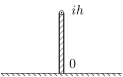
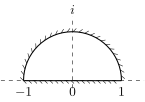
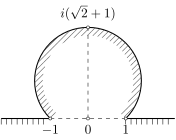
Prove that the image of the domain {z:∣z−ih∣>1+h2}\left\{ z:\left|z-i h\right| > \sqrt{1+h^{2}}\right\} under the mapping w=12(z+1z)w = \frac{1}{2}\left(z+\frac{1}{z}\right) is the entire ww-plane with a cut along the arc of a circle having endpoints at the points w=±1w = \pm 1 and passing through the point w=ihw = i h.

?
Problem 28.10

Find some functions w(z)w(z) that realize conformal mappings of the domains depicted in Fig. 28.46-28.61 onto the half-plane {w:Im(w)>0}\left\{ w: \mathrm{Im}\left(w\right) > 0\right\}.

?
(1)

Fig. 28.46Fig. 28.46

(2)

Fig. 28.47Fig. 28.47

(3)

Fig. 28.48Fig. 28.48

(4)

Fig. 28.49Fig. 28.49

(5)

Fig. 28.50Fig. 28.50

(6)

Fig. 28.51Fig. 28.51

(7)

Fig. 28.52Fig. 28.52

(8)

Fig. 28.53Fig. 28.53

(9)

Fig. 28.54Fig. 28.54

(10)

Fig. 28.55Fig. 28.55

(11)

Fig. 28.56Fig. 28.56

(12)

Fig. 28.57Fig. 28.57

(13)

Fig. 28.58Fig. 28.58

(14)

Fig. 28.59Fig. 28.59

(15)

Fig. 28.60Fig. 28.60

(16)

Fig. 28.61Fig. 28.61

Problem 28.11

Find some functions w(z)w(z) that realize conformal mappings of the domains depicted in Fig. 28.62-28.69 onto the disk {w:∣w∣<1}\left\{ w:\left|w\right| < 1\right\}.

?
(1)

Fig. 28.62Fig. 28.62

(2)

Fig. 28.63Fig. 28.63

(3)

Fig. 28.64Fig. 28.64

(4)

Fig. 28.65Fig. 28.65

(5)

Fig. 28.66Fig. 28.66

(6)

Fig. 28.67Fig. 28.67

(7)

Fig. 28.68Fig. 28.68

(8)

Fig. 28.69Fig. 28.69

Problem 28.12

Find a function w(z)w(z) that conformally maps the half-disk {z:∣z∣<1,Im(z)>0}\left\{ z:\left|z\right| < 1, \mathrm{Im}\left(z\right) > 0\right\} onto the disk {w:∣w∣<1}\left\{ w:\left|w\right| < 1\right\} and satisfies the conditions

w(i2)=0,arg⁡w′(i2)=0. w\left(\frac{i}{2}\right) = 0, \quad \arg w^{\prime }\left(\frac{i}{2}\right) = 0.
?
Problem 28.13

Find a function w(z)w(z) that conformally maps the domain {z=x+iy:x2−y2<1}\left\{ z = x+i y: x^{2}-y^{2} < 1\right\} onto the disk {w:∣w∣<1}\left\{ w:\left|w\right| < 1\right\} and satisfies the conditions w(0)=0,w(1)=1w(0) = 0, w(1) = 1.

?
Problem 28.14

Find a function w(z)w(z) that conformally maps the disk {z:∣z∣<1}\left\{ z:\left|z\right| < 1\right\}, cut along the radius [−1,0][-1,0], onto the disk {w:∣w∣<1}\left\{ w:\left|w\right| < 1\right\} and satisfies the conditions

w(1)=−1,w(−1+i0)=7−4i29,w(−1−i0)=7+4i29. w(1) = -1, \quad w(-1+i 0) = \frac{7-4 i \sqrt{2}}{9}, \quad w(-1-i 0) = \frac{7+4 i \sqrt{2}}{9}.
?
Problem 28.15

Find a function w(z)w(z) that conformally maps the entire zz-plane with a cut along the arc of the circle {z:∣z∣=1,Im(z)>0}\left\{ z:\left|z\right| = 1, \mathrm{Im}\left(z\right) > 0\right\} onto the entire ww-plane with a cut along the segment [−1,1][-1,1] and satisfies the conditions w(1)=1w(1) = 1, w(∞)=∞w(\infty ) = \infty.

?
Problem 28.16

Find the images of the following lines under the mapping given by the function w=12(z+1z):w = \frac{1}{2}\left(z+\frac{1}{z}\right):

?
(1)

{z:∣z∣=1,Im(z)>0}\left\{ z:\left|z\right| = 1, \mathrm{Im}\left(z\right) > 0\right\};

(2)

{z:∣z∣=1,−3π4<arg⁡z<−π4}\left\{ z:\left|z\right| = 1,-\frac{3 \pi }{4} < \arg z < -\frac{\pi }{4}\right\};

(3)

{z:∣z∣=2}\left\{ z:\left|z\right| = 2\right\};

(4)

{z:∣z∣=12}\left\{ z:\left|z\right| = \frac{1}{2}\right\};

(5)

{z:arg⁡z=π4}\left\{ z: \arg z = \frac{\pi }{4}\right\};

(6)

{z:arg⁡z=3π4}\left\{ z: \arg z = \frac{3 \pi }{4}\right\}.

Problem 28.17

Find the images of the following domains under the mapping given by the function w=12(z+1z):w = \frac{1}{2}\left(z+\frac{1}{z}\right):

?
(1)

{z:∣z∣>2}\left\{ z:\left|z\right| > 2\right\};

(2)

{z:∣z∣<12}\left\{ z:\left|z\right| < \frac{1}{2}\right\};

(3)

{z:π4<arg⁡z=3π4}\left\{ z: \frac{\pi }{4} < \arg z = \frac{3 \pi }{4}\right\};

(4)

{z:π4<arg⁡z=3π4,z∉[0,i]}\left\{ z: \frac{\pi }{4} < \arg z = \frac{3 \pi }{4}, z \notin [0, i]\right\};

(5)

{z:∣z∣<1,z∉[0,1]}\left\{ z:\left|z\right| < 1, z \notin [0,1]\right\};

(6)

{z:∣z∣>1,z∉[−2,−1],z∉[1,+∞]}\left\{ z:\left|z\right| > 1, z \notin [-2,-1], z \notin [1,+\infty ]\right\};

(7)

{z:Im(z)>0}\{z:∣z∣=1,0<arg⁡z<π4,3π4<arg⁡z<π}\left\{ z: \mathrm{Im}\left(z\right) > 0\right\} \backslash \left\{ z:\left|z\right| = 1,0 < \arg z < \frac{\pi }{4}, \frac{3 \pi }{4} < \arg z < \pi \right\};

(8)

{z:∣z∣<1,Im(z)<0,z∉[−i,−i2]}\left\{ z:\left|z\right| < 1, \mathrm{Im}\left(z\right) < 0, z \notin \left[-i,-\frac{i}{2}\right]\right\};

(9)

{z:∣z∣<1,0<arg⁡z<π2}\left\{ z:\left|z\right| < 1,0 < \arg z < \frac{\pi }{2}\right\};

(10)

{z:∣z∣<1,−3π4<arg⁡z<−π4}\left\{ z:\left|z\right| < 1,-\frac{3 \pi }{4} < \arg z < -\frac{\pi }{4}\right\}.

Problem 28.18

Find the images of the domains DD under the mappings effected by the indicated functions:

?
(1)

D={z:−π<Im(z)<0},w=ezD = \left\{ z:-\pi < \mathrm{Im}\left(z\right) < 0\right\} , w = e^{z};

(2)

D={z:∣Im(z)∣<π},w=ezD = \left\{ z:\left|\mathrm{Im}\left(z\right)\right| < \pi \right\} , w = e^{z};

(3)

D={z:∣Im(z)∣<π2},w=ezD = \left\{ z:\left|\mathrm{Im}\left(z\right)\right| < \frac{\pi }{2}\right\} , w = e^{z};

(4)

D={z:0<Im(z)<2π,Re(z)>0},w=ezD = \left\{ z: 0 < \mathrm{Im}\left(z\right) < 2 \pi , \mathrm{Re}\left(z\right) > 0\right\} , w = e^{z};

(5)

D={z:0<Im(z)<π2,Re(z)>0},w=e2zD = \left\{ z: 0 < \mathrm{Im}\left(z\right) < \frac{\pi }{2}, \mathrm{Re}\left(z\right) > 0\right\} , w = e^{2 z};

(6)

D={z:0<Re(z)<π,Im(z)>0},w=eizD = \left\{ z: 0 < \mathrm{Re}\left(z\right) < \pi , \mathrm{Im}\left(z\right) > 0\right\} , w = e^{i z};

(7)

D={z:z∉[0,+∞]},w=ln⁡z,w(−1)=−πiD = \left\{ z: z \notin [0,+\infty ]\right\} , w = \ln z, w(-1) = -\pi i;

(8)

D={z:Im(z)>0},w=ln⁡z,w(i)=πi2D = \left\{ z: \mathrm{Im}\left(z\right) > 0\right\} , w = \ln z, w(i) = \frac{\pi i}{2};

(9)

D={z:z∉[−∞,0],z∉[1,+∞]},w=ln⁡z,w(i)=πi2D = \left\{ z: z \notin [-\infty , 0], z \notin [1,+\infty ]\right\} , w = \ln z, w(i) = \frac{\pi i}{2};

(10)

D={z:∣z∣<1,Im(z)>0},w=ln⁡z,w(i−i0)=−3πi2D = \left\{ z:\left|z\right| < 1, \mathrm{Im}\left(z\right) > 0\right\} , w = \ln z, w(i-i 0) = -\frac{3 \pi i}{2};

(11)

D={z:∣z∣<1,z∉[0,1]},w=ln⁡z,w(−1+0)=−πiD = \left\{ z:\left|z\right| < 1, z \notin [0,1]\right\} , w = \ln z, w(-1+0) = -\pi i;

(12)

D={z:∣Im(z)∣<π4},w=th⁡zD = \left\{ z:\left|\mathrm{Im}\left(z\right)\right| < \frac{\pi }{4}\right\} , w = \operatorname {th} z;

(13)

D={z:0<Re(z)<π},w=tg⁡zD = \left\{ z: 0 < \mathrm{Re}\left(z\right) < \pi \right\} , w = \operatorname {tg} z;

(14)

D={z:0<Re(z)<π4},w=ctg⁡zD = \left\{ z: 0 < \mathrm{Re}\left(z\right) < \frac{\pi }{4}\right\} , w = \operatorname {ctg} z;

(15)

D={z:0<Re(z)<1,Im(z)>0},w=tg⁡πzD = \left\{ z: 0 < \mathrm{Re}\left(z\right) < 1, \mathrm{Im}\left(z\right) > 0\right\} , w = \operatorname {tg} \pi z;

(16)

D={z:0<Im(z)<π},w=ch⁡zD = \left\{ z: 0 < \mathrm{Im}\left(z\right) < \pi \right\} , w = \operatorname {ch} z;

(17)

D={z:Re(z)>0,−1<Im(z)<0},w=ch⁡πzD = \left\{ z: \mathrm{Re}\left(z\right) > 0,-1 < \mathrm{Im}\left(z\right) < 0\right\} , w = \operatorname {ch} \pi z;

(18)

D={z:Re(z)>0,0<Im(z)<1,z∉[i2,1+i2]},w=ch⁡πzD = \left\{ z: \mathrm{Re}\left(z\right) > 0,0 < \mathrm{Im}\left(z\right) < 1, z \notin \left[\frac{i}{2}, \frac{1+i}{2}\right]\right\} , w = \operatorname {ch} \pi z;

(19)

D={z:∣Im(z)∣<π,Re(z)>0},w=sh⁡zD = \left\{ z:\left|\mathrm{Im}\left(z\right)\right| < \pi , \mathrm{Re}\left(z\right) > 0\right\} , w = \operatorname {sh} z;

(20)

D={z:0<Re(z)<2π, Im(z)>0}D = \left\{ z: 0 < \mathrm{Re}\left(z\right) < 2 \pi \text{, }\mathrm{Im}\left(z\right) > 0\right\}, w=sin⁡zw = \sin z.

Problem 28.19

Find some functions w(z)w(z) effecting conformal mappings of the domains shown in Figs. 28.70-28.85 onto the half-plane {w:Im(w)>0}\left\{ w: \mathrm{Im}\left(w\right) > 0\right\}.

?
(1)

Fig. 28.70Fig. 28.70

(2)

Fig. 28.71Fig. 28.71

(3)

Fig. 28.72Fig. 28.72

(4)

Fig. 28.73Fig. 28.73

(5)

Fig. 28.74Fig. 28.74

(6)

Fig. 28.75Fig. 28.75

(7)

Fig. 28.76Fig. 28.76

(8)

Fig. 28.77Fig. 28.77

(9)

Fig. 28.78Fig. 28.78

(10)

Fig. 28.79Fig. 28.79

(11)

Fig. 28.80Fig. 28.80

(12)

Fig. 28.81Fig. 28.81

(13)

Fig. 28.82Fig. 28.82

(14)

Fig. 28.83Fig. 28.83

(15)

Fig. 28.84Fig. 28.84

(16)

Fig. 28.85Fig. 28.85

Problem 28.20

Find some functions w(z)w(z) conformally mapping the domains shown in Figs. 28.86-28.91 onto the strip {w:0<Im(w)<1}\left\{ w: 0 < \mathrm{Im}\left(w\right) < 1\right\}.

?
(1)

Fig. 28.86Fig. 28.86

(2)

Fig. 28.87Fig. 28.87

(3)

Fig. 28.88Fig. 28.88

(4)

Fig. 28.89Fig. 28.89

(5)

Fig. 28.90Fig. 28.90

(6)

Fig. 28.91Fig. 28.91

Problem 28.21

Find a function w(z)w(z) conformally mapping the strip {z:∣Im(z)∣<π}\left\{ z:\left|\mathrm{Im}\left(z\right)\right| < \pi \right\} onto the strip {w:∣Im(w)∣<π}\left\{ w:\left|\mathrm{Im}\left(w\right)\right| < \pi \right\} and satisfying the conditions

w(πi)=+∞,w(+∞)=−πi,w(−πi)=−∞. w(\pi i) = +\infty , \quad w(+\infty ) = -\pi i, \quad w(-\pi i) = -\infty .
?
Problem 28.22

Find some functions effecting conformal mappings of the domains shown in Figs. 28.92-28.107 onto the half-plane {w:Im(w)>0}\left\{ w: \mathrm{Im}\left(w\right) > 0\right\}.

?
(1)

Fig. 28.92Fig. 28.92

(2)

Fig. 28.93Fig. 28.93

(3)

Fig. 28.94Fig. 28.94

(4)

Fig. 28.95Fig. 28.95

(5)

Fig. 28.96Fig. 28.96

(6)

Fig. 28.97Fig. 28.97

(7)

Fig. 28.98Fig. 28.98

(8)

Fig. 28.99Fig. 28.99

(9)

Fig. 28.100Fig. 28.100

(10)

Fig. 28.101Fig. 28.101

(11)

Fig. 28.102Fig. 28.102

(12)

Fig. 28.103Fig. 28.103

(13)

Fig. 28.104Fig. 28.104

(14)

Fig. 28.105Fig. 28.105

(15)

Fig. 28.106Fig. 28.106

(16)

Fig. 28.107Fig. 28.107

Problem 29.1

Denote by w(z)w(z) the function conformally mapping the angle {z:0<arg⁡z<π2}\left\{ z: 0 < \arg z < \frac{\pi }{2}\right\} onto the sector {w:∣w∣>1,0<arg⁡w<π2}\left\{ w:\left|w\right| > 1,0 < \arg w < \frac{\pi }{2}\right\} and satisfying the conditions w(1)=1,w(i)=i,w(∞)=∞w(1) = 1, w(i) = i, w(\infty ) = \infty. Having found the function w(z)w(z), verify that it:

?
(1)

conformally maps the domain shown in Fig. 29.12 onto the domain {w:Im(w)>0,∣w∣>1}\left\{ w: \mathrm{Im}\left(w\right) > 0,\left|w\right| > 1\right\};

Fig. 29.12Fig. 29.12

(2)

conformally maps the domain shown in Fig. 29.13 onto the domain {w:∣w∣>1}\left\{ w:\left|w\right| > 1\right\}.

Fig. 29.13Fig. 29.13

Problem 29.2

Denote by w(z)=w(z;z1,z2,z3)w(z) = w\left(z ; z_{1}, z_{2}, z_{3}\right) the function conformally mapping the half-disk {z:∣z∣<1,Im(z)>0}\left\{ z:\left|z\right| < 1, \mathrm{Im}\left(z\right) > 0\right\} onto the same half-disk in the ww-plane and satisfying the conditions

w(z1)=1,w(z2)=i,w(z3)=−1 w\left(z_{1}\right) = 1, \quad w\left(z_{2}\right) = i, \quad w\left(z_{3}\right) = -1

(the points z1,z2,z3z_{1}, z_{2}, z_{3} lie on the boundary of the half-disk {z:∣z∣<1,Im(z)>0}\left\{ z:\left|z\right| < 1, \mathrm{Im}\left(z\right) > 0\right\}). Determine what conditions the points z1,z2,z3z_{1}, z_{2}, z_{3} must satisfy in order for the function w(z)w(z) to conformally map the disk {z:∣z∣<1}\left\{ z:\left|z\right| < 1\right\} onto:

?
(1)

the disk {w:∣w∣<1}\left\{ w:\left|w\right| < 1\right\};

(2)

the half-plane {w:Im(w)>0}\left\{ w: \mathrm{Im}\left(w\right) > 0\right\};

(3)

the domain shown in Fig. 29.14;

Fig. 29.14Fig. 29.14

(4)

the domain shown in Fig. 29.15;

Fig. 29.15Fig. 29.15

(5)

the domain shown in Fig. 29.16;

Fig. 29.16Fig. 29.16

(6)

the domain shown in Fig. 29.17.

Fig. 29.17Fig. 29.17

Problem 29.3

Find some functions w(z)w(z) conformally mapping the domains shown in Figs. 29.18-29.29 onto the half-plane {w:Im(w)>0}\left\{ w: \mathrm{Im}\left(w\right) > 0\right\}.

?
(1)

Fig. 29.18Fig. 29.18

(2)

Fig. 29.19Fig. 29.19

(3)

Fig. 29.20Fig. 29.20

(4)

Fig. 29.21Fig. 29.21

(5)

Fig. 29.22Fig. 29.22

(6)

Fig. 29.23Fig. 29.23

(7)

Fig. 29.24Fig. 29.24

(8)

Fig. 29.25Fig. 29.25

(9)

Fig. 29.26Fig. 29.26

(10)

Fig. 29.27Fig. 29.27

(11)

Fig. 29.28Fig. 29.28

(12)

Fig. 29.29Fig. 29.29

Problem 29.4

Find some function w(z)w(z) conformally mapping the domain

{z=x+iy:x2cos⁡2α−y2sin⁡2α>1,x>0} \left\{ z = x+i y: \frac{x^{2}}{\cos ^{2} \alpha }-\frac{y^{2}}{\sin ^{2} \alpha } > 1, x > 0\right\}

(α\alpha is a constant, 0<α<π/20 < \alpha < \pi / 2) onto the half-plane {w:Im(w)>0}\left\{ w: \mathrm{Im}\left(w\right) > 0\right\}.

?
Problem 29.5

Find some function w(z)w(z) conformally mapping the domain

{z=x+iy:y2<2p(x+p2)},p>0 \left\{ z = x+i y: \quad y^{2} < 2 p\left(x+\frac{p}{2}\right)\right\} , \quad p > 0

onto the half-plane {w:Im(w)>0}\left\{ w: \mathrm{Im}\left(w\right) > 0\right\}.

?
Problem 29.6

Find some functions w(z)w(z) that conformally map the regions depicted in Fig. 29.30-29.33 onto the disk {w:∣w∣<1}\left\{ w:\left|w\right| < 1\right\}.

?
(1)

Fig. 29.30Fig. 29.30

(2)

Fig. 29.31Fig. 29.31

(3)

Fig. 29.32Fig. 29.32

(4)

Fig. 29.33Fig. 29.33

Problem 29.7

Find some function w(z)w(z) that conformally maps the region

{z:z∉[kπi,kπi+i∞](k=0,±1,±2,…)} \left\{ z: z \notin [k \pi i, k \pi i+i \infty ] \quad (k = 0, \pm 1, \pm 2, \ldots )\right\}

onto the half-plane {w:Im(w)>0}\left\{ w: \mathrm{Im}\left(w\right) > 0\right\}.

?
Problem 29.8

Find some function w(z)w(z) that conformally maps the region

{z:Im(z)>0,z∉[kπ,kπ+πi](k=0,±1,±2,…)} \left\{ z: \mathrm{Im}\left(z\right) > 0, z \notin [k \pi , k \pi +\pi i] \quad (k = 0, \pm 1, \pm 2, \ldots )\right\}

onto the half-plane {w:Im(w)>0}\left\{ w: \mathrm{Im}\left(w\right) > 0\right\}.

?
Problem 29.9

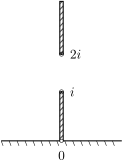
Find some function w(z)w(z) that conformally maps the region {z:Im⁡>0,z∉[2k,2k+2i],z∉[2k+1,2k+1+i](k=0,±1,…)}\left\{ z: \operatorname {Im} > 0, z \notin [2 k, 2 k+2 i], z \notin [2 k+1,2 k+1+i] \quad (k = 0, \pm 1, \ldots )\right\} onto the half-plane {w:Im(w)>0}\left\{ w: \mathrm{Im}\left(w\right) > 0\right\}.

?
Problem 29.10

Find some functions w(z)w(z) that conformally map the regions depicted in Fig. 29.34-29.36 onto the half-plane {w:Im(w)>0}\left\{ w: \mathrm{Im}\left(w\right) > 0\right\}.

?
(1)

Fig. 29.34Fig. 29.34

(2)

Fig. 29.35Fig. 29.35

(3)

Fig. 29.36Fig. 29.36

Problem 29.11

Let the function f(z)f(z) be regular on {z:Im(z)>0}\left\{ z: \mathrm{Im}\left(z\right) > 0\right\}, continuous on {z:Im(z)⩾0}\left\{ z: \mathrm{Im}\left(z\right) \geqslant 0\right\}, and take real values on the real axis. Prove that the function f(z)f(z) can be regularly continued to the entire complex plane.

?
Problem 29.12

Let the function f(z)f(z) be regular on {z:0<Re(z)<1}\left\{ z: 0 < \mathrm{Re}\left(z\right) < 1\right\}, continuous on {z:0⩽Re(z)⩽1}\left\{ z: 0 \leqslant \mathrm{Re}\left(z\right) \leqslant 1\right\}, and take real values on the lines {z:Re(z)=0}\left\{ z: \mathrm{Re}\left(z\right) = 0\right\} and {z:Re(z)=1}\left\{ z: \mathrm{Re}\left(z\right) = 1\right\}. Prove that the function f(z)f(z) can be regularly continued to the entire complex plane and that the function F(z)F(z) effecting this analytic continuation satisfies the condition F(z+2)=F(z)F(z+2) = F(z).

?
Problem 29.13

Let the function f(z)f(z) be regular on {z:0<Im(z)<1}\left\{ z: 0 < \mathrm{Im}\left(z\right) < 1\right\}, continuous on {z:0⩽Im(z)⩽1}\left\{ z: 0 \leqslant \mathrm{Im}\left(z\right) \leqslant 1\right\}, and satisfy the conditions

Re(f(z))=0(Im(z)=0);Im(f(z))=0(Im(z)=1) \mathrm{Re}\left(f(z)\right) = 0 \quad (\mathrm{Im}\left(z\right) = 0) ; \quad \mathrm{Im}\left(f(z)\right) = 0 \quad (\mathrm{Im}\left(z\right) = 1)

Prove that the function f(z)f(z) can be regularly continued to the entire plane and that the function F(z)F(z) effecting this analytic continuation satisfies the condition F(z+2i)=−F(z)F(z+2 i) = -F(z).

?
Problem 29.14

Let the function f(z)f(z) be regular in the rectangle

{z:∣Im(z)∣<h,0<Re(z)<1}, \left\{ z:\left|\mathrm{Im}\left(z\right)\right| < h, 0 < \mathrm{Re}\left(z\right) < 1\right\} ,

continuous in the closure of this rectangle, and satisfy the conditions

Im(f(z))=0(Re(z)=0,∣Im(z)∣<h);Im(f(z))=1(Re(z)=1,∣Im(z)∣<h) \begin{array}{ll} \mathrm{Im}\left(f(z)\right) = 0 & (\mathrm{Re}\left(z\right) = 0,\left|\mathrm{Im}\left(z\right)\right| < h) ; \\ \mathrm{Im}\left(f(z)\right) = 1 & (\mathrm{Re}\left(z\right) = 1,\left|\mathrm{Im}\left(z\right)\right| < h) \end{array}

Prove that the function f(z)f(z) can be regularly continued to the strip {z:∣Im(z)∣<h}\left\{ z:\left|\mathrm{Im}\left(z\right)\right| < h\right\} and that the function F(z)F(z) effecting this continuation has the form iz+F1(z)i z+F_{1}(z), where the function F1(z)F_{1}(z) is regular in the strip {z:∣Im(z)∣<h}\left\{ z:\left|\mathrm{Im}\left(z\right)\right| < h\right\} and periodic with period 2.

?
Problem 29.15

Let the function f(z)f(z) be regular in the half-annulus

{z:ρ<∣z∣<R,Im(z)>0}, \left\{ z: \rho < \left|z\right| < R, \mathrm{Im}\left(z\right) > 0\right\} ,

continuous in its closure, and take real values on the segments (−R,−ρ)(-R,-\rho ) and (ρ,R)(\rho , R). Prove that the function f(z)f(z) can be regularly continued into the annulus {z:ρ<∣z∣<R}\left\{ z: \rho < \left|z\right| < R\right\} to a function regular in this annulus.

?
Problem 29.16

Let the function f(z)f(z) conformally map the rectangle {z:∣Re(z)∣<h,∣Im(z)∣<h}\left\{ z:\left|\mathrm{Re}\left(z\right)\right| < h,\left|\mathrm{Im}\left(z\right)\right| < h\right\} onto some disk (or half-plane). Prove that the regular continuation of the function f(z)f(z) is a function meromorphic in the entire plane and periodic with periods 4h4 h and 4ih4 i h.

?
Problem 29.17

Let the function f(z)f(z) conformally map the sector

{z:∣z∣<1,0<arg⁡z<πn}, \left\{ z:\left|z\right| < 1,0 < \arg z < \frac{\pi }{n}\right\} ,

onto the triangle with the same vertices 0,1,eπi/n0,1, e^{\pi i / n}, in such a way that these vertices remain fixed. Prove that the function f(z)f(z) can be regularly continued into the disk {z:∣z∣<1}\left\{ z:\left|z\right| < 1\right\} and that the function F(z)F(z) effecting this analytic continuation conformally maps the disk {z:∣z∣<1}\left\{ z:\left|z\right| < 1\right\} onto a regular 2n2 n-gon (with center at the point 0 and one of its vertices at the point 1).

?
Problem 29.18

Prove that any conformal mapping of a disk onto a disk (or onto a half-plane) is a fractional-linear mapping.

?
Problem 29.19

Prove that there is no function conformally mapping the annulus {z:1<∣z∣<R1}\left\{ z: 1 < \left|z\right| < R_{1}\right\} onto the annulus {z:1<∣z∣<R2}\left\{ z: 1 < \left|z\right| < R_{2}\right\} if R1≠R2R_{1} \neq R_{2}.

?
Problem 29.20

Let the function f(z)f(z) conformally map the half-plane {z:Im(z)>0}\left\{ z: \mathrm{Im}\left(z\right) > 0\right\} onto the region:

{w:Im(w)>0,0<Re(w)<1,∣w−12∣>12} \left\{ w: \mathrm{Im}\left(w\right) > 0,0 < \mathrm{Re}\left(w\right) < 1,\left|w-\frac{1}{2}\right| > \frac{1}{2}\right\}

Prove that the regular continuation of the function f(z)f(z) leads to a function F(z)F(z) regular in the entire extended complex plane with three punctured points (the preimages of the points 0, 1, and ∞\infty).

?
Problem 30.1

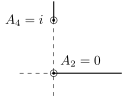
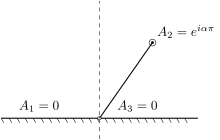
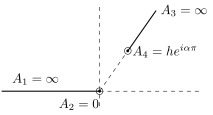
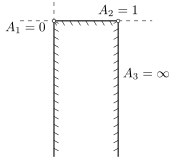
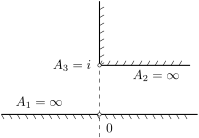
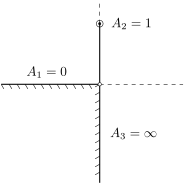
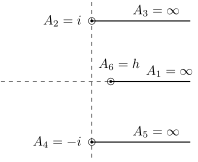
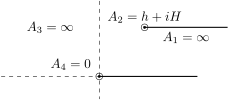
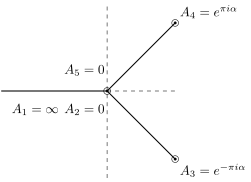
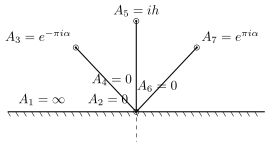
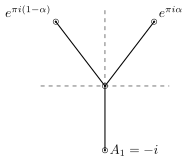
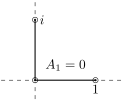
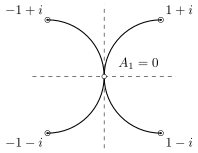
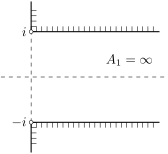
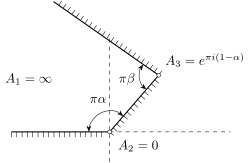
Find functions w(z)w(z) that conformally map the half-plane {z:Im(z)>0}\left\{ z: \mathrm{Im}\left(z\right) > 0\right\} onto the polygons depicted in Fig. 30.5-30.18, in such a way that w(0)=A1,w(1)=A2,w(∞)=A3w(0) = A_{1}, w(1) = A_{2}, w(\infty ) = A_{3} (the vertices AkA_{k} are marked in the figures).

?
(1)

Fig. 30.5Fig. 30.5

(2)

Fig. 30.6Fig. 30.6

(3)

Fig. 30.7Fig. 30.7

(4)

Fig. 30.8Fig. 30.8

(5)

Fig. 30.9Fig. 30.9

(6)

Fig. 30.10Fig. 30.10

(7)

Fig. 30.11Fig. 30.11

(8)

Fig. 30.12Fig. 30.12

(9)

Fig. 30.13Fig. 30.13

(10)

Fig. 30.14Fig. 30.14

(11)

Fig. 30.15Fig. 30.15

(12)

Fig. 30.16Fig. 30.16

(13)

Fig. 30.17Fig. 30.17

(14)

Fig. 30.18Fig. 30.18

Problem 30.2

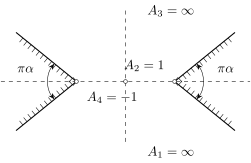
Find some functions w(z)w(z) that conformally map the half-plane {z:Im(z)>0}\left\{ z: \mathrm{Im}\left(z\right) > 0\right\} onto the symmetric polygons depicted in Fig. 30.19-30.24.

?
(1)

Fig. 30.19Fig. 30.19

(2)

Fig. 30.20Fig. 30.20

(3)

Fig. 30.21Fig. 30.21

(4)

Fig. 30.22Fig. 30.22

(5)

Fig. 30.23Fig. 30.23

(6)

Fig. 30.24Fig. 30.24

Problem 30.3

Find functions w(z)w(z) that conformally map the region {z:∣z∣>1}\left\{ z:\left|z\right| > 1\right\} onto the polygons with interior point w=∞w = \infty depicted in Fig. 30.25-30.27, in such a way that w(∞)=∞,w(1)=A1w(\infty ) = \infty , w(1) = A_{1}.

?
(1)

Fig. 30.25Fig. 30.25

(2)

Fig. 30.26Fig. 30.26

(3)

Fig. 30.27Fig. 30.27

Problem 30.4

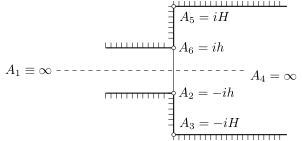
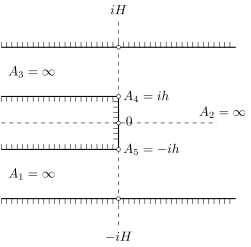
Find functions w(z)w(z) that conformally map the half-plane {z:Im(z)>0}\left\{ z: \mathrm{Im}\left(z\right) > 0\right\} onto the regions depicted in Fig. 30.28-30.31, in such a way that

w(0)=A1,w(1)=A2,w(∞)=A3. w(0) = A_{1}, \quad w(1) = A_{2}, \quad w(\infty ) = A_{3}.
?
(1)

Fig. 30.28Fig. 30.28

(2)

Fig. 30.29Fig. 30.29

(3)

Fig. 30.30Fig. 30.30

(4)

Fig. 30.31Fig. 30.31

Problem 30.5

Find functions w(z)w(z) that conformally map the entire zz-plane cut along the segment [−1,1][-1,1] onto the regions depicted in Fig. 30.32-30.34, in such a way that w(∞)=∞,w(1)=A1w(\infty ) = \infty , w(1) = A_{1}.

?
(1)

Fig. 30.32Fig. 30.32

(2)

Fig. 30.33Fig. 30.33

(3)

Fig. 30.34Fig. 30.34

Problem 30.6

Find functions w(z)w(z) that conformally map the strip {z:∣Im⁡∣<12}\left\{ z:\left|\operatorname {Im}\right| < \frac{1}{2}\right\} onto the regions depicted in Fig. 30.35-30.37, in such a way that w(0)=0,w(+∞)=A1w(0) = 0, w(+\infty ) = A_{1}.

?
(1)

Fig. 30.35Fig. 30.35

(2)

Fig. 30.36Fig. 30.36

(3)

Fig. 30.37Fig. 30.37

Problem 30.7

Find functions w(z)w(z) that conformally map the half-strip {z:Re(z)>0,∣Im(z)∣<π2}\left\{ z: \mathrm{Re}\left(z\right) > 0,\left|\mathrm{Im}\left(z\right)\right| < \frac{\pi }{2}\right\} onto the regions depicted in Fig. 30.38-30.39, in such a way that

w(−πi2)=A1,w(∞)=A2,w(πi2)=A3 w\left(-\frac{\pi i}{2}\right) = A_{1}, \quad w(\infty ) = A_{2}, \quad w\left(\frac{\pi i}{2}\right) = A_{3}
?
(1)

Fig. 30.38Fig. 30.38

(2)

Fig. 30.39Fig. 30.39

Problem 30.8

Find some function w(z)w(z) that conformally maps the half-plane {z:Im(z)>0}\left\{ z: \mathrm{Im}\left(z\right) > 0\right\} onto the ww-plane with cuts along the rays

[ki,ki+i∞],[(k+14)i,(k+14)i+i∞](k=0,±1,±2,…) [k i, k i+i \infty ], \quad \left[\left(k+\frac{1}{4}\right) i,\left(k+\frac{1}{4}\right) i+i \infty \right] \quad (k = 0, \pm 1, \pm 2, \ldots )
?
Problem 30.9

Find some function w(z)w(z) that conformally maps the half-plane {z:Im(z)>0}\left\{ z: \mathrm{Im}\left(z\right) > 0\right\} onto the half-plane ww from which the strips are removed

{w:Re(w)<0,∣k−Im(w)∣<14}(k=0,±1,±2,…) \left\{ w: \mathrm{Re}\left(w\right) < 0,\left|k-\mathrm{Im}\left(w\right)\right| < \frac{1}{4}\right\} \quad (k = 0, \pm 1, \pm 2, \ldots )
?
Problem 30.10

Find functions w(z)w(z) that conformally map the half-plane {z:Im(z)>0}\left\{ z: \mathrm{Im}\left(z\right) > 0\right\} onto the polygons depicted in Fig. 30.40-30.42, in such a way that w(0)=A1,w(1)=A2,w(∞)=A3w(0) = A_{1}, w(1) = A_{2}, w(\infty ) = A_{3}.

?
(1)

Fig. 30.40Fig. 30.40

(2)

Fig. 30.41Fig. 30.41

(3)

Fig. 30.42Fig. 30.42

Problem 30.11

Find a function w(z)w(z) that conformally maps the disk {z:∣z∣<1}\left\{ z:\left|z\right| < 1\right\} onto a regular nn-gon inscribed in the disk {w:∣w∣<1}\left\{ w:\left|w\right| < 1\right\}, in such a way that w(0)=0,w(1)=1w(0) = 0, w(1) = 1.

?
Problem 31.1

Solve the classical Dirichlet problem for the unit disk {z:∣z∣<1}\left\{ z:\left|z\right| < 1\right\}:

{Δu=0,∣z∣<1;u∣∣z∣=1=12+sin⁡φ, where z=reiφ \begin{cases} \Delta u = 0, & \left|z\right| < 1 ; \\ \left.u\right|_{\left|z\right| = 1} = \frac{1}{2+\sin \varphi }, & \text{ where } z = r e^{i \varphi } \end{cases}
?
Problem 31.2

Solve the general Dirichlet problem for the upper half-plane {z:Im(z)>0}\left\{ z: \mathrm{Im}\left(z\right) > 0\right\}:

{Δu=0,y>0u∣y=0=sin⁡x, where z=x+iy \begin{cases} \Delta u = 0, & y > 0 \\ \left.u\right|_{y = 0} = \sin x, & \text{ where } z = x+i y \end{cases}
?
Problem 31.3

Solve the general Dirichlet problem for the lower half-plane {z:Im(z)<0}\left\{ z: \mathrm{Im}\left(z\right) < 0\right\}:

{Δu=0,y<0u∣Re(z)⩾0=1,u∣Re(z)<0=0 \begin{cases} \Delta u = 0, & y < 0 \\ \left.u\right|_{\mathrm{Re}\left(z\right) \geqslant 0} = 1, & \left.u\right|_{\mathrm{Re}\left(z\right) < 0} = 0 \end{cases}
?
Problem 31.4

Solve the general Dirichlet problem for the exterior of the unit disk {z:∣z∣>1}\left\{ z:\left|z\right| > 1\right\}:

{Δu=0,∣z∣>1u∣∣z∣=1=15−4cos⁡φ \begin{cases} \Delta u = 0, \quad \left|z\right| > 1 \\ \left.u\right|_{\left|z\right| = 1} = \frac{1}{5-4 \cos \varphi } \end{cases}
?
Problem 31.5

Solve the general Dirichlet problem for the first quadrant of the plane D={z:Im(z)>0,Re(z)>0}:D = \left\{ z: \mathrm{Im}\left(z\right) > 0, \mathrm{Re}\left(z\right) > 0\right\} :

{Δu=0,z∈D;u∣Re(z)=0Im(z)>0=0,u∣Im(z)=0Re(z)⩾0=1. \begin{cases} \Delta u = 0, & z \in D ; \\ \left.u\right|_{\substack {\mathrm{Re}\left(z\right) = 0 \\ \mathrm{Im}\left(z\right) > 0}} = 0, & \left.u\right|_{\substack {\mathrm{Im}\left(z\right) = 0 \\ \mathrm{Re}\left(z\right) \geqslant 0}} = 1. \end{cases}
?
Problem 31.6

Solve the general Dirichlet problem for the half-strip

D={z:0<Im(z)<π,Re(z)>0}:{Δu=0,z∈D;u∣Im(z)=0Re(z)>0=0,u∣Im(z)=πRe(z)>0=0,u∣Re(z)=00⩽Im(z)⩽π=1. D = \left\{ z: 0 < \mathrm{Im}\left(z\right) < \pi , \mathrm{Re}\left(z\right) > 0\right\} : \begin{cases} \Delta u = 0, & z \in D ; \\ \left.u\right|_{\substack {\mathrm{Im}\left(z\right) = 0 \\ \mathrm{Re}\left(z\right) > 0}} = 0, & \left.u\right|_{\substack {\mathrm{Im}\left(z\right) = \pi \\ \mathrm{Re}\left(z\right) > 0}} = 0, & \left.u\right|_{\substack {\mathrm{Re}\left(z\right) = 0 \\ 0 \leqslant \mathrm{Im}\left(z\right) \leqslant \pi }} = 1. \end{cases}
?
Problem 31.7

Solve the general Dirichlet problem for the region

D={z:Im(z)>0,∣z+il∣<R}, D = \left\{ z: \mathrm{Im}\left(z\right) > 0,\left|z+i l\right| < R\right\} ,

where l>R>0l > R > 0:

{Δu=0,z∈D;u∣Im(z)=0=0,u∣∣z+il∣=R=T=const. \begin{cases} \Delta u = 0, & z \in D ; \\ \left.u\right|_{\mathrm{Im}\left(z\right) = 0} = 0, & \left.u\right|_{\left|z+i l\right| = R} = T = \mathrm{const}. \end{cases}
?
Problem 31.8

Find the Green's function of the Dirichlet problem for the Laplace operator in the unit disk {z:∣z∣<1}\left\{ z:\left|z\right| < 1\right\}.

?
Problem 31.9

Find the Green's function of the Dirichlet problem for the Laplace operator in the upper half-plane {z:Im(z)>0}\left\{ z: \mathrm{Im}\left(z\right) > 0\right\}.

?
Problem 31.10

Find the Green's function of the Dirichlet problem for the Laplace operator in the unit half-disk {z:∣z∣<1,Im(z)>0}\left\{ z:\left|z\right| < 1, \mathrm{Im}\left(z\right) > 0\right\}.

?
Problem 32.1

Find the transform F(p)F(p) of the original f(t)f(t), if:

?
(1)

f(t)=sin⁡tsin⁡3tf(t) = \sin t \sin 3 t;

(2)

f(t)=tsh⁡t;f(t) = t \operatorname {sh} t ;

(3)

f(t)=sin⁡3tf(t) = \sin^{3} t;

(4)

f(t)=cos⁡4t+sin⁡4tf(t) = \cos^{4} t+\sin^{4} t.

Problem 32.2

Find the original f(t)f(t) from its transform F(p)F(p), if:

?
(1)

F(p)=1p2−4p+5F(p) = \frac{1}{p^{2}-4 p+5};

(2)

F(p)=1p2(p2+1)F(p) = \frac{1}{p^{2}\left(p^{2}+1\right)};

(3)

F(p)=p+1p3−2p2−5p+6F(p) = \frac{p+1}{p^{3}-2 p^{2}-5 p+6};

(4)

F(p)=1p(p−1)(p2+4)F(p) = \frac{1}{p(p-1)\left(p^{2}+4\right)};

(5)

F(p)=1(p+1)(p+3)3F(p) = \frac{1}{(p+1)(p+3)^{3}};

(6)

F(p)=p2+2p−1p3+3p2+3p+1F(p) = \frac{p^{2}+2 p-1}{p^{3}+3 p^{2}+3 p+1};

(7)

F(p)=(5p+3)(p−1)(p2+2p+5)F(p) = \frac{(5 p+3)}{(p-1)\left(p^{2}+2 p+5\right)};

(8)

F(p)=p2(p2+4)(p2+9)F(p) = \frac{p^{2}}{\left(p^{2}+4\right)\left(p^{2}+9\right)};

(9)

F(p)=1(p+1)3(p+3)F(p) = \frac{1}{(p+1)^{3}(p+3)};

(10)

F(p)=1(p−1)2(p−2)3F(p) = \frac{1}{(p-1)^{2}(p-2)^{3}}.

Problem 32.3

Solve the Cauchy problem for the differential equation with the given initial conditions:

?
(1)

x′′(t)−2x′(t)+x(t)=t2et,x(0)=0,x′(0)=1x^{\prime \prime }(t)-2 x^{\prime }(t)+x(t) = t^{2} e^{t}, x(0) = 0, x^{\prime }(0) = 1;

(2)

x(3)(t)+3x(2)(t)+3x′(t)+x(t)=1,x(0)=x′(0)=x′′(0)=0x^{(3)}(t)+3 x^{(2)}(t)+3 x^{\prime }(t)+x(t) = 1, x(0) = x^{\prime }(0) = x^{\prime \prime }(0) = 0;

(3)

x(3)(t)−2x(2)(t)+x′(t)=4,x(0)=1,x′(0)=2,x′′(0)=−2x^{(3)}(t)-2 x^{(2)}(t)+x^{\prime }(t) = 4, x(0) = 1, x^{\prime }(0) = 2, x^{\prime \prime }(0) = -2;

(4)

x(3)(t)+x(2)(t)=cos⁡t,x(0)=−2,x′(0)=x′′(0)=0x^{(3)}(t)+x^{(2)}(t) = \cos t, x(0) = -2, x^{\prime }(0) = x^{\prime \prime }(0) = 0;

(5)

x′′(t)+x(t)=2cos⁡t,x(0)=−1,x′(0)=1x^{\prime \prime }(t)+x(t) = 2 \cos t, x(0) = -1, x^{\prime }(0) = 1;

(6)

x′′(t)+4x(t)=2sin⁡2t,x(0)=−1,x′(0)=0x^{\prime \prime }(t)+4 x(t) = 2 \sin 2 t, x(0) = -1, x^{\prime }(0) = 0;

(7)

x(4)(t)−x(t)=1,x(0)=1,x′(0)=1,x′′(0)=2,x(3)(0)=−1x^{(4)}(t)-x(t) = 1, x(0) = 1, x^{\prime }(0) = 1, x^{\prime \prime }(0) = 2, x^{(3)}(0) = -1;

(8)

x(4)(t)−5x(2)(t)+10x′(t)−6x(t)=0x^{(4)}(t)-5 x^{(2)}(t)+10 x^{\prime }(t)-6 x(t) = 0, x(0)=1,x′(0)=0,x′′(0)=6,x(3)(0)=−14x(0) = 1, x^{\prime }(0) = 0, x^{\prime \prime }(0) = 6, x^{(3)}(0) = -14.

Problem 32.4

Solve the Cauchy problem for the system of differential equations with the given initial conditions:

?
(1)

{x′(t)=−x(t)+2y(t),y′(t)=−x(t)−4y(t),x(0)=y(0)=1;\begin{cases} x^{\prime }(t) = -x(t)+2 y(t), \\ y^{\prime }(t) = -x(t)-4 y(t), \end{cases} \quad x(0) = y(0) = 1 ;

(2)

{x′(t)−2x(t)−4y(t)=0,y′(t)+x(t)+2y(t)=0,x(0)=2,y(0)=1\begin{cases} x^{\prime }(t)-2 x(t)-4 y(t) = 0, \\ y^{\prime }(t)+x(t)+2 y(t) = 0, \end{cases} \quad x(0) = 2, \quad y(0) = 1;

(3)

{x′(t)+3x(t)−4y(t)=9e2t,2x(t)+y′(t)−3y(t)=3e2t,x(0)=2,y(0)=0\begin{cases} x^{\prime }(t)+3 x(t)-4 y(t) = 9 e^{2 t}, \\ 2 x(t)+y^{\prime }(t)-3 y(t) = 3 e^{2 t}, \end{cases} \quad x(0) = 2, \quad y(0) = 0;

(4)

{x′(t)+y′(t)=1,x(2)(t)+y′(t)+x(t)=et,x(0)=1,x′(0)=2,y(0)=0,y′(0)=−1\begin{cases} x^{\prime }(t)+y^{\prime }(t) = 1, \\ x^{(2)}(t)+y^{\prime }(t)+x(t) = e^{t}, \end{cases} x(0) = 1, x^{\prime }(0) = 2, y(0) = 0, y^{\prime }(0) = -1.