Section 2

Sequences and Series of Complex Numbers. Complex-Valued Functions of a Real Variable. Curves and Domains in the Complex Plane

[50/22%]
Show
LaTeX
Problem 2.1

Prove the convergence of the sequence and find its limit:

?
(1)

{an1+a2n},∣a∣<1\left\{ \frac{a^{n}}{1+a^{2 n}}\right\} ,\left|a\right| < 1;

(2)

{an1+a2n},∣a∣>1\left\{ \frac{a^{n}}{1+a^{2 n}}\right\} ,\left|a\right| > 1;

(3)

{1n(1+eiφ+…+einφ)},0<φ<2π\left\{ \frac{1}{n}\left(1+e^{i \varphi }+\ldots +e^{i n \varphi }\right)\right\} , 0 < \varphi < 2 \pi;

(4)

{1n(1−eiφ+e2iφ−…+(−1)neinφ)},−π<φ<π\left\{ \frac{1}{\sqrt{n}}\left(1-e^{i \varphi }+e^{2 i \varphi }-\ldots +(-1)^{n} e^{i n \varphi }\right)\right\} ,-\pi < \varphi < \pi.

Problem 2.2

Prove that if ∣zn∣⩽M<∞\left|z_{n}\right| \leqslant M < \infty for n>n0n > n_{0}, then from the sequence {zn}\left\{ z_{n}\right\} one can select a subsequence {znk}\left\{ z_{n_{k}}\right\} converging to a finite limit.

?
Problem 2.3

Let lim⁡n→∞zn=A≠∞\lim_{n \rightarrow \infty } z_{n} = A \neq \infty. Prove that

lim⁡n→∞z1+z2+…+znn=A. \lim _{n \rightarrow \infty } \frac{z_{1}+z_{2}+\ldots +z_{n}}{n} = A.
?
Problem 2.4

Let lim⁡n→∞zn=A≠∞,lim⁡n→∞ζn=B≠∞\lim_{n \rightarrow \infty } z_{n} = A \neq \infty , \lim_{n \rightarrow \infty } \zeta_{n} = B \neq \infty. Prove that

lim⁡n→∞z1ζn+z2ζn−1+…+znζ1n=AB. \lim _{n \rightarrow \infty } \frac{z_{1} \zeta _{n}+z_{2} \zeta _{n-1}+\ldots +z_{n} \zeta _{1}}{n} = A B.
?
Problem 2.5

Let the numbers λ1,λ2,…\lambda_{1}, \lambda_{2}, \ldots be positive, and let

lim⁡n→∞(λ1+λ2+…+λn)=+∞ \lim _{n \rightarrow \infty }\left(\lambda _{1}+\lambda _{2}+\ldots +\lambda _{n}\right) = +\infty

Prove that from the equality lim⁡n→∞zn=A≠∞\lim_{n \rightarrow \infty } z_{n} = A \neq \infty it follows that

lim⁡n→∞λ1z1+λ2z2+…λnznλ1+λ2+…+λn=A. \lim _{n \rightarrow \infty } \frac{\lambda _{1} z_{1}+\lambda _{2} z_{2}+\ldots \lambda _{n} z_{n}}{\lambda _{1}+\lambda _{2}+\ldots +\lambda _{n}} = A.
?
Problem 2.6

Prove that for the sequence {zn}\left\{ z_{n}\right\} to converge to infinity it is necessary and sufficient that the sequence of real numbers {∣zn∣}\left\{ \left|z_{n}\right|\right\} converge to +∞+\infty.

?
Problem 2.7

Prove that lim⁡n→∞zn=∞\lim_{n \rightarrow \infty } z_{n} = \infty if and only if lim⁡n→∞1zn=0\lim_{n \rightarrow \infty } \frac{1}{z_{n}} = 0.

?
Problem 2.8

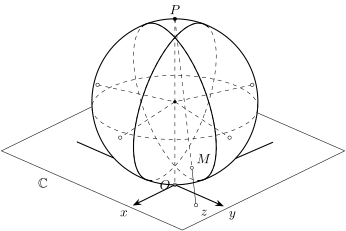
Choose in space a coordinate system ξ,η,ζ\xi , \eta , \zeta such that the axes OξO \xi and OηO \eta coincide with the axes OxO x and OyO y of the complex plane, and the axis OζO \zeta is directed along the diameter of the Riemann sphere (Fig. 2.2). Let x=Re(z)x = \mathrm{Re}\left(z\right), y=Im(z)y = \mathrm{Im}\left(z\right), and let the point M(z)M(z) have spatial coordinates (ξ,η,ζ)(\xi , \eta , \zeta ). Prove the formulas:

Fig. 2.2Fig. 2.2

ξ=x1+∣z∣2,η=y1+∣z∣2,ζ=∣z∣21+∣z∣2x=ξζξ2+η2,y=ηζξ2+η2 \begin{gathered} \xi = \frac{x}{1+\left|z\right|^{2}}, \quad \eta = \frac{y}{1+\left|z\right|^{2}}, \quad \zeta = \frac{\left|z\right|^{2}}{1+\left|z\right|^{2}} \\ x = \frac{\xi \zeta }{\xi ^{2}+\eta ^{2}}, \quad y = \frac{\eta \zeta }{\xi ^{2}+\eta ^{2}} \end{gathered}
?
Problem 2.9

Let the point M(z)M(z) have spatial coordinates (ξ,η,ζ)(\xi , \eta , \zeta ). Find the spatial coordinates of the point MM:

?
(1)

M(−z)M(-z);

(2)

M(zˉ)M(\bar{z});

(3)

M(1z)M\left(\frac{1}{z}\right).

Problem 2.10

Give a geometric description of the sets on the Riemann sphere corresponding to the following sets of the complex plane:

?
(1)

Re(z)>0\mathrm{Re}\left(z\right) > 0;

(2)

Im(z)<0\mathrm{Im}\left(z\right) < 0;

(3)

∣z∣>1\left|z\right| > 1;

(4)

∣z∣<1\left|z\right| < 1.

Problem 2.11

Prove that points M(z1)M\left(z_{1}\right) and M(z2)M\left(z_{2}\right) of the Riemann sphere, distinct from the points OO and NN, are diametrically opposite if and only if the points z1z_{1} and z2z_{2} are related by the condition z1zˉ2=−1z_{1} \bar{z}_{2} = -1.

?
Problem 2.12

Prove that a circle on the Riemann sphere corresponds, on the complex plane, to either a circle or a line, and a line is obtained if and only if the circle on the Riemann sphere passes through its upper pole NN.

?
Problem 2.13

Find the values of the parameter aa for which circles of the complex plane correspond to great circles on the Riemann sphere:

?
(1)

∣z−a∣=a(a>0)\left|z-a\right| = a \quad (a > 0);

(2)

∣z+a2∣=a(a>0)\left|z+\frac{a}{2}\right| = a \quad (a > 0);

(3)

∣z−i∣=a(a>0)\left|z-i\right| = a \quad (a > 0);

(4)

∣z−2ai∣=a(a>0)\left|z-2 a i\right| = a \quad (a > 0).

Problem 2.14

The distance in space between the points M(z1)M\left(z_{1}\right) and M(z2)M\left(z_{2}\right) is called the chordal distance between the points z1z_{1} and z2z_{2} of the extended complex plane and is denoted by the symbol k(z1,z2)k\left(z_{1}, z_{2}\right). Prove the formulas:

?
(1)

k(z1,z2)=∣z1−z2∣1+∣z1∣2⋅1+∣z2∣2(z1≠∞,z2≠∞)k\left(z_{1}, z_{2}\right) = \frac{\left|z_{1}-z_{2}\right|}{\sqrt{1+\left|z_{1}\right|^{2}} \cdot \sqrt{1+\left|z_{2}\right|^{2}}} \quad \left(z_{1} \neq \infty , z_{2} \neq \infty \right);

(2)

k(z1,∞)=11+∣z1∣2k\left(z_{1}, \infty \right) = \frac{1}{\sqrt{1+\left|z_{1}\right|^{2}}}.

Problem 2.15

Give a geometric description of the set of points zz of the complex plane satisfying the inequality:

?
(1)

k(z,0)<R,0<R<1k(z, 0) < R, 0 < R < 1;

(2)

k(z,∞)<R,0<R<1k(z, \infty ) < R, \quad 0 < R < 1;

(3)

k(z,i)>12k(z, i) > \frac{1}{\sqrt{2}};

(4)

12<k(z,1)<12\frac{1}{2} < k(z, 1) < \frac{1}{\sqrt{2}}.

Problem 2.16

Prove that the series ∑n=1∞zn\sum_{n = 1}^{\infty } z_{n} converges absolutely if one of the following conditions holds:

?
(1)

∣zn∣<Mρn(n>n0,M>0,0<ρ<1)\left|z_{n}\right| < M \rho^{n} \quad \left(n > n_{0}, \quad M > 0, \quad 0 < \rho < 1\right);

(2)

lim⁡n→∞∣zn+1zn∣=ρ<1\lim_{n \rightarrow \infty }\left|\frac{z_{n+1}}{z_{n}}\right| = \rho < 1;

(3)

∣zn∣<Mn−α(n>n0,M>0,α>1)\left|z_{n}\right| < M n^{-\alpha } \quad \left(n > n_{0}, \quad M > 0, \alpha > 1\right);

(4)

∣zn∣<Mn(ln⁡n)α(n>n0,M>0,α>1)\left|z_{n}\right| < \frac{M}{n(\ln n)^{\alpha }}\left(n > n_{0}, \quad M > 0, \quad \alpha > 1\right).

Problem 2.17

Prove the absolute convergence of the series:

?
(1)

∑n=1∞nαzn,∣z∣<1,α∈R;\sum_{n = 1}^{\infty } n^{\alpha } z^{n}, \quad \left|z\right| < 1, \quad \alpha \in \mathbb {R} ;

(2)

∑n=1∞n!nnzn,∣z∣<e\sum_{n = 1}^{\infty } \frac{n!}{n^{n}} z^{n},\left|z\right| < e;

(3)

∑n=1∞(2n−1)!(n!)2zn1+zn,∣z∣⩽14\sum_{n = 1}^{\infty } \frac{(2 n-1)!}{(n!)^{2}} \frac{z^{n}}{1+z^{n}}, \quad \left|z\right| \leqslant \frac{1}{4}.

Problem 2.18

Let {λn}\left\{ \lambda_{n}\right\} be a sequence of positive numbers such that λk+1⩽λk(k∈N),lim⁡n→∞λn=0\lambda_{k+1} \leqslant \lambda_{k} \quad (k \in \mathbb {N}), \quad \lim_{n \rightarrow \infty } \lambda_{n} = 0, and let {zn}\left\{ z_{n}\right\} be a sequence of complex numbers such that ∣∑k=1nzk∣⩽M,M>0,n∈N\left|\sum_{k = 1}^{n} z_{k}\right| \leqslant M, M > 0, n \in \mathbb {N}. Prove that the series ∑n=1∞λnzn\sum_{n = 1}^{\infty } \lambda_{n} z_{n} converges.

?
Problem 2.19

Find all values α∈R\alpha \in \mathbb {R} for which the series converges:

?
(1)

∑n=1∞n−αein\sum_{n = 1}^{\infty } n^{-\alpha } e^{i n};

(2)

∑n=1∞n−αeiπ/n\sum_{n = 1}^{\infty } n^{-\alpha } e^{i \pi / n};

(3)

∑n=1∞(n2+1)−α(eiπ/n−1)\sum_{n = 1}^{\infty }\left(n^{2}+1\right)^{-\alpha }\left(e^{i \pi / n}-1\right).

Problem 2.20

Verify the differentiability of the following functions and find their derivatives:

?
(1)

(1+it)2,t∈R(1+i t)^{2}, t \in \mathbb {R};

(2)

1t+i,t∈R\frac{1}{t+i}, t \in \mathbb {R};

(3)

(1+it)3,t>0(1+i \sqrt{t})^{3}, t > 0;

(4)

eit,t∈Re^{i t}, t \in \mathbb {R}.

Problem 2.21

Compute the integral:

?
(1)

∫01(1+it)2dt\int_{0}^{1}(1+i t)^{2} d t;

(2)

∫01(a+(b−a)t)ndt,n=0,1,…\int_{0}^{1}(a+(b-a) t)^{n} d t, \quad n = 0,1, \ldots;

(3)

∫01dt1+it\int_{0}^{1} \frac{d t}{1+i t};

(4)

∫011+it1−itdt\int_{0}^{1} \frac{1+i t}{1-i t} d t;

(5)

∫0πe−itdt\int_{0}^{\pi } e^{-i t} d t;

(6)

∫−ππeintdt,n=±1,±2,…\int_{-\pi }^{\pi } e^{i n t} d t, \quad n = \pm 1, \pm 2, \ldots

Problem 2.22

Let the functions z1(t)z_{1}(t) and z2(t)z_{2}(t) be differentiable. Prove the formulas:

?
(1)

ddt[z1(t)+z2(t)]=z1′(t)+z2′(t)\frac{d}{d t}\left[z_{1}(t)+z_{2}(t)\right] = z_{1}^{\prime }(t)+z_{2}^{\prime }(t);

(2)

ddt[z1(t)z2(t)]=z1(t)z2′(t)+z1′(t)z2(t)\frac{d}{d t}\left[z_{1}(t) z_{2}(t)\right] = z_{1}(t) z_{2}^{\prime }(t)+z_{1}^{\prime }(t) z_{2}(t);

(3)

ddt[z1(t)]n=n[z1(t)]n−1z1′(t),n=0,±1,±2,…\frac{d}{d t}\left[z_{1}(t)\right]^{n} = n\left[z_{1}(t)\right]^{n-1} z_{1}^{\prime }(t), n = 0, \pm 1, \pm 2, \ldots;

(4)

ddtz1(t)z2(t)=z2(t)z1′(t)−z2′(t)z1(t)[z2(t)]2,z2(t)≠0\frac{d}{d t} \frac{z_{1}(t)}{z_{2}(t)} = \frac{z_{2}(t) z_{1}^{\prime }(t)-z_{2}^{\prime }(t) z_{1}(t)}{\left[z_{2}(t)\right]^{2}}, \quad z_{2}(t) \neq 0.

Problem 2.23

Let φ(t)\varphi (t) be a real function, differentiable at the point t0t_{0}, and let z(t)z(t) be a complex-valued function, differentiable at the point φ(t0)\varphi \left(t_{0}\right). Prove that the function z1(t)=z(φ(t))z_{1}(t) = z(\varphi (t)) is differentiable at the point t0t_{0} and that z1′(t0)=z′(φ(t0))φ′(t0)z_{1}^{\prime }\left(t_{0}\right) = z^{\prime }\left(\varphi \left(t_{0}\right)\right) \varphi^{\prime }\left(t_{0}\right).

?
Problem 2.24

Let the function z(t)z(t) be differentiable and nonzero. Prove the formulas:

?
(1)

ddt∣z(t)∣=∣z(t)∣Re(z′(t)z(t));\frac{d}{d t}\left|z(t)\right| = \left|z(t)\right| \mathrm{Re}\left(\frac{z^{\prime }(t)}{z(t)}\right) ;

(2)

ddtarg⁡z(t)=Im(z′(t)z(t))\frac{d}{d t} \arg z(t) = \mathrm{Im}\left(\frac{z^{\prime }(t)}{z(t)}\right);

(3)

ddtz(t)∣z(t)∣=iz(t)∣z(t)∣Im(z′(t)z(t))\frac{d}{d t} \frac{z(t)}{\left|z(t)\right|} = i \frac{z(t)}{\left|z(t)\right|} \mathrm{Im}\left(\frac{z^{\prime }(t)}{z(t)}\right).

Problem 2.25

Let the real function φ(t)\varphi (t) be monotone and continuously differentiable on the segment [a,b][a, b], and let the complex-valued function z(t)z(t) be continuous on the segment [φ(a),φ(b)][\varphi (a), \varphi (b)]. Prove that

∫abz(φ(t))φ′(t)dt=∫φ(a)φ(b)z(t)dt \int _{a}^{b} z(\varphi (t)) \varphi ^{\prime }(t) d t = \int _{\varphi (a)}^{\varphi (b)} z(t) d t
?
Problem 2.26

Let the complex-valued function z(t)z(t) be continuous on the segment a⩽t⩽ba \leqslant t \leqslant b. Prove the inequalities:

?
(1)

∣∫abz(t)dt∣⩽∫ab∣z(t)∣dt;\left|\int_{a}^{b} z(t) d t\right| \leqslant \int_{a}^{b}\left|z(t)\right| d t ;

(2)

∣∫abz(t)dt∣⩽(b−a)max⁡a⩽t⩽b∣z(t)∣\left|\int_{a}^{b} z(t) d t\right| \leqslant (b-a) \max_{a \leqslant t \leqslant b}\left|z(t)\right|;

(3)

∣∫abz(t)dt∣⩾∣∫abRe(z(t))dt∣\left|\int_{a}^{b} z(t) d t\right| \geqslant \left|\int_{a}^{b} \mathrm{Re}\left(z(t)\right) d t\right|;

(4)

∣∫abz(t)dt∣⩾∣∫abIm(z(t))dt∣\left|\int_{a}^{b} z(t) d t\right| \geqslant \left|\int_{a}^{b} \mathrm{Im}\left(z(t)\right) d t\right|.

Problem 2.27

Let z(t)z(t) and ζ(t)\zeta (t) be complex-valued functions, continuous on the segment a⩽t⩽ba \leqslant t \leqslant b. Prove that:

?
(1)

the Cauchy--Bunyakovsky--Schwarz inequality holds:

∣∫abz(t)ζ(t)dt∣2⩽∫ab∣z(t)∣2dt⋅∫ab∣ζ(t)∣2dt \left|\int _{a}^{b} z(t) \zeta (t) d t\right|^{2} \leqslant \int _{a}^{b}\left|z(t)\right|^{2} d t \cdot \int _{a}^{b}\left|\zeta (t)\right|^{2} d t
(2)

for p>1,q>1,1p+1q=1p > 1, q > 1, \frac{1}{p}+\frac{1}{q} = 1 the Hölder inequality holds:

∣∫abz(t)ζ(t)dt∣⩽{∫ab∣z(t)∣pdt}1/p⋅{∫ab∣ζ(t)∣qdt}1/q \left|\int _{a}^{b} z(t) \zeta (t) d t\right| \leqslant \left\{ \int _{a}^{b}\left|z(t)\right|^{p} d t\right\} ^{1 / p} \cdot \left\{ \int _{a}^{b}\left|\zeta (t)\right|^{q} d t\right\} ^{1 / q}
(3)

for p>1p > 1 the Minkowski inequality holds:

{∫ab∣z(t)+ζ(t)∣pdt}1/p⩽{∫ab∣z(t)∣pdt}1/p+{∫ab∣ζ(t)∣pdt}1/p \left\{ \int _{a}^{b}\left|z(t)+\zeta (t)\right|^{p} d t\right\} ^{1 / p} \leqslant \left\{ \int _{a}^{b}\left|z(t)\right|^{p} d t\right\} ^{1 / p}+\left\{ \int _{a}^{b}\left|\zeta (t)\right|^{p} d t\right\} ^{1 / p}
(4)

for 0<p<10 < p < 1 another Minkowski inequality holds:

∫ab∣z(t)+ζ(t)∣pdt⩽∫ab∣z(t)∣pdt+∫ab∣ζ(t)∣pdt \int _{a}^{b}\left|z(t)+\zeta (t)\right|^{p} d t \leqslant \int _{a}^{b}\left|z(t)\right|^{p} d t+\int _{a}^{b}\left|\zeta (t)\right|^{p} d t
Problem 2.28

Let the complex-valued function z(t)z(t) be continuous on the segment [0,1][0,1] and let z(0)≠0z(0) \neq 0. Prove that the improper integral ∫01z(t)t−αdt\int_{0}^{1} z(t) t^{-\alpha } d t converges for α<1\alpha < 1 and diverges for α⩾1\alpha \geqslant 1.

?
Problem 2.29

Let the complex-valued function z(t)z(t) be continuous for t⩾1t \geqslant 1 and let there exist a nonzero limit of this function as t→+∞t \rightarrow +\infty. Prove that the improper integral ∫1∞z(t)t−αdt\int_{1}^{\infty } z(t) t^{-\alpha } d t converges for α>1\alpha > 1 and diverges for α⩽1\alpha \leqslant 1.

?
Problem 2.30

Let the complex-valued function z(t)z(t) be continuous for t⩾1t \geqslant 1 and let the functions Re(z(t))\mathrm{Re}\left(z(t)\right) and Im(z(t))\mathrm{Im}\left(z(t)\right) be nonnegative and monotone for t⩾1t \geqslant 1. Prove that the improper integral ∫1∞z(t)dt\int_{1}^{\infty } z(t) d t and the series ∑n=1∞z(n)\sum_{n = 1}^{\infty } z(n) converge or diverge simultaneously.

?
Problem 2.31

Let φ(t)\varphi (t) be a real function, continuously differentiable for t⩾1t \geqslant 1 and monotonically tending to zero as t→+∞t \rightarrow +\infty, and let z(t)z(t) be a complex-valued function, continuous for t⩾1t \geqslant 1 and having the property that

∣∫1tz(u)du∣⩽M<∞,t⩾1. \left|\int _{1}^{t} z(u) d u\right| \leqslant M < \infty , \quad t \geqslant 1.

Prove that the improper integral ∫1∞z(t)φ(t)dt\int_{1}^{\infty } z(t) \varphi (t) d t converges.

?
Problem 2.32

Determine for which real values of the parameter α\alpha the improper integral converges:

?
(1)

∫01eit2t−αdt\int_{0}^{1} e^{i t^{2}} t^{-\alpha } d t;

(2)

∫1∞1−it21+it2t−αdt\int_{1}^{\infty } \frac{1-i t^{2}}{1+i t^{2}} t^{-\alpha } d t;

(3)

∫01(1+it1−it)2tα(1−t)1−αdt\int_{0}^{1}\left(\frac{1+i t}{1-i t}\right)^{2} t^{\alpha }(1-t)^{1-\alpha } d t;

(4)

∫0∞(1+it21+it)4e−αtdt\int_{0}^{\infty }\left(\frac{1+i t^{2}}{1+i t}\right)^{4} e^{-\alpha t} d t;

(5)

∫01eitt−α(ln⁡t)2dt\int_{0}^{1} e^{i t} t^{-\alpha }(\ln t)^{2} d t;

(6)

∫2∞1+it1−it⋅t−αdtln⁡2t\int_{2}^{\infty } \frac{1+i t}{1-i t} \cdot t^{-\alpha } \frac{d t}{\ln^{2} t}.

Problem 2.33

Prove that the improper integral ∫1∞eitβt−αdt\int_{1}^{\infty } e^{i t^{\beta }} t^{-\alpha } d t, for real values of the constants α\alpha and β\beta, converges if and only if these constants are related by α>min⁡(1,1−β)\alpha > \min (1,1-\beta ).

?
Problem 2.34

Let f(t)f(t) be a complex-valued function, continuous on the segment [a,b][a, b] and differentiable at each interior point of this segment. Prove that the number λ=f(b)−f(a)b−a\lambda = \frac{f(b)-f(a)}{b-a} belongs to the convex hull of the set of values taken by the function f′(t)f^{\prime }(t) on the interval (a,b)(a, b).

?
Problem 2.35

Let the function f(t)f(t) satisfy the same conditions as in Problem 34, and let g(t)g(t) be a real function, continuous on the segment [a,b][a, b] and having a nonzero derivative at each interior point of this segment. Prove that the number λ=f(b)−f(a)g(b)−g(a)\lambda = \frac{f(b)-f(a)}{g(b)-g(a)} belongs to the convex hull of the set of values taken by the function f′(t)g′(t)\frac{f^{\prime }(t)}{g^{\prime }(t)} on the interval (a,b)(a, b).

?
Problem 2.36

By considering the functions

f(t)=t,g(t)=eit f(t) = t, \quad g(t) = e^{i t}

on the segment [0,π][0, \pi ], verify that the condition that the function g(t)g(t) be real in Problem 35 is essential.

?
Problem 2.37

Let f(t)f(t) and g(t)g(t) be complex-valued functions, continuous on the segment [a,b][a, b] and differentiable at each interior point of this segment. Prove that one can choose three points τ1,τ2,τ3\tau_{1}, \tau_{2}, \tau_{3} of the interval (a,b)(a, b) and three nonnegative numbers λ1,λ2,λ3\lambda_{1}, \lambda_{2}, \lambda_{3}, for which λ1+λ2+λ3=1\lambda_{1}+\lambda_{2}+\lambda_{3} = 1, in such a way that the following equality holds

f(b)−f(a)g(b)−g(a)⋅∑k=13λkg′(τk)=∑k=13λkf′(τk) \frac{f(b)-f(a)}{g(b)-g(a)} \cdot \sum _{k = 1}^{3} \lambda _{k} g^{\prime }\left(\tau _{k}\right) = \sum _{k = 1}^{3} \lambda _{k} f^{\prime }\left(\tau _{k}\right)
?
Problem 2.38

Prove that lim⁡t→b−0f(t)g(t)=A\lim_{t \rightarrow b-0} \frac{f(t)}{g(t)} = A, if f(t)f(t) and g(t)g(t) are continuous complex-valued functions satisfying the conditions:

?
(1)

g(t)≠0g(t) \neq 0 for a⩽t<ba \leqslant t < b;

(2)

lim⁡t→b−0f(t)=lim⁡t→b−0g(t)=0\lim_{t \rightarrow b-0} f(t) = \lim_{t \rightarrow b-0} g(t) = 0;

(3)

the functions f(t)f(t) and g(t)g(t) are differentiable for a⩽t<ba \leqslant t < b;

(4)

lim⁡t→b−0f′(t)g′(t)=A≠∞\lim_{t \rightarrow b-0} \frac{f^{\prime }(t)}{g^{\prime }(t)} = A \neq \infty;

(5)

∣arg⁡g′(t)∣⩽α<π2,a⩽t<b\left|\arg g^{\prime }(t)\right| \leqslant \alpha < \frac{\pi }{2}, \quad a \leqslant t < b.

Problem 2.39

Determine which curve is defined by the parametric equation (indicate the set of points of the plane and the order in which they are traversed):

?
(1)

z=a+(b−a)t,0⩽t⩽1z = a+(b-a) t, \quad 0 \leqslant t \leqslant 1;

(2)

z=Reit,0⩽t⩽π,R>0z = R e^{i t}, 0 \leqslant t \leqslant \pi , R > 0;

(3)

z=t+it2,t⩾0z = t+i t^{2}, t \geqslant 0;

(4)

z=t+it,t⩾1z = t+\frac{i}{t}, t \geqslant 1;

(5)

z=1+e−it,0⩽t⩽2πz = 1+e^{-i t}, 0 \leqslant t \leqslant 2 \pi;

(6)

z=tcos⁡t,0⩽t⩽2πz = t \cos t, 0 \leqslant t \leqslant 2 \pi.

Problem 2.40

Let the curve γ\gamma be given by the parametric equation z=z(t),a⩽t⩽bz = z(t), a \leqslant t \leqslant b, and let the function z(t)z(t) have at the point t0t_{0} a nonzero derivative z′(t0)z^{\prime }\left(t_{0}\right). Prove that the curve γ\gamma has a tangent at the point z(t0)z\left(t_{0}\right) and that the complex number z′(t0)z^{\prime }\left(t_{0}\right) represents, on the complex plane, a vector directed along this tangent.

?
Problem 2.41

Let the curve γ\gamma be given by the parametric equation z=z(t),a⩽t⩽bz = z(t), a \leqslant t \leqslant b, where z(t)z(t) is a function having two continuous derivatives on the segment [a,b][a, b]. Denote by τ(t)\tau (t) the complex number representing the unit tangent vector to the curve γ\gamma at the point z(t)z(t) (directed the same way as the curve itself at this point); denote by ν(t)\nu (t) the complex number representing the unit normal vector to the curve γ\gamma at the point z(t)z(t) (directed to the right of the curve); denote by ρ(t)\rho (t) the curvature of the curve γ\gamma at the point z(t)z(t). Prove the formulas:

?
(1)

τ(t)=z′(t)∣z′(t)∣\tau (t) = \frac{z^{\prime }(t)}{\left|z^{\prime }(t)\right|};

(2)

ν(t)=−iz′(t)∣z′(t)∣\nu (t) = -i \frac{z^{\prime }(t)}{\left|z^{\prime }(t)\right|};

(3)

ρ(t)=1∣z′(t)∣∣Im(z′′(t)z′(t))∣\rho (t) = \frac{1}{\left|z^{\prime }(t)\right|}\left|\mathrm{Im}\left(\frac{z^{\prime \prime }(t)}{z^{\prime }(t)}\right)\right|.

Problem 2.42

Let the curve γ\gamma be given by the parametric equation z=z(t),a⩽t⩽bz = z(t), a \leqslant t \leqslant b, where z(t)z(t) is a function continuously differentiable on the segment [a,b][a, b]. Prove that the curve γ\gamma is rectifiable and that for its length λ(γ)\lambda (\gamma ) the formula holds

λ(γ)=∫ab∣z′(t)∣dt \lambda (\gamma ) = \int _{a}^{b}\left|z^{\prime }(t)\right| d t
?
Problem 2.43

Prove that any piecewise-smooth curve is rectifiable.

?
Problem 2.44

Let z=ϰ(t),0⩽t⩽lz = \varkappa (t), \quad 0 \leqslant t \leqslant l, be the natural equation of the curve γ\gamma, and let the function ϰ(t)\varkappa (t) be twice continuously differentiable on the segment [0,l][0, l], with τ(t),ν(t),ρ(t)\tau (t), \nu (t), \rho (t) having the same meaning as in Problem 41. Prove the formulas:

?
(1)

τ(t)=ϰ′(t)\tau (t) = \varkappa^{\prime }(t);

(2)

ν(t)=−iϰ′(t)\nu (t) = -i \varkappa^{\prime }(t);

(3)

ρ(t)=∣ϰ′′(t)∣\rho (t) = \left|\varkappa^{\prime \prime }(t)\right|.

Problem 2.45

Describe by means of inequalities the domain DD if its boundary ∂D\partial D consists of one closed curve defined by the parametric equation:

?
(1)

z=a+ρeit,0⩽t⩽2πz = a+\rho e^{i t}, 0 \leqslant t \leqslant 2 \pi;

(2)

z=a+ρe−it,0⩽t⩽2πz = a+\rho e^{-i t}, 0 \leqslant t \leqslant 2 \pi;

(3)

z=−it,−∞<t<∞z = -i t,-\infty < t < \infty;

(4)

z=t+it2,−∞<t<∞z = t+i t^{2},-\infty < t < \infty;

(5)

z=t2,−∞<t<∞z = t^{2},-\infty < t < \infty.

Problem 2.46

Let DD be a bounded domain, and let its boundary ∂D\partial D consist of one closed curve given by the parametric equation z=z(t),a⩽t⩽bz = z(t), a \leqslant t \leqslant b, where the function z(t)z(t) is continuously differentiable on the segment [a,b][a, b]. Prove that for the area σ(D)\sigma (D) of the domain DD the formula holds

σ(D)=12∫ab∣z(t)∣2Im(z′(t)z(t))dt \sigma (D) = \frac{1}{2} \int _{a}^{b}\left|z(t)\right|^{2} \mathrm{Im}\left(\frac{z^{\prime }(t)}{z(t)}\right) d t
?
Problem 2.47

Let DD be a bounded domain, and let its boundary ∂D\partial D consist of mm closed curves given by the parametric equations

z=zk(t),ak⩽t⩽bk,k=1,2,…,m, z = z_{k}(t), \quad a_{k} \leqslant t \leqslant b_{k}, \quad k = 1,2, \ldots , m,

where zk(t)z_{k}(t) are functions continuously differentiable on the segments [ak,bk]\left[a_{k}, b_{k}\right], respectively. Prove that for the area σ(D)\sigma (D) of the domain DD the formula holds

σ(D)=12∑k=1m∫akbk∣zk(t)∣2Im(zk′(t)zk(t))dt \sigma (D) = \frac{1}{2} \sum _{k = 1}^{m} \int _{a_{k}}^{b_{k}}\left|z_{k}(t)\right|^{2} \mathrm{Im}\left(\frac{z_{k}^{\prime }(t)}{z_{k}(t)}\right) d t
?
Problem 2.48

Prove that for the domain DD to be convex it is necessary and sufficient that it be star-shaped with respect to each of its points.

?
Problem 2.49

Let the boundary ∂D\partial D of a domain DD consist of one smooth closed curve with parametric equation z=z(t),a⩽t⩽bz = z(t), a \leqslant t \leqslant b, where the function z(t)z(t) has, on the segment [a,b][a, b], a continuous and nonzero derivative. Prove that:

?
(1)

the domain DD is convex if and only if

Im(z′′(t)z′(t))⩾0,a⩽t⩽b \mathrm{Im}\left(\frac{z^{\prime \prime }(t)}{z^{\prime }(t)}\right) \geqslant 0, \quad a \leqslant t \leqslant b
(2)

the domain DD is star-shaped with respect to the point z0∈Dz_{0} \in D if and only if

Im(z′(t)z(t)−z0)⩾0,a⩽t⩽b \mathrm{Im}\left(\frac{z^{\prime }(t)}{z(t)-z_{0}}\right) \geqslant 0, \quad a \leqslant t \leqslant b
Problem 2.50

Prove that a domain DD star-shaped with respect to one of its points (in particular, a convex domain) is simply connected.

?