Chapter 3.4

Cauchy's Theorem. The Argument Principle

[64/100%]
Show
LaTeX
Problem 3.145

Put

ω=e2πin,zν=aων,ζν=zν−1+zν2,ν=1,2,…,n;z0=zn,  a fixed,  a≠0. \omega = e^{\frac{2\pi i}{n}}, \quad z_{\nu } = a\omega ^{\nu }, \quad \zeta _{\nu } = \frac{z_{\nu -1}+z_{\nu }}{2}, \quad \nu =1,2,\ldots ,n; \quad z_{0}=z_{n}, \; a \text{ fixed}, \; a\neq 0.

Compute the sum

z1−z0ζ1+z2−z1ζ2+z3−z2ζ3+⋯+zn−zn−1ζn, \frac{z_{1}-z_{0}}{\zeta _{1}} + \frac{z_{2}-z_{1}}{\zeta _{2}} + \frac{z_{3}-z_{2}}{\zeta _{3}} + \cdots + \frac{z_{n}-z_{n-1}}{\zeta _{n}},

which converges to the integral ∮dzz\oint \dfrac {dz}{z} along ∣z∣=∣a∣\left|z\right|=\left|a\right| as n→∞n\to \infty.

?
Problem 3.146

Let kk denote an integer different from −1-1 and LL a closed curve without double points and of finite length; if k≤−2k\leq -2, LL does not pass through z=0z=0; furthermore the points z1,z2,…,znz_{1},z_{2},\ldots ,z_{n} are consecutive points on LL. Show that the integral ∮Lzk dz\oint_{L} z^{k}\, dz vanishes; try to approximate it by a sum of the form

z1k(z1−z0)+z2k(z2−z1)+⋯+znk(zn−zn−1),z0=zn.[Part II, problems 1, 2.] z_{1}^{k}(z_{1}-z_{0}) + z_{2}^{k}(z_{2}-z_{1}) + \cdots + z_{n}^{k}(z_{n}-z_{n-1}), \quad z_{0}=z_{n}. \quad [\text{Part II, problems 1, 2}.]
?
Problem 3.147

Evaluate

∮dz1+z4 \oint \frac{dz}{1+z^{4}}

along the ellipse z=x+iyz=x+iy, x2−xy+y2+x+y=0x^{2}-xy+y^{2}+x+y=0.

?
Problem 3.148

Show that

∫0π2x dϑx2+sin⁡2ϑ=π21+x2whenx>0. \int _{0}^{\frac{\pi }{2}} \frac{x\, d\vartheta }{x^{2}+\sin ^{2}\vartheta } = \frac{\pi }{2\sqrt{1+x^{2}}} \quad \text{when} \quad x>0.
?
Problem 3.149

Prove the formula

∫02π(1+2cos⁡ϑ)ncos⁡nϑ1−r−2rcos⁡ϑ dϑ=2π1−2r−3r2(1−r−1−2r−3r22r2)n, \int _{0}^{2\pi } \frac{(1+2\cos \vartheta )^{n}\cos n\vartheta }{1-r-2r\cos \vartheta }\, d\vartheta = \frac{2\pi }{\sqrt{1-2r-3r^{2}}}\left(\frac{1-r-\sqrt{1-2r-3r^{2}}}{2r^{2}}\right)^{n}, −1<r<13,n=0,1,2,… -1<r<\frac{1}{3}, \quad n=0,1,2,\ldots
?
Problem 3.150

Evaluate the curvilinear integral

∮(1−x2−y2)y dx+(1+x2+y2)x dy1+2x2−2y2+(x2+y2)2 \oint \frac{(1-x^{2}-y^{2})y\, dx + (1+x^{2}+y^{2})x\, dy}{1+2x^{2}-2y^{2}+(x^{2}+y^{2})^{2}}

along an ellipse with the foci (0,−1)(0,-1) and (0,1)(0,1).

?
Problem 3.151

We have for 0<Re(s)<10<\mathrm{Re}\left(s\right)<1

∫0∞xs−1e−ix dx=Γ(s)e−iπs2. \int _{0}^{\infty } x^{s-1}e^{-ix}\, dx = \Gamma (s)e^{-\frac{i\pi s}{2}}.
?
Problem 3.152

The equation

∫0∞sin⁡(xn)xn dx=1n−1Γ(1n)sin⁡(n−1nπ2) \int _{0}^{\infty } \frac{\sin (x^{n})}{x^{n}}\, dx = \frac{1}{n-1}\Gamma \left(\frac{1}{n}\right)\sin \left(\frac{n-1}{n}\frac{\pi }{2}\right)

holds for n>1n>1.

?
Problem 3.153

We find, assuming μ>0\mu >0, 0<α<π20<\alpha <\frac{\pi }{2}, n=0,1,2,…n=0,1,2,\ldots, that

∫0∞e−xμcos⁡αsin⁡(xμsin⁡α)xn dx=1μΓ(n+1μ)sin⁡(n+1)αμ. \int _{0}^{\infty } e^{-x^{\mu }\cos \alpha }\sin (x^{\mu }\sin \alpha )x^{n}\, dx = \frac{1}{\mu }\Gamma \left(\frac{n+1}{\mu }\right)\sin \frac{(n+1)\alpha }{\mu }.

Note the special case α=μπ\alpha =\mu \pi.

?
Problem 3.154

Assume μ>0\mu >0, x>0x>0, μ\mu fixed, xx variable. Show that

lim⁡x→∞xμ+1∫0+∞e−tμcos⁡xt dt=Γ(μ+1)sin⁡μπ2. \lim _{x\to \infty } x^{\mu +1}\int _{0}^{+\infty } e^{-t^{\mu }}\cos xt\, dt = \Gamma (\mu +1)\sin \frac{\mu \pi }{2}.
?
Problem 3.155

Let a>0a>0. The integral

J(α)=12πi∫a−i∞a+i∞eαss2 ds J(\alpha ) = \frac{1}{2\pi i}\int _{a-i\infty }^{a+i\infty } \frac{e^{\alpha s}}{s^{2}}\, ds

along the straight line s=a+its=a+it, −∞<t<∞-\infty <t<\infty, parallel to the imaginary axis converges absolutely for all real values of α\alpha. The integral turns out to be

J(α)={0if α≤0,αif α≥0. J(\alpha ) = \begin{cases} 0 & \text{if } \alpha \leq 0, \\ \alpha & \text{if } \alpha \geq 0. \end{cases}
?
Problem 3.156

We call μ(t)\mu (t) the largest term of the series

1+t1!+t22!+⋯+tnn!+⋯ 1+\frac{t}{1!}+\frac{t^{2}}{2!}+\cdots +\frac{t^{n}}{n!}+\cdots

Assume λ>0\lambda >0 and let zz be the only positive root of the equation

λ−z−e−z=0. \lambda -z-e^{-z} = 0.

Then

∫0∞μ(t)e−λt dt=1z. \int _{0}^{\infty } \mu (t)e^{-\lambda t}\, dt = \frac{1}{z}.
?
Remark.
?
1π∫−∞+∞sin⁡u2 ei(n+12−t)uu du={1if n<t<n+1,0if t<n or t>n+1. \frac{1}{\pi }\int _{-\infty }^{+\infty } \frac{\sin \dfrac {u}{2}\, e^{i(n+\frac{1}{2}-t)u}}{u}\, du = \begin{cases} 1 & \text{if } n<t<n+1, \\ 0 & \text{if } t<n \text{ or } t>n+1. \end{cases}
Problem 3.157

The Legendre polynomials can be defined as the coefficients of the expansion into a power series [Part VI, problem 91]

11−2zx+z2=P0(x)z+P1(x)z2+P2(x)z3+⋯+Pn(x)zn+1+⋯ . \frac{1}{\sqrt{1-2zx+z^{2}}} = \frac{P_{0}(x)}{z} + \frac{P_{1}(x)}{z^{2}} + \frac{P_{2}(x)}{z^{3}} + \cdots + \frac{P_{n}(x)}{z^{n+1}} + \cdots .

Deduce from this Laplace's formula (Part VI, problem 86)

Pn(x)=1π∫−11(x+αx2−1)n dα1−α2 P_{n}(x) = \frac{1}{\pi }\int _{-1}^{1} (x+\alpha \sqrt{x^{2}-1})^{n}\, \frac{d\alpha }{\sqrt{1-\alpha ^{2}}}

and the Dirichlet-Mehler formula

Pn(cos⁡ϑ)=2π∫0ϑcos⁡(n+12)t2(cos⁡t−cos⁡ϑ) dt=2π∫ϑπsin⁡(n+12)t2(cos⁡ϑ−cos⁡t) dt,0<ϑ<π. P_{n}(\cos \vartheta ) = \frac{2}{\pi }\int _{0}^{\vartheta } \frac{\cos (n+\frac{1}{2})t}{\sqrt{2(\cos t-\cos \vartheta )}}\, dt = \frac{2}{\pi }\int _{\vartheta }^{\pi } \frac{\sin (n+\frac{1}{2})t}{\sqrt{2(\cos \vartheta -\cos t)}}\, dt, \quad 0<\vartheta <\pi .

(The square roots are positive.)

?
Problem 3.158

Let H\mathfrak {H} denote the half-strip

Re(z)>0,−π<Im(z)<π \mathrm{Re}\left(z\right)>0, \quad -\pi <\mathrm{Im}\left(z\right)<\pi

and LL the boundary of H\mathfrak {H} consisting of three straight pieces. We orient LL so that H\mathfrak {H} is on the right hand side of LL. The integral

12πi∫Leeζζ−z dζ=E(z) \frac{1}{2\pi i}\int _{L} \frac{e^{e^{\zeta }}}{\zeta -z}\, d\zeta = E(z)

defines a function E(z)E(z) for points zz on the left hand side of LL. Show that E(z)E(z) is an entire function which assumes real values for real zz.

?
Problem 3.159

(continued). We find

12πi∫Leeζ dζ=1. \frac{1}{2\pi i}\int _{L} e^{e^{\zeta }}\, d\zeta = 1.
?
Problem 3.160

(continued). The function

z2(E(z)+1z) z^{2}\left(E(z)+\frac{1}{z}\right)

is bounded outside H\mathfrak {H}. Inside H\mathfrak {H} the function

z2(E(z)−eez+1z) z^{2}\left(E(z)-e^{e^{z}}+\frac{1}{z}\right)

is bounded.

?
Problem 3.161

We define

2zz(z−1)(z−2)⋯(z−n)=fn(z). \frac{2^{z}}{z(z-1)(z-2)\cdots (z-n)} = f_{n}(z).

Show that

lim⁡n→∞∮∣z∣=2nfn(z) dz∮∣z∣=2n∣fn(z)∣ ∣dz∣=i, \lim _{n\to \infty } \frac{\oint _{\left|z\right|=2n} f_{n}(z)\, dz}{\oint _{\left|z\right|=2n} \left|f_{n}(z)\right|\, \left|dz\right|} = i,

where the integrals are computed along the positively oriented circles. [Part II, problem 217.]

?
Problem 3.162

Assume that f(z)f(z) is regular in the disk ∣z∣≤r\left|z\right|\leq r and different from 00 on the circle ∣z∣=r\left|z\right|=r. The largest value of \rezf’(z)f(z)\re z\dfrac {f’(z)}{f(z)} on ∣z∣=r\left|z\right|=r is at least equal to the number of zeros of f(z)f(z) in ∣z∣<r\left|z\right|<r.

?
Problem 3.163

Let z1,z2,…,znz_{1},z_{2},\ldots ,z_{n} be arbitrary but distinct complex numbers and LL be a closed continuous curve without double points, enclosing all the zνz_{\nu }'s. The function f(z)f(z) is supposed to be regular inside of, and on, LL. Then

P(z)=12πi∮Lf(ζ)ω(ζ)ω(ζ)−ω(z)ζ−z dζ, P(z) = \frac{1}{2\pi i}\oint _{L} \frac{f(\zeta )}{\omega (\zeta )}\frac{\omega (\zeta )-\omega (z)}{\zeta -z}\, d\zeta ,

where ω(z)=(z−z1)(z−z2)⋯(z−zn)\omega (z)=(z-z_{1})(z-z_{2})\cdots (z-z_{n}), is the uniquely determined polynomial of degree n−1n-1 that coincides with f(z)f(z) at the points z1,z2,…,znz_{1},z_{2},\ldots ,z_{n}.

?
Problem 3.164

The function f(z)f(z) is analytic on the segment a≤z≤ba\leq z\leq b of the real axis and it assumes there real values. The closed curve LL is continuous without double points and encloses the segment a≤z≤ba\leq z\leq b; f(z)f(z) is regular inside LL. Let z1,z2,…,znz_{1},z_{2},\ldots ,z_{n} denote arbitrary points of the real segment [a,b][a,b]. Then there exists a point z0z_{0} on [a,b][a,b] such that

∮Lf(z)(z−z1)(z−z2)⋯(z−zn) dz=∮Lf(z)(z−z0)n dz. \oint _{L} \frac{f(z)}{(z-z_{1})(z-z_{2})\cdots (z-z_{n})}\, dz = \oint _{L} \frac{f(z)}{(z-z_{0})^{n}}\, dz.
?
Problem 3.165

Assume that the entire function F(z)F(z) satisfies the inequality

∣F(x+iy)∣<Ceϱ∣y∣ \left|F(x+iy)\right| < Ce^{\varrho \left|y\right|}

in the entire zz-plane, z=x+iyz=x+iy; CC and ϱ\varrho are positive constants. Then

ddz(F(z)sin⁡ϱz)=−∑n=−∞+∞ϱ(−1)nF(nπϱ)(ϱz−nπ)2. \frac{d}{dz}\left(\frac{F(z)}{\sin \varrho z}\right) = -\sum _{n=-\infty }^{+\infty } \frac{\varrho (-1)^{n}F\left(\dfrac {n\pi }{\varrho }\right)}{(\varrho z-n\pi )^{2}}.

Example: F(z)=cos⁡ϱzF(z)=\cos \varrho z.

?
Problem 3.166

The entire function G(z)G(z) is supposed to satisfy the inequality

∣G(x+iy)∣<Ceϱ∣y∣ \left|G(x+iy)\right| < Ce^{\varrho \left|y\right|}

on the entire zz-plane, z=x+iyz=x+iy; C,ϱC,\varrho positive constants; in addition assume that G(z)G(z) is an odd function, G(−z)=−G(z)G(-z)=-G(z). Then

G(z)2ϱzcos⁡ϱz=∑n=0∞(−1)nG((n+12)πϱ)((n+12)π)2−ϱ2z2. \frac{G(z)}{2\varrho z\cos \varrho z} = \sum _{n=0}^{\infty } \frac{(-1)^{n}G\left(\dfrac {(n+\frac{1}{2})\pi }{\varrho }\right)}{((n+\frac{1}{2})\pi )^{2}-\varrho ^{2}z^{2}}.

Example: G(z)=sin⁡ϱzG(z)=\sin \varrho z.

?
Problem 3.167

We suppose that the function f(z)f(z) is regular in the disk ∣z∣≤1\left|z\right|\leq 1. Then

∫01f(x) dx=12πi∮∣z∣=1f(z)log⁡z dz=12πi∮∣z∣=1f(z)(log⁡z−iπ) dz, \int _{0}^{1} f(x)\, dx = \frac{1}{2\pi i}\oint _{\left|z\right|=1} f(z)\log z\, dz = \frac{1}{2\pi i}\oint _{\left|z\right|=1} f(z)(\log z-i\pi )\, dz, ∫01xkf(x) dx=1e2πik−1∮∣z∣=1zkf(z) dz,k>−1;  k≠0,1,2,… \int _{0}^{1} x^{k}f(x)\, dx = \frac{1}{e^{2\pi ik}-1}\oint _{\left|z\right|=1} z^{k}f(z)\, dz, \quad k>-1; \; k\neq 0,1,2,\ldots

We integrate with respect to xx along a straight line from 00 to 11, with respect to zz along the positively oriented unit circle. We start at the point z=1z=1 with the branch of log⁡z\log z that is real, and the branch of zkz^{k} that is positive, for positive zz.

?
Problem 3.168

The function f(z)f(z) is regular in the unit disk ∣z∣≤1\left|z\right|\leq 1 and satisfies the condition

∫02π∣f(eiϑ)∣ dϑ=1. \int _{0}^{2\pi } \left|f(e^{i\vartheta })\right|\, d\vartheta = 1.

Let k>−1k>-1. Then

∣∫01xkf(x) dx∣≤{12when k is an integer,12∣sin⁡kπ∣when k is not an integer. \left|\int _{0}^{1} x^{k}f(x)\, dx\right| \leq \begin{cases} \dfrac {1}{2} & \text{when } k \text{ is an integer}, \\ \dfrac {1}{2\left|\sin k\pi \right|} & \text{when } k \text{ is not an integer}. \end{cases}
?
Problem 3.169

Let α>−2\alpha >-2. The quadratic form of the infinitely many real variables x1,x2,x3,…x_{1},x_{2},x_{3},\ldots

∑λ=1∞∑μ=1∞xλxμλ+μ+α \sum _{\lambda =1}^{\infty }\sum _{\mu =1}^{\infty } \frac{x_{\lambda }x_{\mu }}{\lambda +\mu +\alpha }

is bounded, i.e.there exists a constant MM independent of nn such that

∣∑λ=1n∑μ=1nxλxμλ+μ+α∣<M \left|\sum _{\lambda =1}^{n}\sum _{\mu =1}^{n} \frac{x_{\lambda }x_{\mu }}{\lambda +\mu +\alpha }\right| < M

whenever the variables x1,x2,…,xnx_{1},x_{2},\ldots ,x_{n} satisfy the condition x12+x22+⋯+xn2=1x_{1}^{2}+x_{2}^{2}+\cdots +x_{n}^{2}=1; n=1,2,3,…n=1,2,3,\ldots We may choose M=πM=\pi if α\alpha is an integer and M=π∣sin⁡απ∣M=\dfrac {\pi }{\left|\sin \alpha \pi \right|} if α\alpha is not an integer.

?
Problem 3.170

We assume that the functions f1(z),f2(z),…,fn(z),…f_{1}(z),f_{2}(z),\ldots ,f_{n}(z),\ldots are regular in the open region R\mathfrak {R} and that they converge uniformly to the function f(z)f(z) in any closed domain inside R\mathfrak {R}. Then the limit function f(z)f(z) is regular in R\mathfrak {R}.

?
Problem 3.171

The complex function f(z)=u(x,y)+iv(x,y)f(z)=u(x,y)+iv(x,y) of the real variables xx and yy is defined and continuous in a region R\mathfrak {R} of the z=x+iyz=x+iy plane. Moreover we assume that the integral

∮f(z) dz \oint f(z)\, dz

along any circle inside R\mathfrak {R} vanishes. Then f(z)f(z) is an analytic function of the complex variable zz, regular in the entire region R\mathfrak {R}.

?
Remark.
?

Compute the variation of the area integral

Fr(z)=∬ξ2+η2≤r2f(z+ξ+iη) dξ dη F_{r}(z) = \iint _{\xi ^{2}+\eta ^{2}\leq r^{2}} f(z+\xi +i\eta )\, d\xi \, d\eta

when the real or the imaginary part of zz varies.

Problem 3.172

The function f(z)f(z) is assumed to be analytic in the open disk ∣z∣<1\left|z\right|<1, bounded on the closed disk ∣z∣≤1\left|z\right|\leq 1 and continuous, possibly with the exception of a finite number of points. Then

12π∫02πf(eiϑ) dϑ=f(0). \frac{1}{2\pi }\int _{0}^{2\pi } f(e^{i\vartheta })\, d\vartheta = f(0).

(More general than problem 118.)

?
Problem 3.173

The function f(z)f(z) is regular in the disk ∣z∣≤R\left|z\right|\leq R; let 0<r<R0<r<R. Then we have Poisson's formula

f(reiϑ)=12π∫02πf(ReiΘ) R2−r2R2−2Rrcos⁡(Θ−ϑ)+r2 dΘ. f(re^{i\vartheta }) = \frac{1}{2\pi }\int _{0}^{2\pi } f(Re^{i\Theta })\, \frac{R^{2}-r^{2}}{R^{2}-2Rr\cos (\Theta -\vartheta )+r^{2}}\, d\Theta .
?
Problem 3.174

Suppose that the function f(z)f(z) is regular and bounded in the half-plane Re(z)≥0\mathrm{Re}\left(z\right)\geq 0. Then, for x>0x>0,

f(x+iy)=1π∫−∞+∞f(iη) darctan⁡η−yx. f(x+iy) = \frac{1}{\pi }\int _{-\infty }^{+\infty } f(i\eta )\, d\arctan \frac{\eta -y}{x}.
?
Problem 3.175

We assume that the function f(z)f(z) is meromorphic in the disk ∣z∣≤1\left|z\right|\leq 1, regular and non-zero on the boundary and at the origin. The zeros of f(z)f(z) in ∣z∣≤1\left|z\right|\leq 1 are a1,a2,…,ama_{1},a_{2},\ldots ,a_{m} and the poles b1,b2,…,bnb_{1},b_{2},\ldots ,b_{n} (multiple zeros and poles are listed with correct multiplicity). Then we have Jensen's formula

log⁡∣f(0)∣+log⁡1∣a1∣+log⁡1∣a2∣+⋯+log⁡1∣am∣ \log \left|f(0)\right| + \log \frac{1}{\left|a_{1}\right|} + \log \frac{1}{\left|a_{2}\right|} + \cdots + \log \frac{1}{\left|a_{m}\right|} −log⁡1∣b1∣−log⁡1∣b2∣−⋯−log⁡1∣bn∣=12π∫02πlog⁡∣f(eiϑ)∣ dϑ. - \log \frac{1}{\left|b_{1}\right|} - \log \frac{1}{\left|b_{2}\right|} - \cdots - \log \frac{1}{\left|b_{n}\right|} = \frac{1}{2\pi }\int _{0}^{2\pi } \log \left|f(e^{i\vartheta })\right|\, d\vartheta .
?
Remark.
?

Draw circles of radius ε\varepsilon around the zeros and poles in the open disk ∣z∣<1\left|z\right|<1 so that these circles do not have points in common with each other nor with the circle ∣z∣=1\left|z\right|=1. Connect the ε\varepsilon-circles with the unit circle by paths that do not intersect each other (e.g.by radii of the unit circle if all the poles and zeros have different argument, cf.diagram).
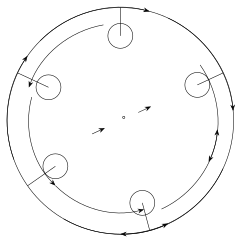
By excluding the ε\varepsilon-disks and the connecting paths we reduce the disk ∣z∣<1\left|z\right|<1 to a simply connected region Rε\mathfrak {R}_{\varepsilon }. Compute the integral ∫log⁡f(z)z dz\displaystyle \int \frac{\log f(z)}{z}\, dz along the positively oriented boundary of Rε\mathfrak {R}_{\varepsilon }.

Problem 3.176

The function f(z)f(z) is meromorphic in the disk ∣z∣≤R\left|z\right|\leq R, regular and different from 00 on the circle ∣z∣=R\left|z\right|=R and it has inside the circle the zeros a1,a2,…,ama_{1},a_{2},\ldots ,a_{m} and the poles b1,b2,…,bnb_{1},b_{2},\ldots ,b_{n}, counted with correct multiplicities. If the point z=reiϑz=re^{i\vartheta }, r<Rr<R, is neither a zero nor a pole we have

log⁡∣f(z)∣+∑μ=1mlog⁡∣R2−aμ‾z(aμ−z)R∣−∑ν=1nlog⁡∣R2−bν‾z(bν−z)R∣ \log \left|f(z)\right| + \sum _{\mu =1}^{m} \log \left|\frac{R^{2}-\overline{a_{\mu }}z}{(a_{\mu }-z)R}\right| - \sum _{\nu =1}^{n} \log \left|\frac{R^{2}-\overline{b_{\nu }}z}{(b_{\nu }-z)R}\right| =12π∫02πlog⁡∣f(ReiΘ)∣ R2−r2R2−2Rrcos⁡(Θ−ϑ)+r2 dΘ. = \frac{1}{2\pi }\int _{0}^{2\pi } \log \left|f(Re^{i\Theta })\right|\, \frac{R^{2}-r^{2}}{R^{2}-2Rr\cos (\Theta -\vartheta )+r^{2}}\, d\Theta .
?
Problem 3.177

The function f(z)f(z) is meromorphic in the half-plane Re(z)≥0\mathrm{Re}\left(z\right)\geq 0, regular and non-zero on its boundary and it has inside the half-plane the zeros a1,a2,…,ama_{1},a_{2},\ldots ,a_{m} and the poles b1,b2,…,bnb_{1},b_{2},\ldots ,b_{n}, counted with correct multiplicity. If f(z)f(z) is regular at infinity (but also under weaker conditions on its behaviour at infinity) and if f(z)f(z) is regular and non-zero at z=x+iyz=x+iy, x>0x>0, we have

log⁡∣f(z)∣+∑μ=1mlog⁡∣z+aμ‾z−aμ∣−∑ν=1nlog⁡∣z+bν‾z−bν∣ \log \left|f(z)\right| + \sum _{\mu =1}^{m} \log \left|\frac{z+\overline{a_{\mu }}}{z-a_{\mu }}\right| - \sum _{\nu =1}^{n} \log \left|\frac{z+\overline{b_{\nu }}}{z-b_{\nu }}\right| =1π∫−∞+∞log⁡∣f(iη)∣ darctan⁡η−yx. = \frac{1}{\pi }\int _{-\infty }^{+\infty } \log \left|f(i\eta )\right|\, d\arctan \frac{\eta -y}{x}.
?
Problem 3.178

The function f(z)f(z) is regular in the domain

(D)r≤∣z∣≤R,−π2≤arg⁡z≤π2, (\mathfrak {D}) \qquad r\leq \left|z\right|\leq R, \quad -\frac{\pi }{2}\leq \arg z\leq \frac{\pi }{2},

different from zero on the boundary of D\mathfrak {D} and it has in D\mathfrak {D} the zeros a1,a2,…,ama_{1},a_{2},\ldots ,a_{m}, aμ=rμeiϑμa_{\mu }=r_{\mu }e^{i\vartheta_{\mu }}, μ=1,2,…,m\mu =1,2,\ldots ,m. Using the definition log⁡∣f(ϱeiϑ)∣=U(ϱ,ϑ)\log \left|f(\varrho e^{i\vartheta })\right|=U(\varrho ,\vartheta ) we have the formula

∑r<rμ<R(1rμ−rμR2)cos⁡ϑμ=1πR∫−π2+π2U(R,ϑ)cos⁡ϑ dϑ \sum _{r<r_{\mu }<R} \left(\frac{1}{r_{\mu }}-\frac{r_{\mu }}{R^{2}}\right)\cos \vartheta _{\mu } = \frac{1}{\pi R}\int _{-\frac{\pi }{2}}^{+\frac{\pi }{2}} U(R,\vartheta )\cos \vartheta \, d\vartheta +12π∫rR(1ϱ2−1R2)[U(ϱ,π2)+U(ϱ,−π2)]dϱ+χ(R), + \frac{1}{2\pi }\int _{r}^{R} \left(\frac{1}{\varrho ^{2}}-\frac{1}{R^{2}}\right)\left[U\left(\varrho ,\frac{\pi }{2}\right) + U\left(\varrho ,-\frac{\pi }{2}\right)\right]d\varrho + \chi (R),

where χ(R)\chi (R) is bounded as R→∞R\to \infty; r,f(z)r,f(z) are fixed.

?
Remark.
?

∮log⁡f(z)(1z2+1R2)dzi\displaystyle \oint \log f(z)\left(\frac{1}{z^{2}}+\frac{1}{R^{2}}\right)\frac{dz}{i} has to be computed along a path analogous to the one in problem 175.

Problem 3.179

Prove problem 25 by examining the change of arctan⁡V(x)U(x)\arctan \dfrac {V(x)}{U(x)} as xx increases from −∞-\infty to +∞+\infty along the real axis.

?
Problem 3.180

We consider a closed, continuous, oriented curve in the zz-plane that avoids the origin. If, starting from an arbitrary point, zz describes the entire curve in the given direction (returning to its starting point) the argument of zz changes continuously and its total variation is a multiple, 2πn2\pi n, of 2π2\pi. The integer nn is called the winding number of the curve.

Every ray from the origin intersects the curve in question at least ∣n∣\left|n\right| times.

?
Problem 3.181

Here LL denotes a closed continuous curve without double points and D\mathfrak {D} the closed interior of LL. The winding number of a closed, continuous, oriented curve avoiding the origin is the integer nn such that the argument of ww changes by 2πn2\pi n as ww describes the entire curve once in the given direction.

The functions φ(z)\varphi (z) and ψ(z)\psi (z) are regular in D\mathfrak {D}, except possibly at finitely many poles, finite and different from 00 on the boundary LL of D\mathfrak {D}. We define f(z)=φ(z)ψ(z)f(z)=\varphi (z)\psi (z). The winding number of the image under w=f(z)w=f(z) of LL is equal to the sum of the winding numbers of the images of LL under w=φ(z)w=\varphi (z) and w=ψ(z)w=\psi (z) respectively.

?
Problem 3.182

Let LL denote a closed continuous curve without double points and D\mathfrak {D} the closed interior of LL. The argument principle states: if f(z)f(z) is regular in D\mathfrak {D}, except possibly at finitely many poles, finite and non-zero on LL, then as zz moves along LL in the positive sense the point w=f(z)w=f(z) describes a closed continuous curve the winding number of which is equal to the number of zeros inside LL minus the number of poles inside LL.

Prove the argument principle for a polynomial.

?
Problem 3.183

Let LL denote a closed continuous curve without double points and D\mathfrak {D} the closed interior of LL. The argument principle states: if f(z)f(z) is regular in D\mathfrak {D}, except possibly at finitely many poles, finite and non-zero on LL, then as zz moves along LL in the positive sense the point w=f(z)w=f(z) describes a closed continuous curve the winding number of which is equal to the number of zeros inside LL minus the number of poles inside LL.

The argument principle implies: If φ(z)\varphi (z) is regular and non-zero in the domain D\mathfrak {D} the winding number of the image of LL (the boundary curve of D\mathfrak {D}) generated by w=φ(z)w=\varphi (z) vanishes; i.e.the argument of φ(z)\varphi (z) is a single-valued function on LL. Deduce the general statement of the principle from this particular case.

?
Problem 3.184

The real trigonometric polynomial

amcos⁡mϑ+bmsin⁡mϑ+am+1cos⁡(m+1)ϑ+bm+1sin⁡(m+1)ϑ+⋯ a_{m}\cos m\vartheta + b_{m}\sin m\vartheta + a_{m+1}\cos (m+1)\vartheta + b_{m+1}\sin (m+1)\vartheta + \cdots ⋯+ancos⁡nϑ+bnsin⁡nϑ \cdots + a_{n}\cos n\vartheta + b_{n}\sin n\vartheta

has at least 2m2m and at most 2n2n zeros in the interval 0≤ϑ<2π0\leq \vartheta <2\pi.

?
Remark.
?

Examine

P(z)=(am−ibm)zm+(am+1−ibm+1)zm+1+⋯+(an−ibn)zn. P(z) = (a_{m}-ib_{m})z^{m} + (a_{m+1}-ib_{m+1})z^{m+1} + \cdots + (a_{n}-ib_{n})z^{n}.
Problem 3.185

Let 0<a1<a2<⋯<an0<a_{1}<a_{2}<\cdots <a_{n}. Then the trigonometric polynomial

a0+a1cos⁡ϑ+a2cos⁡2ϑ+⋯+ancos⁡nϑ a_{0} + a_{1}\cos \vartheta + a_{2}\cos 2\vartheta + \cdots + a_{n}\cos n\vartheta

has 2n2n distinct zeros in the interval 0≤ϑ<2π0\leq \vartheta <2\pi. [Problem 22.] [Consequently it has real zeros only, Part VI, problem 14.]

?
Problem 3.186

Here LL denotes a closed continuous curve without double points.

The function f(z)f(z) is meromorphic in the interior of the curve LL and regular on the curve LL. If ∣a∣\left|a\right| is larger than the maximum of ∣f(z)∣\left|f(z)\right| on LL then f(z)f(z) assumes the value aa inside LL just as often as it has poles there.

?
Problem 3.187

The function

w=eπz−e−πz w = e^{\pi z} - e^{-\pi z}

assumes any value ww with positive real part once and only once in the half-strip Re(z)>0\mathrm{Re}\left(z\right)>0, −12<Im(z)<12-\frac{1}{2}<\mathrm{Im}\left(z\right)<\frac{1}{2}.

?
Problem 3.188

Suppose that f(z)f(z) is regular in the closed disk ∣z∣≤r\left|z\right|\leq r and univalent on the circle ∣z∣=r\left|z\right|=r, that is it assumes there no value more than once. Then the image of ∣z∣=r\left|z\right|=r under w=f(z)w=f(z) has the same orientation as ∣z∣=r\left|z\right|=r and the function f(z)f(z) is univalent (schlicht) also in the disk ∣z∣<r\left|z\right|<r.

?
Problem 3.189

The zeros of the function ∫0ze−x22 dx\displaystyle \int_{0}^{z} e^{-\frac{x^{2}}{2}}\, dx lie with the exception of z=0z=0 inside the region Re(z2)<0\mathrm{Re}\left(z^{2}\right)<0. [Cornu spiral, cf.e.g.A. Sommerfeld: Optics. New York: Academic Press 1954, pp.243--244].

?
Problem 3.190

The winding number of a closed, continuous, oriented curve avoiding the origin is the integer nn such that the argument of ww changes by 2πn2\pi n as ww describes the entire curve once in the given direction.

The function f(z)f(z) is single-valued, regular and does not assume a certain value aa in the annulus r<∣z∣<Rr<\left|z\right|<R. All the closed continuous curves without double points that enclose the circle ∣z∣=r\left|z\right|=r and that lie inside the annulus are mapped by the function w=f(z)−aw=f(z)-a onto curves in the ww-plane with the same winding number.

?
Problem 3.191

Here LL denotes a closed continuous curve without double points and D\mathfrak {D} the closed interior of LL.

The function f(z)f(z) is regular in the domain D\mathfrak {D} and its absolute value on the boundary curve LL of D\mathfrak {D} is constant. As zz moves on the curve LL the argument of f(z)f(z) changes monotonically. (Whence a new proof of problem 142.)

?
Problem 3.192

Here LL denotes a closed continuous curve without double points and D\mathfrak {D} the closed interior of LL.

The function f(z)f(z) has one zero more than f′(z)f'(z) inside LL under the hypothesis of problem 191. (More informative than problem 142.) This means geometrically: Inside a closed level line without double points the modular graph has more pits than saddle points, namely precisely one more.

?
Problem 3.193

Here LL denotes a closed continuous curve without double points and D\mathfrak {D} the closed interior of LL.

If f(z)f(z) is regular in the domain D\mathfrak {D} and f′(z)f'(z) does not vanish in D\mathfrak {D} the mapping w=f(z)w=f(z) of D\mathfrak {D} is not necessarily schlicht [problem 72]. If however ∣f(z)∣\left|f(z)\right| is constant on the boundary of D\mathfrak {D} the mapping in question has to be schlicht.

?
Problem 3.194

Here LL denotes a closed continuous curve without double points and D\mathfrak {D} the closed interior of LL.

We suppose that f(z)f(z) and φ(z)\varphi (z) are two functions that are regular in the interior of D\mathfrak {D}, continuous in the closed domain D\mathfrak {D} and that furthermore ∣f(z)∣>∣φ(z)∣\left|f(z)\right|>\left|\varphi (z)\right| on the boundary LL of D\mathfrak {D}. Then the function f(z)+φ(z)f(z)+\varphi (z) has exactly the same number of zeros inside D\mathfrak {D} as f(z)f(z).

?
Problem 3.195

Let λ\lambda be real, λ>1\lambda >1. The equation

zeλ−z=1 ze^{\lambda -z} = 1

has exactly one root in the disk ∣z∣=1\left|z\right|=1. This root is real and positive.

?
Problem 3.196

Let λ\lambda be real, λ>1\lambda >1. The equation

λ−z−e−z=0 \lambda - z - e^{-z} = 0

has only one root in the half-plane Re(z)≥0\mathrm{Re}\left(z\right)\geq 0 which, consequently, is real.

?
Problem 3.197

A function (not necessarily schlicht) that maps the closed unit disk onto a domain contained in the open unit disk has exactly one fixed point. I.e.if f(z)f(z) is regular in the disk ∣z∣≤1\left|z\right|\leq 1 and if ∣f(z)∣<1\left|f(z)\right|<1 in ∣z∣≤1\left|z\right|\leq 1 then the equation f(z)−z=0f(z)-z=0 has exactly one root in ∣z∣≤1\left|z\right|\leq 1.

?
Problem 3.198

The entire function 1Γ(z)\dfrac {1}{\Gamma (z)} assumes each value infinitely often in the half-strip

−d<Im(z)<d,Re(z)<0(d arbitrary). -d<\mathrm{Im}\left(z\right)<d, \quad \mathrm{Re}\left(z\right)<0 \quad (d \text{ arbitrary}).
?
Problem 3.199

Let f(t)f(t) be a real-valued twice continuously differentiable function on the interval 0≤t≤10\leq t\leq 1. If ∣f(1)∣>∣f(0)∣\left|f(1)\right|>\left|f(0)\right| the entire function

F(z)=∫01f(t)sin⁡zt dt F(z) = \int _{0}^{1} f(t)\sin zt\, dt

has infinitely many real zeros and only a finite number of complex zeros; if 0<∣f(1)∣<∣f(0)∣0<\left|f(1)\right|<\left|f(0)\right| it has only a finite number of real, and infinitely many complex, zeros. [The zeros of F(z)F(z) behave with respect to reality like the zeros of f(0)−f(1)cos⁡zf(0)-f(1)\cos z.]

?
Problem 3.200

Let aa be a constant, ∣a∣>2.5\left|a\right|>2.5. The power series

1+za+z2a4+z2a9+⋯+znan2+⋯=F(z) 1 + \frac{z}{a} + \frac{z^{2}}{a^{4}} + \frac{z^{2}}{a^{9}} + \cdots + \frac{z^{n}}{a^{n^{2}}} + \cdots = F(z)

defines an entire function which does not vanish on the boundary of the annulus

∣a∣2n−2<∣z∣<∣a∣2n \left|a\right|^{2n-2} < \left|z\right| < \left|a\right|^{2n}

and has exactly one zero inside the annulus, n=1,2,…n=1,2,\ldots. [Examine the maximum term on the circle ∣z∣=∣a∣2n\left|z\right|=\left|a\right|^{2n}, problem 117.]

?
Problem 3.201

(continuation of problem 170). Let S\mathfrak {S} denote the set of all zeros of all the functions fn(z)f_{n}(z), n=1,2,3,…n=1,2,3,\ldots in R\mathfrak {R}. If the limit function does not vanish identically its zeros in R\mathfrak {R} are identical with the limit points of S\mathfrak {S} in R\mathfrak {R}. (The term ``limit point'' is used here to mean a point an arbitrary fixed neighborhood of which contains at least one zero of fn(z)f_{n}(z) for all sufficiently large nn.)

?
Problem 3.202

The functions f1(z),f2(z),…,fn(z),…f_{1}(z),f_{2}(z),\ldots ,f_{n}(z),\ldots are schlicht in the unit disk ∣z∣<1\left|z\right|<1 and converge in any smaller disk ∣z∣≤r<1\left|z\right|\leq r<1 uniformly to a not everywhere constant limit function f(z)f(z). Then the function f(z)f(z) is schlicht in the unit disk ∣z∣<1\left|z\right|<1.

?
Problem 3.203

Let g1(z),g2(z),…,gn(z),…g_{1}(z),g_{2}(z),\ldots ,g_{n}(z),\ldots be entire functions which have real zeros only. If

lim⁡n→∞gn(z)=g(z) \lim _{n\to \infty } g_{n}(z) = g(z)

uniformly in any finite domain, the entire function g(z)g(z) can have only real zeros.

?
Problem 3.204

Assume

0<a0≤a1≤⋯≤an;a≥0,d>0. 0 < a_{0} \leq a_{1} \leq \cdots \leq a_{n}; \quad a\geq 0, \quad d>0.

The entire function

∑ν=0naνcos⁡(a+νd)z \sum _{\nu =0}^{n} a_{\nu }\cos (a+\nu d)z

has only real zeros.

?
Problem 3.205

Suppose that f(t)f(t) is a positive valued, never decreasing function, defined on the interval 0≤t<10\leq t<1 and that its integral ∫01f(t) dt\displaystyle \int_{0}^{1} f(t)\, dt is finite. The entire function

∫01f(t)cos⁡zt dt \int _{0}^{1} f(t)\cos zt\, dt

has real zeros only. [Problem 185.]

?
Problem 3.206

The domain D\mathfrak {D} contains the segment a≤z≤ba\leq z\leq b of the real axis. The functions f1(z),f2(z),…,fn(z),…f_{1}(z),f_{2}(z),\ldots ,f_{n}(z),\ldots are regular in D\mathfrak {D}, they assume real values for real zz and they have no zeros on [a,b][a,b]. If these functions converge in D\mathfrak {D} uniformly to a not identically vanishing limit function f(z)f(z) then f(z)f(z) has no zero on the segment a≤z≤ba\leq z\leq b. --This statement is false.

?
Problem 3.206.1

The analytic functions f1(z),f2(z),…,fn(z)f_{1}(z),f_{2}(z),\ldots ,f_{n}(z) are regular and single-valued in the connected closed domain D\mathfrak {D}; let c1,c2,…,cnc_{1},c_{2},\ldots ,c_{n} denote constants. If the function

c1f1(z)+c2f2(z)+⋯+cnfn(z) c_{1}f_{1}(z) + c_{2}f_{2}(z) + \cdots + c_{n}f_{n}(z)

does not vanish identically the number of its zeros in D\mathfrak {D} cannot exceed a certain upper bound which depends on f1(z),f2(z),…,fn(z)f_{1}(z),f_{2}(z),\ldots ,f_{n}(z) and D\mathfrak {D} but does not depend on c1,c2,…,cnc_{1},c_{2},\ldots ,c_{n}. (Problem 206.2 is less general but more precise.)

?
Problem 3.206.1

The analytic functions f1(z),f2(z),…,fn(z)f_{1}(z),f_{2}(z),\ldots ,f_{n}(z) are regular and single-valued in the connected closed domain D\mathfrak {D}; let c1,c2,…,cnc_{1},c_{2},\ldots ,c_{n} denote constants. If the function

c1f1(z)+c2f2(z)+⋯+cnfn(z) c_{1}f_{1}(z) + c_{2}f_{2}(z) + \cdots + c_{n}f_{n}(z)

does not vanish identically the number of its zeros in D\mathfrak {D} cannot exceed a certain upper bound which depends on f1(z),f2(z),…,fn(z)f_{1}(z),f_{2}(z),\ldots ,f_{n}(z) and D\mathfrak {D} but does not depend on c1,c2,…,cnc_{1},c_{2},\ldots ,c_{n}. (Problem 206.2 is less general but more precise.)

?
Problem 3.206.2

Let λ1,λ2,…,λl\lambda_{1},\lambda_{2},\ldots ,\lambda_{l} denote real numbers

λ1<λ2<⋯<λl \lambda _{1} < \lambda _{2} < \cdots < \lambda _{l}

and m1,m2,…,mlm_{1},m_{2},\ldots ,m_{l} positive integers,

m1≥1,…,ml≥1,m1+m2+⋯+ml=n. m_{1}\geq 1, \ldots , m_{l}\geq 1, \quad m_{1}+m_{2}+\cdots +m_{l} = n.

Let f1(z),f2(z),…,fn(z)f_{1}(z),f_{2}(z),\ldots ,f_{n}(z) stand for the functions

eλ1z,zeλ1z,…,zm1−1eλ1z e^{\lambda _{1}z}, ze^{\lambda _{1}z}, \ldots , z^{m_{1}-1}e^{\lambda _{1}z} eλ2z,zeλ2z,…,zm2−1eλ2z e^{\lambda _{2}z}, ze^{\lambda _{2}z}, \ldots , z^{m_{2}-1}e^{\lambda _{2}z} ⋯⋯⋯⋯⋯⋯⋯⋯ \cdots \cdots \cdots \cdots \cdots \cdots \cdots \cdots eλlz,zeλlz,…,zml−1eλlz e^{\lambda _{l}z}, ze^{\lambda _{l}z}, \ldots , z^{m_{l}-1}e^{\lambda _{l}z}

taken in this order, and NN for the number of those zeros of the function

c1f1(z)+c2f2(z)+⋯+cnfn(z) c_{1}f_{1}(z) + c_{2}f_{2}(z) + \cdots + c_{n}f_{n}(z)

that are contained in the horizontal strip

α≤Im(z)≤β. \alpha \leq \mathrm{Im}\left(z\right) \leq \beta .

Assuming that

∣c1∣+∣c2∣+⋯+∣cm1∣>0,∣cn−ml+1∣+⋯+∣cn−1∣+∣cn∣>0 \left|c_{1}\right|+\left|c_{2}\right|+\cdots +\left|c_{m_{1}}\right| > 0, \quad \left|c_{n-m_{l}+1}\right|+\cdots +\left|c_{n-1}\right|+\left|c_{n}\right| > 0

show that

(λl−λ1)(β−α)2π−n+1≤N≤(λl−λ1)(β−α)2π+n−1. \frac{(\lambda _{l}-\lambda _{1})(\beta -\alpha )}{2\pi } - n + 1 \leq N \leq \frac{(\lambda _{l}-\lambda _{1})(\beta -\alpha )}{2\pi } + n - 1.

(Problem 206.1 is more general but less precise.)

?
Problem 3.206.2

Let λ1,λ2,…,λl\lambda_{1},\lambda_{2},\ldots ,\lambda_{l} denote real numbers

λ1<λ2<⋯<λl \lambda _{1} < \lambda _{2} < \cdots < \lambda _{l}

and m1,m2,…,mlm_{1},m_{2},\ldots ,m_{l} positive integers,

m1≥1,…,ml≥1,m1+m2+⋯+ml=n. m_{1}\geq 1, \ldots , m_{l}\geq 1, \quad m_{1}+m_{2}+\cdots +m_{l} = n.

Let f1(z),f2(z),…,fn(z)f_{1}(z),f_{2}(z),\ldots ,f_{n}(z) stand for the functions

eλ1z,zeλ1z,…,zm1−1eλ1z e^{\lambda _{1}z}, ze^{\lambda _{1}z}, \ldots , z^{m_{1}-1}e^{\lambda _{1}z} eλ2z,zeλ2z,…,zm2−1eλ2z e^{\lambda _{2}z}, ze^{\lambda _{2}z}, \ldots , z^{m_{2}-1}e^{\lambda _{2}z} ⋯⋯⋯⋯⋯⋯⋯⋯ \cdots \cdots \cdots \cdots \cdots \cdots \cdots \cdots eλlz,zeλlz,…,zml−1eλlz e^{\lambda _{l}z}, ze^{\lambda _{l}z}, \ldots , z^{m_{l}-1}e^{\lambda _{l}z}

taken in this order, and NN for the number of those zeros of the function

c1f1(z)+c2f2(z)+⋯+cnfn(z) c_{1}f_{1}(z) + c_{2}f_{2}(z) + \cdots + c_{n}f_{n}(z)

that are contained in the horizontal strip

α≤Im(z)≤β. \alpha \leq \mathrm{Im}\left(z\right) \leq \beta .

Assuming that

∣c1∣+∣c2∣+⋯+∣cm1∣>0,∣cn−ml+1∣+⋯+∣cn−1∣+∣cn∣>0 \left|c_{1}\right|+\left|c_{2}\right|+\cdots +\left|c_{m_{1}}\right| > 0, \quad \left|c_{n-m_{l}+1}\right|+\cdots +\left|c_{n-1}\right|+\left|c_{n}\right| > 0

show that

(λl−λ1)(β−α)2π−n+1≤N≤(λl−λ1)(β−α)2π+n−1. \frac{(\lambda _{l}-\lambda _{1})(\beta -\alpha )}{2\pi } - n + 1 \leq N \leq \frac{(\lambda _{l}-\lambda _{1})(\beta -\alpha )}{2\pi } + n - 1.

(Problem 206.1 is more general but less precise.)

?