Linear Transformations
[19/100%]Determine which of the following functions are linear operators on .
;
;
;
;
;
.
For , determine which of the following functions are linear transformations.
;
for ;
;
.
Explain why for every linear transformation .
Determine which of the following mappings are linear operators on , the vector space of polynomials of degree or less.
, where is the -order differentiation operator (i.e., ).
.
Let be a fixed vector in and let be the mapping defined by (i.e., the standard inner product).
Is a linear operator?
Is a linear transformation?
For the operator defined by , determine , where is the basis .
Let be the linear transformation defined by .
Determine , where and are the standard bases for and , respectively.
Determine , where is the basis for obtained by permuting the standard basis according to .
Let be the operator on defined by and consider the vector
Determine and .
Compute , and then verify that .
For , let be the linear operator on defined by . That is, is the operator defined by matrix multiplication. With respect to the standard basis , show that .
Formula (4.7.4): if and are bases and , then is the coordinate matrix representation of , satisfying for every .
If is a linear operator on a space with basis , explain why for all nonnegative integers .
Let be the projector that maps each point to its orthogonal projection on the line .
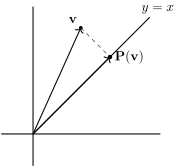 Figure 4.7.4
Determine the coordinate matrix of with respect to the standard basis.
Determine the orthogonal projection of onto the line .
For the standard basis of , determine the matrix representation for each of the following linear operators on , and then verify for .
.
, where .
For and (the spaces of polynomials of degrees less than or equal to two and three, respectively), let be the linear transformation defined by . Determine , where and .
Let be the linear operator on that rotates each point counterclockwise through an angle , and let be the linear operator on that reflects each point about the -axis.
Determine the matrix of the composition relative to the standard basis .
Relative to the standard basis, determine the matrix of the linear operator that rotates each point in counterclockwise through an angle .
Let and be two linear transformations, and let and be arbitrary bases for and , respectively.
Provide the details to explain why .
Provide the details to explain why , where is an arbitrary scalar.
Let be the identity operator on an -dimensional space .
Explain why
regardless of the choice of basis .
Let and be two different bases for , and let be the linear operator on that maps vectors from to vectors in according to the rule for . Explain why
When , determine for
Let be the linear operator defined by
Determine .
Determine , where is the standard basis for .
Let be a linear operator on an -dimensional space . Show that the following statements are equivalent.
-
exists.
-
is a one-to-one mapping (i.e., ).
-
.
-
is an onto mapping (i.e., for each , there is an such that ).
Let be an -dimensional space with a basis .
Prove that a set of vectors is linearly independent if and only if the set of coordinate vectors
is a linearly independent set.
If is a linear operator on , then the range of is the set
Suppose that the basic columns of occur in positions . Explain why is a basis for .