Addition and Transposition
[8/100%]Determine the unknown quantities in the following expressions.
.
.
Identify each of the following as symmetric, skew symmetric, or neither.
.
.
.
.
Construct an example of a matrix that satisfies the following conditions.
is both symmetric and skew symmetric.
is both hermitian and symmetric.
is skew hermitian.
Explain why the set of all symmetric matrices is closed under matrix addition. That is, explain why the sum of two symmetric matrices is again an symmetric matrix. Is the set of all skew-symmetric matrices closed under matrix addition?
Prove that each of the following statements is true.
If is skew symmetric, then for each .
If is skew hermitian, then each is a pure imaginary number -- i.e., a multiple of the imaginary unit .
If is real and symmetric, then is skew hermitian.
Let be any square matrix.
Show that is symmetric and is skew symmetric.
Prove that there is one and only one way to write as the sum of a symmetric matrix and a skew-symmetric matrix.
If and are two matrices of the same shape, prove that each of the following statements is true.
.
.
Recall the spring-system setup of Example 3.2.1: for a line of springs connecting nodes, if node is displaced units (positive to the left, negative to the right) and consecutive nodes are joined by a spring of stiffness constant , then the force exerted on an interior node by its two adjacent springs is the sum of times the relative displacement with each neighbor, and organizing the resulting force balance equations into a linear system produces a symmetric stiffness matrix as the coefficient matrix. For two springs joining three nodes with a common stiffness constant , this construction gives
Using the conventions given in Example 3.2.1, determine the stiffness matrix for a system of identical springs, with stiffness constant , connected in a line similar to that shown in Figure 3.2.1.
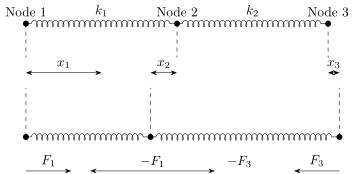 Figure 3.2.1