Cellular homology of a two-dimensional CW complex
[8/100%]Compute the cellular homology groups for all surfaces without boundary, where we form the CW complex by thinking of the surface as a polygon with identifications.
For a two-dimensional CW complex , the cellular chain complex , , is defined as follows (with all higher , since there are no cells in those dimensions). Let be the free abelian group with one generator for each -cell , and set . For each -cell , choose the standard positive orientation of the interval, giving a generator for this oriented -cell; if it is attached via so that , , then . For each -cell , choose the standard positive orientation of the cell, giving a generator ; when the -cell is attached via , the induced map on determines the coefficients of by computing the degree of the composition of with the map collapsing all of except the -cell to a point. The cellular homology groups are then .
For example, for the torus , the -cell is attached to via the commutator , so ; since there is only one -cell, as well. Thus all boundary maps are , giving , , . For the Klein bottle, the attaching map of the -cell instead follows the pattern , giving ; thus , so , while , and again .
Compute the cellular homology groups for the dunce hat, using the cellular chain complex construction of the remark to Exercise 6.4.1.
See Exercise 5.3.3.
Compute the cellular homology groups for the pseudoprojective plane (Exercise 3.9.4), which has a CW complex decomposition as a -cell, one -cell, and one -cell, where the -cell is attached trivially to the -cell to form a circle for , and the attaching map for the -cell is the map which wraps around the circle times, using the cellular chain complex construction of the remark to Exercise 6.4.1.
Compute the cellular homology groups for the CW complex with cellular decomposition given by a single -cell, two trivially attached -cells (labeled ), and three -cells attached via , , , using the cellular chain complex construction of the remark to Exercise 6.4.1.
Find the cellular homology groups of the two spaces in Figure 5.2, using the cellular chain complex construction of the remark to Exercise 6.4.1.
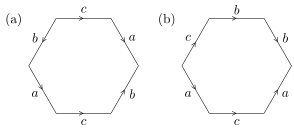 Figure for Exercise 5.2.3.
The space obtained from the polygon labeled (a) in Figure 5.2.
The space obtained from the polygon labeled (b) in Figure 5.2.
Find the cellular homology groups of the two spaces in Figure 5.3, using the cellular chain complex construction of the remark to Exercise 6.4.1.
 Figure for Exercise 5.2.4.
The space obtained from the polygon labeled (a) in Figure 5.3.
The space obtained from the polygon labeled (b) in Figure 5.3.
Find the cellular homology groups of the two spaces in Figure 5.4, using the cellular chain complex construction of the remark to Exercise 6.4.1.
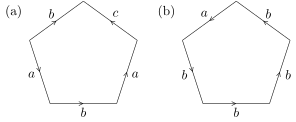 Figure for Exercise 5.2.5.
The space obtained from the polygon labeled (a) in Figure 5.4.
The space obtained from the polygon labeled (b) in Figure 5.4.
Find the cellular homology groups of the two spaces in Figure 5.5, using the cellular chain complex construction of the remark to Exercise 6.4.1.
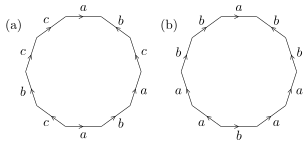 Figure for Exercise 5.2.6.
The space obtained from the polygon labeled (a) in Figure 5.5.
The space obtained from the polygon labeled (b) in Figure 5.5.