Homology of a -complex
[7/100%]For a -complex , the associated chain complex has the free abelian group with one generator for each -simplex in the -complex structure (using the order on the vertices that comes with the -complex structure), and , with for defined on generators by
where indicates that the vertex is omitted, extended linearly to all of .
Show that the composition .
Show that in general .
For part (b): it suffices to check this on a generator . For any -simplex formed from this by omitting two vertices, show that this term occurs twice with opposite signs in .
Suppose is a path connected -complex. Recall that the -homology groups are defined by , using the chain complex of Exercise 6.2.1.
Show that is path connected, and in particular, given any two vertices , there is a sequence of directed edges (which give some of the -simplices, possibly with the opposite directions) which connect with .
Show that factoring out by serves to identify all vertices in by showing that for any . Conclude that , with a generator coming from each vertex.
For part (a): first show that adding higher-dimensional simplices does not change path connectivity, so that and have the same path connectivity properties. Then show that a path connecting two vertices may be replaced by a simplicial path.
Suppose that is a -complex with path components . Show that each chain group and the boundary homomorphisms respect this splitting since . Use this to show that . Thus the computation of homology just decomposes into the computation of the homology groups of the path components. Conclude that is the free abelian group with generators.
Use the -complex structure of the Klein bottle from Figure 5.16 to compute the -homology groups of .
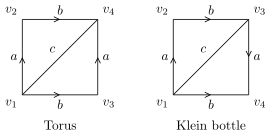 \Delta -complex structures for T, K.
Use the -complex structure of the sphere from Exercise 5.5.3 to compute the -homology groups of .
Use the -complex structure of the projective plane from Exercise 5.5.4 to compute the -homology groups of .
Show that a compact connected surface without boundary with a -complex structure satisfies when it is orientable as given in the remark below, and when it is nonorientable. Here we are using for the trivial abelian group with one element.
Orientability of a surface given as a simplicial complex is phrased as follows. First, the condition that the space is a surface (possibly with boundary) is phrased by requiring that, for each -simplex, there are either exactly two -simplices with that simplex as a face (for an interior point) or there is exactly one -simplex with that -simplex as a face (for a boundary point). A simplicial complex is called orientable if we can choose an orientation for each -simplex so that, for each interior -simplex, the two -simplices with it as a face impose opposite orientations on that -simplex. In a -complex where there are identifications on the boundary of a -simplex, it is also possible to have a single -simplex where two edges emanating from a vertex are identified (this occurs for the sphere in Exercise 6.2.5). In the -complex case, each simplex has the orientation given by its ordered vertices, and this determines how boundaries are mapped and the corresponding boundary map for the -chain complex. Then the condition required for the orientability of the surface is that orientations extend across identifications. This translates to the condition that we can select a sign for each ordered -simplex so that, for any -simplex, it occurs with opposite signs in the boundary of two different signed -simplices or occurs with both signs in the boundary of a single -simplex.
Hint for the exercise itself: show that the only way to get a -cycle is from a multiple of , where and we sum over all -simplices. You may use the fact that connectedness implies that, given any two -simplices, there is a chain of -simplices going from one to the other with a common face. Start with an arbitrary sum of -simplices and show that the only way it could be a cycle is that all are equal.