Proof of homotopy invariance of homology
[12/100%]Suppose that are homotopic maps, via a homotopy with , . To show that are chain homotopic (and hence in homology), we first look at dimension . Since these maps are linear, it suffices to look at a singular -simplex ; the induced maps are and . Suppose . Let be the singular -simplex defined by the composition .
Define and show that provides a chain homotopy between and .
We now look at dimension , needing to define so that, for a singular -simplex , we have the formula (with as in Exercise 6.16.1).
We first use the homotopy to define a map , where . Note that , , where , . If , are the singular -simplices coming from restricting to its end points, then , and , .
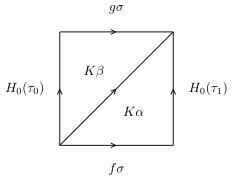 Constructing H_1.
Motivated by Figure 6.6, define two singular -simplices in with positive orientation on and negative orientation on as depicted via the arrows on their boundaries, and define .
Show that with this definition of , we have the required formula .
Use Exercises 6.16.1 and 6.16.2 to show that if are homotopic maps, then the induced maps are chain homotopic in dimensions and . Deduce that in homology.
To extend to higher-dimensional chains, note that the homotopy is used only at the last step and can be separated from the definition: writing for , we have , . If we label the maps already defined (, Exercises 6.16.1-6.16.2), there are corresponding maps (using the identity homotopy connecting and ) so that factors as . The term becomes , and since , , we can rewrite . So the formula follows from the special case
by composing with .
Let be the corresponding inclusions for . Using the identity map , there is a formula ; applying to both sides, using that (Exercise 6.16.2) and that is a chain map commuting with , the left-hand side becomes . On the right-hand side, using and , we get , so the right-hand side becomes .
Verify by an argument analogous to the one given above that
follows from the similar formula
Show that, if is a continuous map, then , (with as in Exercises 6.16.1, 6.16.2, and 6.16.4).
We now extend to : first define it for and , showing it satisfies , then extend via (satisfying the analogous formula for and the same naturality as Exercise 6.16.5). We extend inductively, having already defined for on and extended it over any via ; in particular is already defined on the face maps , giving . Write and (points of ). The general definition of in any dimension is
Check that this corresponds to the definition given for above (Exercises 6.16.1, 6.16.2).
Check that our naturality property gives
Show that
Using Exercise 6.16.6(b),
Now compute directly from the formula of Exercise 6.16.6, and compare with this expression for .
Show that
(notation as in Exercises 6.16.6-6.16.7).
Combine the calculations of Exercises 6.16.7 and 6.16.8 to show that
Show that if we define (with as in Exercises 6.16.6-6.16.9) and extend linearly to chains, then this satisfies the condition
Moreover, show that this satisfies the naturality property that when , then .
The formula of Exercise 6.16.10 shows that and are chain-homotopic chain maps, with chain homotopy ; hence they induce the same map in homology, . Applying this to homotopic maps via a homotopy : , so , proving the homotopy property in the absolute case.
Prove that if is a homotopy equivalence, then is an isomorphism.
Adapt Exercises 6.16.1--6.16.11 to prove the relative case: if are homotopic, then .
Show that if is a homotopy equivalence, then is an isomorphism.