Vector fields on surfaces
[13/100%]Suppose are equivalent differential structures on . Show that is differentiable in terms of iff it is differentiable in terms of . Thus equivalent differential structures have exactly the same differentiable maps to .
A surface can be covered by open sets with homeomorphisms , open in ; a differential structure is such a cover so that whenever , the transition map is a diffeomorphism. Two differential structures , on are equivalent if, whenever , the composition is a diffeomorphism.
Draw a picture to show the effect on the vector field on the unit circle when we reflect through the line perpendicular to the line from the origin to .
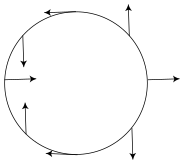 The vector field v(z) = z^2.
Your picture should show the images of the vectors pictured in the figure above. Verify from your picture that the degree of the new vector field is .
An orthogonal linear transformation from to is the composition of the reflection with multiplication by a number in (i.e. , where ) or a map of the form of itself. Show that the degree of is . Show that the degree of an orthogonal linear transformation is . Determine the inverses of and , and show that they have the same degree as the original map or .
Prove that any continuous map is homotopic to for some .
Use the information that it has degree for some and reinterpret what that means in terms of certain maps from the interval being homotopic to show that and are homotopic.
Give an example of a vector field on the sphere with one singularity.
Give an example of a vector field on with one singularity at the north pole and one singularity at the south pole.
Give an example of a vector field on with four isolated singularities of indices .
Show that, if is continuous, then there must be some so that , where and is thought of as a point in .
Reinterpret as a (not necessarily tangent) vector field on and get a tangent vector field from it by projection onto the tangent plane at .
Give an example of a vector field on the torus with no singularities.
First find a nonvanishing vector field on a circle.
Recall the differential structure on the projective plane induced via the covering map : there is a cover of so that , a homeomorphism with inverse , and a diffeomorphism of interchanging with ; taking diffeomorphisms together with , the differential structure on uses the maps , .
Show that the map is differentiable in terms of the differential structures on and as defined above.
Show that the map is locally a diffeomorphism.
Show that a map is differentiable iff the composition is differentiable.
Prove Theorem 3.7.5 as outlined below.
Theorem 3.7.5: The index of a vector field on a compact connected surface is given by the Euler characteristic.
Outline: it was already shown directly that this holds for (Theorem 3.7.1, index ), (Theorem 3.7.2, index ), and (Theorem 3.7.3, index ), each matching the Euler characteristic of the surface. Lemma 3.7.4: Suppose are surfaces so that the index of any vector field on each is given by the Euler characteristic. Then the same is true of . (Sketch of Lemma 3.7.4: form by removing a disk from each of and gluing the boundary circles; a vector field on determines vector fields on by extending over the removed disks via radial damping, contributing one new singularity each. If denote the degrees of on their boundary circles, then , , and since the vector fields on the two disks are related on their common boundary the same way as for the sphere; hence .) Since every compact connected surface is homeomorphic to a connected sum of copies of , induction using Lemma 3.7.4 together with the base cases for proves the theorem.
Give an alternate proof of Theorem 3.7.5 (the index of a vector field on a compact connected surface is given by the Euler characteristic) for the surface as being formed from two regions in the plane with holes in each, by identifying points on the boundary circles. Such a description arises from thinking of as sitting in symmetrically with respect to the -plane and then slicing it by that plane and flattening out the two halves.
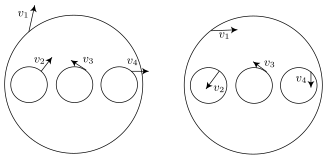 Corresponding vector fields from T^{(3)}.
Give an analysis of how tangent vectors on identified circles correspond, similar to the analysis for (Theorem 3.7.2, obtained by cutting the torus into two annuli along its equator circles) to relate the indices of the vector fields on the two halves. The figure above depicts this decomposition in the case of .
Suppose is a compact, connected oriented surface with a vector field of index . Identify .
Show that there are vector fields on with a prescribed integer as index, and so Theorem 3.7.5 (the index of a vector field on a compact connected surface is given by the Euler characteristic) does not apply to surfaces with boundary without some additional hypothesis.
By adding disks to a surface with boundary, find a formula for the index of a vector field on a surface with boundary where the vector field is required to be an exterior normal vector field on each boundary circle.