Vector fields in the plane
[12/100%]Give the details for the claim that the degree of does not depend on the choice of radius as long as we are inside a disk where only vanishes at .
Setup: a vector field on is a continuous function . For a circle of radius about a point , let , giving a map ; if does not vanish on this circle, is defined as usual (via the normalized map into ). A point where vanishes is called a singularity; it is isolated if there is a deleted neighborhood of where is nonzero. For an isolated singularity , the index is the degree of for a small enough that the only zero inside the disk of radius about is itself.
Use Proposition 3.5.10(3): if is continuous on the closed annulus , then .
Give an explicit construction of the homotopy of to described in the computation of the index of the vector field at its singularity .
Recall the analogous computation at the singularity : extends to a map of the unit disk into , so is a homotopy into between and the constant map ; then , normalized, gives a homotopy between and as maps , and is homotopic to via . For the singularity at , restrict to the circle of radius about and look at ; homotope the term to to get a homotopy of this to , which normalizes to a homotopy of to .
Each part of the figure below depicts the vector field on a circle about an isolated singularity. Determine the index of each of the singularities.
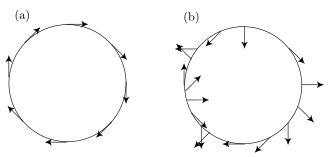 Vector fields for Exercise 3.6.3.
Give an example of a vector field in the plane which has two singularities of index and one singularity of index .
Start with a vector field with one singularity of index and then introduce two new singularities that look like the canceling-singularity pair shown below (constantly outside an oblong region, with two singularities of index and inside it whose total index is ).
 Another example of canceling singularities.
Show that , (a constant), is homotopic to .
Show that, if satisfies (complex multiplication of and ) and is homotopic to , then is homotopic to .
Show that, if extends over the unit disk to , then is homotopic to .
Use the map , , composed with to get a homotopy to the constant map . Then use path connectivity in to move to .
Give an explicit homotopy between and as maps from to .
Suppose (complex multiplication) is a vector field with an isolated singularity at . Suppose , , and the only singularity of inside is at . Show that the index of at as computed on the circle of radius about is the same as the index of as computed on the same circle.
Suppose is given as a factored polynomial. Show that has isolated singularities and that each has index , so the index of the vector field is .
Use the preceding exercise.
Verify that , , is a quotient map, and that the induced map gives an extension of , in the context of the proof of the following lemma.
Lemma 3.6.1: Let be a continuous map whose composition with has degree . Then extends to a continuous map from to .
In the proof, a homotopy between (where ) and a constant map induces, since is a quotient of via , a homotopy with .
Verify the claim made in the proof of the following proposition, for the base case : that the degree of is the same as the degree of , using a homotopy between the map and the map onto a small circle around the singularity .
Proposition 3.6.2: Suppose is a vector field defined on the disk centered at which has isolated singularities at . The degree of the map is the sum of the indices of the singularities; that is, the index of the vector field may be computed by computing the degree using the vector field on the boundary circle.