Vector Functions. Curves
[143/35%]Construct the hodograph of the vector function :
;
;
;
;
;
;
.
Prove that the hodograph of the vector function
lies on a sphere.
Prove that the hodograph of the vector function
lies in some plane, and find the equation of this plane.
Prove that if , then . Is the converse statement true?
Prove that the vector function is infinitesimal as .
Find the limit of the vector function:
at ;
at .
Prove that for the vector function to have, as , a limit equal to , it is necessary and sufficient that it can be represented in the form
where is a vector function infinitesimal as .
Prove that if and , then
Prove that if , and , then:
;
;
.
Prove that if the scalar functions and the vector functions are continuous at the point , then the following functions are also continuous at this point:
;
.
Find the derivative of the vector function and write the equation of the tangent at an arbitrary point of its hodograph, if:
;
.
Find the derivative of the functions:
;
;
.
Prove that if the length of the vectors is constant in a neighborhood of the point and the derivative exists, then the vectors and are orthogonal. What is the mechanical meaning of this fact?
Prove that for the vectors and to be orthogonal at every point of some interval, it is necessary and sufficient that the scalar function be constant on this interval.
Prove that for a differentiable vector function , nonvanishing on the interval , to have constant direction (i.e., for the vector to be collinear, for any , with, for example, the vector ), it is necessary and sufficient that the vectors and be collinear.
Let the vector function have a derivative at the point . Will the function be differentiable at this point? Are the equalities and valid at this point?
Prove that if
where — continuously differentiable functions of their arguments, and are continuously differentiable functions of , then
Construct the hodographs of the vector function
and its derivative.
Using the definition of the derivative of a vector function, prove the formulas:
is a scalar function;
;
;
.
Prove that if , where , and are constants, then:
;
.
Prove that if , where , , and are constants, then
Prove that if the vector function is differentiable at the point , then it is also continuous at it.
Let the vector function satisfy the differential equation , where is a constant vector. Express in terms of and :
;
.
Let, for a vector function twice differentiable on the interval , the conditions
hold at all points of this interval. Prove that then the hodograph of the vector function lies in some plane.
Prove that if, for a vector function twice differentiable on the interval , the vectors and are nonzero and collinear at all points of this interval, then the hodograph of the vector function is a line segment.
Prove that the hodograph of the vector function , , where , and are constant vectors, with the vectors and not collinear, is a parabola. What will the hodograph be if the vectors and are collinear?
Prove that the hodograph of the vector function , where , and are constant vectors, with the vectors and not collinear, is an ellipse.
Prove that the trajectory of a material point moving under the action of a central force is planar.
The trajectory of motion of a point is given in cylindrical coordinates:
where is the time, are known functions. Find:
the cosine of the angle between the radius vector of the moving point and the vector of its instantaneous velocity;
the magnitude of the acceleration in the case of motion along the cylinder .
The trajectory of a moving point is given in spherical coordinates:
where is the time, are known functions. Find the magnitude of the instantaneous velocity.
Let be the mass of a point, the force acting on it, the law of motion of the point, its acceleration, the kinetic energy ( is the time, a constant). From Newton's law , derive the formula .
Under the conditions of the previous problem, prove the formula , where is the moment of momentum of the point relative to an arbitrarily chosen origin , and is the moment of the force relative to the point . (The momentum of a material point is the vector equal to the product of its mass and velocity. If some vector is applied at the point , then the moment of the vector relative to the point is called the vector .)
Give an example of a differentiable vector function , , for which there is no point such that (i.e., show that for vector functions, the analogue of the Lagrange finite-increment formula does not hold in this sense).
Prove that for a vector function , differentiable on the interval , to be constant (i.e., , a constant vector), it is necessary and sufficient that the derivative be identically zero on the interval .
Write the parametric equation of the involute of a circle, i.e., the trajectory of the end of a taut thread unwinding from a fixed round flat spool.
The line , not perpendicular to the axis , rotates uniformly about it with constant angular velocity . A point moves along the line :
with a speed proportional to the distance of the moving point from the point ;
with constant speed.
In the first case the point describes a conical spiral, and in the second a conical helix. Write the parametric equations of these curves.
Prove that the equations
and
are parametrizations of one and the same curve.
Prove that the equations
and
are parametrizations of one and the same curve. How does the point move along this curve as the parameter increases from to ?
Show that the curve lies on the cone .
Show that the curve
is a spherical curve.
Under what condition on the matrix is the curve
a planar curve?
Prove that the projection of Viviani's curve
onto the plane of the variables and is an arc of a parabola.
Find the projection of the curve , onto the plane of the variables and .
Prove that the projection of the helix
onto the plane of the variables and is a sine curve.
Prove that under a translation of the origin to the point and a rotation of the - and -axes about the new -axis through an angle , the representation of the helix , can be brought to the form . This shows that the helix can slide along itself.
Find the equation of the tangent to the curve:
at ;
at .
Write the equation of the tangent to the curve
at . What angle does this tangent make with the axis ?
Find the equation of the tangent line and the normal plane of the curve at an arbitrary point of it.
Find the tangent to Viviani's curve (see problem 42) parallel to the plane .
At which points is the tangent to the curve parallel to the plane ?
Find the normal plane of the curve , perpendicular to the line .
Find the tangent to the curve at the point .
Find the cosines of the angles with the coordinate axes made by the tangents to the curve .
A tangent is drawn to the curve at the point where . Find the length of the segment of this tangent from the point of tangency to the plane .
Prove that the normal planes of the curve pass through the line .
Prove that the tangents to the curve make a constant angle with some fixed direction.
The coordinates of the points of a certain curve satisfy the relation
Prove that the tangents to this curve are tangent to the sphere .
Prove that the tangents to the curve
intersect the plane of the variables and in the circle .
Write the equation of the tangent and the normal plane of the curve at the point . What curve results from the intersection of the tangents with the plane of the variables ?
Find the equation of the normal plane at an arbitrary point of the curve .
Prove that all normal planes of Viviani's curve pass through the origin.
Prove that if all normal planes of a space curve pass through a fixed point, then the curve is spherical.
Prove that the curve intersects all the generators of the cone at one and the same angle.
Prove that the curves of intersection of the cylinders with the surface intersect, at a right angle, all the generators of this surface belonging to one family.
Prove that the curve lies on the surface of a paraboloid and intersects, at a right angle, all its generators of one family.
The curve called a loxodrome is defined by the equation
where is the latitude and the longitude of a point on the sphere. Prove that it intersects the meridians of the sphere at an angle whose tangent equals .
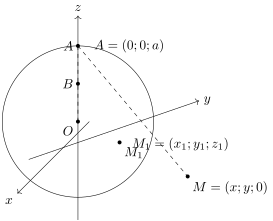
Fig. 24.8
Let us formulate the definition of the stereographic projection of a plane onto a sphere tangent to it. Suppose that in the space a Cartesian rectangular coordinate system is fixed, and a sphere of radius with center at the point , tangent to the plane of the variables and (Fig. 24.8), is given. Its equation has the form
Let us join by a line the top point of the sphere, i.e., the point , with an arbitrarily fixed point of the plane of the variables and . Then the point at which this line intersects the sphere (53) is called the stereographic projection of the point onto the sphere (53), and the point is called the stereographic projection of the point of the sphere onto the plane in question. The stereographic projection establishes a one-to-one correspondence between the points of the plane and the sphere with the point removed. The coordinates of the points and are related by
Prove that the stereographic projection gives a conformal map, i.e., that curves in the plane intersect at the same angle as their images on the sphere.
Prove that the curve , situated in the plane of the variables and so that the polar axis coincides with the positive part of the -axis, maps to a loxodrome under the stereographic projection (54).
Prove that circles on the sphere, under the stereographic projection, go over into circles or lines in the plane.
The central projection of the coordinate plane of the variables onto the hemisphere , consists of the following. An arbitrarily fixed point of the plane of the variables and is joined by a line to the center of the given hemisphere, i.e., to the point . The point at which this line intersects the hemisphere is taken as the image of the point on the hemisphere.
Prove that this projection is not a conformal map, i.e., it does not, in general, preserve the angles between curves.
Find the derivative of the arc length with respect to the parameter for:
the catenary ;
the ellipse ;
the hyperbola ;
the astroid ;
the cycloid ;
the helix ;
Viviani's curve .
Let a plane curve be given in polar coordinates by the equation , where the function is continuously differentiable on some interval . Prove that if is the arc length of the curve , measured from its starting point, then
Find the derivative of the arc length for the following curve given in polar coordinates:
the Archimedean spiral ;
the hyperbolic spiral ;
the logarithmic spiral .
Prove that the boundary of a bounded convex figure in the plane is a rectifiable curve.
Prove that when curves are joined their lengths add: if , then .
Find the curvature and the radius of curvature at an arbitrary point:
the parabola ;
the cubic parabola ;
the sinusoid ;
the catenary ;
the curve .
Find the curvature and the center of curvature at an arbitrary point:
the hyperbola ;
the semicubical parabola ;
the astroid .
Find the curvature of the curve at an arbitrary point:
the ellipse ;
the hyperbola ;
the cycloid .
Find the evolute of the curve:
;
the hyperbola ;
the cycloid ;
the involute of a circle .
Find the curvature at the point of the graph of the function given implicitly by the equation :
;
;
;
.
Find the greatest curvature of the curve:
;
;
;
;
;
;
;
.
Prove that the radius of curvature of the parabola equals , where is the angle of inclination of the tangent to the axis of abscissas.
Let be a twice continuously differentiable function on the interval and let be the angle formed by the tangent to its graph with the axis at the point . Prove that if is the curvature of the graph at this point, then ( is the variable arc length).
Let be a twice differentiable curve without singular points, lying in the plane of the variables ; let be the angle of inclination of its tangent at some point to the axis ( is the variable arc length); are the coordinates of the center of curvature at the same point of the curve . Prove that
and also that
Prove that if is the representation of a twice continuously differentiable curve in polar coordinates, then for its curvature the formula
Find the radii of curvature of the curves given in polar coordinates:
the lemniscate ;
the cardioid ;
;
the Archimedean spiral ;
the hyperbolic spiral ;
the logarithmic spiral .
What is the evolute of a circle?
Write the equation of the evolute:
the tractrix ;
the logarithmic spiral ;
the cardioid .
Prove that the evolute of a cycloid is also a cycloid, differing from the given one only in position.
Prove that the evolute of a cardioid is also a cardioid.
Prove that the evolute of an astroid is an astroid similar to the given one, with similarity coefficient 2, rotated relative to the given one by an angle .
Find the condition on the parameter of the logarithmic spiral under which its evolute coincides with the spiral itself.
Prove that the evolutes of the epicycloid
and of the hypocycloid
,
are again, respectively, an epicycloid and a hypocycloid, obtained from the given ones by a rotation and a similarity transformation.
Prove that for points of the Archimedean spiral , as , the difference between the length of the radius vector and the radius of curvature tends to zero.
Prove that under the conditions of Problem 94 the center of curvature moves along a curve tending to coincide with the circle .
Let , be the representation of a twice continuously differentiable curve in polar coordinates, let be the angle of inclination of its tangent at some point to the polar axis, and let be the angle formed by this tangent with the extension of the radius vector of the point of tangency . Let the line be perpendicular to the line , let the line be the normal to the given curve at the point , and let be the center of curvature of the curve at the same point. Prove that
Prove that for the curves , the polar normal (i.e., the segment of the normal from a point of the curve to its point of intersection with the polar axis) is times larger than the radius of curvature.
Prove that for the curves , the length of the part of the radius vector contained inside the circle of curvature equals .
Let be the length of the radius vector of a point of a given twice continuously differentiable curve, the length of the perpendicular dropped from the origin to the tangent line at the indicated point, and the radius of curvature. Prove that .
Prove that on an ellipse there exist, in general, three points such that the circles of curvature of the ellipse at these points pass through a given point of the ellipse.
Prove that the centers of curvature at points of the Archimedean spiral lying on one ray are located on an ellipse whose semi-axes do not depend on the choice of ray.
Let some point of a twice continuously differentiable curve be taken as the origin of coordinates, the positively directed tangent to the curve at this point as the -axis, and let the -axis be directed from the point of tangency to the center of curvature. Prove that in a neighborhood of the point of tangency the curve has the representation
Prove that if at the point of the curve the radius of curvature has a maximum, then there exists a neighborhood of the point such that the part of the curve corresponding to the parameter values lies inside the circle of curvature at the point .
Prove that if at the point of the curve the radius of curvature has a minimum, then there exists a neighborhood of the point such that the part of the curve corresponding to the parameter values lies outside the circle of curvature at the point .
Find the parabola joining the origin with the point so that the arc of the parabola together with the lower half of the circle forms a curve with continuous tangent and continuous curvature.
Find the parabola with axis of symmetry parallel to the -axis that has, with the sinusoid at the point , a common tangent and curvature.
Prove that if are the coordinates of the center of curvature of a twice continuously differentiable curve , then
Using the properties of the evolute, find the lengths of the following curves:
one arch of the cycloid ;
the astroid between the points and ;
the cardioid .
Write the equations of the osculating, normal, and rectifying planes at an arbitrary point of the curve:
the helix ;
;
;
;
;
.
Find the equation of the principal normal and the binormal to the curve:
;
;
.
Prove that the principal normal of the helix , is perpendicular to the -axis, and that its binormal forms with this axis a constant angle whose cosine equals .
Prove that one of the bisectors of the angles between the tangent and the binormal to the curve has a constant direction.
Along the principal normals (but in the opposite direction) of the helix , segments of length are laid off. Find the curve described by their endpoints.
Prove that the line drawn from an arbitrary point of the curve parallel to the plane until it meets the -axis lies in the osculating plane of the curve at the point .
Write the equation of the osculating plane of the curve at .
Write the equation of the osculating plane at the point of the curve that is the intersection of the sphere and the hyperbolic cylinder .
Prove that if all the osculating planes of a twice continuously differentiable curve pass through a fixed point, then this curve is planar.
Find the vectors and of the curve at the origin.
Find the vectors and at an arbitrary point of the curve;
;
.
Prove that the curvature of a curve is identically zero if and only if the curve is a segment of a straight line.
Find the curvature of the conical helix , at the origin.
Find the curvature of the following curve:
;
;
;
;
;
.
Find the torsion of the curve:
;
;
.
Find the curvature and torsion of the curve:
;
;
;
;
Viviani's curve ; are there points of rectification and points of flattening on Viviani's curve?
Find the points of rectification and flattening, as well as the arcs on which the torsion retains its sign, for the curve:
.
Starting from the definition of the principal normal as the unit vector in the direction of the vector ( is the unit tangent vector, and is the variable arc length of a given three-times continuously differentiable curve without singular points) and the definition of the binormal , prove that:
the derivative of the binormal is collinear with the principal normal;
if , then (in other words, prove the Frenet formulas).
Prove that for a three-times continuously differentiable curve , where is the variable arc length, the relations
Under the assumptions of the previous problem, prove that
Prove that if at the point the curvature of the curve is nonzero, then equals the curvature of the projection of onto its osculating plane at the point .
Prove that if all the normal planes of a twice continuously differentiable curve without singular points and with nonvanishing curvature are parallel to a constant vector, then this curve is planar.
Prove that for the curve , each edge of the accompanying Frenet trihedron forms a constant angle with the -axis.
Along the binormals of the helix , segments of one and the same length are laid off. Find the equation of the curve formed by the endpoints of these segments.
A curve is called a curve of constant slope if its tangents form a constant angle with some straight line.
Prove that a twice continuously differentiable curve with nonzero curvature is a curve of constant slope if and only if one of the following conditions holds:
all the principal normals are parallel to some plane;
all the rectifying planes are parallel to some line;
in the case of a three-times continuously differentiable curve, there exists a constant such that ; moreover , where is the angle referred to in the definition of a curve of constant slope.
Under what condition does the center of curvature of the helix lie on the same cylinder as the helix itself?
Prove that for the curve , the segments of the normal from a point on the curve to the -axis equal the reciprocal of the absolute value of the torsion of the curve: .
Let be a twice continuously differentiable curve without singular points, and . Draw a plane through the points and . Prove that if at the point the curvature is nonzero, then as and this plane tends (define this notion) to the osculating plane at the point .
Let be the plane passing through the tangent line at the point of a twice continuously differentiable curve , where is the variable arc length of the curve , and let be the distance from the point to the plane .
Prove that the plane is the osculating plane of the curve if and only if
Under the assumptions of Problem 136, draw a circle through the same three points and . Prove that as and this circle tends to the circle that is the boundary of the circle of curvature at the point (this circle is called the osculating circle at the given point of the curve).
Through four points of a curve one can draw a sphere. If they tend to a single point, then under corresponding conditions this sphere tends to a certain limiting sphere, called the osculating sphere. Find its center and radius.
Prove that the acceleration vector of a moving material point is perpendicular to the binormal of the trajectory of motion, and find its decomposition along the tangent vector and the principal normal vector. Prove that
where is the radius of curvature of the trajectory of motion.
Prove that for a three-times continuously differentiable curve , where is the variable arc length:
the formula
if by we denote the coordinates of a point in the coordinate system given by the unit vectors , then in a neighborhood of the point of the curve, the projection of the curve onto the osculating plane has the form
the projection onto the normal plane has the form
the projection onto the rectifying plane has the form
Prove that if, on a three-times continuously differentiable curve , where is the variable arc length, the parameter is regarded as time, then as it changes the accompanying Frenet trihedron moves along the curve like a rigid body with angular velocity . Thus the curvature is numerically equal to the speed of rotation of the Frenet trihedron about the binormal (this rotation always occurring from the tangent vector toward the principal normal vector ), and the torsion is the speed of its rotation about the tangent.
Prove that the Frenet formulas can be written in the form
(the vector is defined in the previous problem).