Factor groups and homomorphisms
[14/21%]Recall the definition from [ВА I, Ch. 4, § 2, item 4] of the inner automorphism and of the group . Show that and , where is the center of the group . The quotient group is called the group of outer automorphisms.
Let and be subgroups of a group . Show that
(an analogue of the formula known from the theory of linear spaces). Show, further, that the set is a subgroup if and only if ; in the case this condition is automatically satisfied.
Let us form, for the symmetric group , a table
| 1 | 3 | 6 | 8 | 6 |
|---|---|---|---|---|
analogous to those we used in the examples just considered. Relying on the fairly obvious consideration that in any group a normal subgroup is a union of some set of conjugacy classes, repeat the description we gave in Example 2 of the normal subgroups of the group .
Show that .
If , then is isomorphic to some subgroup of . Is this true?
Let . Prove that either the subgroup is abelian, or one of the intersections is nontrivial. Give an example of a group with a nontrivial normal subgroup such that and . Thus, from it does not follow, in general, that .
Is the quaternion group a semidirect product of two of its proper subgroups?
Show that for any proper subgroup .
Show that the groups and are not isomorphic.
Show that (since , then, by Exercise ).
All complex -th roots of unity, , form an infinite group . It is called quasicyclic, since any finite number of its elements generates a cyclic group. Verify this and show that
Let
where . Prove that , i.e., and in fact is a cyclic group of order 3.
Construct a monomorphism such that the matrix , , has determinant .
Matrices of the form , are called permutation matrices. The restriction of to is a monomorphism into . The composition of the maps (Cayley's theorem) and leads to a monomorphism for any finite group .
Write out the map explicitly for .
Fill in the details of the following formal definition of the free group of rank . To the alphabet , consisting of letters and their "antipodes" , one adds the symbol . Let be the set of all "words" obtained by writing out these symbols in any order in strings of finite length. Repetitions of symbols are allowed in words. By the product of two words one understands the concatenation of the word to the end of the word . The word inverse to , is called . An equivalence relation is introduced on . Namely, two words are considered equivalent if one is obtained from the other by applying a finite number of the following elementary transformations:
Each equivalence class contains one and only one "irreducible" (shortest) word. On the equivalence classes with respect to this relation there is defined an associative multiplication operation (and inversion of classes), induced by multiplication of words. The identity is the equivalence class of the "empty" word . The set of equivalence classes with this multiplication operation is precisely the free group with free generators (the free group of rank ).
Example. Along a "figure eight" whose loops encircle two posts, a kitten with a spool of thread runs in different directions, laying successive turns of thread over the previous ones. When the kitten is at the center between the posts, the direction of its motion may change arbitrarily. The paths it traces, with start and end points at the center, are evidently interpreted as elements of the free group of rank 2.
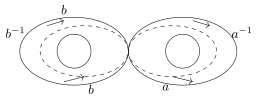
Fig. 3
Irreducible words correspond to taut threads, freed from the trivial loops . In Fig. 3 the segments and and are depicted as geometrically distinct only for the sake of clarity. Our example realizes as the collection of classes of "homotopically equivalent paths" (topological terminology) of a lemniscate. In this sense, the fundamental group of the petal depicted in Fig. 6 in the commentary to 3.3.2 in the section of answers and solutions will be the free group .