Section I.1.4
Determinants of low orders
[3/0%]LaTeX
Problem I.1.4.1
Formula (8) is easier to remember if one uses the following visual rule of signs for writing out the products occurring in the expansion of a third-order determinant:
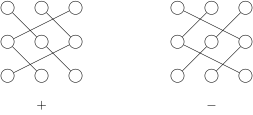
Find an analogous rule for a fourth-order determinant.
?
Origin: AI-translated from another node content of the same node
Generated from: Stated according to the original source
Problem I.1.4.2
Show that all six terms in the expansion of a third-order determinant cannot be simultaneously positive.
?
Origin: AI-translated from another node content of the same node
Generated from: Stated according to the original source
Problem I.1.4.3
Verify that
?
Origin: AI-translated from another node content of the same node
Generated from: Stated according to the original source