Categories and Functors
[30/47%]Construct a contravariant functor from the category of all subsets of a given set (again the morphisms are the imbeddings) into itself.
Does there exist a universal repelling object in: the category of groups, the category of linear spaces over a given field, the categories dual to the categories of groups and linear spaces?
An object of a category is called a universal repelling object (or, briefly, a universal object) if for every object there is exactly one morphism from to . The dual category has the same objects, with the arrows and the order of composition reversed.
Let be the category of abelian groups with a distinguished generator (the morphisms are the group homomorphisms preserving the distinguished generator.) Determine universal objects in .
An object of a category is called a universal repelling object (or, briefly, a universal object) if for every object there is exactly one morphism from to . The dual category has the same objects, with the arrows and the order of composition reversed.
Let be the category of groups with two distinguished generators (the morphisms are the group homomorphisms preserving the distinguished generators). Prove that has a universal object. This object is called the free group with two generators.
An object of a category is called a universal repelling object (or, briefly, a universal object) if for every object there is exactly one morphism from to .
Let be the subcategory of (see Problem 46) whose objects are the abelian groups with two distinguished generators. Prove that there is a universal object in . This object is called the free abelian group with two generators.
An object of a category is called a universal repelling object (or, briefly, a universal object) if for every object there is exactly one morphism from to .
Let be the category of associative algebras with distinguished generators over a field . Prove that there is a universal object in . This universal object is the so-called tensor algebra over an -dimensional linear space over the field .
An object of a category is called a universal repelling object (or, briefly, a universal object) if for every object there is exactly one morphism from to .
Prove that there exists a universal object for the subcategory of consisting of the commutative algebras.
An object of a category is called a universal repelling object (or, briefly, a universal object) if for every object there is exactly one morphism from to .
Prove that there exists a universal object for the category of Lie algebras with distinguished generators over the field . The corresponding object is called the free Lie algebra with generators.
An object of a category is called a universal repelling object (or, briefly, a universal object) if for every object there is exactly one morphism from to .
Let be a Lie algebra over a field of characteristic zero. We consider the category whose objects are those linear mappings from into associative algebras (depending on the object) having the property that
A morphism of an object to an object is defined to be a homomorphism which makes the following diagram commute:

Prove that has a universal object . The algebra is called the associative hull or enveloping algebra of .
An object of a category is called a universal repelling object (or, briefly, a universal object) if for every object there is exactly one morphism from to .
Prove that the associative hull (see Problem 51) of the free Lie algebra with generators is isomorphic to the tensor algebra over an -dimensional space.
An object of a category is called a universal repelling object (or, briefly, a universal object) if for every object there is exactly one morphism from to .
Let be a family of objects in the category . We consider the category whose objects are the sets of morphisms , ( is some object in depending on the object in ). The morphisms in are the sets of commutative diagrams of the form
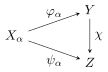
If has a universal repelling object, then the corresponding object in is called the sum of the objects and is denoted by . The morphisms are called the canonical imbeddings of the terms in the sum. Prove that in the category of sets and in the category of linear spaces over a given field, the sum of any family of objects is defined.
An object of a category is called a universal repelling object (or, briefly, a universal object) if for every object there is exactly one morphism from to .
The definition of the product of a family of objects in a category is obtained from the definition of the sum (see Problem 53) by reversing the arrows. Namely, the product is defined to be the sum of the objects in the dual category . The morphisms are called the canonical projections of the product onto the factors. Prove that in the categories of sets and of linear spaces over a given field, the product of any family of objects is defined.
An object of a category is called a universal repelling object (or, briefly, a universal object) if for every object there is exactly one morphism from to . The dual category has the same objects, with the arrows and the order of composition reversed.
Prove that the sum and the product of finitely many objects of the category of linear spaces over a given field are isomorphic.
Let and be two linear spaces over a field . We consider the category whose objects are bilinear mappings , where is a linear space (depending on the object ). A morphism from an object to an object is defined to be a linear mapping for which the diagram

commutes. Prove that the resulting category has a universal repelling object . The space is called the tensor product of the spaces and over the field .
An object of a category is called a universal repelling object (or, briefly, a universal object) if for every object there is exactly one morphism from to .
Let and be finite abelian groups. We consider the category of all mappings , where is a finite abelian group (depending on the object), which are homomorphisms in each variable. The morphisms are the commutative diagrams of the form
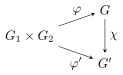
where is a homomorphism. Prove that this category has a universal object (the so-called torsion product of the two groups). Compute , where is the cyclic group of order .
An object of a category is called a universal repelling object (or, briefly, a universal object) if for every object there is exactly one morphism from to .
Let be a directed set, and let be a category. Suppose that for each an object has been singled out, and for each pair a morphism has been chosen in such a way that for any the diagram
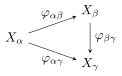
commutes. Consider the category whose objects are families of morphisms compatible with the , where is an object of depending on the family. A morphism from the object to the object is defined to be a morphism such that the diagram
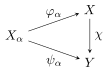
commutes for any . A universal object in (if it exists) is called the inductive limit of the family . The dual concept of a projective limit is defined to be a universal object in . Prove that:
the additive group of the field of rational numbers is the inductive limit of a countable family of groups of integers;
the ring of -adic integers (see Problem 33) is the projective limit of the rings of residue classes modulo .
An object of a category is called a universal repelling object (or, briefly, a universal object) if for every object there is exactly one morphism from to . The dual category has the same objects, with the arrows and the order of composition reversed.
Each complex linear space can be regarded as a real space, and each complex linear mapping as a real linear mapping. Prove that the correspondence described is a covariant functor from the category of linear spaces over to the category of linear spaces over .
Prove that the mapping (tensor product over in the sense of Problem 56) generates a covariant functor from to .
Prove that the categories and (see Problem 59) are not equivalent.
Two categories and are equivalent if there exist covariant functors and such that and are naturally isomorphic to the identity functors in the respective categories.
Let be a group and a field. Consider the collection of formal linear combinations of elements of with coefficients in . It is an algebra over with respect to the natural operations of addition, multiplication, and multiplication by elements of . Prove that:
the correspondence is a covariant functor from the category of groups into the category of -algebras;
is a universal object in the category of multiplicative mappings of the group into -algebras.
An object of a category is called a universal repelling object (or, briefly, a universal object) if for every object there is exactly one morphism from to .