Part I

A Primer on Functional Analysis

[132/99%]
Show
LaTeX
Problem 1.1

Show that if ∥⋅∥\left\| \cdot \right\| is a norm on the scalar field F\mathbf{F}, then there exists a positive number λ>0\lambda > 0 such that ∥x∥=λ∣x∣\left\| x\right\| = \lambda \left|x\right|, where ∣x∣\left|x\right| is the absolute value of xx.

?
Problem 1.2

Given a normed linear space XX, prove the following facts.

?
(a)

Every convergent sequence in XX is Cauchy, and the limit of a convergent sequence is unique.

(b)

Every Cauchy sequence in XX is bounded.

(c)

Reverse Triangle Inequality: ∣∥x∥−∥y∥∣≤∥x−y∥\left|\left\| x\right\| -\left\| y\right\| \right| \leq \left\| x-y\right\| for all x,y∈Xx, y \in X.

(d)

Continuity of the norm: xn→x⟹∥xn∥→∥x∥x_{n} \rightarrow x \Longrightarrow \left\| x_{n}\right\| \rightarrow \left\| x\right\|.

(e)

Continuity of vector addition:

xn→x and yn→y⟹xn+yn→x+y x_{n} \rightarrow x \text{ and } y_{n} \rightarrow y \quad \Longrightarrow \quad x_{n}+y_{n} \rightarrow x+y
(f)

Continuity of scalar multiplication:

xn→x and cn→c⟹cnxn→cx x_{n} \rightarrow x \text{ and } c_{n} \rightarrow c \Longrightarrow c_{n} x_{n} \rightarrow c x
(g)

Convexity of open balls: If x,y∈Br(z)x, y \in B_{r}(z) then

θx+(1−θ)y∈Br(z) for all 0≤θ≤1 \theta x+(1-\theta ) y \in B_{r}(z) \text{ for all } 0 \leq \theta \leq 1
Problem 1.3
?
(a)

Assuming that the functions ∣⋅∣p|\cdot |_{p} on Fd\mathbf{F}^{d} given in equation (1.1) are norms on Fd\mathbf{F}^{d}, show that any two of these norms are equivalent.

(b)

Assuming that F\mathbf{F} is complete with respect to absolute value, show that Fd\mathbf{F}^{d} is complete with respect to any one of the norms ∣⋅∣p|\cdot |_{p}.

Problem 1.4

Let VV be a finite-dimensional vector space. Prove that the function ∥⋅∥1\left\| \cdot \right\|_{1} on VV defined in Example 1.6 is a norm, and that VV is complete with respect to this norm.

?
Problem 1.5

Show that if vectors xnx_{n} in a normed space XX satisfy ∥xn+1−xn∥<2−n\left\| x_{n+1}-x_{n}\right\| < 2^{-n} for every n∈Nn \in \mathbb {N}, then {xn}\left\{ x_{n}\right\} is a Cauchy sequence in XX.

?
Problem 1.6

Let {xn}\left\{ x_{n}\right\} be a sequence in a normed space XX, and let x∈Xx \in X be fixed. Suppose that every subsequence {yn}\left\{ y_{n}\right\} of {xn}\left\{ x_{n}\right\} has a subsequence {zn}\left\{ z_{n}\right\} of {yn}\left\{ y_{n}\right\} such that zn→xz_{n} \rightarrow x. Show that xn→xx_{n} \rightarrow x.

?
Problem 1.7

Let XX be a complex Banach space. Let XR=XX_{\mathbb {R}} = X as a set, but consider XRX_{\mathbb {R}} as a vector space over the real field. That is, vector addition in XRX_{\mathbb {R}} is defined just as in XX, but scalar multiplication in XRX_{\mathbb {R}} is restricted to multiplication by real scalars. Let ∥⋅∥R=∥⋅∥\left\| \cdot \right\|_{\mathbb {R}} = \left\| \cdot \right\|, and show that (XR,∥⋅∥R)(X_{\mathbb {R}},\left\| \cdot \right\|_{\mathbb {R}}) is a real Banach space.

?
Problem 1.8

We say that a set XX (not necessarily a vector space) is a metric space if for each x,y∈Xx, y \in X there exists a real number d(x,y)\mathrm{d}(x, y) such that for all x,yx, y, z∈Xz \in X we have: i. i. d(x,y)≥0\mathrm{d}(x, y) \geq 0, ii. d(x,y)=0\mathrm{d}(x, y) = 0 if and only if x=yx = y, iii. d(x,y)=d(y,x)\mathrm{d}(x, y) = \mathrm{d}(y, x), and iv. the Triangle Inequality: d(x,y)≤d(x,z)+d(y,z)\mathrm{d}(x, y) \leq \mathrm{d}(x, z)+\mathrm{d}(y, z).

In this case we call d a metric on XX, and we refer to d(x,y)\mathrm{d}(x, y) as the distance between xx and yy.

?
(a)

Show that if XX is a normed space, then d(x,y)=∥x−y∥\mathrm{d}(x, y) = \left\| x-y\right\| is a metric on XX.

(b)

Make a definition of convergent and Cauchy sequences in a metric space, and show that every convergent sequence is Cauchy.

(c)

Define a metric space to be complete if every Cauchy sequence in XX converges to an element of XX. Let X=QX = \mathbb {Q} and set d(x,y)=∣x−y∣\mathrm{d}(x, y) = \left|x-y\right|, the ordinary absolute value of the difference of xx and yy. Show that d is a metric on Q\mathbb {Q}, but Q\mathbb {Q} is incomplete with respect to this metric.

Problem 1.9

Fix 0<p<10 < p < 1, and define ℓp\ell^{p} by equation (1.2) and ∥⋅∥ℓp\left\| \cdot \right\|_{\ell^{p}} by equation (1.3).

?
(a)

Show that ∥⋅∥ℓp\left\| \cdot \right\|_{\ell^{p}} fails the Triangle Inequality and hence is not a norm on ℓp\ell^{p}.

(b)

Show that ∥x+y∥ℓpp≤∥x∥ℓpp+∥y∥ℓpp\left\| x+y\right\|_{\ell^{p}}^{p} \leq \left\| x\right\|_{\ell^{p}}^{p}+\left\| y\right\|_{\ell^{p}}^{p}, and use this to show that ℓp\ell^{p} is a vector space and d(x,y)=∥x−y∥ℓpp\mathrm{d}(x, y) = \left\| x-y\right\|_{\ell^{p}}^{p} is a metric on ℓp\ell^{p}.

(c)

Let B={x∈ℓp:d(x,0)<1}B = \left\{ x \in \ell^{p}: \mathrm{d}(x, 0) < 1\right\} be the "open unit ball" with respect to the metric d, and show that BB is not convex. Use this to show that there is no norm ∥⋅∥\left\| \cdot \right\| on ℓp\ell^{p} such that d(x,y)=∥x−y∥\mathrm{d}(x, y) = \left\| x-y\right\|.

Problem 1.10
?
(a)

Show that if 0<θ<10 < \theta < 1, then tθ≤θt+(1−θ)t^{\theta } \leq \theta t+(1-\theta ) for t≥0t \geq 0, with equality if and only if t=1t = 1.

(b)

Suppose that 1<p<∞1 < p < \infty and a,b≥0a, b \geq 0. Apply part (a) with t=apb−p′t = a^{p} b^{-p^{\prime }} and θ=1/p\theta = 1 / p to show that ab≤ap/p+bp′/p′a b \leq a^{p} / p+b^{p^{\prime }} / p^{\prime }, with equality if and only if b=ap−1b = a^{p-1}.

Problem 1.11

Show that equality holds in Hölder's Inequality for sequences (part (a) of Theorem 1.12) if and only if there exist scalars α,β\alpha , \beta, not both zero, such that α∣xk∣p=β∣yk∣p′\alpha \left|x_{k}\right|^{p} = \beta \left|y_{k}\right|^{p^{\prime }} for each k∈Ik \in I.

?
Problem 1.12

Show that if 1≤p<q≤∞1 \leq p < q \leq \infty, then ℓp⊊ℓq\ell^{p} \subsetneq \ell^{q} and ∥x∥ℓq≤∥x∥ℓp\left\| x\right\|_{\ell^{q}} \leq \left\| x\right\|_{\ell^{p}} for all x∈ℓpx \in \ell^{p}.

?
Problem 1.13

Let E⊆RE \subseteq \mathbb {R} be measurable with ∣E∣<∞\left|E\right| < \infty. Show that if 1≤p<q≤∞1 \leq p < q \leq \infty, then Lq(E)⊊Lp(E)L^{q}(E) \subsetneq L^{p}(E) and ∥f∥Lp≤∣E∣1p−1q∥f∥Lq\left\| f\right\|_{L^{p}} \leq \left|E\right|^{\frac{1}{p}-\frac{1}{q}}\left\| f\right\|_{L^{q}} for all f∈Lp(E)f \in L^{p}(E).

?
Problem 1.14

Show that if x∈ℓqx \in \ell^{q} for some finite qq, then ∥x∥ℓp→∥x∥ℓ∞\left\| x\right\|_{\ell^{p}} \rightarrow \left\| x\right\|_{\ell^{\infty }} as p→∞p \rightarrow \infty, but this can fail if x∉ℓqx \notin \ell^{q} for any finite qq.

?
Problem 1.15

Given an arbitrary index set II, define ℓ∞(I)\ell^{\infty }(I) to be the space of all bounded sequences x=(xi)i∈Ix = \left(x_{i}\right)_{i \in I} indexed by II, with ∥x∥∞=sup⁡i∈I∣xi∣\left\| x\right\|_{\infty } = \sup_{i \in I}\left|x_{i}\right|. For 1≤p<∞1 \leq p < \infty let ℓp(I)\ell^{p}(I) consist of all sequences x=(xi)i∈Ix = \left(x_{i}\right)_{i \in I} with at most countably many nonzero components such that ∥x∥ℓpp=∑∣xi∣p<∞\left\| x\right\|_{\ell^{p}}^{p} = \sum \left|x_{i}\right|^{p} < \infty. Show that each of these spaces ℓp(I)\ell^{p}(I) is a Banach space with respect to ∥⋅∥ℓp\left\| \cdot \right\|_{\ell^{p}}. What is ℓp(I)\ell^{p}(I) if I={1,…,d}I = \left\{ 1, \ldots , d\right\}?

?
Problem 1.16

Let X,YX, Y be normed linear spaces. Given 1≤p<∞,x∈X1 \leq p < \infty , x \in X, and y∈Yy \in Y, define ∥(x,y)∥p=(∥x∥Xp+∥y∥Yp)1/p\left\| (x, y)\right\|_{p} = \left(\left\| x\right\|_{X}^{p}+\left\| y\right\|_{Y}^{p}\right)^{1 / p} and ∥(x,y)∥∞=max⁡{∥x∥X,∥y∥Y}\left\| (x, y)\right\|_{\infty } = \max \left\{ \left\| x\right\|_{X},\left\| y\right\|_{Y}\right\}.

?
(a)

Prove that ∥⋅∥p\left\| \cdot \right\|_{p} is a norm on the Cartesian product X×YX \times Y, and ∥⋅∥p\left\| \cdot \right\|_{p} and ∥⋅∥q\left\| \cdot \right\|_{q} are equivalent norms on X×YX \times Y for any 1≤p,q≤∞1 \leq p, q \leq \infty.

(b)

Show that if XX and YY are Banach spaces, then X×YX \times Y is a Banach space with respect to ∥⋅∥p\left\| \cdot \right\|_{p}.

Problem 1.17

Prove Lemma 1.16: Let EE be a subset of a metric space XX.

?
(a)

EE is closed if and only if EE contains all of its limit points.

(b)

Eˉ=E∪{x∈X:x is a limit point of E}\bar{E} = E \cup \left\{ x \in X: x\text{ is a limit point of }E\right\}. Consequently, EE is closed if and only if E=EˉE = \bar{E}.

(c)

EE is dense in XX if and only if every x∈Xx \in X is a limit point of EE.

Problem 1.18

Prove Lemma 1.17.

?
Remark.
?

Lemma 1.17: Let SS be a subspace of a Banach space XX. Then SS is a Banach space with respect to the norm on XX if and only if SS is a closed subset of XX.

Problem 1.19

Show that if f∈Cb(R)f \in C_{b}(\mathbb {R}), then ess⁡sup⁡t∈R∣f(t)∣=sup⁡t∈R∣f(t)∣\operatorname {ess}_{\sup }^{t \in \mathbb {R}}\left|f(t)\right| = \sup_{t \in \mathbb {R}}\left|f(t)\right|, and consequently ∥f∥L∞=∥f∥∞\left\| f\right\|_{L^{\infty }} = \left\| f\right\|_{\infty }.

?
Problem 1.20
?
(a)

Show that cc and c0c_{0} are closed subspaces of ℓ∞\ell^{\infty }.

(b)

Show that c00c_{00} is a proper, dense subspace of c0c_{0}, and hence is not closed with respect to the norm ∥⋅∥ℓ∞\left\| \cdot \right\|_{\ell \infty }.

(c)

Let {δn}\left\{ \delta_{n}\right\} denote the sequence of standard basis vectors (see Example 1.30). Given x=(xn)∈c0x = \left(x_{n}\right) \in c_{0}, show that x=∑xnδnx = \sum x_{n} \delta_{n}, where the series converges with respect to the norm ∥⋅∥ℓ∞\left\| \cdot \right\|_{\ell \infty }. Show further that the scalars xnx_{n} in this representation are unique.

Problem 1.21
?
(a)

Show that Cb(R)C_{b}(\mathbb {R}) is a Banach space with respect to the uniform norm ∥⋅∥∞\left\| \cdot \right\|_{\infty }.

(b)

Show that C0(R)C_{0}(\mathbb {R}) is a closed subspace of Cb(R)C_{b}(\mathbb {R}).

(c)

Show that Cc(R)C_{c}(\mathbb {R}) is a proper, dense subspace of C0(R)C_{0}(\mathbb {R}), and hence is not closed with respect to ∥⋅∥∞\left\| \cdot \right\|_{\infty }.

(d)

Let C(T)C(\mathbf{T}) be the set of all continuous functions f∈C(R)f \in C(\mathbb {R}) that are 1 -periodic, i.e., f(t+1)=f(t)f(t+1) = f(t) for every t∈Rt \in \mathbb {R}. Show that C(T)C(\mathbf{T}) is a closed subspace of Cb(R)C_{b}(\mathbb {R}).

Problem 1.22

Let Cbm(R)C_{b}^{m}(\mathbb {R}) be the space of all mm-times differentiable functions on R\mathbb {R} each of whose derivatives is bounded and continuous, i.e.,

Cbm(R)={f∈Cb(R):f,f′,…,f(m)∈Cb(R)}. C_{b}^{m}(\mathbb {R}) = \left\{ f \in C_{b}(\mathbb {R}): f, f^{\prime }, \ldots , f^{(m)} \in C_{b}(\mathbb {R})\right\} .
?
(a)

Show that Cbm(R)C_{b}^{m}(\mathbb {R}) is a Banach space with respect to the norm

∥f∥Cbm=∥f∥∞+∥f′∥∞+⋯+∥f(m)∥∞ \left\| f\right\| _{C_{b}^{m}} = \left\| f\right\| _{\infty }+\left\| f^{\prime }\right\| _{\infty }+\cdots +\left\| f^{(m)}\right\| _{\infty }

and

C0m(R)={f∈C0(R):f,f′,…,f(m)∈C0(R)} C_{0}^{m}(\mathbb {R}) = \left\{ f \in C_{0}(\mathbb {R}): f, f^{\prime }, \ldots , f^{(m)} \in C_{0}(\mathbb {R})\right\}

is a subspace of Cbm(R)C_{b}^{m}(\mathbb {R}) that is also a Banach space with respect to the same norm.

(b)

Now we change the norm on Cb1(R)C_{b}^{1}(\mathbb {R}). Show that (Cb1(R),∥⋅∥∞)(C_{b}^{1}(\mathbb {R}),\left\| \cdot \right\|_{\infty }) is a normed space, but is not complete.

Problem 1.23

We say that a function f:R→Ff: \mathbb {R} \rightarrow \mathbf{F} is Hölder continuous with exponent α>0\alpha > 0 if there exists a constant K>0K > 0 such that

∀x,y∈R,∣f(x)−f(y)∣≤K∣x−y∣α \forall x, y \in \mathbb {R}, \quad \left|f(x)-f(y)\right| \leq K\left|x-y\right|^{\alpha }

A function that is Hölder continuous with exponent α=1\alpha = 1 is said to be Lipschitz.

?
(a)

Show that if ff is Hölder continuous for some α>1\alpha > 1, then ff is constant.

(b)

Show that if ff is differentiable on R\mathbb {R} and f′f^{\prime } is bounded, then ff is Lipschitz. Find a function gg that is Lipschitz but is not differentiable at every point.

(c)

Given 0<α<10 < \alpha < 1, define

Cα(R)={f∈C(R):f is Ho¨lder continuous with exponent α}.  C^{\alpha }(\mathbb {R}) = \left\{ f \in C(\mathbb {R}): f \text{ is Hölder continuous with exponent } \alpha \right\} \text{. }

Show that Cα(R)C^{\alpha }(\mathbb {R}) is a Banach space with respect to the norm

∥f∥Cα=∣f(0)∣+sup⁡x≠yf(x)−f(y)∣x−y∣α \left\| f\right\| _{C^{\alpha }} = \left|f(0)\right|+\sup _{x \neq y} \frac{f(x)-f(y)}{\left|x-y\right|^{\alpha }}
Problem 1.24

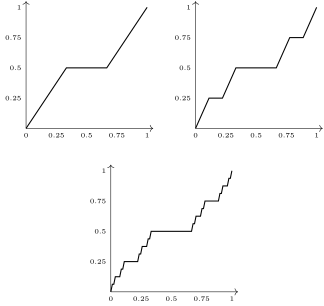
Consider the two functions φ1,φ2\varphi_{1}, \varphi_{2} pictured in Figure 1.1. The function φ1\varphi_{1} takes the constant value 1/21 / 2 on the interval (1/3,2/3)(1 / 3,2 / 3) that is removed in the first stage of the construction of the classical Cantor middle-thirds set, and is linear on the remaining intervals. The function φ2\varphi_{2} also takes the same constant 1/21 / 2 on the interval (1/3,2/3)(1 / 3,2 / 3) but additionally is constant with values 1/41 / 4 and 3/43 / 4 on the two intervals (1/9,2/9)(1 / 9,2 / 9) and (7/9,8/9)(7 / 9,8 / 9) that are removed in the second stage of the construction of the Cantor set. Continue this process, defining φ3,φ4,…\varphi_{3}, \varphi_{4}, \ldots, and prove the following facts.

Fig. 1.1. Top left: The function \varphi _{1}. Top right: The function \varphi _{2}. Bottom: The Devil’s staircase (Cantor-Lebesgue function).Fig. 1.1. Top left: The function \varphi _{1}. Top right: The function \varphi _{2}. Bottom: The Devil’s staircase (Cantor-Lebesgue function).

?
(a)

Each φk\varphi_{k} is monotone increasing on [0,1][0,1], and ∣φk+1(t)−φk(t)∣<2−k\left|\varphi_{k+1}(t)-\varphi_{k}(t)\right| < 2^{-k} for every t∈[0,1]t \in [0,1].

(b)

φ(t)=lim⁡k→∞φk(t)\varphi (t) = \lim_{k \rightarrow \infty } \varphi_{k}(t) converges uniformly on [ 0,1 ]. The limit function φ\varphi is called the Cantor-Lebesgue function or, more picturesquely, the Devil's staircase.

(c)

The Cantor-Lebesgue function is Hölder continuous on the interval [0,1][0,1] precisely for exponents α\alpha in the range 0<α≤log⁡32≈0.6309…0 < \alpha \leq \log_{3} 2 \approx 0.6309 \ldots. In particular, φ\varphi is continuous and monotone increasing on [0,1][0,1] but it is not Lipschitz. Even so, φ\varphi is differentiable for a.e. t∈[0,1]t \in [0,1], and φ′(t)=0\varphi^{\prime }(t) = 0 a.e.

Problem 1.25

Let XX be a normed linear space that is not complete. Let C\mathcal{C} be the set of all Cauchy sequences in XX, and define a relation ∼\sim on C\mathcal{C} by declaring that {xn}∼{yn}\left\{ x_{n}\right\} \sim \left\{ y_{n}\right\} if lim⁡n→∞∥xn−yn∥=0\lim_{n \rightarrow \infty }\left\| x_{n}-y_{n}\right\| = 0.

?
(a)

Show that ∼\sim is an equivalence relation on C\mathcal{C}.

(b)

Let [xn]={{yn}:{yn}∼{xn}}\left[x_{n}\right] = \left\{ \left\{ y_{n}\right\} :\left\{ y_{n}\right\} \sim \left\{ x_{n}\right\} \right\} denote the equivalence class of {xn}\left\{ x_{n}\right\} under the relation ∼\sim. Let X~\widetilde{X} be the set of all equivalence classes [xn]\left[x_{n}\right]. Define ∥[xn]∥X~=lim⁡n→∞∥xn∥\left\| \left[x_{n}\right]\right\|_{\widetilde{X}} = \lim_{n \rightarrow \infty }\left\| x_{n}\right\|. Prove that ∥⋅∥X~\left\| \cdot \right\|_{\widetilde{X}} is a well-defined norm on X~\widetilde{X}.

(c)

Given x∈Xx \in X, let [x][x] denote the equivalence class of the Cauchy sequence {x,x,x,…}\left\{ x, x, x, \ldots \right\}. Show that T:x↦[x]T: x \mapsto [x] is an isometric map of XX into X~\widetilde{X}, where isometric means that ∥Tx∥X~=∥x∥\left\| T x\right\|_{\widetilde{X}} = \left\| x\right\| for every xx (see Definition 1.60). Show also that T(X)T(X) is a dense subspace of X~\widetilde{X} (so, in the sense of identifying of XX with T(X)T(X), we can consider XX to be a subspace of X~\widetilde{X}).

(d)

Show that X~\widetilde{X} is a Banach space with respect to ∥⋅∥X~\left\| \cdot \right\|_{\widetilde{X}}. We call X~\widetilde{X} the completion of XX.

(e)

Prove that X~\widetilde{X} is unique in the sense that if YY is a Banach space and U:X→YU: X \rightarrow Y is a linear isometry such that U(X)U(X) is dense in YY, then there exists a linear isometric bijection V:Y→X~V: Y \rightarrow \widetilde{X}.

Problem 1.26

Suppose that ∑xn\sum x_{n} and ∑yn\sum y_{n} are convergent series in a normed space XX. Show that ∑(xn+yn)\sum \left(x_{n}+y_{n}\right) is convergent and equals ∑xn+∑yn\sum x_{n}+\sum y_{n}.

?
Problem 1.27

Show that C0(R)C_{0}(\mathbb {R}) is separable.

?
Problem 1.28
?
(a)

Show that if XX is a normed linear space and there exists an uncountable set S⊆XS \subseteq X such that ∥x−y∥=1\left\| x-y\right\| = 1 for every x≠y∈Sx \neq y \in S, then XX is not separable.

(b)

Let D={x=(x1,x2,…)∈ℓ∞:xk=0,1 for each k}D = \left\{ x = \left(x_{1}, x_{2}, \ldots \right) \in \ell^{\infty }: x_{k} = 0,1 \text{ for each } k\right\}. Show that DD is uncountable and that if x,yx, y are two distinct vectors in DD, then ∥x−y∥ℓ∞=1\left\| x-y\right\|_{\ell \infty } = 1. Conclude that ℓ∞\ell^{\infty } is not separable.

(c)

Show that L∞(R)L^{\infty }(\mathbb {R}) is not separable.

Problem 1.29

Let (ck)k≥0\left(c_{k}\right)_{k \geq 0} be a fixed sequence of real numbers. Show that if the series ∑k=0∞ckyk\sum_{k = 0}^{\infty } c_{k} y^{k} converges for some y∈Ry \in \mathbb {R}, then the series f(x)=∑k=0∞ckxkf(x) = \sum_{k = 0}^{\infty } c_{k} x^{k} converges absolutely for all ∣x∣<∣y∣\left|x\right| < \left|y\right|, and show that this function ff is infinitely differentiable for all xx with ∣x∣<∣y∣\left|x\right| < \left|y\right|.

?
Problem 1.30

An n×nn \times n matrix AA is said to be positive definite if Ax⋅x>0A x \cdot x > 0 for all x∈Fnx \in \mathbf{F}^{n} (compare Definition 2.14).

?
(a)

Show that if AA is a positive definite n×nn \times n matrix then equation (1.13) defines an inner product on Fd\mathbf{F}^{d}.

(b)

Show that if ⟨⋅,⋅⟩\left\langle \cdot , \cdot \right\rangle is an inner product on Fd\mathbf{F}^{d} then there exists some positive definite matrix AA such that equation (1.13) holds.

(c)

Prove that the inner products on Fd\mathbf{F}^{d} defined by equation (1.13) are all equivalent.

Problem 1.31

Prove Lemma 1.36.

?
(a)

Polar Identity: ∥f+g∥2=∥f∥2+2Re⁡⟨f,g⟩+∥g∥2\left\| f+g\right\|^{2} = \left\| f\right\|^{2}+2 \operatorname {Re} \left\langle f, g \right\rangle +\left\| g\right\|^{2}.

(b)

Pythagorean Theorem: if f⊥gf \perp g then ∥f±g∥2=∥f∥2+∥g∥2\left\| f \pm g\right\|^{2} = \left\| f\right\|^{2}+\left\| g\right\|^{2}.

(c)

Parallelogram Law: ∥f+g∥2+∥f−g∥2=2∥f∥2+2∥g∥2\left\| f+g\right\|^{2}+\left\| f-g\right\|^{2} = 2\left\| f\right\|^{2}+2\left\| g\right\|^{2}.

Problem 1.32

Show that if p≠2p \neq 2 then the norm ∥⋅∥ℓp\left\| \cdot \right\|_{\ell^{p}} on ℓp\ell^{p} is not induced from any inner product on ℓp\ell^{p}.

?
Problem 1.33

Show that equality holds in the Cauchy-Bunyakovski-Schwarz Inequality if and only if x=cyx = c y or y=cxy = c x for some scalar c∈Fc \in \mathbf{F}.

?
Problem 1.34

We say that ⟨⋅,⋅⟩\left\langle \cdot , \cdot \right\rangle is a semi-inner product on a vector space HH if properties (a), (c), and (d) of Definition 1.33 are satisfied. Prove that if ⟨⋅,⋅⟩\left\langle \cdot , \cdot \right\rangle is a semi-inner product then ∥x∥=⟨x,x⟩1/2\left\| x\right\| = \left\langle x, x \right\rangle^{1 / 2} defines a seminorm on HH, and ∣⟨x,y⟩∣≤∥x∥∥y∥\left| \left\langle x, y \right\rangle \right| \leq \left\| x\right\| \left\| y\right\| for all x,y∈Hx, y \in H.

?
Problem 1.35

Given a closed subspace MM of a Hilbert space HH and given x∈Hx \in H, prove that the point in MM closest to xx is unique.

?
Problem 1.36

Prove Lemma 1.42.

?
Remark.
?

Lemma 1.42: If AA is a subset of a Hilbert space HH, then A⊥A^{\perp } is a closed subspace of HH.

Problem 1.37

Prove Theorem 1.43.

?
Remark.
?

Theorem 1.43: If MM is a closed subspace of a Hilbert space HH and x∈Hx \in H, then the following statements are equivalent: (a) x=p+ex = p+e where pp is the orthogonal projection of xx onto MM; (b) x=p+ex = p+e where p∈Mp \in M and e∈M⊥e \in M^{\perp }; (c) x=p+ex = p+e where ee is the orthogonal projection of xx onto M⊥M^{\perp }.

Problem 1.38

Prove Lemma 1.44.

?
(a)

If MM is a closed subspace of HH, then (M⊥)⊥=M\left(M^{\perp }\right)^{\perp } = M.

(b)

If AA is any subset of HH, then A⊥=(span⁡(A))⊥=(span⁡‾(A))⊥A^{\perp } = \left(\operatorname {span}(A)\right)^{\perp } = \left(\overline{\operatorname {span}}(A)\right)^{\perp }, and (A⊥)⊥=span⁡‾(A)\left(A^{\perp }\right)^{\perp } = \overline{\operatorname {span}}(A).

(c)

A sequence {xn}\left\{ x_{n}\right\} in HH is complete if and only if: x∈Hx \in H and ⟨x,xn⟩=0\left\langle x, x_{n} \right\rangle = 0 for every nn implies x=0x = 0.

Problem 1.39

Prove Lemma 1.46.

?
(a)

M⊕NM \oplus N is a closed subspace of HH.

(b)

M⊕M⊥=HM \oplus M^{\perp } = H.

Problem 1.40

Let H,KH, K be Hilbert spaces. Show that H×KH \times K is a Hilbert space with respect to the inner product ⟨(h1,k1),(h2,k2)⟩=⟨h1,h2⟩H+⟨k1,k2⟩K\left\langle \left(h_{1}, k_{1}\right), \left(h_{2}, k_{2}\right) \right\rangle = \left\langle h_{1}, h_{2} \right\rangle_{H}+ \left\langle k_{1}, k_{2} \right\rangle_{K}.

?
Problem 1.41

Prove that the completion H~\widetilde{H} (Exercise 1.25) of an inner product space HH is a Hilbert space with respect to an inner product that extends the inner product on HH.

?
Problem 1.42

Prove the remaining parts of Theorems 1.49 and 1.50.

?
Remark.
?

Theorem 1.49: If {xn}\left\{ x_{n}\right\} is an orthonormal sequence in a Hilbert space HH, then the following statements hold.

  1. Bessel’s Inequality: ∑∣⟨x,xn⟩∣2≤∥x∥2\sum \left| \left\langle x, x_{n} \right\rangle \right|^{2} \leq \left\| x\right\|^{2} for every x∈Hx \in H.

  2. If x=∑cnxnx = \sum c_{n} x_{n} converges, then cn=⟨x,xn⟩c_{n} = \left\langle x, x_{n} \right\rangle.

  3. ∑cnxn\sum c_{n} x_{n} converges   ⟺  \iff ∑∣cn∣2<∞\sum \left|c_{n}\right|^{2} < \infty.

  4. x∈span⁡‾{xn}  ⟺  x=∑⟨x,xn⟩xnx \in \overline{\operatorname {span}}\left\{ x_{n}\right\} \iff x = \sum \left\langle x, x_{n} \right\rangle x_{n}.

  5. If x∈Hx \in H, then p=∑⟨x,xn⟩xnp = \sum \left\langle x, x_{n} \right\rangle x_{n} is the orthogonal projection of xx onto span⁡‾{xn}\overline{\operatorname {span}}\left\{ x_{n}\right\}. Theorem 1.50: If {xn}\left\{ x_{n}\right\} is an orthonormal sequence in a Hilbert space HH, then the following statements are equivalent.

  6. {xn}\left\{ x_{n}\right\} is complete in HH.

  7. {xn}\left\{ x_{n}\right\} is a basis for HH, i.e., for each x∈Hx \in H there exists a unique sequence of scalars (cn)\left(c_{n}\right) such that x=∑cnxnx = \sum c_{n} x_{n}.

  8. x=∑⟨x,xn⟩xnx = \sum \left\langle x, x_{n} \right\rangle x_{n} for each x∈Hx \in H.

  9. Plancherel’s Equality: ∥x∥2=∑∣⟨x,xn⟩∣2\left\| x\right\|^{2} = \sum \left| \left\langle x, x_{n} \right\rangle \right|^{2} for all x∈Hx \in H.

  10. Parseval’s Equality: ⟨x,y⟩=∑⟨x,xn⟩⟨xn,y⟩\left\langle x, y \right\rangle = \sum \left\langle x, x_{n} \right\rangle \left\langle x_{n}, y \right\rangle for all x,y∈Hx, y \in H. The text proves part (a), the implication ⇐\Leftarrow of part (c) and the implication ⇒\Rightarrow of part (d) of Theorem 1.49, and the implications (a) ⇒\Rightarrow (c) and (d) ⇒\Rightarrow (c) of Theorem 1.50.

Problem 1.43
?
(a)

Let MM be a proper, closed subspace of a Hilbert space HH. Given x∈H\Mx \in H \backslash M, let pp be the orthogonal projection of xx onto MM, and show that the vector y=(x−p)/∥x−p∥y = (x-p) /\left\| x-p\right\| satisfies ∥y∥=1,y∈M⊥\left\| y\right\| = 1, y \in M^{\perp }, and dist⁡(y,M)=inf⁡m∈M∥y−m∥=1\operatorname {dist}(y, M) = \inf_{m \in M}\left\| y-m\right\| = 1.

(b)

Show that if HH is an infinite-dimensional Hilbert space, then there exists an infinite orthonormal sequence {en}\left\{ e_{n}\right\} in HH, and no subsequence {enk}\left\{ e_{n_{k}}\right\} is Cauchy. Contrast this with the Bolzano-Weierstrass Theorem, which states that every bounded sequence in Fd\mathbf{F}^{d} has a convergent subsequence.

Remark In another language, this problem shows that the closed unit ball D={x∈H:∥x∥≤1}D = \left\{ x \in H:\left\| x\right\| \leq 1\right\} in HH is not compact when HH is infinite dimensional.

Problem 1.44

This exercise will extend Exercise 1.43 to an arbitrary normed linear space XX.

?
(a)

Prove F. Riesz's Lemma: If MM is a proper, closed subspace of XX and ε>0\varepsilon > 0, then there exists x∈Xx \in X with ∥x∥=1\left\| x\right\| = 1 such that dist⁡(x,M)=inf⁡m∈M∥x−m∥>1−ε\operatorname {dist}(x, M) = \inf_{m \in M}\left\| x-m\right\| > 1-\varepsilon.

(b)

Prove that if XX is infinite dimensional then there exists a bounded sequence {xn}\left\{ x_{n}\right\} in XX that has no convergent subsequences (hence the closed unit ball D={x∈X:∥x∥≤1}D = \left\{ x \in X:\left\| x\right\| \leq 1\right\} is never compact in an infinite-dimensional Banach space).

Problem 1.45

Let {xn}\left\{ x_{n}\right\} be a finitely linearly independent sequence in a Hilbert space HH. Show that there exists an orthogonal sequence {yn}\left\{ y_{n}\right\} in HH such that span⁡{y1,…,yN}=span⁡{x1,…,xN}\operatorname {span}\left\{ y_{1}, \ldots , y_{N}\right\} = \operatorname {span}\left\{ x_{1}, \ldots , x_{N}\right\} for each N∈NN \in \mathbb {N} (this is the GramSchmidt orthogonalization procedure).

?
Problem 1.46

We say that a sequence {xn}\left\{ x_{n}\right\} in a Banach space XX is ω\omega-dependent if there exist scalars cnc_{n}, not all zero, such that ∑cnxn=0\sum c_{n} x_{n} = 0, where the series converges in the norm of XX. A sequence is ω\omega-independent if it is not ω\omega-dependent (we explore ω\omega-independent sequences in more detail in Chapter 5).

?
(a)

Show that if {xn}\left\{ x_{n}\right\} is a basis for a Hilbert space HH then {xn}\left\{ x_{n}\right\} is ω\omega independent.

(b)

Let α,β∈C\alpha , \beta \in \mathbb {C} be fixed nonzero scalars such that ∣α/β∣>1\left|\alpha / \beta \right| > 1. Let {δn}n∈N\left\{ \delta_{n}\right\}_{n \in \mathbb {N}} be the standard basis for ℓ2\ell^{2}, and define x0=δ1x_{0} = \delta_{1} and xn=αδn+βδn+1x_{n} = \alpha \delta_{n}+\beta \delta_{n+1} for n∈Nn \in \mathbb {N}. Prove that {xn}n≥0\left\{ x_{n}\right\}_{n \geq 0} is complete and finitely independent in ℓ2\ell^{2}, but is not ω\omega-independent and therefore is not a basis for ℓ2\ell^{2}.

Problem 1.47

Let {xn}\left\{ x_{n}\right\} be a sequence in a Hilbert space HH. Prove that the following two statements are equivalent.

?
(a)

For each m∈Nm \in \mathbb {N} we have xm∉span⁡‾{xn}n≠mx_{m} \notin \overline{\operatorname {span}}\left\{ x_{n}\right\}_{n \neq m} (such a sequence is said to be minimal).

(b)

There exists a sequence {yn}\left\{ y_{n}\right\} in HH such that ⟨xm,yn⟩=δmn\left\langle x_{m}, y_{n} \right\rangle = \delta_{m n} for all m,n∈Nm, n \in \mathbb {N} (we say that sequences {xn}\left\{ x_{n}\right\} and {yn}\left\{ y_{n}\right\} satisfying this condition are biorthogonal).

Show further that, in case these hold, the sequence {yn}\left\{ y_{n}\right\} is unique if and only if {xn}\left\{ x_{n}\right\} is complete.

Remark Lemma 5.4 will establish an analogous result for Banach spaces.

Problem 1.48

Let ψ=χ[0,1/2)−χ[1/2,1)\psi = \chi_{[0,1 / 2)}-\chi_{[1 / 2,1)} be the Haar wavelet. Compute the Fourier coefficients of ψ\psi and apply the Plancherel Equality to show that π28=∑n=1∞1(2n−1)2\frac{\pi^{2}}{8} = \sum_{n = 1}^{\infty } \frac{1}{(2 n-1)^{2}}.

?
Problem 1.49

This exercise provides a real-valued analogue of the orthonormal basis {e2πint}n∈Z\left\{ e^{2 \pi i n t}\right\}_{n \in \mathbb {Z}} for complex L2(T)L^{2}(\mathbf{T}) discussed in Example 1.52. Let real L2(T)L^{2}(\mathbf{T}) consist of all real-valued, 1 -periodic functions on R\mathbb {R} that are square integrable on [0,1][0,1]. Assuming the fact that {e2πint}n∈Z\left\{ e^{2 \pi i n t}\right\}_{n \in \mathbb {Z}} is complete in complex L2(T)L^{2}(\mathbf{T}), show that {1}∪{2sin⁡2πnt}n∈N∪{2cos⁡2πnt}n∈N\left\{ 1\right\} \cup \left\{ \sqrt{2} \sin 2 \pi n t\right\}_{n \in \mathbb {N}} \cup \left\{ \sqrt{2} \cos 2 \pi n t\right\}_{n \in \mathbb {N}} forms an orthonormal basis for real L2(T)L^{2}(\mathbf{T}) if we take F=R\mathbf{F} = \mathbb {R}, and forms an orthonormal basis for complex L2(T)L^{2}(\mathbf{T}) if we take F=C\mathbf{F} = \mathbb {C}.

?
Problem 1.50
?
(a)

Prove that the Haar system discussed in Remark 1.55(a) is an orthonormal basis for L2(R)L^{2}(\mathbb {R}).

(b)

Prove that the Haar system given in Remark 1.55(b) is an orthonormal basis for L2[0,1]L^{2}[0,1].

Problem 1.51

Let {xn}\left\{ x_{n}\right\} be an orthonormal basis for a separable Hilbert space HH.

?
(a)

Show that if ∑∥xn−yn∥2<1\sum \left\| x_{n}-y_{n}\right\|^{2} < 1, then {yn}\left\{ y_{n}\right\} is complete in HH.

(b)

Show that this conclusion need not hold if ∑∥xn−yn∥2=1\sum \left\| x_{n}-y_{n}\right\|^{2} = 1.

Problem 1.52

Let {xn}\left\{ x_{n}\right\} be an orthonormal sequence in a Hilbert space HH. Given a vector x∈Hx \in H, show that x∈span⁡‾{xn}x \in \overline{\operatorname {span}}\left\{ x_{n}\right\} if and only if ∥x∥2=∑∣⟨x,xn⟩∣2\left\| x\right\|^{2} = \sum \left| \left\langle x, x_{n} \right\rangle \right|^{2}.

?
Problem 1.53

Let MM be a closed subspace of a Hilbert space HH. If MM is finite dimensional, let dim⁡(M)\operatorname {dim}(M) be the dimension of MM, otherwise set dim⁡(M)=∞\operatorname {dim}(M) = \infty. Let PP be the orthogonal projection of HH onto MM. Show that if {en}\left\{ e_{n}\right\} is any orthonormal basis for HH, then ∑∥Pen∥2=dim⁡(M)\sum \left\| P e_{n}\right\|^{2} = \operatorname {dim}(M).

?
Problem 1.54

This result is due to Vitali. Let {fn}\left\{ f_{n}\right\} be an orthonormal sequence in L2[a,b]L^{2}[a, b]. Show that {fn}\left\{ f_{n}\right\} is complete if and only if

∑n=1∞∣∫axfn(t)dt∣2=x−a,x∈[a,b] \sum _{n = 1}^{\infty }\left|\int _{a}^{x} f_{n}(t) d t\right|^{2} = x-a, \quad x \in [a, b]
?
Problem 1.55

Use the Vitali criterion (Exercise 1.54) to prove that the following two statements are equivalent.

?
(a)

The trigonometric system {e2πinx}n∈Z\left\{ e^{2 \pi i n x}\right\}_{n \in \mathbb {Z}} is complete in L2(T)L^{2}(\mathbf{T}).

(b)

∑n=1∞1−cos⁡2πnxπ2n2=x−x2\sum_{n = 1}^{\infty } \frac{1-\cos 2 \pi n x}{\pi^{2} n^{2}} = x-x^{2} for x∈[0,1]x \in [0,1].

Remark If we assume Euler's formula

∑n=1∞1n2=π26 \sum _{n = 1}^{\infty } \frac{1}{n^{2}} = \frac{\pi ^{2}}{6}

then statement (b) reduces to

∑n=1∞cos⁡2πnxπ2n2=x2−x+16,x∈[0,1](1.15) \sum _{n = 1}^{\infty } \frac{\cos 2 \pi n x}{\pi ^{2} n^{2}} = x^{2}-x+\frac{1}{6}, \quad x \in [0,1] \tag {1.15}

Conversely, equation (1.15) implies Euler's formula by taking x=0x = 0. For a proof that equation (1.15) holds, see Exercise 13.25.

Problem 1.56

This result is due to Dalzell. Let {fn}\left\{ f_{n}\right\} be an orthonormal sequence in L2[a,b]L^{2}[a, b]. Show that {fn}\left\{ f_{n}\right\} is complete if and only if

∑n=1∞∫ab∣∫axfn(t)dt∣2=(b−a)22 \sum _{n = 1}^{\infty } \int _{a}^{b}\left|\int _{a}^{x} f_{n}(t) d t\right|^{2} = \frac{(b-a)^{2}}{2}
?
Problem 1.57

This result is due to Boas and Pollard [BP48]. Suppose that {fn}n∈N\left\{ f_{n}\right\}_{n \in \mathbb {N}} is an orthonormal basis for L2[a,b]L^{2}[a, b]. Show that there exists a function m∈L∞[a,b]m \in L^{\infty }[a, b] such that {mfn}n≥2\left\{ m f_{n}\right\}_{n \geq 2} is complete in L2[a,b]L^{2}[a, b].

?
Problem 1.58
?
(a)

Let HH be a Hilbert space. Show that if HH contains an uncountable orthonormal subset, then HH is not separable.

(b)

Prove that the space ℓ2(R)\ell^{2}(\mathbb {R}) defined in Example 1.57 is a Hilbert space. Given t∈Rt \in \mathbb {R}, define et(t)=1e_{t}(t) = 1 and et(i)=0e_{t}(i) = 0 for i≠ti \neq t. Show that {et}t∈R\left\{ e_{t}\right\}_{t \in \mathbb {R}} is a complete uncountable orthonormal system for ℓ2(R)\ell^{2}(\mathbb {R}), and conclude that ℓ2(R)\ell^{2}(\mathbb {R}) is nonseparable.

Problem 1.59

For each ξ∈R\xi \in \mathbb {R}, define a function eξ:R→Ce_{\xi }: \mathbb {R} \rightarrow \mathbb {C} by eξ(t)=e2πiξte_{\xi }(t) = e^{2 \pi i \xi t}. Let H=span⁡{eξ}ξ∈RH = \operatorname {span}\left\{ e_{\xi }\right\}_{\xi \in \mathbb {R}}, i.e., HH consists of all finite linear combinations of the functions eξe_{\xi }. Show that

⟨f,g⟩=lim⁡T→∞12T∫−TTf(t)g(t)‾dt,f,g∈H \left\langle f, g \right\rangle = \lim _{T \rightarrow \infty } \frac{1}{2 T} \int _{-T}^{T} f(t) \overline{g(t)} d t, \quad f, g \in H

defines an inner product on HH, and {eξ}ξ∈R\left\{ e_{\xi }\right\}_{\xi \in \mathbb {R}} is an uncountable orthonormal system in HH.

Remark The completion H~\widetilde{H} of HH is an important nonseparable Hilbert space. In particular, it contains the class of almost periodic functions [Kat04], and it plays an important role in Wiener's theory of generalized harmonic analysis [Wie33]. Since span⁡{eξ}ξ∈R=H\operatorname {span}\left\{ e_{\xi }\right\}_{\xi \in \mathbb {R}} = H and HH is dense in H~,{eξ}ξ∈R\widetilde{H},\left\{ e_{\xi }\right\}_{\xi \in \mathbb {R}} is a complete orthonormal system in H~\widetilde{H}.

?
Problem 1.60

Prove Theorem 1.59.

?
Remark.
?

Theorem 1.59: Let X,YX, Y be normed spaces, and let f:X→Yf: X \rightarrow Y be given. Then ff is continuous if and only if f−1(V)f^{-1}(V) is open in XX for each open set V⊆YV \subseteq Y.

Problem 1.61

Prove Theorem 1.61.

?
Remark.
?

Theorem 1.61: Let X,YX, Y be normed linear spaces, and let L:X→YL: X \rightarrow Y be a linear operator. (a) L(0)=0L(0) = 0, and LL is injective if and only if ker⁡L={0}\ker L = \left\{ 0\right\}; in particular, if LL is an isometry then it is injective. (b) If LL is a bijection then the inverse map L−1:Y→XL^{-1}: Y \rightarrow X is also a linear bijection. (c) LL is bounded if and only if ∥L∥<∞\left\| L\right\| < \infty. (d) If LL is bounded then ∥Lx∥≤∥L∥∥x∥\left\| L x\right\| \leq \left\| L\right\| \left\| x\right\| for x∈Xx \in X, and ∥L∥\left\| L\right\| is the smallest real number KK such that ∥Lx∥≤K∥x∥\left\| L x\right\| \leq K\left\| x\right\| for all x∈Xx \in X. (e) ∥L∥=sup⁡∥x∥≤1∥Lx∥=sup⁡x≠0∥Lx∥/∥x∥\left\| L\right\| = \sup_{\left\| x\right\| \leq 1}\left\| L x\right\| = \sup_{x \neq 0} \left\| L x\right\| /\left\| x\right\|.

Problem 1.62

If X,YX, Y are normed spaces and L:X→YL: X \rightarrow Y is continuous, show that ker⁡(L)\operatorname {ker}(L) is a closed subspace of XX.

?
Problem 1.63

Let XX be a normed space and suppose L∈B(X)L \in \mathcal{B}(X). Show that if λ\lambda is an eigenvalue of LL, then ∣λ∣≤∥L∥\left|\lambda \right| \leq \left\| L\right\|.

?
Problem 1.64
?
(a)

Define L:ℓ2→ℓ2L: \ell^{2} \rightarrow \ell^{2} by L(x)=(x2,x3,…)L(x) = \left(x_{2}, x_{3}, \ldots \right). Prove that this left-shift operator is bounded, linear, surjective, not injective, is not an isometry, and satisfies ∥L∥=1\left\| L\right\| = 1. Find all of the eigenvalues and eigenvectors of LL.

(b)

Define R:ℓ2→ℓ2R: \ell^{2} \rightarrow \ell^{2} by R(x)=(0,x1,x2,x3,…)R(x) = \left(0, x_{1}, x_{2}, x_{3}, \ldots \right). Prove that this rightshift operator is bounded, linear, injective, not surjective, and is an isometry. Find all of the eigenvalues and eigenvectors of RR.

(c)

Compute LRL R and RLR L and show that LR≠RLL R \neq R L. Contrast this with the fact that in finite dimensions, if A,B:Fn→FnA, B: \mathbf{F}^{n} \rightarrow \mathbf{F}^{n} are linear maps (hence correspond to multiplication by n×nn \times n matrices), then AB=IA B = I if and only if BA=IB A = I.

Problem 1.65

Recall from Exercise 1.22 that Cb(R)C_{b}(\mathbb {R}) is a Banach space with respect to the uniform norm ∥⋅∥∞\left\| \cdot \right\|_{\infty }, and Cb1(R)C_{b}^{1}(\mathbb {R}) is a Banach space with respect to the norm ∥f∥Cb1=∥f∥∞+∥f′∥∞\left\| f\right\|_{C_{b}^{1}} = \left\| f\right\|_{\infty }+\left\| f^{\prime }\right\|_{\infty }.

?
(a)

Define D:Cb1(R)→Cb(R)D: C_{b}^{1}(\mathbb {R}) \rightarrow C_{b}(\mathbb {R}) by Df=f′D f = f^{\prime }, and show that DD is a bounded operator.

(b)

Let D:Cb1(R)→Cb(R)D: C_{b}^{1}(\mathbb {R}) \rightarrow C_{b}(\mathbb {R}) be the same operator as in part (a), but replace the norm on Cb1(R)C_{b}^{1}(\mathbb {R}) by the L∞L^{\infty }-norm. Show that DD is now an unbounded operator.

Problem 1.66

Let {en}\left\{ e_{n}\right\} be an orthonormal basis for a separable Hilbert space HH, and fix a sequence of scalars λ=(λn)∈ℓ∞\lambda = \left(\lambda_{n}\right) \in \ell^{\infty }. Define

Mλx=∑n=1∞λn⟨x,en⟩en,x∈H, M_{\lambda } x = \sum _{n = 1}^{\infty } \lambda _{n} \left\langle x, e_{n} \right\rangle e_{n}, \quad x \in H,

and prove the following facts.

?
(a)

MλM_{\lambda } is a bounded mapping of HH into itself, and its operator norm is ∥Mλ∥=∥λ∥ℓ∞\left\| M_{\lambda }\right\| = \left\| \lambda \right\|_{\ell^{\infty }}.

(b)

Each λn\lambda_{n} is an eigenvalue for MλM_{\lambda } with corresponding eigenvector ene_{n}.

(c)

MλM_{\lambda } is injective if and only if λn≠0\lambda_{n} \neq 0 for every nn.

(d)

MλM_{\lambda } is surjective if and only if inf⁡n∣λn∣>0\inf_{n}\left|\lambda_{n}\right| > 0. Further, if inf⁡∣λn∣=0\inf \left|\lambda_{n}\right| = 0 but λn≠0\lambda_{n} \neq 0 for every nn then range⁡(Mλ)\operatorname {range}\left(M_{\lambda }\right) is a dense but proper subspace of HH.

Problem 1.67

Let E⊆RE \subseteq \mathbb {R} be Lebesgue measurable, and choose 1≤p<∞1 \leq p < \infty and m∈L∞(R)m \in L^{\infty }(\mathbb {R}). Define Tm:Lp(R)→Lp(R)T_{m}: L^{p}(\mathbb {R}) \rightarrow L^{p}(\mathbb {R}) by Tmf=fmT_{m} f = f m, i.e., pointwise multiplication of ff by the function mm. Show that TmT_{m} is bounded and ∥Tm∥=∥m∥∞\left\| T_{m}\right\| = \left\| m\right\|_{\infty }.

?
Problem 1.68

Prove Theorem 1.66.

?
Remark.
?

Theorem 1.66: If VV is a finite-dimensional vector space and YY is a normed linear space, then any linear operator T:V→YT: V \rightarrow Y is bounded.

Problem 1.69

Fill in the details and finish the proof of Theorem 1.67: let XX and YY be normed linear spaces.

?
(a)

B(X,Y)\mathcal{B}(X,Y) is a normed linear space with respect to the operator norm.

(b)

If YY is a Banach space, then B(X,Y)\mathcal{B}(X,Y) is a Banach space with respect to the operator norm.

(c)

The operator norm is submultiplicative, i.e., if A∈B(X,Y)A \in \mathcal{B}(X,Y) and B∈B(Y,Z)B \in \mathcal{B}(Y,Z), then BA∈B(X,Z)BA \in \mathcal{B}(X,Z) and ∥BA∥≤∥B∥∥A∥\left\| BA\right\| \leq \left\| B\right\| \left\| A\right\|.

Problem 1.70

Let AA be an m×nm \times n matrix with entries in F\mathbf{F}, which we view as a linear operator A:Fn→FmA: \mathbf{F}^{n} \rightarrow \mathbf{F}^{m}. The operator norm of AA depends on the choice of norm for Fn\mathbf{F}^{n} and Fm\mathbf{F}^{m}.

?
(a)

Show that if the norm on Fn\mathbf{F}^{n} and Fm\mathbf{F}^{m} is ∥⋅∥1\left\| \cdot \right\|_{1} then

∥A∥=max⁡j=1,…,n{∑i=1m∣aij∣} \left\| A\right\| = \max _{j = 1, \ldots , n}\left\{ \sum _{i = 1}^{m}\left|a_{i j}\right|\right\}
(b)

Show that if the norm on Fn\mathbf{F}^{n} and Fm\mathbf{F}^{m} is ∥⋅∥∞\left\| \cdot \right\|_{\infty } then

∥A∥=max⁡i=1,…,m{∑j=1n∣aij∣} \left\| A\right\| = \max _{i = 1, \ldots , m}\left\{ \sum _{j = 1}^{n}\left|a_{i j}\right|\right\}
Problem 1.71

Show that if H,KH, K are separable Hilbert spaces, then HH and KK are isometrically isomorphic.

?
Problem 1.72

Let YY be a dense subspace of a normed space XX, and let ZZ be a Banach space. Given L∈B(Y,Z)L \in \mathcal{B}(Y, Z), show that there exists a unique operator L~∈B(X,Z)\widetilde{L} \in \mathcal{B}(X, Z) whose restriction to YY is LL. Prove that ∥L~∥=∥L∥\left\| \widetilde{L}\right\| = \left\| L\right\|.

?
Problem 1.73

Complete the proof of Theorem 1.73 for p=1p = 1 and p=∞p = \infty.

?
Remark.
?

Theorem 1.73 (Dual Space of ℓp\ell^{p}): Fix 1≤p≤∞1 \leq p \leq \infty, and let p′p^{\prime } be the dual index, 1p+1p′=1\frac{1}{p}+\frac{1}{p^{\prime }} = 1. For each y∈ℓp′y \in \ell^{p^{\prime }}, let μy:ℓp→F\mu_{y}: \ell^{p} \rightarrow \mathbf{F} be given by μy(x)=⟨x,μy⟩=∑nxnyn\mu_{y}(x) = \left\langle x, \mu_{y} \right\rangle = \sum_{n} x_{n} y_{n}, x∈ℓpx \in \ell^{p}. Then the mapping T:ℓp′→(ℓp)∗T: \ell^{p^{\prime }} \rightarrow \left(\ell^{p}\right)^{*} given by T(y)=μyT(y) = \mu_{y} is a linear isometry of ℓp′\ell^{p^{\prime }} into (ℓp)∗\left(\ell^{p}\right)^{*}, and it is an isometric isomorphism if p<∞p < \infty.

The text proves the case 1<p<∞1 < p < \infty, and has already shown (by Holder's Inequality) that TT maps ℓp′\ell^{p^{\prime }} into (ℓp)∗\left(\ell^{p}\right)^{*} with ∥μy∥≤∥y∥ℓp′\left\| \mu_{y}\right\| \leq \left\| y\right\|_{\ell^{p^{\prime }}} for each y∈ℓp′y \in \ell^{p^{\prime }}.

Problem 1.74

Let XX be a normed space. Given μ∈X∗,μ≠0\mu \in X^{*}, \mu \neq 0, show that if z∉ker⁡(μ)z \notin \operatorname {ker}(\mu ), then every x∈Xx \in X can be written uniquely as x=y+czx = y+c z where y∈ker⁡(μ)y \in \operatorname {ker}(\mu ) and c∈Fc \in \mathbf{F}.

?
Problem 1.75

Given y=(yk)∈ℓ1y = \left(y_{k}\right) \in \ell^{1}, define μy:c0→F\mu_{y}: c_{0} \rightarrow \mathbf{F} by ⟨x,μy⟩=∑xkyk\left\langle x, \mu_{y} \right\rangle = \sum x_{k} y_{k}. Show that y↦μyy \mapsto \mu_{y} is an isometric isomorphism of ℓ1\ell^{1} onto c0∗c_{0}{ }^{*}. Thus c0∗≅ℓ1c_{0}{ }^{*} \cong \ell^{1}.

?
Problem 1.76

Let XX be a normed space, and suppose that the series x=∑xnx = \sum x_{n} converges in XX. Show that if μ∈X∗\mu \in X^{*}, then ∑⟨xn,μ⟩\sum \left\langle x_{n}, \mu \right\rangle is a convergent series of scalars, and ⟨x,μ⟩=∑⟨xn,μ⟩\left\langle x, \mu \right\rangle = \sum \left\langle x_{n}, \mu \right\rangle.

?
Problem 1.77

Prove Theorem 1.75: for h∈Hh \in H, define μh:H→F\mu_{h}: H \rightarrow \mathbf{F} by μh(f)=⟨f,h⟩\mu_{h}(f) = \left\langle f, h \right\rangle.

?
(a)

μh∈H∗\mu_{h} \in H^{*} and ∥μh∥=∥h∥\left\| \mu_{h}\right\| = \left\| h\right\| for each h∈Hh \in H.

(b)

For every μ∈H∗\mu \in H^{*}, there exists h∈Hh \in H such that μ=μh\mu = \mu_{h}.

(c)

Conclude that the mapping h↦μhh \mapsto \mu_{h} is an antilinear bijective isometry of HH onto H∗H^{*}.

Problem 1.78

Fix 1≤p≤∞1 \leq p \leq \infty, and let y=(yn)y = \left(y_{n}\right) be a fixed sequence of scalars. Use Theorem 1.73 to show that there exists a constant CC such that ∣⟨x,y⟩∣≤C∥x∥ℓp\left| \left\langle x, y \right\rangle \right| \leq C\left\| x\right\|_{\ell^{p}} for all finite sequences x∈c00x \in c_{00} if and only if y∈ℓp′y \in \ell^{p^{\prime }}.

?
Problem 1.79

Let μ\mu be a linear functional on a normed space XX. Prove that

μ is bounded ⟺ker⁡(μ) is closed.  \mu \text{ is bounded } \Longleftrightarrow \operatorname {ker}(\mu ) \text{ is closed. }
?
Problem 1.80

Let X,YX, Y be normed spaces. Then, by Exercise 1.16, the Cartesian product X×YX \times Y is a normed space with respect to the norm ∥(x,y)∥∞=max⁡{∥x∥,∥y∥}\left\| (x, y)\right\|_{\infty } = \max \left\{ \left\| x\right\| ,\left\| y\right\| \right\}. Likewise, X∗×Y∗X^{*} \times Y^{*} is normed with respect to ∥(x∗,y∗)∥1=∥x∗∥+∥y∗∥\left\| \left(x^{*}, y^{*}\right)\right\|_{1} = \left\| x^{*}\right\| +\left\| y^{*}\right\|. Show that, with respect to these choices of norms, (X×Y)∗(X \times Y)^{*} is isometrically isomorphic to X∗×Y∗X^{*} \times Y^{*}.

?
Problem 2.1

Let MM be a subspace of a Hilbert space HH and fix λ∈M\lambda \in M. Show directly that there exists some Λ∈H\Lambda \in H such that ⟨x,Λ⟩=⟨x,λ⟩\left\langle x, \Lambda \right\rangle = \left\langle x, \lambda \right\rangle for all x∈Mx \in M and ∥Λ∥=∥λ∥\left\| \Lambda \right\| = \left\| \lambda \right\|.

?
Problem 2.2

Suppose that MM is a closed subspace of a Hilbert space H,x0∈H\MH, x_{0} \in H \backslash M, and d=dist⁡(x0,M)d = \operatorname {dist}\left(x_{0}, M\right). Show directly that there exists a μ∈H\mu \in H such that ⟨x0,μ⟩=1,⟨x,μ⟩=0\left\langle x_{0}, \mu \right\rangle = 1, \left\langle x, \mu \right\rangle = 0 for all x∈Mx \in M, and ∥μ∥=1/d\left\| \mu \right\| = 1 / d.

?
Problem 2.3

Let XX be a normed space.

?
(a)

Show that if X∗X^{*} is separable then XX is separable.

(b)

Show that the converse can fail.

Problem 2.4

The Weierstrass Approximation Theorem implies that {xk}k≥0\left\{ x^{k}\right\}_{k \geq 0} is complete in C[0,1]C[0,1]. Show that {x2k}k≥0\left\{ x^{2 k}\right\}_{k \geq 0} is also complete in C[0,1]C[0,1].

?
Problem 2.5

Given a subset AA of a normed space XX, define its orthogonal complement A⊥⊆X∗A^{\perp } \subseteq X^{*} by

A⊥={μ∈X∗:⟨x,μ⟩=0 for all x∈A} A^{\perp } = \left\{ \mu \in X^{*}: \left\langle x, \mu \right\rangle = 0 \text{ for all } x \in A\right\}

Prove that A⊥A^{\perp } is a closed subspace of X∗X^{*}, and explain how this relates to Corollary 2.5.

?
Problem 2.6

Let SS be a subspace of a normed space XX, and show that its closure Sˉ\bar{S} is given by

Sˉ=⋂{ker⁡(μ):μ∈X∗ and S⊆ker⁡(μ)}. \bar{S} = \bigcap \left\{ \operatorname {ker}(\mu ): \mu \in X^{*} \text{ and } S \subseteq \operatorname {ker}(\mu )\right\} .
?
Problem 2.7

Show that ℓp\ell^{p} is reflexive for each 1<p<∞1 < p < \infty.

?
Problem 2.8

Let XX be a Banach space. Show that if XX is separable but X∗X^{*} is not, then XX is not reflexive. Use this to show that ℓ1\ell^{1} is a proper subspace of (ℓ∞)∗\left(\ell^{\infty }\right)^{*}.

?
Problem 2.9

Let X,YX, Y be Banach spaces. Given T∈B(X,Y)T \in \mathcal{B}(X, Y), show that there is a unique operator T∗∈B(Y∗,X∗)T^{*} \in \mathcal{B}\left(Y^{*}, X^{*}\right) that satisfies equation (2.4).

?
Problem 2.10

Let XX be a Banach space. Given μ∈X∗=B(X,F)\mu \in X^{*} = \mathcal{B}(X, \mathbf{F}), explicitly describe its adjoint μ∗\mu^{*}.

?
Problem 2.11

Let MM be a closed subspace MM of a normed space XX, and fix L∈B(X)L \in \mathcal{B}(X). We say that MM is invariant under LL if L(M)⊆ML(M) \subseteq M. Show that if M⊆XM \subseteq X is invariant under LL, then M⊥M^{\perp } is invariant under L∗L^{*}, where M⊥M^{\perp } is the orthogonal complement defined in Exercise 2.5.

?
Problem 2.12

Suppose that MM is a closed subspace of a Banach space XX. Let ϵ:M→X\epsilon : M \rightarrow X be the embedding map, i.e., ϵ(x)=x\epsilon (x) = x for x∈Mx \in M. Show that ϵ∗:X∗→M∗\epsilon^{*}: X^{*} \rightarrow M^{*} is the restriction map, i.e., if μ∈X∗\mu \in X^{*}, then ϵ∗μ=μ∣M\epsilon^{*} \mu = \left.\mu \right|_{M}.

?
Problem 2.13

Let A:Cn→CmA: \mathbb {C}^{n} \rightarrow \mathbb {C}^{m} be a linear operator, which we identify with its m×nm \times n matrix representation. Show that the adjoint of AA in the Hilbert space sense (Definition 2.10) is the conjugate transpose matrix A∗=AT‾A^{*} = \overline{A^{\mathrm{T}}}, while the adjoint of AA in the Banach space sense (Definition 2.8) is the transpose matrix ATA^{\mathrm{T}}.

?
Problem 2.14

Let L,RL, R be the left- and right-shift operators on ℓ2\ell^{2} defined in Exercise 1.64. Show that R=L∗R = L^{*}.

?
Problem 2.15

Fix λ∈ℓ∞\lambda \in \ell^{\infty }, and let MλM_{\lambda } be the multiplication operator defined in Exercise 1.66. Find Mλ∗M_{\lambda }^{*}, and determine when MλM_{\lambda } is self-adjoint, positive, or positive definite.

?
Problem 2.16

Prove Theorem 2.13.

?
Remark.
?

Theorem 2.13: Let H,K,LH, K, L be Hilbert spaces, and fix A∈B(H,K)A \in \mathcal{B}(H, K) and B∈B(K,L)B \in \mathcal{B}(K, L). (a) (A∗)∗=A(A^{*})^{*} = A. (b) (BA)∗=A∗B∗(B A)^{*} = A^{*} B^{*}. (c) ker⁡(A)=range⁡(A∗)⊥\ker (A) = \operatorname {range}(A^{*})^{\perp }. (d) ker⁡(A)⊥=range⁡(A∗)‾\ker (A)^{\perp } = \overline{\operatorname {range}(A^{*})}. (e) AA is injective if and only if range⁡(A∗)\operatorname {range}(A^{*}) is dense in HH. (f) ∥A∥=∥A∗∥=∥A∗A∥1/2=∥AA∗∥1/2\left\| A\right\| = \left\| A^{*}\right\| = \left\| A^{*} A\right\|^{1 / 2} = \left\| A A^{*}\right\|^{1 / 2}.

Problem 2.17

Let MM be a closed subspace of a Hilbert space HH, and let P∈B(H)P \in \mathcal{B}(H) be given. Show that PP is the orthogonal projection of HH onto MM if and only if P2=P,P∗=PP^{2} = P, P^{*} = P, and range (P)=M(P) = M.

?
Problem 2.18

Let HH be a Hilbert space and suppose that A,B∈B(H)A, B \in \mathcal{B}(H) are self-adjoint.

?
(a)

Show that ABAA B A and BABB A B are self-adjoint.

(b)

Show that ABA B is self-adjoint if and only if AB=BAA B = B A.

(c)

Exhibit self-adjoint operators A,BA, B that do not commute.

Problem 2.19

Let HH be a Hilbert space and let A∈B(H)A \in \mathcal{B}(H) be fixed.

?
(a)

Show that if AA is self-adjoint then all eigenvalues of AA are real, and eigenvectors of AA corresponding to distinct eigenvalues are orthogonal.

(b)

Show that if AA is a positive operator then all eigenvalues of AA are real and nonnegative.

(c)

Show that if AA is a positive definite operator then all eigenvalues of AA are real and strictly positive.

Problem 2.20

Let H,KH, K be Hilbert spaces. Show that if A∈B(H,K)A \in \mathcal{B}(H, K), then A∗A∈B(H)A^{*} A \in \mathcal{B}(H) and AA∗∈B(K)A A^{*} \in \mathcal{B}(K) are positive operators.

?
Problem 2.21

Let HH be a Hilbert space. Given A∈B(H)A \in \mathcal{B}(H),

?
(a)

show that ker⁡(A)=ker⁡(A∗A)\operatorname {ker}(A) = \operatorname {ker}\left(A^{*} A\right).

(b)

show that range⁡(A∗A)‾=range⁡(A∗)‾\overline{\operatorname {range}\left(A^{*} A\right)} = \overline{\operatorname {range}\left(A^{*}\right)}.

Problem 2.22

Let H,KH, K be Hilbert spaces, and fix U∈B(H,K)U \in \mathcal{B}(H, K). Show that UU is unitary if and only if UU is a bijection and U−1=U∗U^{-1} = U^{*}.

?
Problem 2.23

Fill in the details in the proof of Theorem 2.18.

?
(a)

Show that ∥A∥≤1\left\| A\right\| \leq 1 when AA is self-adjoint with 0≤A≤I0 \leq A \leq I.

(b)

Show that for 0<t<∥A∥−10 < t < \left\| A\right\|^{-1}, tA≤It A \leq I; hence AA has a square root if and only if tAt A does.

(c)

Show by induction that Tn+1−TnT_{n+1}-T_{n} is a polynomial in B=I−AB = I-A with all nonnegative coefficients.

(d)

Show that ∥Tn∥≤1\left\| T_{n}\right\| \leq 1 for every nn, so that (⟨Tnx,x⟩)\left( \left\langle T_{n} x, x \right\rangle \right) is a bounded, increasing sequence.

(e)

Show that the limit operator TT (where Tx=lim⁡n→∞TnxT x = \lim_{n \rightarrow \infty } T_{n} x) is linear and bounded (hence positive).

Problem 2.24

Let AA be a positive operator on a Hilbert space HH.

?
(a)

Show that ⟨Ax,x⟩=0\left\langle A x, x \right\rangle = 0 if and only if Ax=0A x = 0.

(b)

Show that the operator A1/2A^{1 / 2} constructed in Theorem 2.18 is unique, i.e., there is only one positive operator SS satisfying S2=AS^{2} = A.

Problem 2.25

Prove Lemma 2.20.

?
Remark.
?

Lemma 2.20: Let EE be a nonempty subset of a Banach space XX. Then EE is nowhere dense if and only if EE contains no nonempty open subsets.

Problem 2.26

Show that Cc(R)C_{c}(\mathbb {R}) is a meager subset of C0(R)C_{0}(\mathbb {R}).

?
Problem 2.27

Suppose that ff is an infinitely differentiable function on R\mathbb {R} such that for each t∈Rt \in \mathbb {R} there exists some integer nt≥0n_{t} \geq 0 so that f(nt)(t)=0f^{\left(n_{t}\right)}(t) = 0. Prove that there exists some open interval (a,b)(a, b) and some polynomial pp such that f(t)=p(t)f(t) = p(t) for all t∈(a,b)t \in (a, b).

?
Problem 2.28

Let DD be the subset of C[0,1]C[0,1] consisting of all functions f∈C[0,1]f \in C[0,1] that have a right-hand derivative at at least one point in [0,1][0,1]. Show that DD is meager in C[0,1]C[0,1], and conclude that there are functions in C[0,1]C[0,1] that are not differentiable at any point.

?
Problem 2.29

Prove Theorem 2.23.

?
Remark.
?

Theorem 2.23 (Banach--Steinhaus Theorem): Let XX and YY be Banach spaces. If An∈B(X,Y)A_{n} \in \mathcal{B}(X, Y) for n∈Nn \in \mathbb {N} and Ax=lim⁡n→∞AnxA x = \lim_{n \rightarrow \infty } A_{n} x exists for each x∈Xx \in X, then A∈B(X,Y)A \in \mathcal{B}(X, Y) and ∥A∥≤sup⁡n∥An∥<∞\left\| A\right\| \leq \sup_{n}\left\| A_{n}\right\| < \infty.

Problem 2.30

Let {en}\left\{ e_{n}\right\} be an orthonormal basis for a Hilbert space HH, and let PNP_{N} be the orthogonal projection of HH onto span⁡{e1,…,eN}\operatorname {span}\left\{ e_{1}, \ldots , e_{N}\right\}. Show that PNx→xP_{N} x \rightarrow x for every x∈Hx \in H, but ∥I−PN∥↛0\left\| I-P_{N}\right\| \nrightarrow 0 as N→∞N \rightarrow \infty.

?
Problem 2.31

Let X,YX, Y be Banach spaces. Suppose An∈B(X,Y)A_{n} \in \mathcal{B}(X, Y) for n∈Nn \in \mathbb {N} and Ax=lim⁡n→∞AnxA x = \lim_{n \rightarrow \infty } A_{n} x exists for each xx in a dense subspace SS of XX.

?
(a)

Show that if sup⁡n∥An∥<∞\sup_{n}\left\| A_{n}\right\| < \infty then AA extends to a bounded map on XX, and Ax=lim⁡n→∞AnxA x = \lim_{n \rightarrow \infty } A_{n} x for all x∈Xx \in X.

(b)

Give an example that shows that the hypothesis sup⁡n∥An∥<∞\sup_{n}\left\| A_{n}\right\| < \infty in part (a) is necessary.

Problem 2.32

Prove Theorem 2.24 for the cases p=1p = 1 and p=∞p = \infty.

?
Remark.
?

Theorem 2.24: Fix 1≤p≤∞1 \leq p \leq \infty and any sequence of scalars y=(yk)y = \left(y_{k}\right). Then ∑xkyk\sum x_{k} y_{k} converges for all x∈ℓpx \in \ell^{p} if and only if y∈ℓp′y \in \ell^{p^{\prime }}. Furthermore, in this case Tyx=(xkyk)T_{y} x = \left(x_{k} y_{k}\right) defines a bounded linear map of ℓp\ell^{p} into ℓ1\ell^{1}, and

∑k∣xkyk∣=∥Tyx∥ℓ1≤∥x∥ℓp∥y∥ℓp′,x∈ℓp. \sum _{k}\left|x_{k} y_{k}\right| = \left\| T_{y} x\right\| _{\ell ^{1}} \leq \left\| x\right\| _{\ell ^{p}}\left\| y\right\| _{\ell ^{p^{\prime }}}, \quad x \in \ell ^{p}.

Here p′p^{\prime } is the dual index, 1p+1p′=1\frac{1}{p}+\frac{1}{p^{\prime }} = 1.

Problem 2.33
?
(a)

Let XX be a Banach space. Show that S⊆X∗S \subseteq X^{*} is bounded if and only if sup⁡{∣⟨x,x∗⟩∣:x∗∈S}<∞\sup \left\{ \left| \left\langle x, x^{*} \right\rangle \right|: x^{*} \in S\right\} < \infty for each x∈Xx \in X.

(b)

Let XX be a normed linear space. Show that S⊆XS \subseteq X is bounded if and only if sup⁡{∣⟨x,x∗⟩∣:x∈S}<∞\sup \left\{ \left| \left\langle x, x^{*} \right\rangle \right|: x \in S\right\} < \infty for each x∗∈X∗x^{*} \in X^{*}.

Problem 2.34

Fix 1≤p,q≤∞1 \leq p, q \leq \infty. Let A=[aij]i,j∈NA = \left[a_{i j}\right]_{i, j \in \mathbb {N}} be an infinite matrix and set ai=(aij)j∈Na_{i} = \left(a_{i j}\right)_{j \in \mathbb {N}} for each i∈Ni \in \mathbb {N}. Suppose that

?
(a)

(Ax)i=⟨x,ai⟩=∑jaijxj(A x)_{i} = \left\langle x, a_{i} \right\rangle = \sum_{j} a_{i j} x_{j} converges for each x∈ℓpx \in \ell^{p} and i∈Ni \in \mathbb {N}, and

(b)

Ax=((Ax)i)i∈N=(⟨x,ai⟩)i∈N∈ℓqA x = \left((A x)_{i}\right)_{i \in \mathbb {N}} = \left( \left\langle x, a_{i} \right\rangle \right)_{i \in \mathbb {N}} \in \ell^{q} for each x∈ℓpx \in \ell^{p}.

Identifying the matrix AA with the map x↦Axx \mapsto A x, prove that A∈B(ℓp,ℓq)A \in \mathcal{B}\left(\ell^{p}, \ell^{q}\right).

Problem 2.35

Let XX and YY be Banach spaces. Show that A∈B(X,Y)A \in \mathcal{B}(X, Y) is surjective if and only if range⁡(A)\operatorname {range}(A) is not meager in YY.

?
Problem 2.36

Show that if T:X→YT: X \rightarrow Y is a topological isomorphism of a normed space XX onto a normed space YY, then a sequence {xn}\left\{ x_{n}\right\} is complete in XX if and only if {Txn}\left\{ T x_{n}\right\} is complete in YY.

?
Problem 2.37

Let XX and YY be normed linear spaces. Show that if T:X→YT: X \rightarrow Y is a topological isomorphism, then ∥T−1∥−1∥x∥≤∥Tx∥≤∥T∥∥x∥\left\| T^{-1}\right\|^{-1}\left\| x\right\| \leq \left\| T x\right\| \leq \left\| T\right\| \left\| x\right\| for all x∈Xx \in X.

?
Problem 2.38

Let XX be a Banach space and YY a normed linear space. Suppose that L:X→YL: X \rightarrow Y is bounded and linear. Prove that the following two statements are equivalent.

?
(a)

There exists c>0c > 0 such that ∥Lx∥≥c∥x∥\left\| L x\right\| \geq c\left\| x\right\| for all x∈Xx \in X.

(b)

LL is injective and range⁡(L)\operatorname {range}(L) is closed.

Show further that, in case these hold, L:X→range⁡(L)L: X \rightarrow \operatorname {range}(L) is a topological isomorphism.

Problem 2.39

Given a sequence of scalars λ=(λk)\lambda = \left(\lambda_{k}\right), define a mapping TλT_{\lambda } on sequences x=(xk)x = \left(x_{k}\right) by Tλx=(λkxk)T_{\lambda } x = \left(\lambda_{k} x_{k}\right). Prove the following statements.

?
(a)

TλT_{\lambda } is a bounded map of ℓ2\ell^{2} into itself if and only if λ∈ℓ∞\lambda \in \ell^{\infty }.

(b)

TλT_{\lambda } is a topological isomorphism of ℓ2\ell^{2} onto itself if and only if 0<inf⁡∣λk∣≤sup⁡∣λk∣<∞0 < \inf \left|\lambda_{k}\right| \leq \sup \left|\lambda_{k}\right| < \infty.

(c)

TλT_{\lambda } is an isometric isomorphism of ℓ2\ell^{2} onto itself if and only if ∣λk∣=1\left|\lambda_{k}\right| = 1 for every nn.

Problem 2.40

Let XX be a Banach space. Given T∈B(X)T \in \mathcal{B}(X), define T0=IT^{0} = I. Show that if ∥T∥<1\left\| T\right\| < 1, then I−TI-T is a topological isomorphism of XX onto itself and (I−T)−1=∑n=0∞Tn(I-T)^{-1} = \sum_{n = 0}^{\infty } T^{n}, where the series converges in operator norm (this is called a Neumann series for (I−T)−1(I-T)^{-1}).

?
Problem 2.41

Show that if XX is a Banach space, YY is a normed linear space, and T:X→YT: X \rightarrow Y is a topological isomorphism, then YY is a Banach space.

?
Problem 2.42

Prove Theorem 2.31.

?
(a)

If T:X→YT: X \rightarrow Y is a topological isomorphism, then its adjoint T∗:Y∗→X∗T^{*}: Y^{*} \rightarrow X^{*} is a topological isomorphism.

(b)

If TT is an isometric isomorphism, then so is T∗T^{*}.

Problem 2.43

Show that the operator A†=B−1PA^{\dagger } = B^{-1} P defined in Theorem 2.33 satisfies statements (a)-(c) of that theorem.

?
Remark.
?

Theorem 2.33: Let HH and KK be Hilbert spaces. Assume that A∈B(H,K)A \in \mathcal{B}(H, K) has closed range, and let PP be the orthogonal projection of KK onto range⁡(A)\operatorname {range}(A). Then the mapping B:ker⁡(A)⊥→range⁡(A)B: \operatorname {ker}(A)^{\perp } \rightarrow \operatorname {range}(A) defined by Bx=AxB x = A x for x∈ker⁡(A)⊥x \in \operatorname {ker}(A)^{\perp } is a topological isomorphism, and A†=B−1P∈B(K,H)A^{\dagger } = B^{-1} P \in \mathcal{B}(K, H) satisfies the following:

  1. AA†y=yA A^{\dagger } y = y for every y∈range⁡(A)y \in \operatorname {range}(A),

  2. AA†A A^{\dagger } is the orthogonal projection of KK onto range⁡(A)\operatorname {range}(A), and

  3. A†AA^{\dagger } A is the orthogonal projection of HH onto range⁡(A∗)\operatorname {range}\left(A^{*}\right).

Problem 2.44

Assume that A∈B(H,K)A \in \mathcal{B}(H, K) has closed range, and let A†A^{\dagger } be its pseudoinverse. Prove the following statements.

?
(a)

ker⁡(A†)=range⁡(A)⊥\operatorname {ker}\left(A^{\dagger }\right) = \operatorname {range}(A)^{\perp }.

(b)

range⁡(A†)=ker⁡(A)⊥\operatorname {range}\left(A^{\dagger }\right) = \operatorname {ker}(A)^{\perp }.

(c)

AA†y=yA A^{\dagger } y = y for all y∈range⁡(A)y \in \operatorname {range}(A).

(d)

A†A^{\dagger } is the unique operator in B(K,H)\mathcal{B}(K, H) that satisfies statements (a)-(c) above.

Problem 2.45

Let HH be a Hilbert space. Given a positive definite operator A∈B(H)A \in \mathcal{B}(H), prove the following statements.

?
(a)

AA is injective and has dense range.

(b)

AA is a topological isomorphism of HH onto itself if and only if it is surjective. Show by example that a positive definite operator need not be a topological isomorphism.

(c)

If AA is a surjective positive definite operator, then (x,y)=⟨Ax,y⟩(x, y) = \left\langle A x, y \right\rangle defines an inner product that is equivalent to the original inner product ⟨⋅,⋅⟩\left\langle \cdot , \cdot \right\rangle on HH.

Problem 2.46

Prove the claim in Theorem 2.35 that ∣∣∣⋅∣∣∣|||\cdot ||| is a norm on XX and XX is complete with respect to this norm.

?
Remark.
?

Theorem 2.35 (Closed Graph Theorem): Let XX and YY be Banach spaces. If T:X→YT: X \rightarrow Y is linear, then the following statements are equivalent.

  1. TT is continuous.

  2. If xn→xx_{n} \rightarrow x in XX and Txn→yT x_{n} \rightarrow y in YY, then y=Txy = T x. In the proof of (b) ⇒\Rightarrow (a) one assumes that statement (b) holds and defines ∣∣∣x∣∣∣=∥x∥X+∥Tx∥Y|||x||| = \left\| x\right\|_{X}+\left\| T x\right\|_{Y}, x∈Xx \in X.

Problem 2.47

Use the Closed Graph Theorem to give another proof of Theorem 2.24.

?
Problem 2.48

Use the Closed Graph Theorem to give another proof of Exercise 2.34.

?
(a)

Using Theorem 2.24, show that ai∈ℓp′a_{i} \in \ell^{p^{\prime }} for each ii.

(b)

Using the Closed Graph Theorem, show that AA is a bounded map of ℓp\ell^{p} into ℓq\ell^{q}.

Problem 2.49

Let Cb(R)C_{b}(\mathbb {R}) and Cb1(R)C_{b}^{1}(\mathbb {R}) be as in Exercise 1.22, and assume that the norm on both of these spaces is the uniform norm. In this case Cb(R)C_{b}(\mathbb {R}) is complete, but Cb1(R)C_{b}^{1}(\mathbb {R}) is not. Show that the differentiation operator D:Cb1(R)→Cb(R)D: C_{b}^{1}(\mathbb {R}) \rightarrow C_{b}(\mathbb {R}) given by Df=f′D f = f^{\prime } is unbounded, but has a closed graph, i.e., if fn→ff_{n} \rightarrow f uniformly and fn′→gf_{n}^{\prime } \rightarrow g uniformly then f′=gf^{\prime } = g.

?
Problem 2.50

Prove part (b) of Theorem 2.38.

?
Problem 2.51

In this exercise we will denote the components of x∈ℓpx \in \ell^{p} by x=(x(k))x = (x(k)).

?
(a)

Given 1<p<∞1 < p < \infty and xn,y∈ℓpx_{n}, y \in \ell^{p}, show that xn→wyx_{n} \xrightarrow {\mathrm{w}} y in ℓp\ell^{p} if and only if sup⁡∥xn∥ℓp<∞\sup \left\| x_{n}\right\|_{\ell^{p}} < \infty and xnx_{n} converges componentwise to yy, i.e., lim⁡n→∞xn(k)=y(k)\lim_{n \rightarrow \infty } x_{n}(k) = y(k) for each k∈Nk \in \mathbb {N}. Does either implication remain valid if p=1p = 1?

(b)

Given 1≤p≤∞1 \leq p \leq \infty and xn,y∈ℓpx_{n}, y \in \ell^{p}, show that xn→w∗yx_{n} \xrightarrow {\mathrm{w}^{*}} y in ℓp\ell^{p} if and only if xnx_{n} converges componentwise to yy and sup⁡∥xn∥ℓp<∞\sup \left\| x_{n}\right\|_{\ell^{p}} < \infty (recall that ℓ1≅c0∗\ell^{1} \cong c_{0}{ }^{*} and ℓp′≅(ℓp)∗\ell^{p^{\prime }} \cong \left(\ell^{p}\right)^{*} for 1≤p<∞1 \leq p < \infty.

Problem 2.52

Show that if {xn}\left\{ x_{n}\right\} is an orthonormal sequence in a Hilbert space HH, then xn→w0x_{n} \xrightarrow {\mathrm{w}} 0.

?