The Fourier Method
[54/83%]For a homogeneous string of length , fastened at the ends and , the deviation from the rectilinear equilibrium position and the velocities of the points are known at the initial moment of time. Study by the Fourier method the transverse vibrations of the string (the equation of small vibrations of the string --- problem 5797: , ).
Hint. The problem reduces to integrating the equation
and to satisfying the conditions: , for every ; , for .
Study by means of the Fourier method the longitudinal vibrations of a cylindrical rod of length , one end of which is fixed while the other is free (the equation of small longitudinal vibrations of the rod --- problem 5798: , ).
Hint. The problem reduces to integrating the equation
under the conditions: , for every ; , for .
Solve the preceding problem (problem 5847) under the condition that both ends of the rod are free.
Integrate by the Fourier method the equation of torsional vibrations of a shaft , , under the condition that one of the ends of the shaft is fixed, and to the other a pulley is attached (see problem 5801).
Hint. The integral of the vibration equation satisfies the conditions
for every , and , for , where and denotes the moment of inertia of the pulley relative to the axis of the shaft.
Solve the same problem (problem 5849), assuming that two identical pulleys are attached to the ends of the shaft.
Hint. The boundary conditions have the form
To the end of a homogeneous rod, fastened at the point , a weight of kg is suspended. Study the forced longitudinal vibrations of the rod, assuming that it is acted on by an external continuously distributed force .
Hint. The problem reduces to integrating the equation
under the conditions
--- the acceleration of free fall.
A string of length is fastened at the ends and and at the initial moment of time is drawn aside at the point by a distance from the axis ; it is then released without imparting any initial velocity to its points (Fig. 15.15). Determine the deviation of the string for any moment of time (see problem 5846).
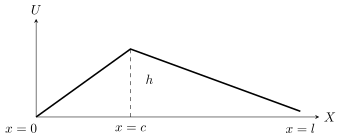 Fig. 15.15
A string of length is fastened at the ends and and at the initial moment of time, at the point , receives a blow from a small hammer (a piano string). It is assumed that during the blow the hammer touches a very small portion of the string, and that the blow itself lasts very briefly compared to the period of vibration of the string. Find the expression for the deviation of the string (see problem 5846).
Hint. The initial conditions of vibration: throughout the interval , throughout the interval except for a very small portion , where .
A perfectly insulated electric wire of length , at a certain moment of time, taken as the initial one, is charged to a certain constant potential . Determine the magnitude of the voltage and the current after a time from the initial moment, assuming that one of the ends of the wire is short-circuited and the other is open (the equations of the line --- problem 5810: , ).
Hint. The problem reduces to integrating the system of equations
under the conditions: , for every , , for .
A homogeneous string of length , under the influence of a strong tension , is in a rectilinear position of equilibrium and is fastened at the ends and . At the point a concentrated harmonic force acts on the string.
Determine the deviation of the string from the equilibrium position (Fig. 15.16).
 Fig. 15.16
Hint. The problem can be reduced to integrating the equations
and to satisfying the boundary conditions:
A homogeneous string of length , fastened at the ends and , vibrates under the action of an external disturbing force , distributed continuously along the entire length of the string. Find the deviations of the string from the equilibrium position, taking into account its free vibrations, caused by the initial deviation and the initial velocity.
Hint. The equation of forced vibrations has the form
the integral of this equation is written as the sum , where is the integral of the homogeneous equation , satisfying the conditions:
and is the integral of the inhomogeneous equation, subject to the conditions:
Study the forced transverse vibrations of a string, fastened at the end and subject at the end to the action of a disturbing harmonic force, causing a displacement equal to .
Solve the preceding problem (problem 5857) under the assumption that the string is fastened at the ends and and that the external disturbing force is concentrated at the point of the string. Investigate the special case in which the force acts harmonically.
Hint. The force concentrated at the point can be regarded as the limiting case of a force , continuously distributed over a very small portion .
Two dissimilar strings of length and are joined together at the point and fastened at the ends and . Determine the period of transverse vibrations.
Hint. The problem reduces to integrating the equations
under the conditions
A string, fastened at the ends, consists of two inhomogeneous parts and , with a ball of mass placed at the point . Prove that the period of transverse vibrations is determined from the equation
where --- the magnitude of the tension of the string.
Hint. One should take into account the condition
A rod , fastened at the beginning and free at the end , consists of two inhomogeneous parts and . Prove that the period of longitudinal vibrations of the rod is determined by the equation
where , .
Hint. Single out vibrations of one and the same frequency, satisfying the equations
under the conditions
A heavy extensible rod, whose length in the unstretched state equals , is suspended by the end , while the end is left free. Study the forced vibrations of the rod.
Hint. The problem reduces to integrating the equation
under the conditions: ; , ; .
Prove that the radial vibrations of a homogeneous gas, enclosed between two fixed concentric spheres of radii and , , can occur harmonically, with the period of the tone expressed by the formula
where --- the smallest positive root of the equation
here --- Poisson's constant, and --- the initial pressure and density.
Prove that the equation of radial vibrations of a gas has the solution , which vanishes as .
Prove that if the equation of small vibrations of a gas has the form
then it admits the integral
which vanishes as .
Prove that the solution of problem 5802 (problem 5802: a perfectly flexible string of length is suspended by the end , and to the other end a weight of kg is attached; the density of the string , where ; it is required to find the small vibrations of the string about the equilibrium position) is given by the series
where
and denote the positive roots of the equation .
The linear density of a suspended string varies according to the law , where . Derive the equation of small vibrations of the string and prove that the deviation from the equilibrium position is expressed by the formula
where --- the positive roots of the equation , and and --- constants depending on the initial conditions.
On a circular membrane, fastened at the rim, an external harmonic force acts
continuously distributed over its entire area.
Prove that the forced vibrations of the membrane are expressed by the equality
where --- the radius of the membrane.
Given a thin homogeneous rod of length , isolated from the external space. Throughout the entire time of observation the ends and are held at constant temperature . In addition, the initial distribution of temperature along the rod is known.
Determine its temperature at the moment of time (the heat conduction equation of the rod --- problem 5812: , ).
Hint. The problem reduces to integrating the heat conduction equation , under the conditions: , , for every ; for .
Solve the preceding problem (problem 5869) under the assumption that the end of the rod has temperature equal to zero, and that at the end heat is radiated into the surrounding medium, whose temperature is taken to be zero.
Hint. The second of the boundary conditions of the preceding problem should be replaced by the condition: , where and denote the coefficients of internal and external thermal conductivity of the material of the rod.
Solve the preceding problem (problem 5870) under the assumption that radiation of heat into the surrounding medium occurs at both ends of the rod.
Hint. The boundary conditions have the form
Apply the Fourier method to the study of heat propagation in a homogeneous ring, assuming that the initial distribution of heat is known (the heat conduction equation of the ring --- problem 5814: , , ).
Hint. The problem reduces to integrating the equation
under the fulfillment of the initial condition
Given a homogeneous sphere of radius , whose center is located at the origin of coordinates. It is known that the initial temperature of any point of the sphere depends only on the distance of that point from the center of the sphere. Throughout the entire time of observation the outer surface of the sphere is held at temperature . Determine the temperature of any point inside the sphere at the moment of time (the equation of radial heat propagation in the sphere --- problem 5816: , , ).
Hint. The problem reduces to integrating the equation , , and to satisfying the conditions: , for every ; for .
Solve the preceding problem (problem 5873) under the assumption that the surface of the sphere is continually freely cooling in a medium having temperature .
Hint. The second of the boundary conditions in the preceding problem must be changed to the following:
A homogeneous gas is enclosed in a fixed vessel having the shape of a sphere of radius . Investigate the radial vibrations of the gas, assuming that the motion occurs with a velocity potential.
Hint. For small vibrations, the velocity potential satisfies the wave equation
, where and --- the initial pressure and density, and --- Poisson's constant.
Transforming the vibration equation to spherical coordinates , , , seek by the Fourier method the integral satisfying the conditions a finite value,
for .
A heavy homogeneous string of length , suspended by one of its ends (), is taken out of equilibrium and released without initial velocity (Fig. 15.17). Determine the deviation as a function of the abscissa and the time .
 Fig. 15.17
Hint. The problem reduces to integrating the equation , under the conditions: a finite value, for every , , for .
Given a cylindrical tube of radius , long enough that it can be considered as extending in both directions to infinity. Investigate the small radial vibrations of a homogeneous gas enclosed in the tube.
Hint. The vibration equation should be transformed to cylindrical coordinates , , , directing the axis along the axis of the tube, and then one should seek the integral of the equation
satisfying the conditions: a finite value, for every ; , for .
Apply the Fourier method to the study of the radial vibrations of a membrane, having the shape of a circle of radius and fastened at the rim (the equation of small vibrations of the membrane --- problem 5811: , ).
Hint. The problem reduces to integrating the equation
under the conditions a finite value, for every and , for .
Investigate the radial propagation of heat in an infinite cylinder of radius , whose lateral surface is at all times at temperature .
Hint. The heat conduction equation in cylindrical coordinates has the form
One should seek the integral of this equation satisfying the conditions a finite value, for every and for .
A cylinder with base radius and height has, throughout the entire experiment, the temperature of its lower base and lateral surface equal to , while the temperature of the upper base is a certain function of . Find the steady-state temperature of the interior points of the cylinder.
Hint. To solve the problem it is necessary to find such an integral of the equation as satisfies the conditions: a finite value, , , for .
Solve the preceding problem (problem 5880) under the assumption that the lateral surface of the cylinder is covered with a jacket impermeable to heat.
Hint. The third of the boundary conditions given in the preceding problem should be replaced by the following: .
Solve problem 5880 under the assumption that the lateral surface of the cylinder is freely cooling in air having temperature .
Hint. The boundary condition on the lateral surface has the form: , where ; for the meanings of the letters and see problem 5870 (problem 5870: and --- coefficients of internal and external thermal conductivity of the material of the rod).
A cylinder with base radius and height has the temperature of both bases equal to , while the temperature of the lateral surface represents a given function of : . Find the steady-state temperature of the interior points of the cylinder.
Given a thin rectangular plate with sides and (coinciding with the coordinate axes), for which the initial distribution of temperature is known. Throughout the entire time of observation the perimeter of the plate is held at temperature . It is required to determine the temperature of each point of the plate after a time from the initial moment (the heat conduction equation of the plate --- problem 5813: , ).
Hint. The problem reduces to integrating the equation
under the conditions:
Given a rectangular parallelepiped with edges , , (three of its edges coinciding with the coordinate axes). Throughout the entire time of observation the lateral faces are held at temperature , while both bases have a given distribution of temperature. Determine the steady-state temperature of the interior points of the parallelepiped.
Hint. The desired function satisfies the equation under the conditions: at , at , at , at , at , at .
Investigate the small vibrations of a membrane, fastened at the edges and having the shape of a rectangle, whose sides and coincide with the coordinate axes and (the equation of small vibrations of the membrane --- problem 5811: , ).
Hint. The problem reduces to integrating the equation
under the conditions:
Investigate the propagation of heat in an infinitely long rod, isolated from the external space (the heat conduction equation of the rod --- problem 5812: , ).
Hint. The desired temperature satisfies the equation
and the condition .
Given a homogeneous rod, one end of which is removed to infinity, while the other has a temperature that changes with time in a known manner. Determine the temperature of the rod after a time from the initial moment.
Hint. One should integrate the equation of heat propagation in the rod under the conditions: , .
Investigate the propagation of heat in a thin plate, assuming that it is so large that it can be considered as extending unboundedly in all directions (the heat conduction equation of the plate --- problem 5813: , ).
Hint. The desired temperature satisfies the equation
and the condition .
Investigate the propagation of heat in an infinite plate, bounded on one edge, on which the temperature changes in a known manner.
Hint. If the axis of ordinates is drawn along the edge of the plate, then the problem reduces to integrating the equation given in the preceding problem, subject to the conditions:
Determine the temperature at the point of unbounded space, assuming that the initial distribution of temperature is known.
Hint. The desired temperature satisfies the equation
and the condition .
A flexible homogeneous string rotates with constant angular velocity about a vertical axis. At the moment of time taken as the initial one, the string is taken out of its relative equilibrium position, and its points are imparted initial velocities. Determine the deviation of the string after a time from the initial moment (the equation of vibrations of the string --- problem 5804: , ).
Hint. The problem reduces to integrating the equation
under the conditions: , a finite value for every and , for .
Prove that Laplace's equation
admits the particular solution
where and denote arbitrary constants, is a nonnegative integer, and is the Legendre polynomial of index .
A given function can be expanded into series of the following form:
Find such a solution of the equation given in the preceding problem (problem 5893: , with particular solution ) as would satisfy the condition
A circular wire ring of radius is charged with units of static electricity. Find the potential of the electrified ring at any point of the field (Fig. 15.18).
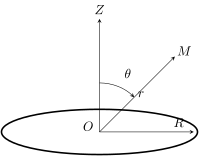 Fig. 15.18
Hint. Use the result of the preceding problem.
Find such a solution of the equation of problem 5893 (problem 5893: , with particular solution ) that, for (on the surface of a sphere of radius centered at the origin), it turns into a given function of the angle , i.e. for .
Hint. Take into account the result of problem 5893 and use the expansion of the function in a series of Legendre polynomials
By a layer of non-conducting substance, the surface of a spherical conductor of radius is divided into two hemispheres, charged to potentials: (upper) and (lower). Find the potential of such a conductor at any point of the field (Fig. 15.19).
 Fig. 15.19
Hint. One should use the result of the preceding problem, taking into account the equalities:
A metal ball of radius with a soot-blackened surface is subject to the action of sunlight in air whose temperature equals . Determine the steady-state temperature of the interior points of the ball (Fig. 15.20).
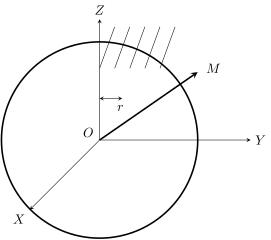 Fig. 15.20
Hint. The problem reduces to integrating Laplace's equation (see problem 5893: ) under the following condition:
where is constant, and
Integrate by the Fourier method the equation of transverse vibrations of a beam under the conditions , at , , expressing that both ends of the beam are rigidly fastened (Fig. 15.21).
 Fig. 15.21
Hint. The characteristic numbers of the problem are determined from the equation
and the corresponding fundamental functions
form a system of functions orthogonal on the interval .